By Tiger VC Newsletter
Published: 2026-06-23
URL: https://princetonchen.substack.com/p/spacex-post-ipo-correction-bond-issuance
Daily Market Read II | Category: Company Read | Date: June 23, 2026
Tiger Capital Research
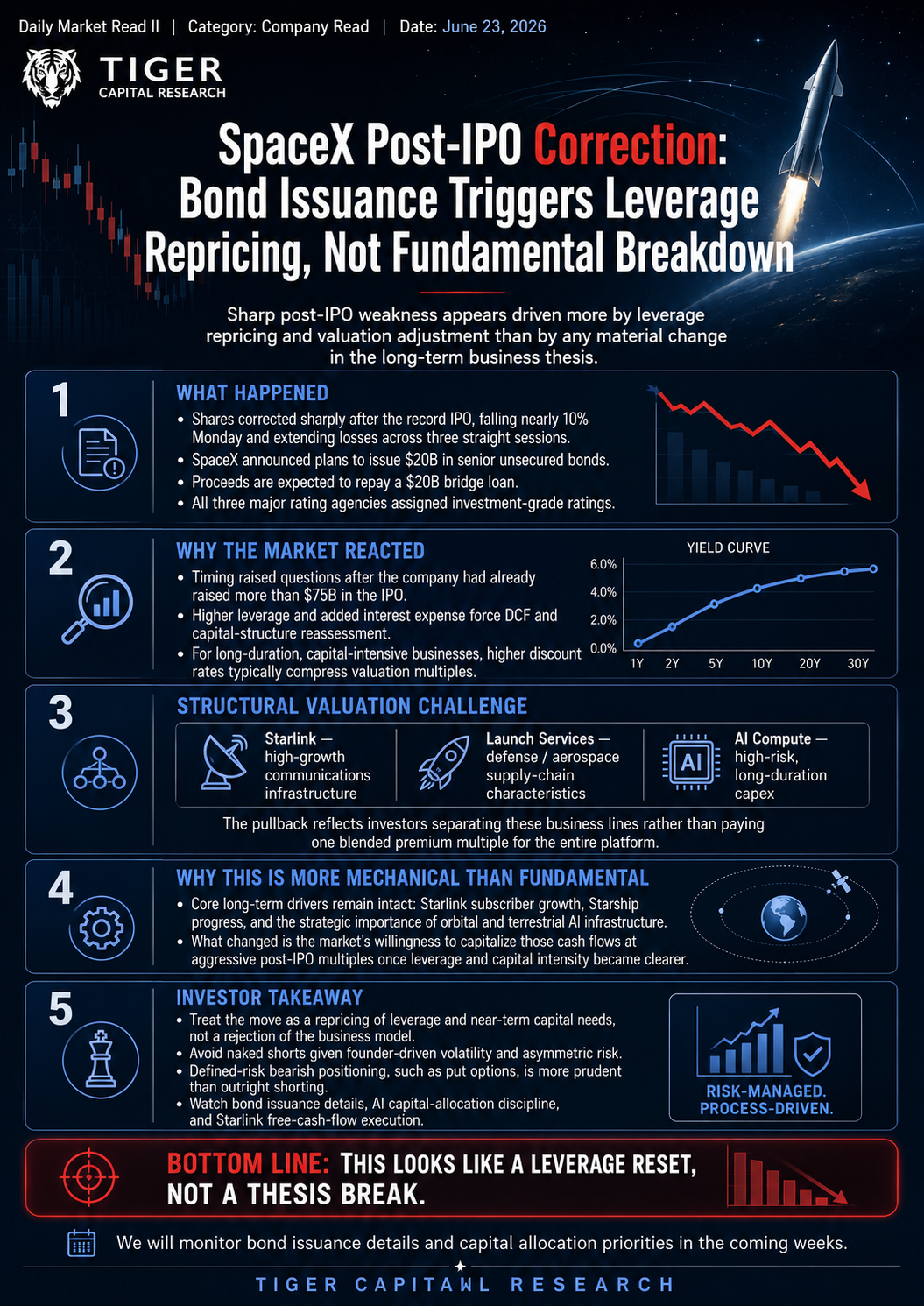
SpaceX shares have corrected sharply since their record-breaking IPO, falling nearly 10% on Monday and extending losses over three consecutive sessions. While the stock has not yet broken below its issue price, the rapid compression of gains has prompted investors to reassess the company’s capital structure and valuation framework.
The immediate trigger was SpaceX’s announcement that it plans to issue $20 billion in senior unsecured bonds. The proceeds will primarily be used to repay a $20 billion bridge loan taken out earlier. All three major rating agencies assigned investment-grade ratings to the bonds, albeit with some variation in outlook.
From a corporate finance perspective, the move is rational: in an environment where credit spreads remain relatively tight, locking in long-term funding at fixed rates is generally advantageous compared with equity issuance or continued reliance on short-term debt.
However, the market has reacted negatively for two main reasons. First, the timing — coming so soon after raising over $75 billion in the IPO — has led some investors to question whether the equity proceeds were sufficient to fund the company’s aggressive growth plans, particularly in AI infrastructure.
Second, and more importantly from a valuation standpoint, the increased leverage and higher interest burden require adjustments to discounted cash flow models. Higher discount rates and greater financial leverage typically compress valuations, especially for capital-intensive businesses with long investment cycles.
SpaceX’s valuation challenge is structural. The company operates across three distinct businesses with very different risk and return profiles: Starlink (high-growth communications infrastructure), launch services (defense and aerospace supply chain characteristics), and AI-related compute (high-risk, long-duration capital expenditure).
The IPO initially priced the company on a blended narrative of these businesses. The recent pullback reflects investors beginning to dissect these segments more carefully rather than applying a single premium multiple across the entire platform.
This correction appears more mechanical than fundamental. The core drivers behind SpaceX’s long-term thesis — Starlink subscriber growth, Starship progress, and the strategic importance of orbital and terrestrial AI infrastructure — have not materially changed in the past week.
What has shifted is the market’s willingness to capitalize those cash flows at the aggressive multiples seen immediately after the IPO, now that leverage and capital intensity are more clearly visible in the capital structure.
For investors considering exposure, the current environment favors caution over aggression. Naked shorting SpaceX carries asymmetric risk given the company’s founder-driven culture and history of volatility. Those with a bearish view would be better served using defined-risk instruments, such as purchasing put options, rather than shorting the stock outright.
The more constructive approach at this stage is to treat the recent weakness as a repricing of leverage and near-term capital needs rather than a rejection of the underlying business model. Whether this marks a healthy consolidation or the start of a more extended derating will depend on how clearly SpaceX articulates the returns on its AI investments and how quickly it can demonstrate sustained free cash flow generation from Starlink.
We will monitor the details of the bond issuance and any updates on capital allocation priorities in the coming weeks.
Tiger Capital Research