By Tiger Capital Research
Published: 2026-06-22
URL: https://princetonchen.substack.com/p/deutsche-bank-turns-hawkish-on-the
Daily Market Read I | Category: Regime Read | Date: June 22, 2026
Tiger Capital Research
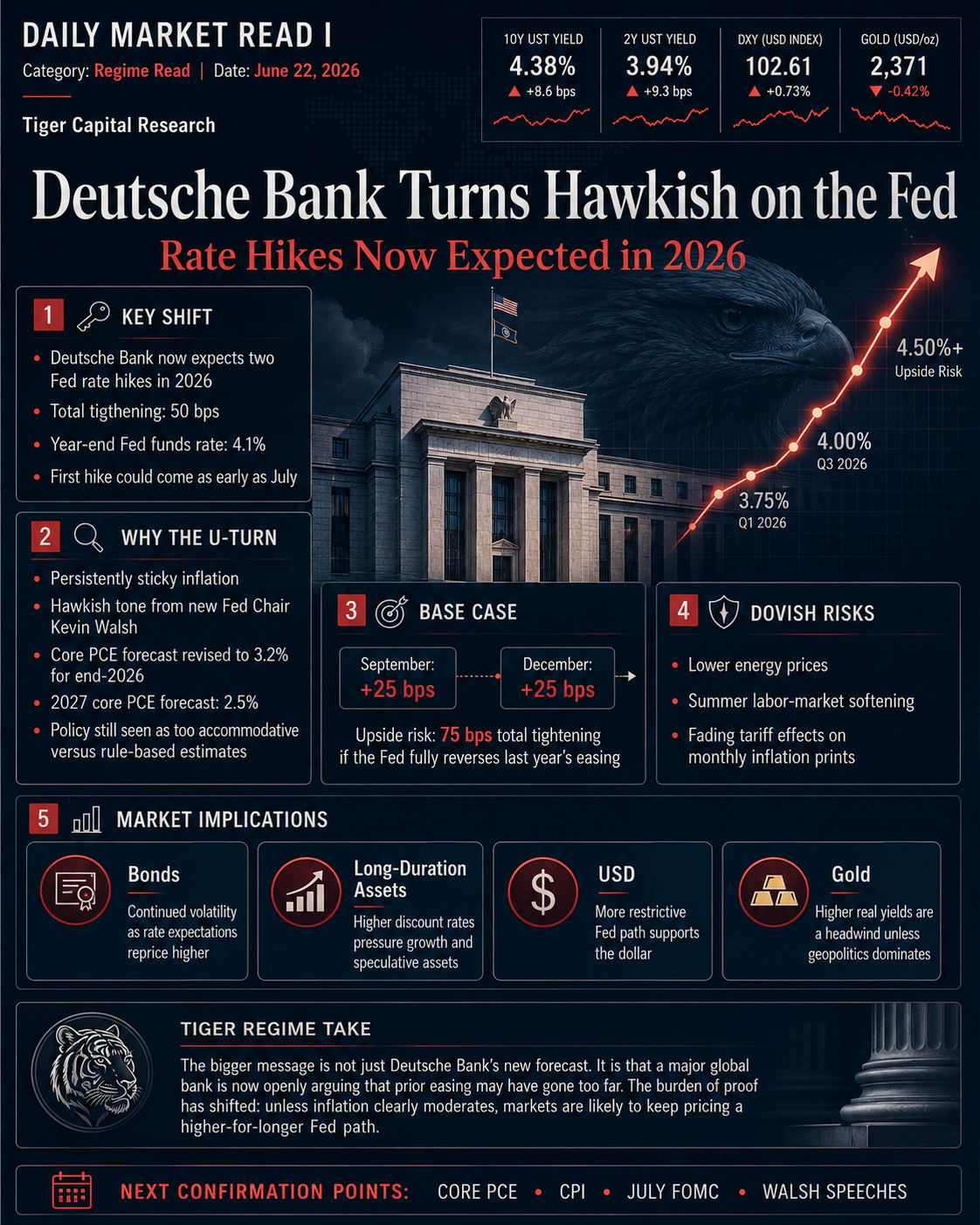
Deutsche Bank has made a sharp U-turn in its Federal Reserve outlook. After previously anticipating easier policy, the bank now expects the Fed to deliver two rate hikes this year, for a total of 50 basis points, lifting the federal funds rate to 4.1% by year-end. It does not rule out the possibility of the first hike occurring as early as July.
The shift is driven by two main factors: persistently sticky inflation and the clearly hawkish tone set by new Fed Chair Kevin Walsh at his first FOMC meeting. Deutsche Bank now sees inflation as more broad-based and entrenched than previously assumed, with core PCE forecasts revised significantly higher to 3.2% for the end of 2026 and 2.5% for 2027.
The bank argues that the current policy rate remains too accommodative relative to multiple policy rules and the Fed’s own estimates of the neutral rate. In its view, last year’s rate cuts provided more “insurance” than was ultimately needed, and some of that accommodation now needs to be withdrawn.
Deutsche Bank’s base case calls for hikes in September and December. However, it highlights meaningful upside risk to this path. If Chair Walsh wants to quickly establish credibility on inflation, the Committee could move earlier than September. A more aggressive scenario of 75 basis points of tightening this year is also possible if the Fed aims to fully reverse last year’s easing.
On the dovish side, the bank notes several factors that could slow the pace of tightening: further declines in energy prices, seasonal softening in the labor market during the summer, and the fading impact of tariffs on monthly inflation prints.
For markets, this updated view reinforces the recent repricing of interest-rate expectations. With Deutsche Bank now aligned with a “higher for longer” framework, pressure on rate-sensitive assets is likely to persist. Fixed-income markets in particular face the prospect of continued volatility as investors adjust to a less dovish policy path than many had assumed earlier this year.
The broader implication is that the burden of proof has shifted. Unless inflation data shows clearer signs of moderation in the coming months, the market will likely continue to price in a more restrictive policy stance than was expected just a few weeks ago.
We will monitor upcoming inflation prints and any further commentary from Fed officials for confirmation of whether this hawkish repricing is justified or has gone too far.
Tiger Capital Research