By Tiger Capital Research
Published: 2026-06-20
URL: https://princetonchen.substack.com/p/intel-ceo-lip-bu-tan-lays-out-510
Daily Market Read I | Category: Company Read | Date: June 19, 2026
Tiger Capital Research
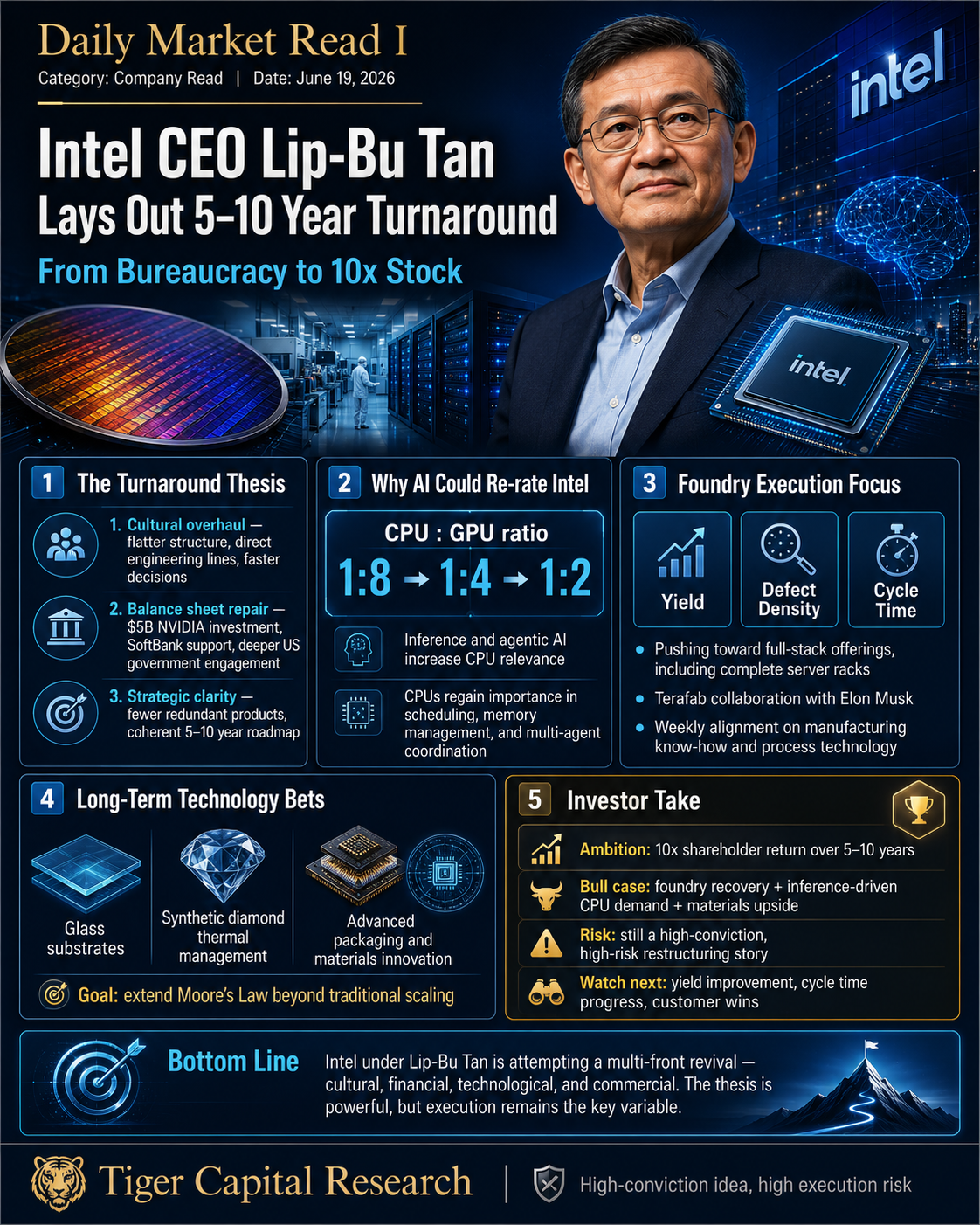
Intel’s new CEO Lip-Bu Tan, in a rare extended interview, laid out a clear and unusually candid plan to revive the company. At 66, Tan took the role explicitly to “save Intel,” despite widespread advice that he should retire. His diagnosis of the company’s problems is blunt: excessive bureaucracy, slow decision-making, and a culture disconnected from customers.
In his first 14 months, Tan has focused on three immediate priorities. First, cultural overhaul. He has flattened reporting lines so engineering teams report directly to him, eliminated layers of cross-functional meetings, and imposed startup-style speed and accountability.
Second, balance sheet repair. He stabilized Intel’s finances with a $5 billion investment from NVIDIA, support from SoftBank, and deeper engagement with the US government: moves he compares to how Taiwan and Singapore backed TSMC in its early days.
Third, strategic clarity. He has pruned redundant product lines and refocused the company on a coherent 5-to-10-year roadmap.
On the product side, Tan sees a structural tailwind. In the shift from training to inference and agentic AI workloads, the CPU-to-GPU ratio is improving from roughly 1:8 toward 1:4 or even 1:2. He argues that CPUs are regaining relevance in complex scheduling, memory management, and multi-agent coordination — areas where GPUs alone are inefficient.
In foundry, Tan is ruthlessly focused on three operational metrics: yield, defect density, and cycle time. He is also pushing the business toward “full-stack” offerings, with some customers now requesting not just wafers but complete server racks. A notable development is the Terafab collaboration with Elon Musk. Intel is helping Musk build his own advanced fab by transferring manufacturing know-how and process technology, with weekly alignment meetings between the two teams.
Longer term, Tan is betting on materials and packaging breakthroughs to extend Moore’s Law beyond traditional scaling. Intel is investing heavily in glass substrates and synthetic diamond for thermal management, areas where the company holds extensive IP.
Tan’s stated ambition is straightforward: deliver a 10x return for shareholders over 5 to 10 years. Whether this is achievable depends on execution across three fronts — restoring foundry competitiveness, capitalizing on the inference-driven CPU opportunity, and successfully commercializing new materials and packaging technologies.
For investors, the interview provides the clearest articulation yet of Intel’s turnaround thesis under Tan. It also highlights the enormous execution risk that remains. Intel is attempting a multi-front revival: cultural, financial, technological, and commercial, at a time when competition in both CPUs and foundry is intense and capital requirements are rising across the industry.
The coming quarters will show whether the cultural and operational changes are translating into measurable improvements in yield, cycle time, and customer wins. Until then, Intel remains a high-conviction but high-risk restructuring story rather than a straightforward AI beneficiary.
Tiger Capital Research