By Tiger Capital Research
Published: 2026-06-19
URL: https://princetonchen.substack.com/p/excess-liquidity-turns-negative-markets
Daily Market Read I | Category: Regime Read | Date: June 19, 2026
Tiger Capital Research
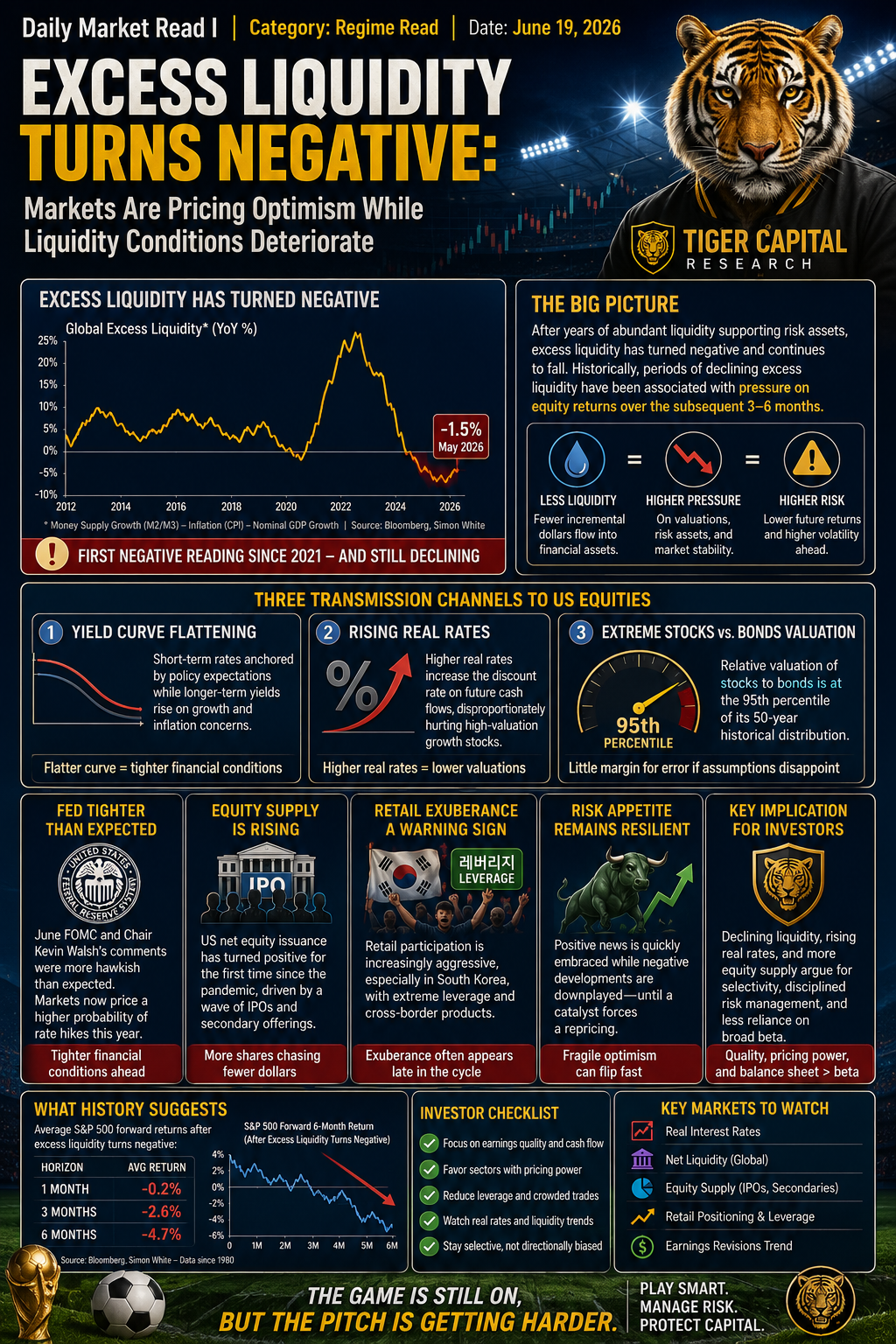
Despite recent relief from US-Iran de-escalation signals and a strong SpaceX debut, a deeper shift is underway in global financial conditions. According to Bloomberg strategist Simon White, excess liquidity: defined as money supply growth adjusted for inflation and economic growth, has turned negative for the first time since 2021 and continues to decline.
This marks a meaningful change from the abundant liquidity environment that supported risk assets over the past several years. The implications are straightforward but underappreciated. When excess liquidity contracts, the incremental capital available to flow into financial assets shrinks. Historically, periods of declining excess liquidity have been associated with pressure on equity returns over the subsequent three to six months. Three specific channels are transmitting this tightening to US equities.
First, the yield curve is flattening as short-term rates remain anchored by policy expectations while longer-term yields are pulled higher by growth and inflation concerns. Second, real interest rates are rising, which directly increases the discount rate applied to future cash flows: an effect that disproportionately hurts high-valuation growth stocks.
Third, the relative valuation between stocks and bonds has reached the 95th percentile of its 50-year historical distribution, leaving little margin for error if any of the underlying assumptions on liquidity, rates, or earnings disappoint.
The Federal Reserve under new Chair Kevin Walsh has reinforced this backdrop. The June FOMC statement and Walsh’s comments were more hawkish than many had anticipated, prompting the bond market to price in a higher probability of rate hikes later this year.
This effectively tightens financial conditions even without an immediate policy move. At the same time, the supply side of the equity market is shifting. US net equity issuance has turned positive for the first time since the pandemic, driven by a wave of IPOs and secondary offerings.
When new supply increases while liquidity conditions are deteriorating, the market must absorb more shares with fewer incremental dollars — a combination that historically raises volatility. A further warning sign lies in investor behavior. Retail participation has become increasingly aggressive in several markets, most notably in South Korea, where investors have used extreme leverage, including cross-border products, to chase equity gains. Such episodes of retail exuberance have often appeared in the later stages of market advances.
The current environment is one in which headline risk appetite remains resilient, yet the underlying liquidity and valuation support is eroding. This creates a fragile setup in which positive news is quickly embraced while negative developments are downplayed: until a catalyst forces a repricing.
For investors, particularly those exposed to high-valuation segments such as semiconductors and AI infrastructure, the combination of declining excess liquidity, rising real rates, and increasing equity supply suggests that selectivity and risk management should take priority over broad beta exposure.
The market can remain optimistic for longer than fundamentals might justify, but the margin for disappointment has narrowed. Tiger Capital Research