By Tiger Capital Research
Published: 2026-06-11
URL: https://princetonchen.substack.com/p/the-fading-world-cup-curse-meets
Daily Market Read II | Category: Event Read | Date: June 11, 2026
Tiger Capital Research
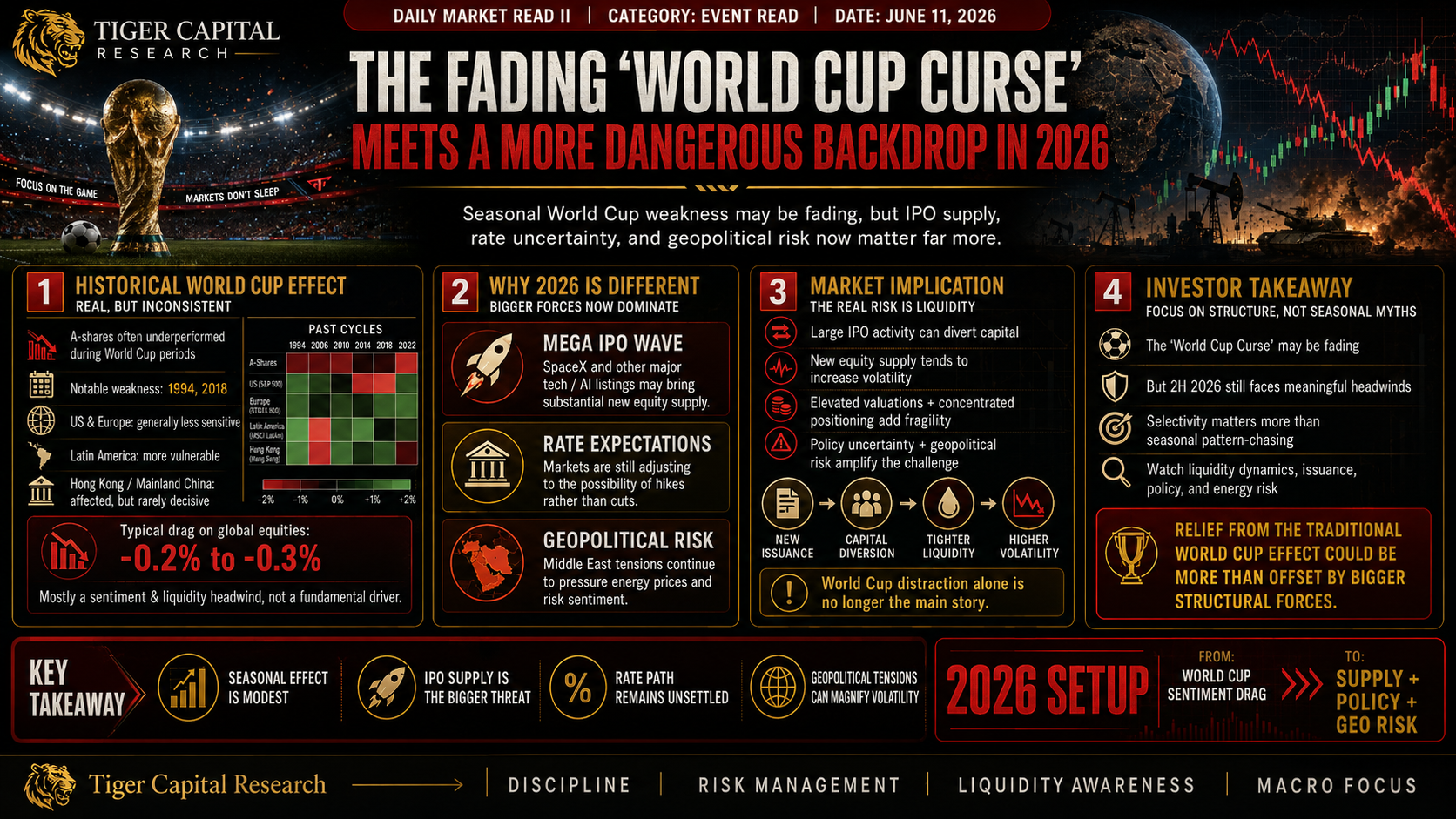
Every four years, a familiar narrative resurfaces in global markets: the so-called “World Cup Curse.” The theory holds that investor attention drifts toward the tournament, causing trading volumes to drop and risk appetite to weaken, which historically has produced a modest negative drag on equity markets.
Data from past cycles shows the effect has been real but inconsistent. A-shares have tended to underperform during World Cup periods, with notable weakness in 1994 and 2018. US and European markets have generally been less sensitive, while Latin American equities have shown greater vulnerability. Hong Kong and mainland China have fallen somewhere in between: affected, but rarely in a decisive way.
The magnitude of the historical impact has also been limited. Studies suggest the World Cup period has typically shaved only 0.2% to 0.3% off global equity returns on average. In most cycles, the effect has been more of a sentiment and liquidity headwind than a fundamental driver of market direction.
This year, however, the backdrop is materially different. Even if the traditional World Cup effect continues to fade: as it has in recent cycles, several more powerful forces are converging in the second half of 2026:
• A wave of exceptionally large IPOs, led by SpaceX and potentially followed by other major technology and AI-related listings, is set to bring substantial new equity supply into the market.
• Monetary policy expectations remain unsettled, with markets still adjusting to the possibility of rate hikes rather than cuts.
• Geopolitical tensions, particularly in the Middle East, continue to influence energy prices and risk sentiment.
These factors are likely to matter far more than the World Cup itself. Large-scale IPO activity tends to divert capital and increase volatility, especially when it coincides with already elevated valuations and concentrated positioning. When combined with policy uncertainty and geopolitical risk, the liquidity and sentiment environment can become more challenging even without the World Cup distraction.
In short, the “World Cup Curse” may be losing its bite, but that does not mean 2026 will be free of seasonal or structural headwinds. The more relevant question is whether markets can absorb the coming supply of new equity and navigate a more complex policy and geopolitical landscape without experiencing a sharper correction.
For now, the combination of heavy new issuance, shifting rate expectations, and lingering geopolitical uncertainty suggests that any relief from the traditional World Cup effect could be more than offset by other, larger forces. Investors should treat the second half of the year as a period that requires greater selectivity and attention to liquidity dynamics rather than relying on historical seasonal patterns.
Tiger Capital Research