By Tiger Capital Research
Published: 2026-06-05
URL: https://princetonchen.substack.com/p/spacex-ipo-in-7-days-three-critical
Daily Market Read II | Category: Risk Read | Date: June 4, 2026
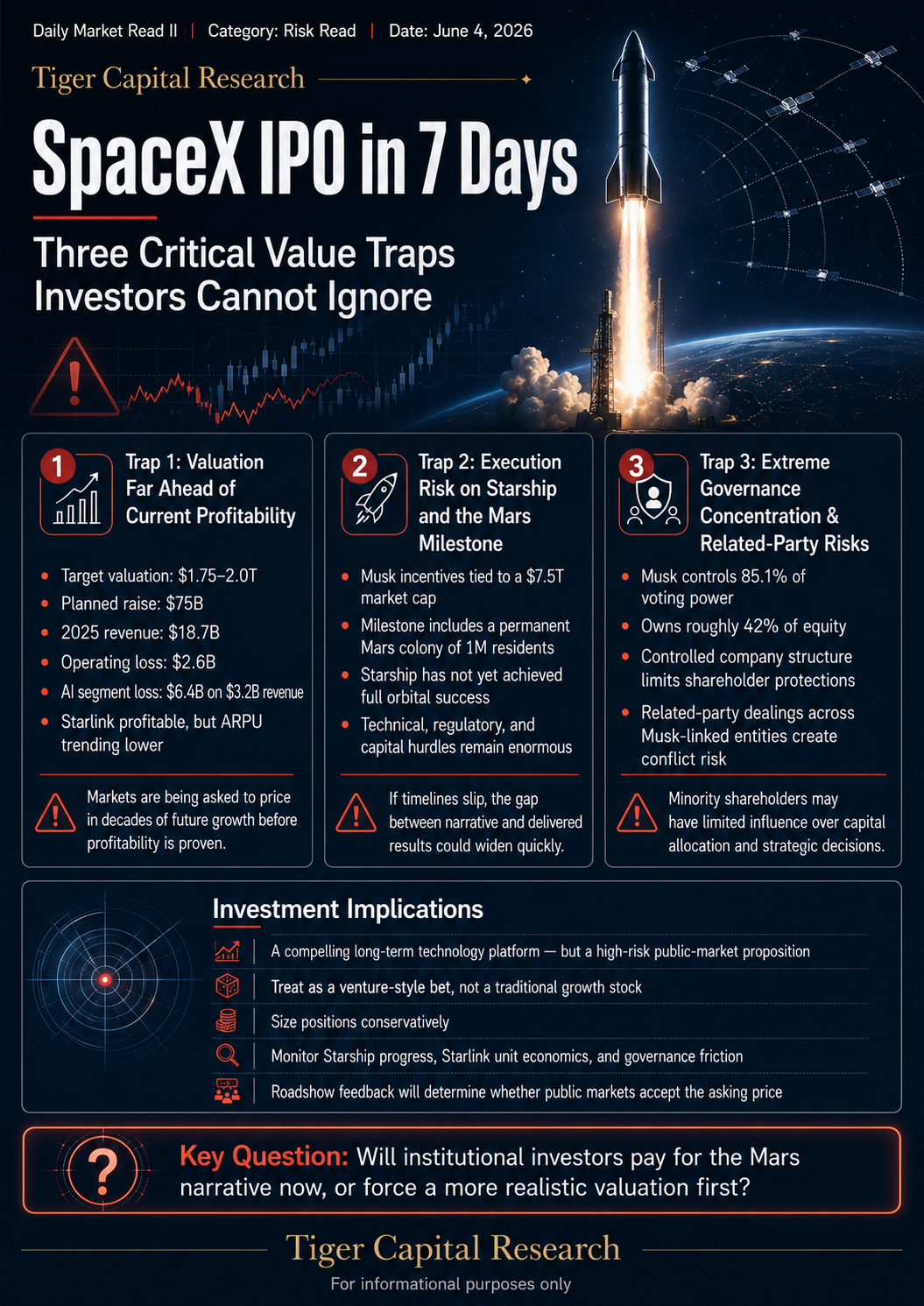
Tiger Capital Research With SpaceX’s IPO roadshow now underway and pricing potentially as early as next week, investor attention is shifting from narrative excitement to hard questions about valuation, execution, and governance.
At a targeted valuation of $1.75–2 trillion and a planned $75 billion raise, the offering is not just large: it is one of the most ambitious listings in capital market history. Yet beneath the Starlink growth story and Mars vision lie three structural value traps that could significantly impact long-term returns. Trap 1: Valuation Far Ahead of Current Profitability SpaceX is asking public markets to price in decades of future growth while the company is still deeply unprofitable on an operating basis.
In 2025 the company generated $18.7 billion in revenue but posted a $2.6 billion operating loss. The AI segment alone lost $6.4 billion last year on just $3.2 billion of revenue. Starlink is the only consistently profitable division, yet even there ARPU has been declining as the company expands into lower-price markets.
At $1.8 trillion, investors are effectively paying a premium that assumes flawless execution across Starship, orbital data centers, and massive AI infrastructure buildout: all while absorbing continued heavy losses. History shows that companies asking for such extreme forward multiples rarely deliver sustained returns unless profitability scales dramatically and predictably. Trap 2: Execution Risk on Starship and the Mars Milestone A significant portion of Elon Musk’s compensation is tied to reaching a $7.5 trillion market cap and establishing a permanent Mars colony with at least one million residents.
While ambitious milestones can align incentives, they also highlight the binary nature of the bet. Starship has yet to achieve full orbital success after multiple test flights, and the technical, regulatory, and financial hurdles to building a self-sustaining Mars colony remain enormous. Public investors will own economic exposure without any meaningful ability to influence execution. If Starship timelines slip or capital requirements continue to escalate, the gap between narrative and delivered results could widen quickly.
Trap 3: Extreme Governance Concentration and Related-Party Risks Musk controls 85.1% of voting power despite owning roughly 42% of the equity. The company has opted out of many standard shareholder protections and operates as a “controlled company,” allowing non-independent directors on key committees. Several directors and related entities maintain billions of dollars in leasing and business relationships with SpaceX and xAI.
For minority shareholders, this structure means limited recourse in the event of conflicts of interest, strategic shifts across Musk’s other companies (Tesla, xAI, Neuralink), or decisions that prioritize long-term vision over near-term returns. High voting control combined with heavy ongoing capital needs creates a classic principal-agent risk at unprecedented scale. Investment Implications SpaceX represents one of the most compelling long-term technology platforms of the decade, with genuine leadership in reusable launch, global broadband, and emerging AI infrastructure.
However, the combination of extreme valuation, execution dependencies, and concentrated control makes it a high-risk proposition for most public-market investors. Those considering participation should size positions conservatively, treat the IPO as a long-term venture-style bet rather than a traditional growth stock, and closely monitor Starship progress, Starlink unit economics, and any signs of governance friction in the first year of trading.
The coming weeks of roadshow feedback will reveal whether institutional investors are willing to meet SpaceX at its asking price: or whether these value traps will force a more realistic valuation. Tiger Capital Research