By Tiger Capital Research
Published: 2026-06-05
URL: https://princetonchen.substack.com/p/bitcoins-structural-downside-risk
Daily Market Read I | Category: Risk Read | Date: June 5, 2026
Tiger Capital Research
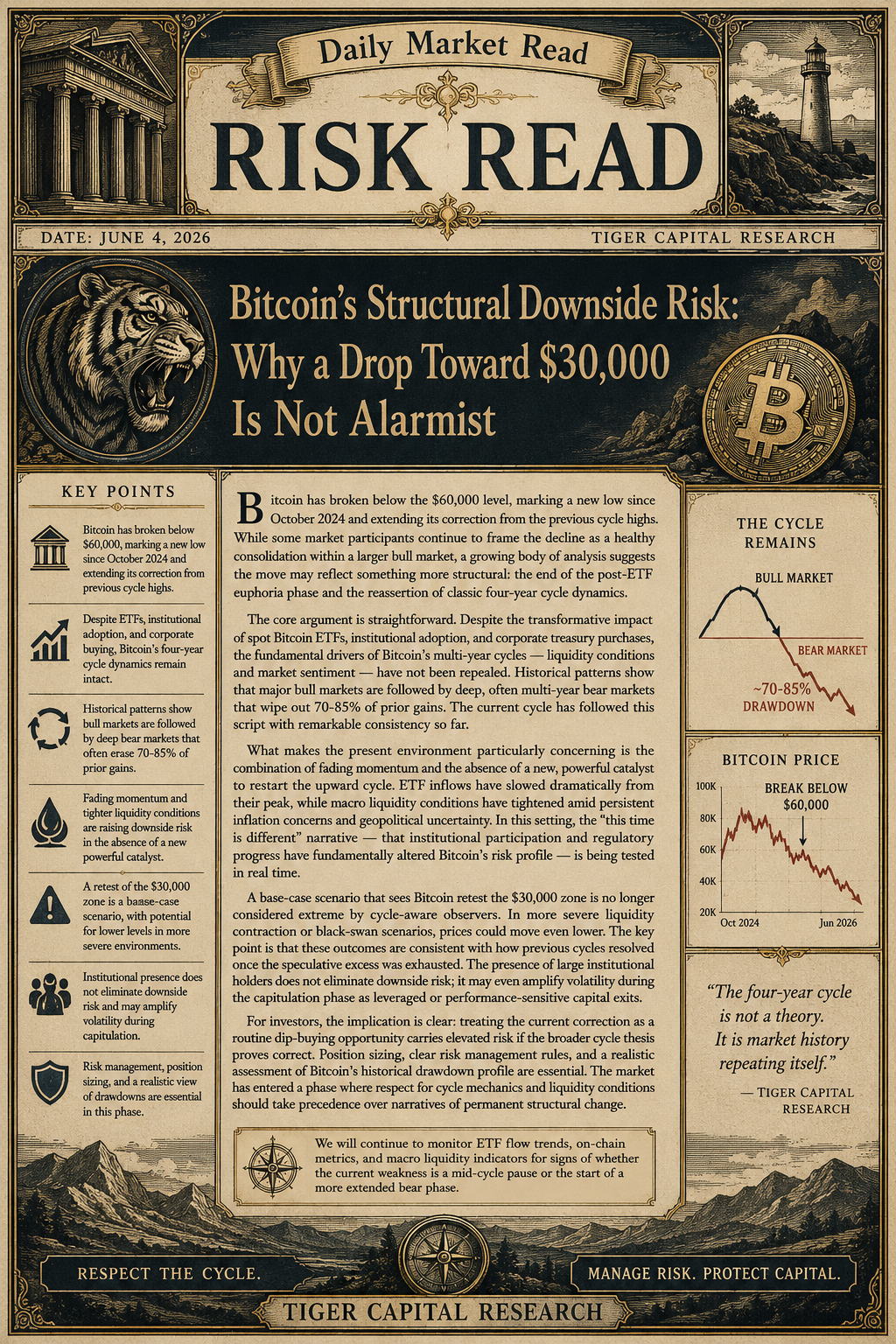
Bitcoin has broken below the $60,000 level, marking a new low since October 2024 and extending its correction from the previous cycle highs. While some market participants continue to frame the decline as a healthy consolidation within a larger bull market, a growing body of analysis suggests the move may reflect something more structural: the end of the post-ETF euphoria phase and the reassertion of classic four-year cycle dynamics.
The core argument is straightforward. Despite the transformative impact of spot Bitcoin ETFs, institutional adoption, and corporate treasury purchases, the fundamental drivers of Bitcoin’s multi-year cycles: liquidity conditions and market sentiment, have not been repealed. Historical patterns show that major bull markets are followed by deep, often multi-year bear markets that wipe out 70-85% of prior gains. The current cycle has followed this script with remarkable consistency so far.
What makes the present environment particularly concerning is the combination of fading momentum and the absence of a new, powerful catalyst to restart the upward cycle. ETF inflows have slowed dramatically from their peak, while macro liquidity conditions have tightened amid persistent inflation concerns and geopolitical uncertainty.
In this setting, the “this time is different” narrative: that institutional participation and regulatory progress have fundamentally altered Bitcoin’s risk profile, is being tested in real time.
A base-case scenario that sees Bitcoin retest the $30,000 zone is no longer considered extreme by cycle-aware observers. In more severe liquidity contraction or black-swan scenarios, prices could move even lower.
The key point is that these outcomes are consistent with how previous cycles resolved once the speculative excess was exhausted. The presence of large institutional holders does not eliminate downside risk; it may even amplify volatility during the capitulation phase as leveraged or performance-sensitive capital exits.
For investors, the implication is clear: treating the current correction as a routine dip-buying opportunity carries elevated risk if the broader cycle thesis proves correct. Position sizing, clear risk management rules, and a realistic assessment of Bitcoin’s historical drawdown profile are essential. The market has entered a phase where respect for cycle mechanics and liquidity conditions should take precedence over narratives of permanent structural change.
We will continue to monitor ETF flow trends, on-chain metrics, and macro liquidity indicators for signs of whether the current weakness is a mid-cycle pause or the start of a more extended bear phase.
Tiger Capital Research