By Tiger Capital Research
Published: 2026-06-04
URL: https://princetonchen.substack.com/p/broadcom-plunges-15-micron-breaks
Daily Market Read I | Category: Regime Read | Date: June 4, 2026
Tiger Capital Research
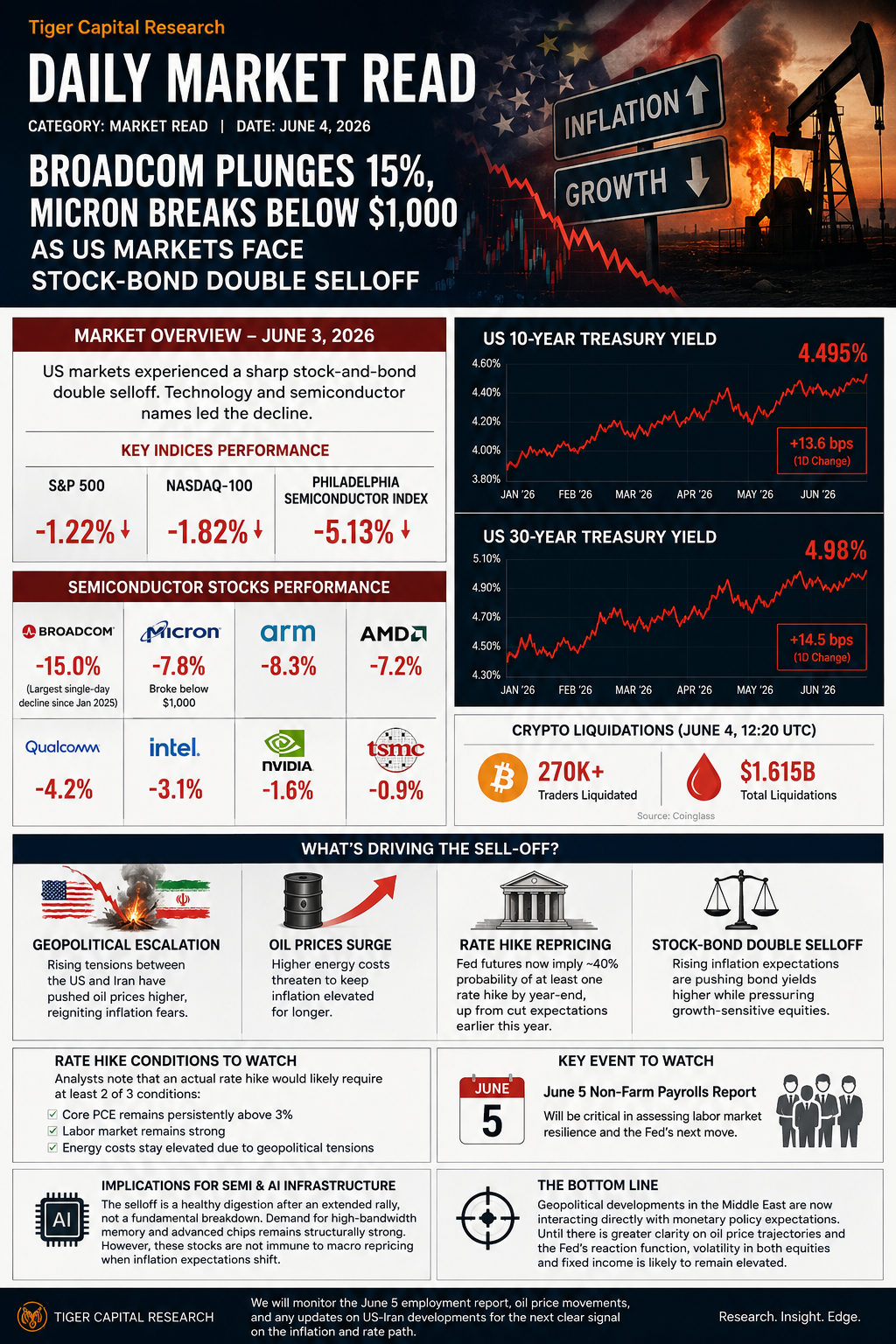
US markets experienced a sharp stock-and-bond double selloff on June 3. Technology and semiconductor names led the decline, with the Philadelphia Semiconductor Index falling more than 5%. Broadcom dropped as much as 15%: its largest single-day decline since January 2025, while Micron Technology fell nearly 8% and broke below the $1,000 level. Other chip names also came under pressure: ARM declined more than 8%, AMD fell over 7%, Qualcomm dropped more than 4%, and Intel declined over 3%. NVIDIA and TSMC were relatively more resilient but still finished lower.
The selloff was not confined to equities. US Treasury yields rose sharply across the curve. The 10-year yield climbed to 4.495%, while the 30-year yield approached 5%. The move reflected a clear repricing of interest-rate expectations driven by renewed inflation concerns.
The immediate catalyst was the escalation in Middle East tensions between the US and Iran. Higher oil prices have reignited fears that energy costs could push inflation higher for longer. This has prompted markets to reassess the likelihood of Federal Reserve rate hikes later this year. Interest-rate futures now assign roughly a 40% probability of at least one hike by year-end: a notable shift from earlier in the year when cuts were the dominant expectation.
The simultaneous weakness in stocks and bonds is particularly notable. Traditionally, bonds act as a hedge when equities fall. In this episode, however, the common driver: rising inflation expectations, has undermined that relationship. Higher oil prices are feeding directly into inflation forecasts, which in turn are pushing long-term yields higher and pressuring growth-sensitive assets such as technology stocks.
Analysts note that triggering an actual rate hike would likely require at least two of three conditions to be met: core PCE remaining persistently above 3%, continued strength in the labor market, and sustained high energy costs from geopolitical tensions. The upcoming June 5 non-farm payrolls report will be closely watched for clues on whether the labor market remains resilient enough to support a more hawkish Fed stance.
For semiconductor and AI infrastructure names, the selloff represents a healthy digestion after an extended rally rather than a fundamental breakdown. Demand for high-bandwidth memory and advanced chips remains structurally strong. However, the episode underscores that these stocks are not immune to macro repricing when inflation expectations shift.
The broader message is that geopolitical developments in the Middle East are now interacting directly with monetary policy expectations. Until there is greater clarity on oil price trajectories and the Fed’s reaction function, volatility in both equities and fixed income is likely to remain elevated.
We will monitor the June 5 employment report, oil price movements, and any updates on US-Iran developments for the next clear signal on the inflation and rate path.
Tiger Capital Research