By Tiger Capital Research
Published: 2026-06-03
URL: https://princetonchen.substack.com/p/s-and-p-500s-16-two-month-surge-echoes
Daily Market Read I | Category: Risk Read | Date: June 3, 2026
Tiger Capital Research
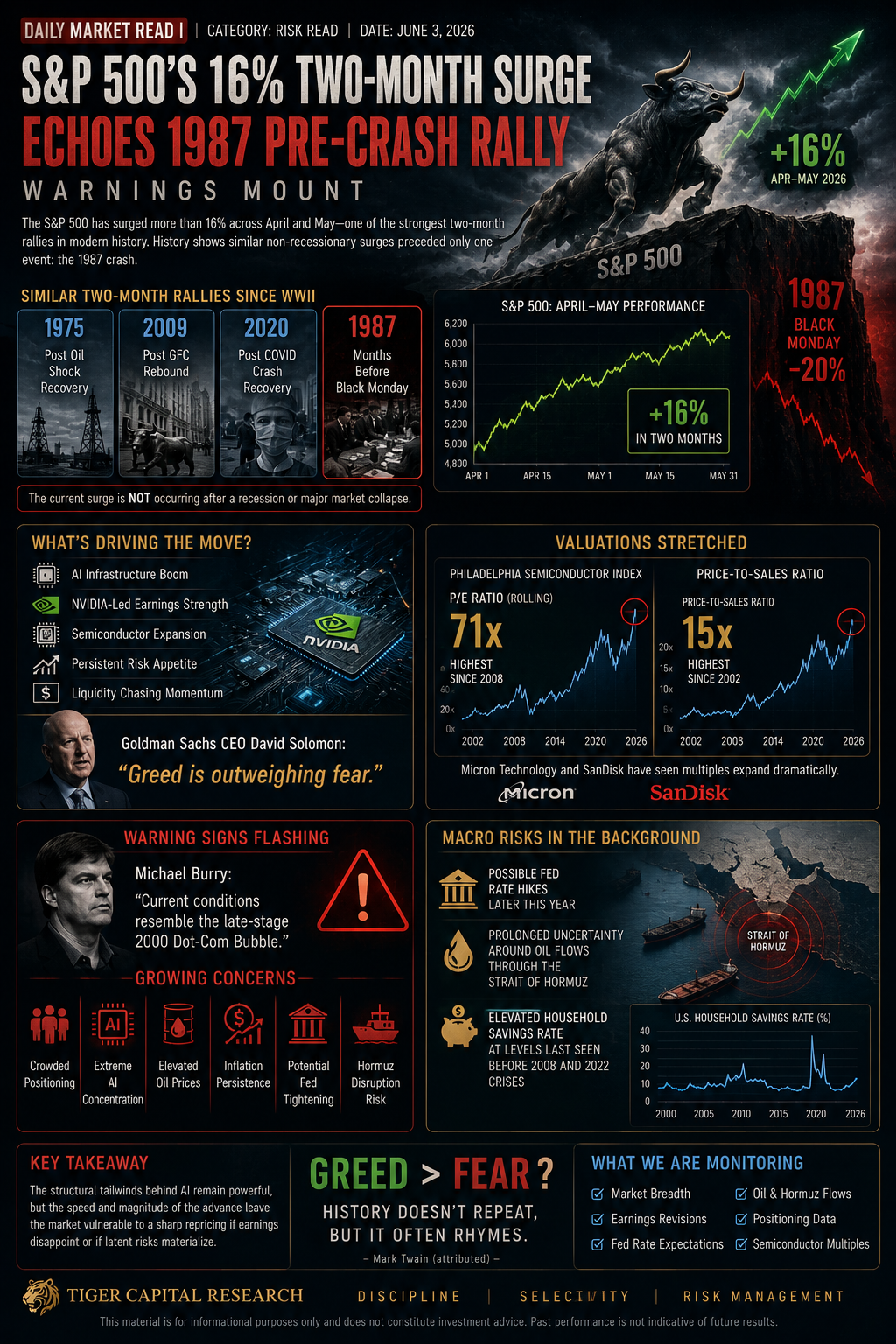
The S&P 500 has delivered one of its strongest two-month rallies in modern history. In April and May combined, the index rose more than 16%: a pace seen only four times since World War II. The previous three instances all occurred in the immediate aftermath of major crises: the sharp rebound in April–May 2020, the powerful recovery in March–April 2009 after the global financial crisis, and the surge in January–February 1975 following the first oil shock.
What makes the current move unusual is that it is not occurring in the wake of a recession or major market crash. The last time the S&P 500 posted a similar non-recessionary surge of this magnitude was in the months leading up to the October 1987 crash, when the index fell more than 20% in a single day.
Deutsche Bank analysts highlighted this historical parallel in a recent report, noting that the current advance lacks the clear “bad news is behind us” catalyst that drove previous episodes. Instead, the rally has been fueled primarily by sustained enthusiasm for artificial intelligence and strong earnings from technology leaders.
Goldman Sachs CEO David Solomon captured the prevailing mood when he recently observed that “greed is outweighing fear” in financial markets. Investors appear willing to look past elevated asset prices, high oil prices, and rising inflation concerns.
Valuations have stretched accordingly. The Philadelphia Semiconductor Index now trades at a rolling price-to-earnings ratio of approximately 71x: the highest level since the 2008 financial crisis, while its price-to-sales ratio sits at 15x, the highest since 2002. Micron Technology and SanDisk have seen their multiples expand dramatically as well.
Prominent investor Michael Burry has publicly warned that current market conditions bear an uncomfortable resemblance to the peak of the 2000 internet bubble. Other strategists have flagged signs of overcrowding, with positioning across major asset classes becoming increasingly one-sided.
Several macro risks remain in the background. The possibility of Federal Reserve rate hikes later this year, prolonged uncertainty around oil flows through the Strait of Hormuz, and an elevated household savings rate (now at levels last seen before the 2008 and 2022 crises) all suggest that the economic backdrop is more fragile than the market’s price action implies.
While the structural tailwinds behind AI investment remain powerful, the speed and magnitude of the recent advance have left the market vulnerable to a sharp repricing if earnings momentum disappoints or if any of the latent macro risks materialize.
We will continue to monitor breadth, valuation metrics, and positioning data closely. In environments where historical parallels to pre-crash periods are being widely discussed, selectivity and risk management become increasingly important.
Tiger Capital Research