What the Nvidia news means for national security and the economy
Published: 2026-11-15
URL: https://post.substack.com/p/a-consequential-sex-scandal-at-last
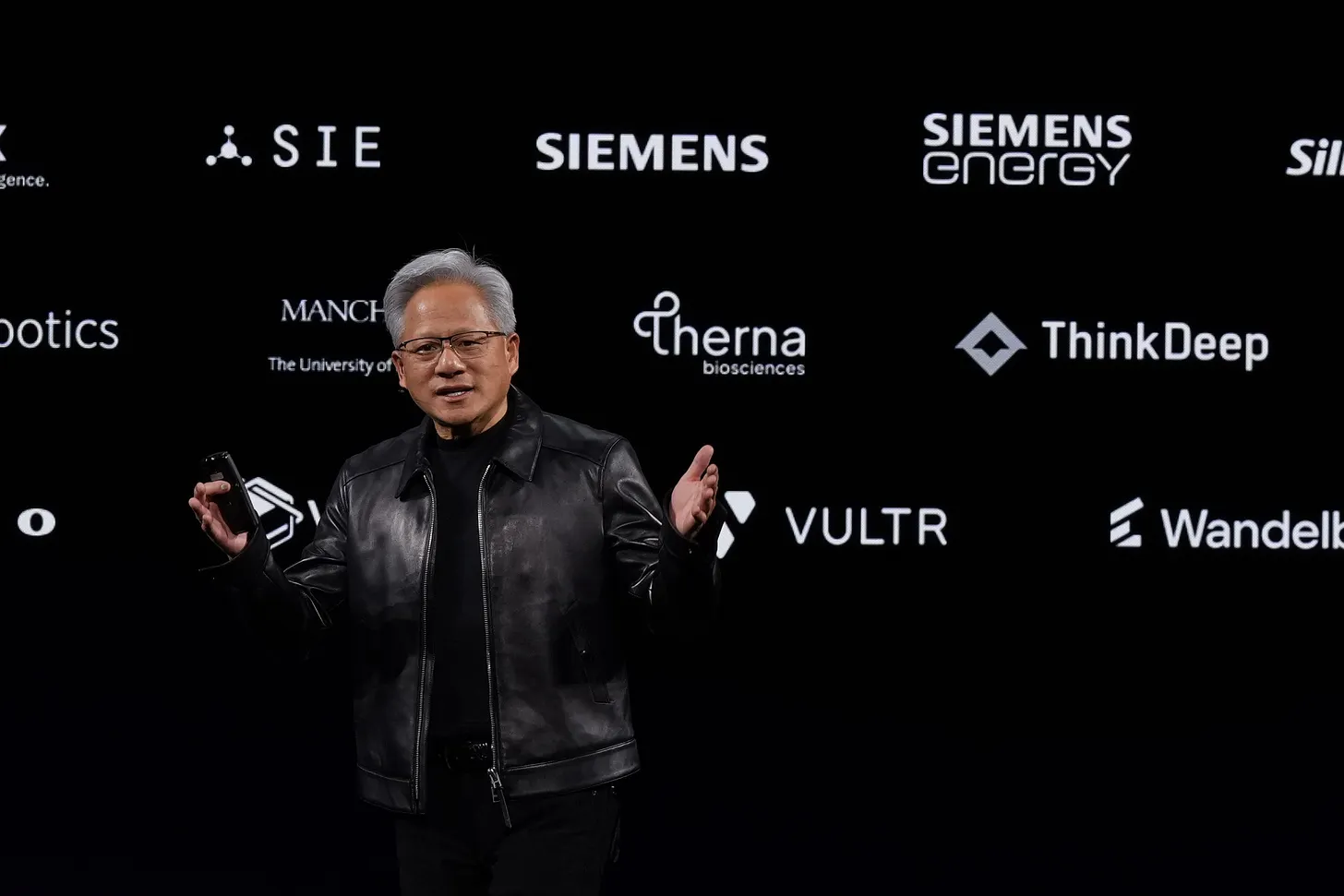
\Photo shared byYancheng Zhang\
It was the honey trap heard round the world: this week, Jensen Huang, the co-founder of Nvidia and one of the most powerful people in AI, resigned amid revelations of extramarital relationships, including one with a suspected Chinese spy.
What happened?
Last Friday, broke the news that “the US intelligence community believed that Jensen Huang, the co-founder and CEO of Nvidia, had a romantic relationship with a woman named Alice Huang,” as he subsequently recounted on his Substack.
Alice Huang, an executive at the Singapore-based company Megaspeed, was suspected of helping divert Nvidia chips to China. U.S. intelligence also believes she had been recruited by China’s Ministry of State Security.
Since then, additional relationships have been reported, and Jensen Huang has resigned from Nvidia. CFO Colette Kress is serving as interim CEO.
Why does it matter?
Given AI’s outsize economic role and its importance to U.S.-China competition, these revelations are a big deal. Or, as describes it: “a consequential sex scandal at last!”
“The downfall of arguably the single most important person in AI is a massive story,” writes. “But the implications and insinuations of this scandal go deeper, touching on everything from American national security, US-China relations, the future of the AI buildout, chip export policies, your retirement account, and an existential debate among AI experts about who should have access to the most advanced AI chips.”
What’s the national security angle?
The twists and turns of this scandal have been dominating headlines all week, and yet, according to , “the political world is under-reacting to the Nvidia story.”
Tina Brown puts the stakes starkly. “The disclosure of this high-tech honey trap is one of the most explosive national security scandals since the Cold War,” she writes.
One detail that’s raising eyebrows: “Many people seem to have understood that something hinky was going on between Nvidia and Megaspeed,” as writes at The Bulwark. Nevertheless, “inside the Trump administration, [Commerce Secretary Howard] Lutnick was working to loosen restrictions on Nvidia. Trump was talking to (Jensen) Huang constantly. And the American intelligence community was all over (Alice) Huang’s ties to China’s MSS.”
This leaves Brown with questions: “Why wasn’t Jensen tipped off that his paramour was a spy when Trump has known about the surveillance for a year, and was Jensen vulnerable to leverage from China that might have impacted U.S. policy?”
Senator is calling for an investigation, and former Congressman has suggested an insider trading investigation, pointing to Nvidia’s falling stock price before the story broke.
What does it mean for AI and the economy?
It’s hard to overstate Nvidia’s—and Jensen Huang’s—importance in the AI world. “I thought of him as the person with the best visibility into what was going on in AI, simply because everything ran on his chips,” writes in Exponential View.
Not only are Nvidia’s chips dominant—Azhar reports that “they account for 85% of the market”—but the company is a major investor in other AI startups. “[Nvidia] has provided financial guarantees to the constellation of upstart AI infrastructure companies, the so-called neoclouds, so they can get their business moving. It has been a substantial venture capital backer of AI companies, with nearly $10 billion across Europe in the last year—the biggest investor there.”
And with Anthropic looking to IPO next week, “[t]he leadership shakeup comes at a particularly sensitive moment for the AI industry, as investors question whether the enormous infrastructure spending will deliver adequate returns,” writes.
For longtime AI bears, the scandal brings fresh scrutiny to concerns they’ve been raising for months. writes, “The fallout is just starting now, but the clues were in NVIDIA’s stock price, in the financing [of] the bubble, in the SEC filings, in the regulatory filings, and here and there, almost all year long.” sees signs of a broader reckoning. “Nvidia is down 29% over the last six months, Oracle 35%, CoreWeave 54%, and Anthropic’s perceived valuation is down 25% in just a matter of weeks. People may not want to admit it, but those numbers sure look like a bubble popping to me.”
The scandal could also reshape who gets access to advanced AI chips. and his co-authors at predict that restrictions on China will tighten faster without Jensen’s advocacy. But they warn that broader restrictions could also hurt American companies and the open-source AI ecosystem. , meanwhile, has called for tighter export controls.
What does it mean for Nvidia?
How well can Nvidia run without its perpetually leather-jacket-clad founder? “The company is run like a kingdom with one king, with everyone else, regardless of seniority, a peon doing his bidding,” Patel and his co-authors write. “The company without the man might be an entirely different beast. SpaceX and Tesla don’t function without Elon, Nvidia doesn’t function without Jensen.”
Azhar looked to another tech icon. “This isn’t like Apple without Steve Jobs. When Steve Jobs relinquished the CEO role in 2011, shortly before he passed away, he left a well-briefed successor and a management team known to customers and the market alike. And if Nvidia has been the linchpin of the AI boom, Jensen has been the linchpin of Nvidia,” he writes.
Without Jensen at the helm, Nvidia will likely face stronger headwinds. “Everyone now agrees that, having lost Huang’s cool-dork impermeability shield, scrutiny will have to increase on Nvidia’s funkier vendor financing contracts and off-balance-sheet liabilities,” writes. After all, “it’s not as if these themes have gone unreported beforehand!”
How are people reacting?
Thompson captures the overall mood well: “It’s sketchy for chief executives to have affairs with their employees and major clients; sketchier still for them to have affairs with clients whose business is suspected of violating federal law; even sketchier for that paramour to also be a suspected secret agent of a foreign government; maximally sketchy if that foreign government is America’s top geopolitical adversary; and beyond all reckoning of sketchiness if the US government knew of these allegations and revelations and did approximately f\*ck-all about it for months.”
And, to tie it to the week’s other big story: