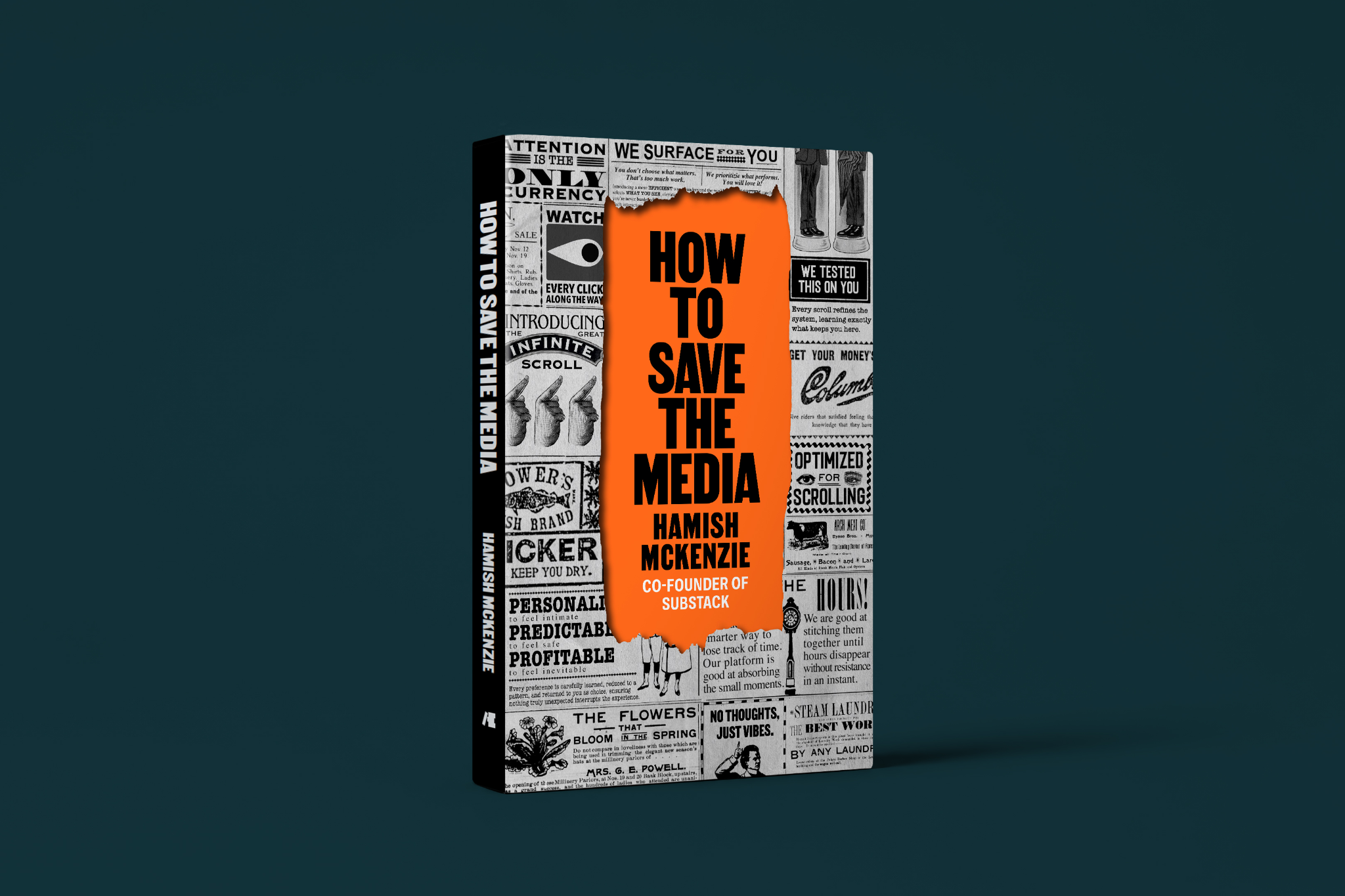
An excerpt from How to Save the Media, on sale November 17
By Hamish McKenzie
Published: 2026-11-10
URL: https://post.substack.com/p/why-save-the-media
\Art by Joro Chen\
Below is a passage from the final chapter of my new book, How to Save the Media, which comes out on November 17. The book draws on my experiences as a cofounder of Substack to show how a better model for the media can help us escape our current cultural crisis. In this excerpt, I ask why the media matters. The answer, I think, has something to do with a story’s ability to scale trust and understanding—two qualities that have been compromised by more than a decade of living in the attention economy. Thank you for reading, and please consider pre-ordering the book to help this message spread. — Hamish
What exactly do we mean when we talk about saving the media? What is the thing that needs saving?
Midway through my journalism master’s program in 2006, I did an internship at the Dominion Post, the daily newspaper in Wellington, New Zealand’s capital city. One day, I reported a short piece about a group of World War II veterans who were planning a trip to Crete and trying to raise funds. The journey would mark the sixty-fifth anniversary of the Battle of Crete, where more than seven thousand New Zealanders helped defend the island from a German air assault, and 671 were killed in battle. My story was brief and not especially memorable, focusing on the camaraderie of the troops and the memory of those left behind. It was buried in the middle of the next day’s paper. But one response stuck with me.
On the day it was published, one of the veterans’ daughters called the newsroom and asked for me by name. I can’t remember everything she said, but I recall the sincere gratitude in her voice. She wanted me to know how much the story mattered to her father and the eight other veterans who would be making the trip to Crete with their families. “We so appreciate the story, and it really means a lot to us all,” she said. I would go on to write many more consequential stories in my journalism career, but no single piece of feedback struck more deeply.
The reason, I think, is that it embodied the importance of the job the media does.
Much is made of the media’s role in serving democracy. It comforts the afflicted and afflicts the comfortable. It can also entertain us. But my understanding of the media is simpler. I believe that its primary function is to help people communicate and understand each other so we can see problems clearly and figure out how to solve them together. It is the ultimate community-service work, spreading information and sharing stories that would otherwise be geographically constrained. It gives us a way to talk to and think with each other across space and time. It helps shape how we think, what we want, how we relate to others, and who we are.
I’ve known since high school that I wanted to work in the media. Part of that is because I loved the idea of seeing my byline in a magazine or my face on television. I also liked how journalism offers a mix of indoor and outdoor work and constantly exposes you to fascinating stories. The main draw, however, was that good journalism helps people.
I vividly remember being photographed with classmates in the school sports field when some Air Force helicopters came to visit my hometown, Alexandra. The next day, the photo of me and my classmates appeared in the local newspaper, the Central Otago News. At eight years old, it was my first media appearance, and I was thrilled when our family friends buzzed about it and my mother clipped it for safekeeping. Later, as a teenager and a member of the Dunstan High School basketball team, I wrote recaps of the local league for the same paper, slipping in commentary about one of our older rivals being “taller than his hair.” When I got to university and became the editor of Critic, Otago University’s student magazine, I invited a reporter from the Otago Daily Times to come speak to our staff and volunteer writers. “We have the best job in the world,” she said. “We get paid to tell stories that change people’s lives.”
Sharing photos of kids beside military flying machines and running reviews written by teenagers of basketball games that no one watched might not seem like much. It’s certainly not on the same level as exposing massacres or revealing political corruption, but it does serve a similar purpose at the root. I felt it even as a child in that school field. The media tells us stories about ourselves and gives us a platform for cooperation. When it’s working well, it helps us build trust and understanding with each other so that we thrive not just as individuals but as people.