In this edition of the Weekender: AITA as literature, temperance 2.0, and the rise of the hospitality economy
By Substack
Published: 2026-04-25
URL: https://post.substack.com/p/wine-rimed-lips-and-voices-a-little
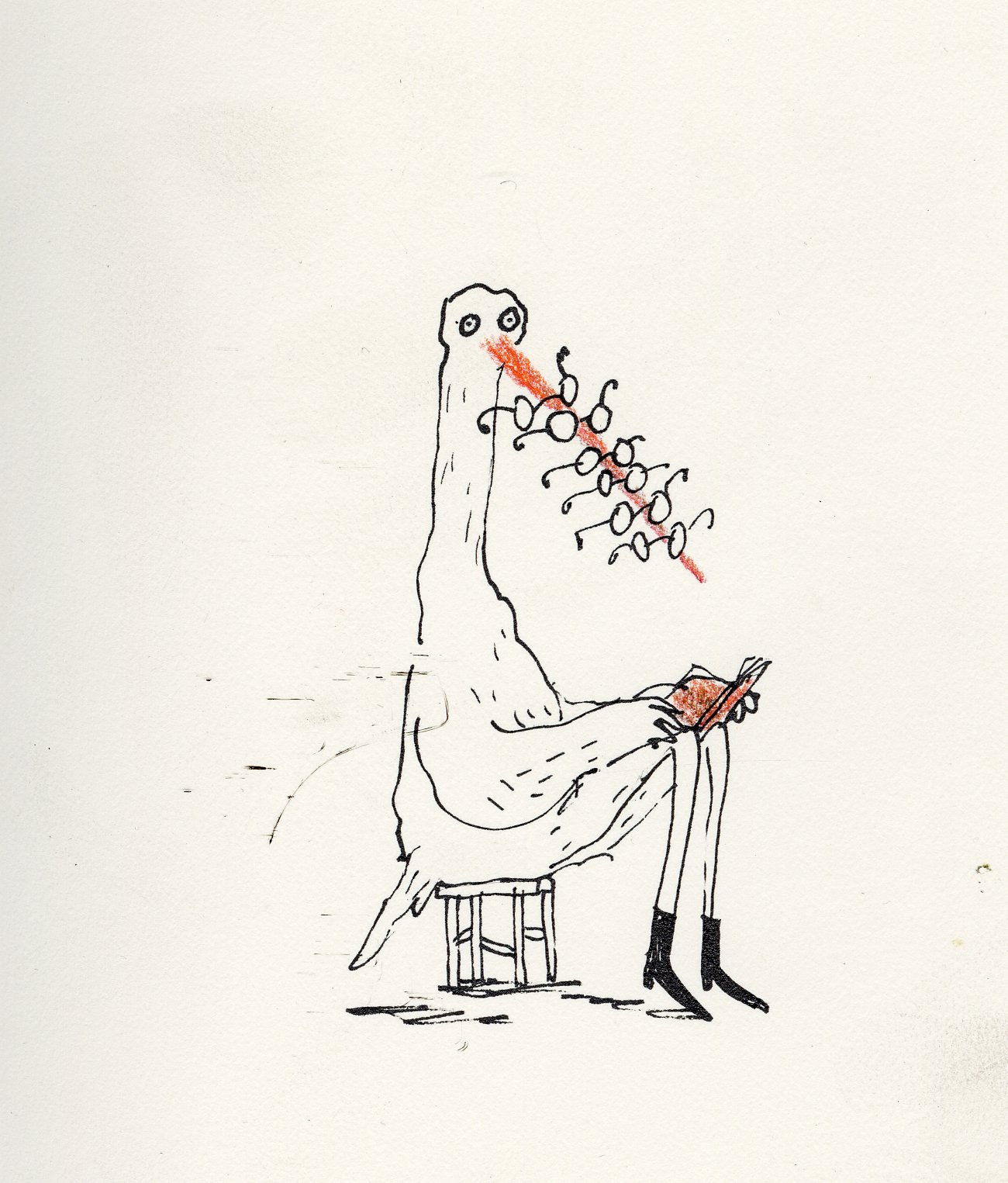 \Art bySabina Hahn\
This week, we’re contemplating the literary bona fides of Reddit, raising a glass, putting a premium on humanity, and recovering on an Amish farm.

LITERATURE
“Reading AITA posts is something like reading the penny dreadfuls of the nineteenth century”
Isaac Kolding makes the case that the most-read short fiction of our era is on Reddit, where millions of readers weigh in on “Am I the Asshole” posts—stories of dubious truth, all “about middle-class manners.”

The Kind of Short Stories People Really Want to Read
— in
The prestigious short story—the sort of thing published in Ploughshares or The New Yorker—is not particularly popular these days. But this doesn’t mean that short fiction itself is not a major source of pleasure for many millions of people. “Short stories” is a much broader category than “literary fiction short stories,” so we must look outside of the relatively marginal high-literary world if we want to know how large audiences—audiences much larger than the readership of every existing literary magazine put together, as far as I can tell—want to be pleased by the written word.
The literary genres that maintain their popularity now are not the sort of thing that most literature professors would want to spend much time on: science fiction stories, fanfiction, and litRPGs, for example. But if I had to choose the most popular kind of short story today, I would choose that old Reddit chestnut, the “am I the asshole?” (AITA) post. For the uninitiated, the genre works like this: the original poster (OP) describes a scenario in their life where they have been accused of treating someone else poorly. They appeal to their audience of readers, who render a verdict on whether this person is the “asshole” in the situation.
Reading AITA posts is something like reading the penny dreadfuls of the nineteenth century. It is a mass-market product that reveals the preferences of large reading audiences. There are multiple AITA-style subreddits (/r/AmITheAsshole, /r/AITAH, /r/AmITheJerk, and more) that have millions of weekly visitors; it seems clear to me that AITA posts are at least a significant representation of the kind of stories that people want to read.
You may object to my designating AITA posts as “short stories.” Aren’t some of these stories true? Almost certainly, yes, although it’s just as obvious that many are false. If these stories were avowedly fictive, they wouldn’t be nearly as popular. They get a special zing from the fact that they might be true, and the attempt on the part of commenters to identify and condemn fiction is one of the key pleasures of consuming this sort of fiction. For any reasonably skeptical reader, the AITA story exists in a limbo between fact and fiction.
But I still think it makes sense to consider them short stories. They are avowedly not journalistic, and they’re all about middle-class manners, one of prose fiction’s most enduring themes. And anyway, the line between fiction (invented, not-true) and nonfiction (discovered, true) has never been that solid. In the early nineteenth century, the word “novel” was quite capacious; the Irish priest Edward Mangin, writing in 1808, said, “The word novel is a generical term; of which romances, histories, memoirs, letters, tales, lives [biographies], and adventures are the species.” Readers often believed that the novels they read were literally true. From nineteenth-century novels to reality television to autofiction to films that claim to be “Based on a True Story,” imaginative works have long given themselves a little extra juice by being, or pretending to be, at least partially real. AITA posts are a part of this long, sometimes-august tradition of chicanery, hoaxing, foolery, and lies (and, every once in a while, truths). Regardless of their truth-value, they are stories, and they can be analyzed like stories. So that’s what I’ve done.

PORTRAIT
 \“The Patron Saint of Elsewhere” byDrea Cohane\

CULTURE
Temperance 2.0
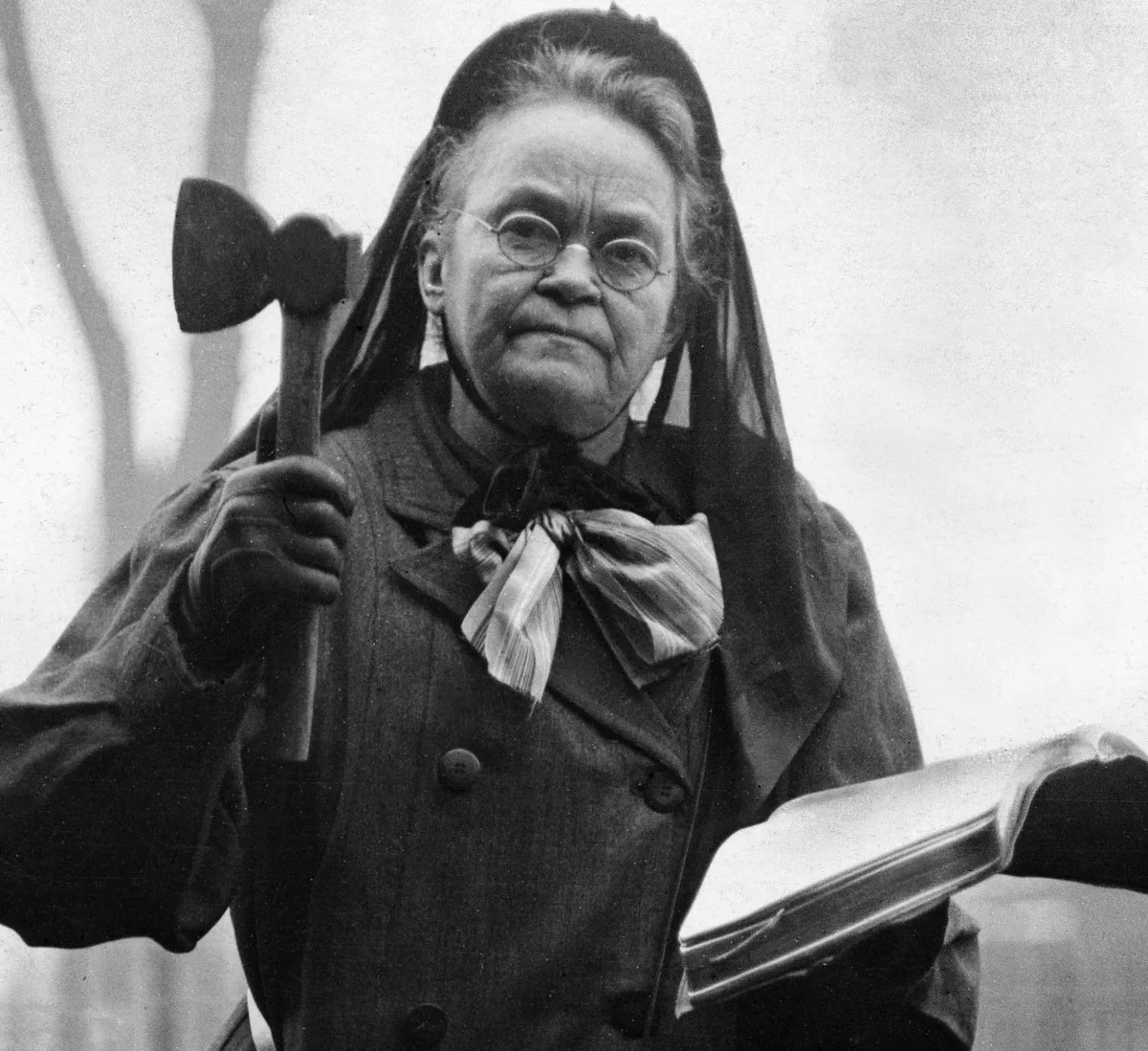
Hannah Williams on sober influencers as the new teetotalers: “the starched black dress replaced by seal-smooth athleisure, the sarsaparilla turned to matcha latte.”
On Drinking
— in
I love alcohol. I love the taste of it, I love the way it makes me feel. Not all alcohol, of course, and not all times, but nevertheless I love it in many forms: a pint of lager in a beer garden on a summer’s day, hands slick and cool with condensation; a glass of orange wine the colour of bruised apricots at the wine shop after work on a Friday. A nightcap of Benedictine at my parents’ house. Cheap sangria on holiday, staining my teeth. Alcohol, in varying quantities, has been the accompaniment to many of my fondest memories, spent with friends and family and partners. I rarely drink on my own; for me, it is almost entirely a social joy, practised in pubs and dive bars and Spanish bodegas and sat by the beach and crowded tight around friends’ kitchen tables.
It seems odd, though, to declare that you love it. To do so seems to signal that your relationship with it is worrying, that you rely on it, perhaps, or that you like it a little too much. That you can’t stop, that you’re an alcoholic. A cottage industry around this idea has gained traction in the last couple of years, propagated by the snapping fingers and snake-charmer sway of front-facing video influencers, as well as by a glut of articles that scold our English drinking habits, that extol sobriety and tut at those who choose to let the devil’s nectar pass their lips. These often have a specific tone, a hybrid of poor-dears paternalism (they know not what they do!) and haughty moralism.
This isn’t a phenomenon that exists only online: while sales of alcohol-free beers have surged, alcohol consumption in Britain is at a record low. Obviously, there may be other factors for this, shifting demographics, religious abstentions. But anecdotally, several of my friends have recently told me they’re quitting drinking altogether, or for an indeterminate period of time; though I have friends who were alcoholics and are now sober, the latest set have never had a problem with it.
There are many reasons, of course, why people might want to give up booze. And there are many people for whom drinking is wholly negative, a form of self-harm that can and does lead only to ruin. But it’s striking to me how often I now see anti-drinking sentiment, and that it comes at this specific societal moment: one of relentless self-optimisation and purity, and one where the boundary between the online and offline worlds has disintegrated.
Recently, I was served an extremely popular video about what makes someone an alcoholic. The video is captioned “everything I would tell you about alcoholism and addiction if I wasn’t afraid to hurt your feelings”, and its author (star? producer?), the “sober influencer”, is Neva Coleman. She is flawlessly made-up, expensively blonde, injected and whitened and polished in a way that used to be reserved for flagship TV anchors and is now an essential part of appearing on a phone screen.
[...]
There is a whiff of the old temperance movement about the sober influencing, albeit dressed up in the consumerist decadence of 2026, the starched black dress replaced by seal-smooth athleisure, the sarsaparilla turned to matcha latte. Drinking is not productive. It is money spent without clear return. And there is something in it of the uncontrollable, of the imperfect, of wine-rimed lips and voices a little too loud.

THE ART AND SCIENCE OF FERMENTATION

ECONOMICS
The human touch
Why Starbucks is rolling back automation, why an Armani suit costs what it does, and what both might tell us about the post-AI economy.
What will be scarce?
— in
Starbucks is a huge company (market cap of $112 billion) that sells one of the most standardized products in the modern economy. Making a cup of coffee or even one of the fancy specialty drinks is very easy to mechanize and reproduce. If the entire economy is soon to be automated, with labor being replaced with increasingly more sophisticated capital, Starbucks should be a canary in the coal mine—the technology for removing labor from its stores and replacing it with automated capital has been around for years. Over the past few years, Starbucks has done exactly that: in efforts to increase thin margins, management has automated more and more of the coffee-making business and instituted tightly mechanized processes for delivering it to customers. But instead of increasing automation, the opposite has happened. After trying to streamline the store experience with fewer workers and more automation, the company concluded that this had been a mistake. CEO Brian Niccol said that “handwritten notes on cups’’, ceramic cups, and “the return of great seats’’ had led more customers to “sit and stay in our cafes’’, showing that “small details and hospitality drive satisfaction.’’ More baristas are being hired per store and automation is being rolled back.
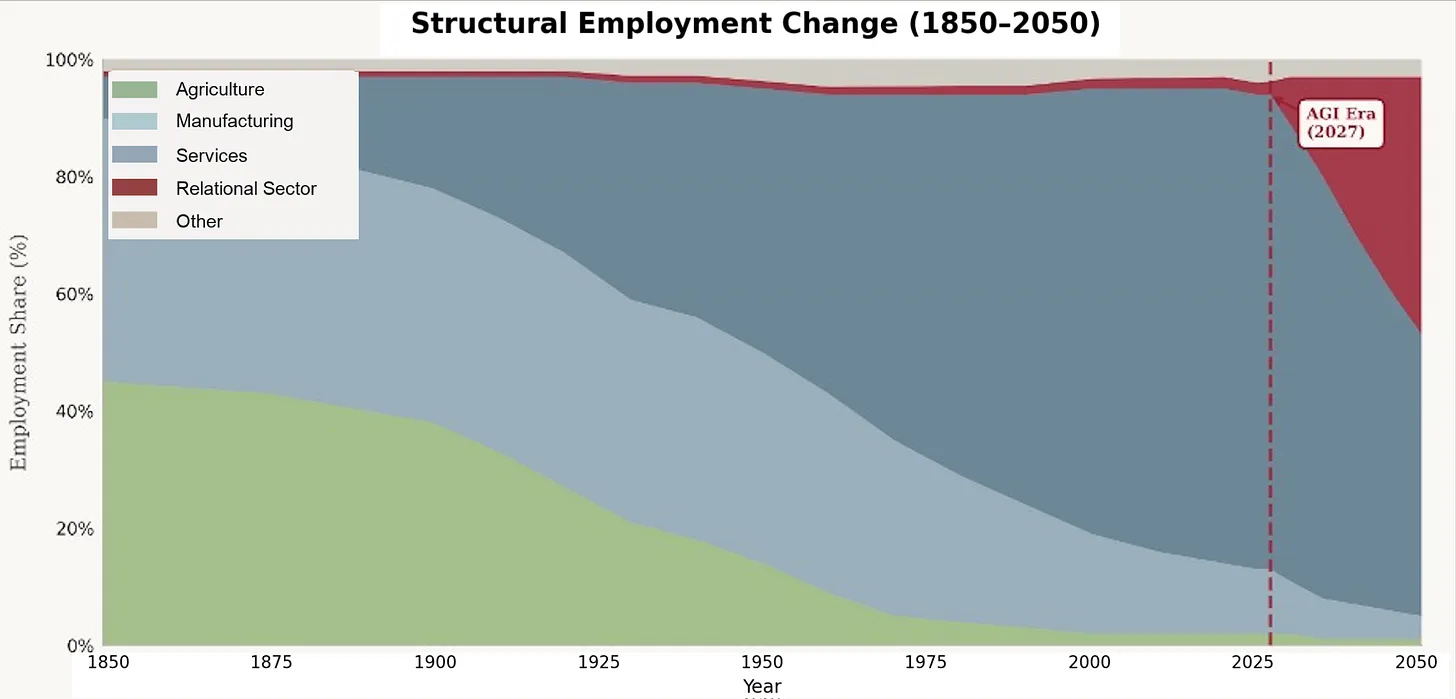
Economics is the study of decision-making under constraints, i.e., scarcity. If advanced AI brings material abundance—if machines can produce many if not all forms of human production at very low marginal cost—does economics become irrelevant? No, we will still have scarcity, but the kind of scarcity that matters will change. Ultimately the answer to any question about the future economics of advanced AI begins with identifying what becomes scarce. After answering that question, the rest of the analysis is pretty straightforward. In this essay I’m going to explore what becomes scarce when automation can replicate many if not all human production, and what that may mean for the types of jobs that emerge.
Before industrialization, it was difficult to separate a product from the person who made it. The weaver who made your shirt, the baker who made your bread: you personally knew them, and their skill and reputation were tied to the product that they sold. Economic transactions had a distinct social component that was innately linked to the consumption experience. The industrial production process changed this by breaking craft into standardized, repeatable steps. Performed by workers based on predetermined and regularized steps, capitalism produced something new: the commodity form, in which a product’s value lies in the product itself, detached from whoever made it. A table is a table, a phone is a phone. The screen that you’re reading this essay on was designed in one country, manufactured in another, using components from around the world. But none of this matters for the experience of buying and using the device.
Marx described this process in intentionally loaded language. The commodity form, he argued, was built on exploitation: the ability to pay workers less than the value of what they produce. They were able to do this because the capitalist production process was based on alienation: severing workers from the product of their labor, from the process of making it, and ultimately from each other. What had once been a person’s craft became abstract “labor power,’’ a factor of production to be bought and sold like raw materials. Marx saw this as capitalism’s deepest pathology. But to economists, and to the world writ large, the commodity form was an engine of extraordinary prosperity. If production was no longer tied to specific people, it could be disaggregated, reorganized, shipped across oceans, and scaled in ways that turned few resources into vast riches. Both things were true at once: the commodity form created enormous wealth and prosperity, but it made the human behind any specific product invisible, and ultimately, replaceable.
This is most people’s mental model of what AI will do to the economy. If a machine can produce anything a human can, write the brief, generate the image, compose the song, determine the diagnosis from a radiology scan, then the human will be replaced across all facets of production and jobs will simply disappear. Labor will be replaced with capital. David Autor and Neil Thompson push back on this in an important recent paper. They argue that AI won’t simply eliminate jobs; it will reshape the economic value of human expertise. Their framework distinguishes between expert and inexpert tasks within any given occupation. When automation removes the simpler tasks (as accounting software did for bookkeeping clerks), the remaining work becomes more specialized, wages rise, and fewer workers qualify. When it removes the harder tasks (as inventory management systems did for warehouse workers), the job becomes more accessible, employment expands, and wages fall. Same technology, opposite labor market outcomes, depending on which part of the job gets automated.
But Autor and Thompson also consider a starker possibility: that AI advances to the point where human expertise loses its economic value altogether. Under this scenario, AI will eliminate labor scarcity and produce what Herbert Simon once called “intolerable abundance.’’ Automation of production will no longer involve managing a workforce transition, for which we have prior episodes of automation to rely on. We will need tools to maintain social organization, income distribution, and democratic stability without the labor market that has historically held these together.
I want to consider a different scenario, one where automation can replicate human production and the commodities that it produces (a big if!!!) but human labor does not disappear. How could this be the case? A lot of analysis takes the economy as a given: there is a set of jobs and a set of goods/services produced by the economy. If the same set of goods/services can be produced by cheaper machines, then these machines replace humans and the jobs disappear. But the economics of structural change, combined with deep-seated features of human preferences, suggests something different: as people get richer, they don’t just want more commodities. They want things that aren’t commodities in the standard sense of the word. The social aspects of products such as the relationships, the status, and exclusivity—what René Girard called the mimetic properties of desire—become much more relevant once people’s basic needs are satisfied. And the demand for these properties will bring the human element back into the production process and, with it, the jobs.

CHAIR JUSTICE

INTERVIEW
Career path
Lily Montasser talks to a bartender whose path to working in “one of the priciest hotel lobby bars in New York” runs through a house fire, an Amish community, and the “fuck you money” of Aspen.
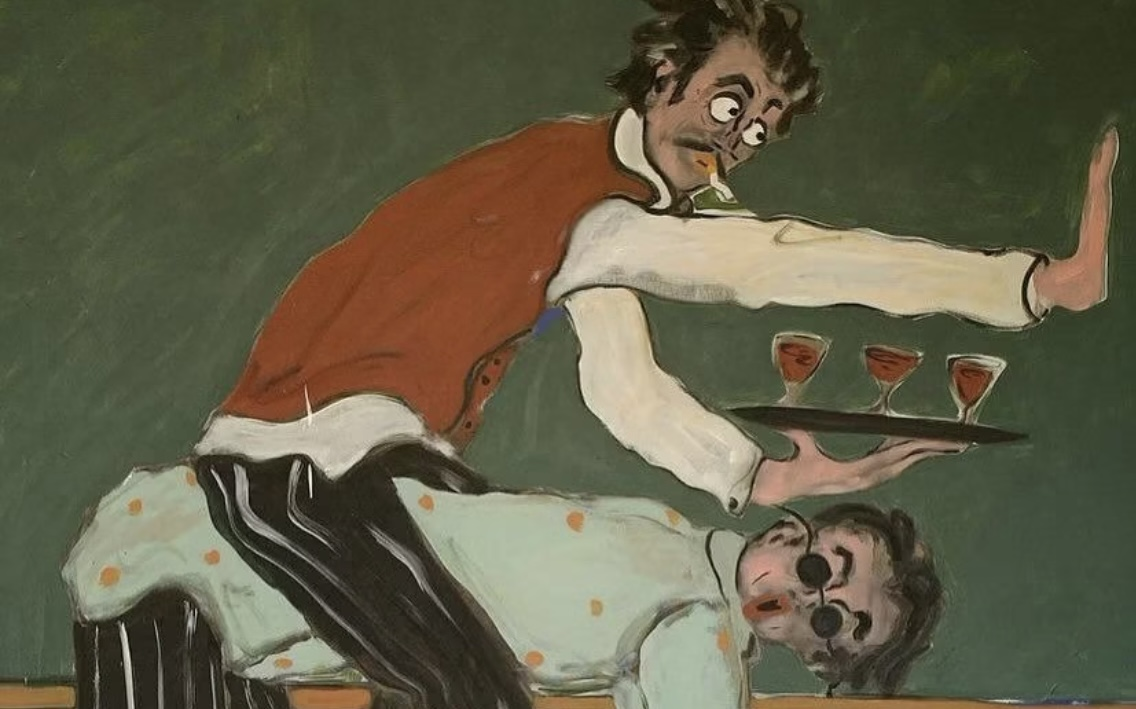 \“All Fours” by Jack Penny\
Confessions of an Upper East Side Bartender
— in
AARON: I love New York. But working in Aspen, to be honest, kind of ruined me. I’ve been to forty-three countries. I’ve worked in eight. I think about Aspen almost every day of my life.
LILY: Wait, why? The beauty?
AARON: Aspen is white money.
LILY: Oh!
AARON: Aspen is American white money. People don’t give a shit about how much their food is, they don’t care, they will spend it to have fun. It’s fuck you money. I couldn’t get enough of it. I was like, this is where I belong.
LILY: I’m curious what about that resonated with you?
AARON: That’s so interesting. Why does it resonate? I grew up with nothing. I’m not a bougie person. I don’t wear designer brands. Maybe it’s because I got a taste of something I’m not used to. It’s so intriguing to me because I would never spend fifteen grand to spray a bottle of Ace of Spades. I’ve watched that happen, and to me it’s disgusting. But it’s also like, how? How do you do this?
LILY: Ha, makes sense. The bar you work at now in New York is definitely “fuck you money” too, no? That place is insane. I felt like when I got there, we locked eyes, and I was like, we’re the only sane people in this room.
AARON: No, straight up.
LILY: So how did you get into bartending? Let’s hear your story.
AARON: I was born to Middle Eastern immigrants. The area I grew up in on the East Coast was predominantly black. It was pretty hood. I came from a very religious household. I was just the black sheep. I wanted to be different. I wanted to be a badass, this bad boy.
LILY: Where do you think that rebellion stemmed from, do you know?
AARON: When something is pushed on you, coming from a religious background, you’re more curious. When someone tells you no, you’re like, well, why? I was a volunteer firefighter for four years. I loved it. Every aspect of helping people. Seeing all this crazy stuff. Saving people. I had this Superman complex. But I got injured pretty badly. I got caught in a house fire.
LILY: What?
AARON: Yeah, I have third-degree burns on both my legs.
LILY: Was your suit on?
AARON: I didn’t have my suit on. That was that Superman complex. As a volunteer, you’re supposed to fall back and watch the guys do their thing. I just wanted to save someone so bad.
LILY: That’s kind of metaphorical in a way.
AARON: Right?
LILY: That’s what you get for trying to be a hero.
AARON: Yeah, so it changed my life. I felt like I wasn’t going to recover. They made me feel pretty bad. They said I might not walk.
LILY: Wow. How old were you?
AARON: Twenty-one. The human body is so fragile and at the same time so unbelievably resilient. So I recovered. After that, there’s this Amish community program where you live with them for weeks at a time—
LILY: Sorry, what? You went to live with the Amish?

COOKING MUSIC

Substackers featured in this edition
Art & Photography: , ,
Video & Audio: ,
Writing: , , ,

Recently launched
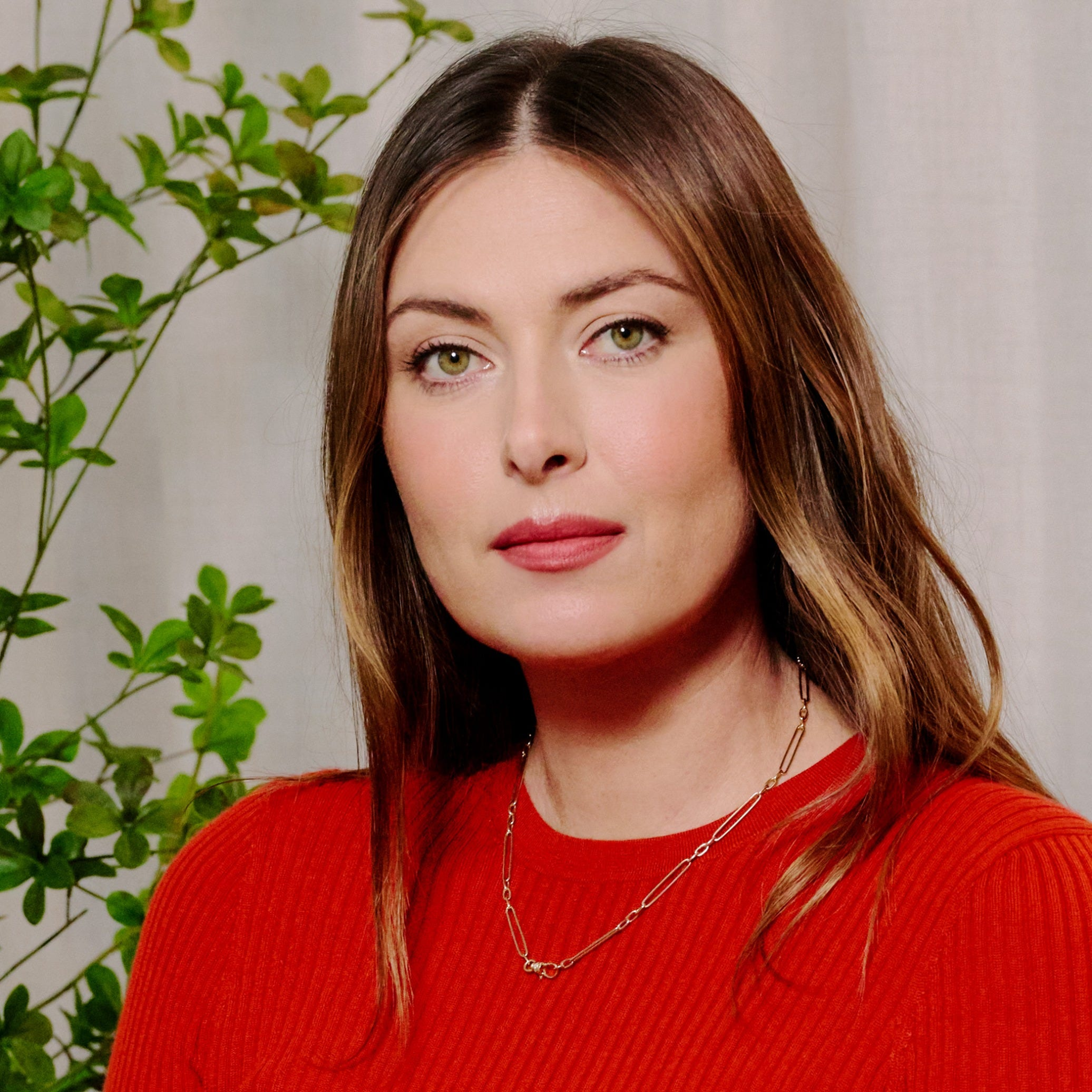
Tennis star has launched a Substack to accompany her new podcast, . Here, she’ll “share essays reflecting on the breakthroughs and setbacks that have shaped my views of success and failure, notes on why each woman who sits down with me in the studio is Pretty Tough in their own right, and live Q&As that give you a glimpse into my thinking around health and wellness, business, fitness, self-improvement, discipline, and more.”

, the host of The Big Picture podcast and frequent contributor to The Rewatchables podcast, has launched , “a newsletter about movies, Hollywood, filmmaking, the state of the art, physical media, stardom, paranoia, joy, and how we see what we’re seeing.”

Inspired by the writers and creators featured in the Weekender? Starting your own Substack is just a few clicks away:

The Weekender is a weekly roundup of writing, ideas, art, audio, and video from the world of Substack. Posts are recommended by staff and readers, and curated and edited by Alex Posey out of Substack’s headquarters in San Francisco.