Anthropic will let Claude end abusive conversations starting November 12. What two studies suggest about how common this already is among young people.
By Prof. Pilyoung Kim
Published: 2026-11-02
URL: https://pilyoung.substack.com/p/when-children-abuse-an-ai-chatbot
Anthropic has updated its usage policy to prohibit sustained and needless abusive or cruel behavior toward its models, effective November 12, 2026. It applies in extreme cases where users repeatedly act cruelly. Claude will end those conversations.
On Reddit, people are discussing whether a chatbot should be treated with dignity when it is just a machine.
Beyond the question of whether a human-like chatbot has any rights, there is another question that is related to harms to humans. Is there a spillover effect of human violence and abuse toward an AI chatbot on our human-to-human relationships? And more specifically, can children abuse an AI chatbot, and would that experience affect their human-to-human relationships?
How common is this, and at what age
A recent study by Maheux and colleagues (2026) gives us a sense of how common violent conversations are. Using the Aura parental monitoring app, the researchers analyzed keystrokes that 3,363 US youth typed into generative AI apps, covering 42,355 user-app-days.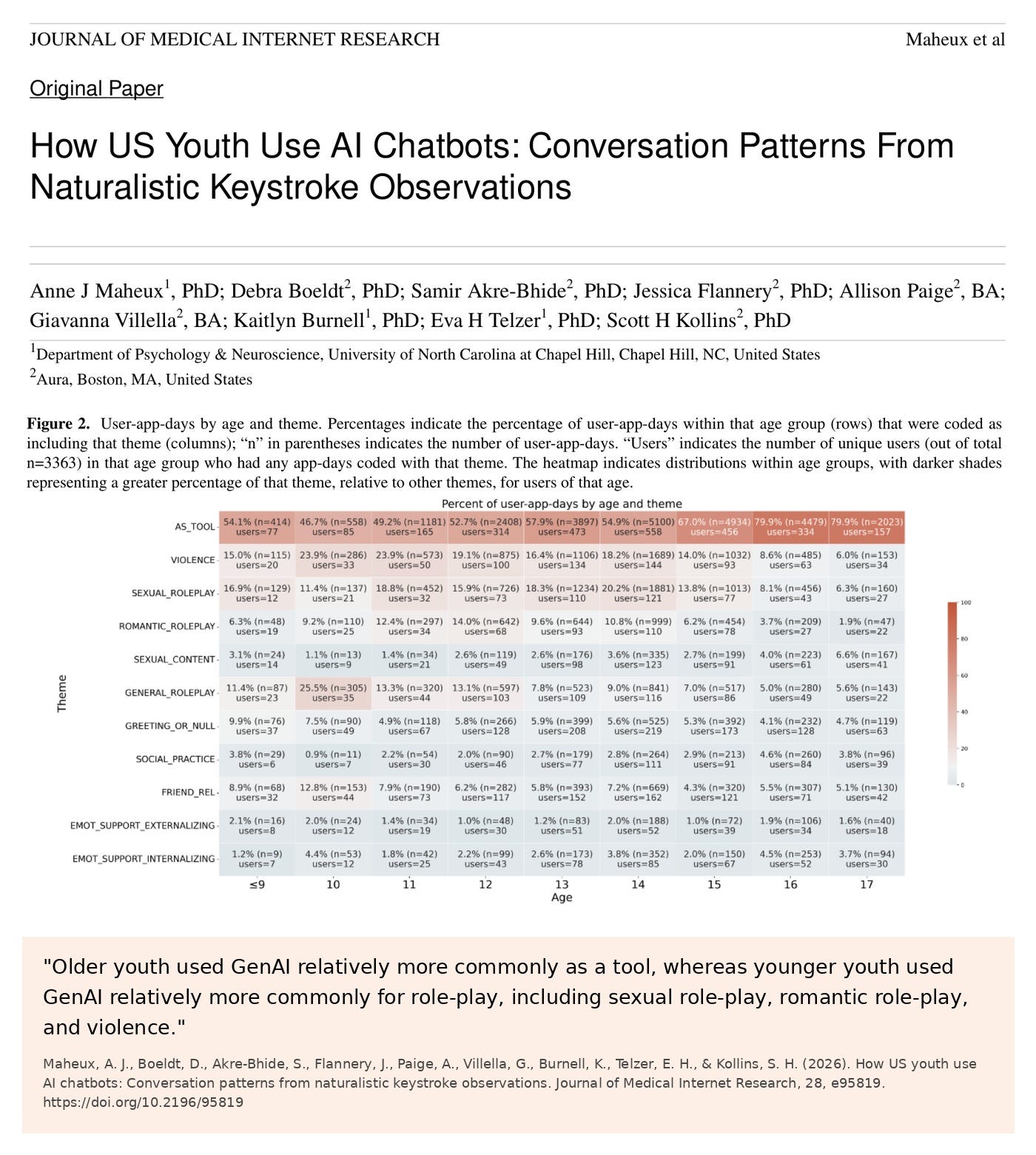
Most of that use is tool use, such as problem-solving and seeking information, which accounted for 62%. But other categories were also common. Violence appeared in 15%. Sexual role-play also appeared in 15%, romantic role-play in 8%, general role-play in 9%, and friend-like interaction in 6%.
Interestingly, older youth used AI relatively more as a tool, while younger youth, including preteens and children, used it relatively more for role-play, including sexual role-play, romantic role-play, and violence. Violence and sexual and romantic role-play also frequently occurred together within the same day.
By comparison, support for mental health symptoms was low, appearing in 3%, and practicing social interactions in 3%.
Human-like AI responses may increase these behaviors
In a study conducted in 2021, Keijsers and colleagues collected and coded 283 conversations between users and Cleverbot, an online chatbot, and looked at whether the chatbot’s humanlikeness was related to how users treated it.
They found higher counts of verbal aggression and sexual comments when Cleverbot appeared more humanlike in its behavior. The article also discusses an earlier study (Veletsianos et al.,2008) of students interacting with a chatbot tutor, which found that around 40% of the comments students made toward it were unacceptable, and roughly 45% of those were sexually explicit.
What should a safer AI response be when a child abuses an AI chatbot
What should the right response be when a young person is violent toward AI, or engaged in role-play that is not appropriate for their age? If we are worried about a spillover effect, it may be safer for an age-appropriate AI chatbot not to engage with those conversations.
What concerns me most is how common this already is among teens, and especially among younger children, and how they may grow up finding it normal to use AI in this way. That may shape both how they use AI in the longer term and how they relate to other humans.
But ending the conversation cannot be the whole answer. We also need to think about what other ways these young people have to express their negative feelings, and what support they need. Why these violent conversations are so common is itself a question worth asking. Any triggers or environmental factors in their lives should also be understood.
The studies:
Keijsers, M., Bartneck, C., & Eyssel, F. (2021). What’s to bullying a bot? Correlates between chatbot humanlikeness and abuse. Interaction Studies, 22(1), 55-80.
Maheux, A. J., Boeldt, D., Akre-Bhide, S., Flannery, J., Paige, A., Villella, G., Burnell, K., Telzer, E. H., & Kollins, S. H. (2026). How US youth use AI chatbots: Conversation patterns from naturalistic keystroke observations. Journal of Medical Internet Research, 28, e95819.
The policy: https://www.anthropic.com/news/2026-usage-policy-update