A field experiment gave 250 employees ChatGPT for a week. The benefit flowed through information. How much of it employees got depended on their metacognition.
By Prof. Pilyoung Kim
Published: 2026-08-21
URL: https://pilyoung.substack.com/p/ai-made-them-more-creative-their
There has been a lot of debate, and mixed findings, about whether AI helps or hurts human creativity. To me, that mix suggests there are different conditions under which AI works for or against our creativity.
This new study in the Journal of Applied Psychology addresses the question of when and for whom AI can help human creativity.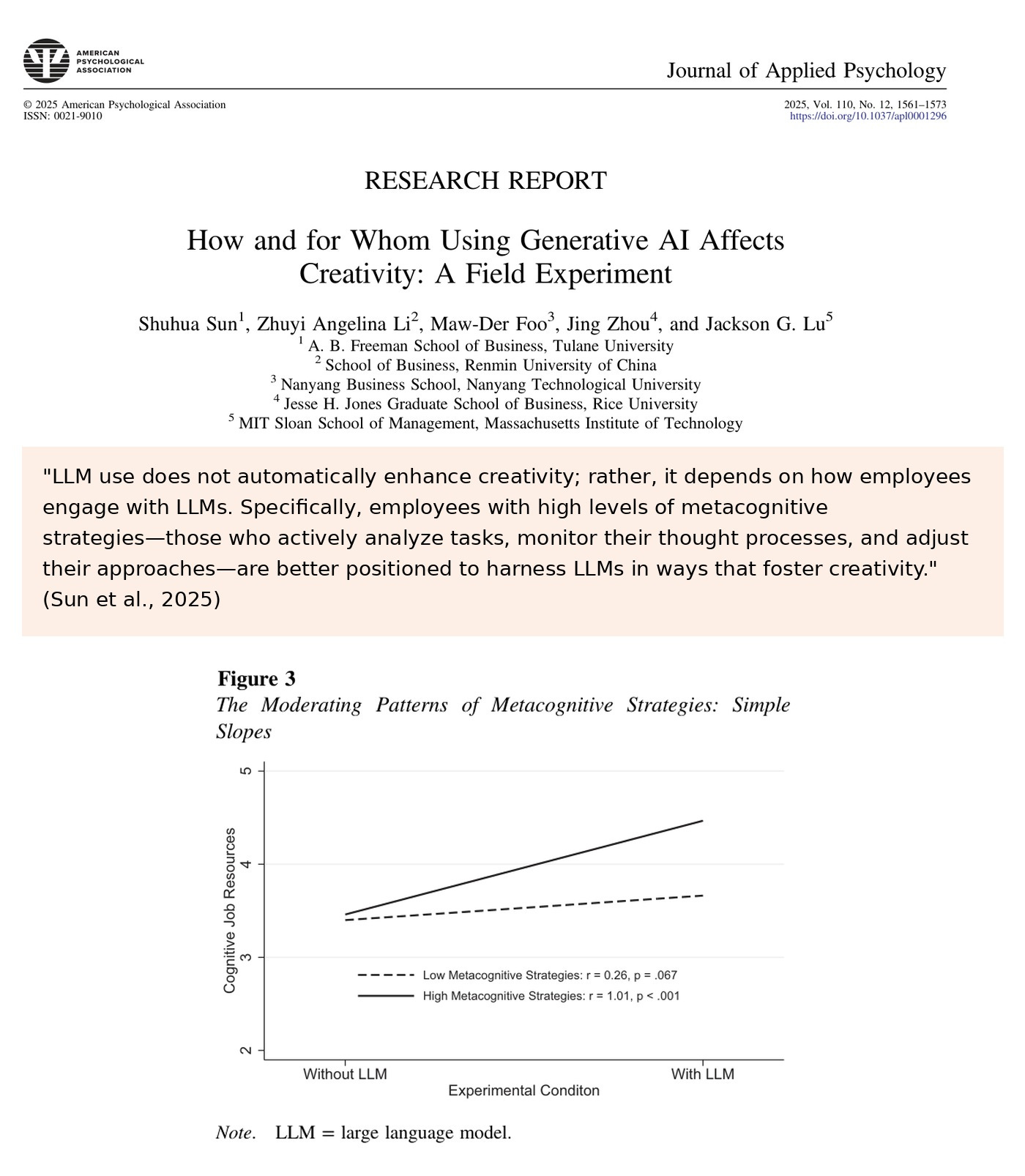
Sun et al. (2025), Journal of Applied Psychology. Figure 3 shows the moderating pattern of metacognitive strategies.
The study
The study asked the research question: Does using a large language model actually increase employee creativity at work, and if so, how does it work, and who does it work for?
Sun and colleagues ran a randomized field experiment inside a technology consulting firm in China in August 2023. Out of 286 eligible employees, 250 participated. Employees were randomly assigned to receive a ChatGPT account (with usage examples) or not. A week later, everyone completed a survey measuring cognitive job resources and metacognitive strategies.
Creativity was measured two ways. First, each employee’s direct supervisor rated their creative performance over that week. Supervisors were blind to the experiment and the hypotheses. Second, employees answered an open-ended question about protecting employee privacy in a digitalized workplace, and two external raters independently scored those responses for novelty and usefulness.
The key findings:
- LLM access increased creativity. Supervisor-rated creativity was significantly higher in the treatment group, as was externally rated novelty.
- The mechanism was cognitive job resources. “Cognitive job resources” means having access to useful information and knowledge to solve complex problems. LLM access raised these resources, and that increase accounted for part of the path to creativity.
- But how much of that resource gain you got depended on metacognitive strategies. For employees reporting high metacognitive strategies, LLM use significantly increased cognitive job resources. For those reporting low metacognitive strategies, it did not.
My thoughts
First, this finding is interesting to me because it shows a mechanism, not just that AI can increase creativity, but how. It does it by giving people more information and knowledge, and more room to think. That fits what we know about creativity from the cognitive resource perspective. Creativity requires recombining and synthesizing information in novel and useful ways. AI can expand the pool of information you are working with, and free up cognitive capacity you were spending elsewhere.
But what I found to be most interesting is that how well people can take advantage of AI for that more helpful information seems to depend on their metacognitive strategies. It is the ability to identify what information they need the most, to actively monitor and regulate their own thinking and the AI output, and to switch flexibly as they navigate it.
What this might mean for children
While the study was done with adults, this finding makes me think about the implications for children and their AI use.
Metacognition is one of the highest-level cognitive abilities we have. It is therefore one of the last to mature, continuing to develop all the way into early adulthood. So for children who do not yet have fully developed metacognitive skills, this study suggests they may be at greater risk of not being able to take advantage of AI for their creativity, because the ability that unlocks the tool is still under construction.
Thus, this may suggest a caution about how much we hand AI to children, and about how we introduce it when we do. If the benefit partly runs through metacognition, then the important intervention would be teaching the metacognitive thinking.
And for adults at work
The study’s own practical recommendations are aimed at organizations. They suggest training metacognitive strategies, and considering them when deciding how to roll LLMs out. What follows is my own extension to the individual level. If the benefit runs through metacognition, then using AI intentionally should matter more than using it often. Concretely, that looks like prompting iteratively rather than in one shot:
-
Plan first: what is my goal for this task?
-
Share your own initial ideas before asking for AI’s
-
Ask AI for feedback on those ideas
-
Ask it to consider alternative options
-
Ask it to provide supporting evidence
-
Ask it to evaluate the different options against each other
Three takeaways
- AI can boost creativity by providing more information and more cognitive resources. That means more knowledge to work with, and more room to think.
- Our metacognitive ability, our ability to select and evaluate information, influences how much high-quality information AI can actually give us.
- So to use AI for creativity, consider using it intentionally. And for children with still-maturing metacognition, this may be one reason AI is less likely to boost their creativity. That is a reason to teach the metacognitive thinking alongside the tool.
Reference
Sun, S., Li, Z. A., Foo, M.-D., Zhou, J., & Lu, J. G. (2025). How and for whom using generative AI affects creativity: A field experiment. Journal of Applied Psychology, 110(12), 1561–1573. https://doi.org/10.1037/apl0001296