By Prof. Pilyoung Kim
Published: 2026-04-16
URL: https://pilyoung.substack.com/p/what-students-and-teachers-are-telling
As schools are increasingly faced with the question of how to integrate AI into teaching and learning, one thing feels increasingly clear to me: we need to listen more carefully to the people who are actually living with these changes every day, especially students and teachers.
I recently reviewed two reports that stayed with me for this reason. One focused on youth perspectives, and the other on teacher perspectives. They are not research studies designed to establish causal effects. But they are still deeply valuable because they surface something we too often move past in AI policy conversations: what people closest to the classroom are actually worried about, hoping for, and asking for.
The two reports
1. I-Think Student Voice Insight Report This report brings together perspectives from Ontario Canada students in grades 6 through 12 who participated in the Fall 2025 Artificial Intelligence Challenge Kit.
It is a student insight report focused on how young people think about AI in education, including its opportunities, risks, and the kind of guidance they want from schools. The report includes participation from 51 schools, 5000+ students, and 690+ innovations.
The report was shared by Heidi Siwak, Teacher Coach, at I-Think.
2. A Guide to AI in Schools: Perspectives for the Perplexed This guide by MIT Teaching System Lab is a practitioner oriented, interview based resource built around teacher, student, and school leader perspectives on AI in schools. It is designed to help schools think through AI policy, teaching, and ethics in a rapidly changing environment. The guide notes that it is based on over 90 interviews with teachers, school administrators, and students.
What students are telling us
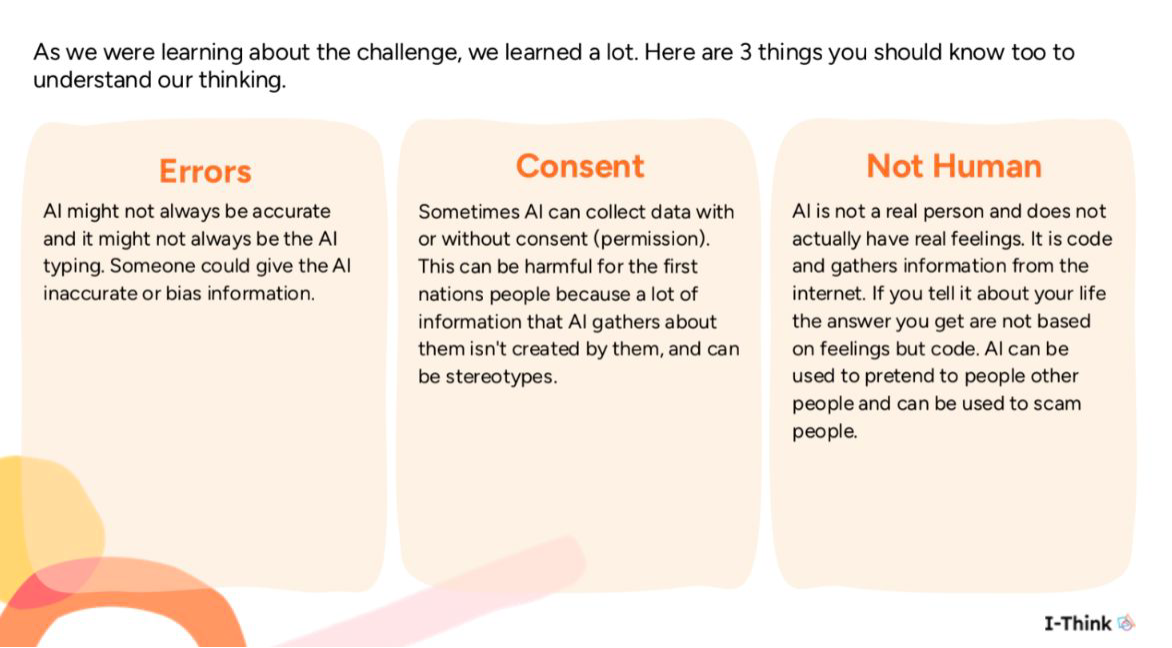
What struck me first in the student insight report is that young people are not simply for or against AI. Their thinking is much more nuanced than that.
Key points from the student report
- Students saw AI as potentially useful for personalized learning, accessibility, and timely help
- Some students imagined AI as a built-in friend or social support tool for people feeling lonely
- Students also raised concerns about surveillance, consent, bias, fairness, and environmental costs
- A major theme was that AI should make schooling more efficient, not less human
- Students emphasized the need to rebuild trust among students, teachers, and parents through clearer guidance and boundaries
One thing I found especially important is that students did not seem to want AI to replace teachers or human relationships. Students wanted AI to support learning while preserving human connection and deeper learning.
What teachers are telling us
The teacher guide raised a parallel point from a different angle. It argues that when schools face educational challenges, one of the best places to begin is by listening closely to educators and learners on the frontlines. The guide repeatedly shows just how mixed and context dependent views on AI are in schools.
Key points from the teacher guide
- The guide begins from the premise that schools should listen closely to educators and learners on the frontlines
- It presents AI in schools as a space of real uncertainty, not settled best practice
- Teachers described both benefits such as differentiation, accessibility, and productivity, and risks such as dependency, reduced thinking, and loss of human connection
- The guide emphasizes that AI policy should involve teachers, students, parents, and other stakeholders
- It repeatedly suggests that schools need clearer guidance, shared language, and ongoing revision, rather than assuming a one time solution
The report explicitly describes schools as still figuring this out, and emphasizes that policies should be developed with input from administrators, teachers, students, parents, and even skeptics.
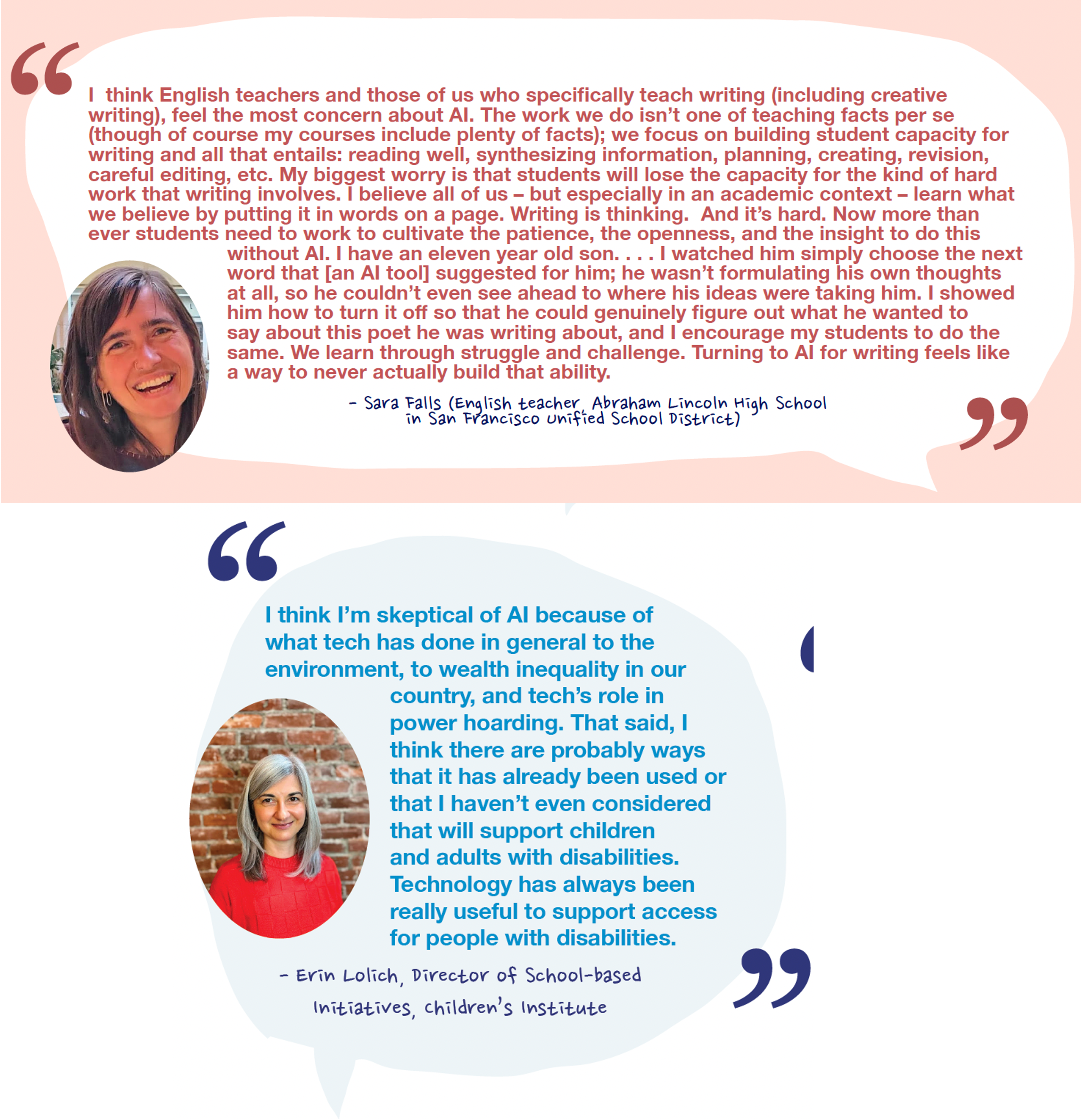
Guide to AI in Schools: Perspectives for the Perplexed.
What I Found Especially Insightful
What I found particularly insightful across these reports was how strongly both students and teachers pointed to the relational side of AI in schools.
A few points especially stayed with me:
- Students were thinking about parent needs too. They wanted parents to be informed and supported as AI becomes part of school life.
- They were attentive to consent. Students raised important questions about data use, privacy, and whether people truly understand what they are agreeing to.
- They described a tension among students. Some felt they could do the work themselves, but still worried that not using AI might leave them behind.
- They noticed an inconsistency in teacher guidance. Some students felt disappointed and confused when students are discouraged from using AI while teachers used it themselves, suggesting that inconsistent expectations can erode students’ trust.
- Teachers pointed to social and emotional AI literacy issues. The guide identifies AI’s impact on students’ social, emotional, and mental well-being, and on learning, as important parts of AI literacy, even though it does not yet fully develop what that means in practice.
Together, these reports suggest that the challenge is not only whether schools use AI, but whether they can do so in ways that protect trust, clarity, consent, and human relationships.
References
Smith, J. M., Dukes, J., Sheldon, J., Nnamani, M. N., Esteves, N., & Reich, J. (2025). A Guide to AI in Schools: Perspectives for the Perplexed. MIT Teaching Systems Lab. Retrieved from tsl.mit.edu/ai-guidebook/
Guidetoaiinschools
7.1MB ∙ PDF file
I-Think. (2025). Student Voice Insight Report: Fall 2025 Artificial Intelligence Challenge Kit. Retrieved from the I-Think report.
I Think Student Voice Insight Report Fall 2025
4.54MB ∙ PDF file