By Prof. Pilyoung Kim
Published: 2025-09-12
URL: https://pilyoung.substack.com/p/what-i-heard-at-imagination-in-action
I attended Imagination in Action (IIA) on September 8 (Google campus) and September 9 (Stanford campus)—an event led by John Werner with roughly 250 speakers across industry and research. I joined both days. Below are the themes I heard most often, concerns raised, and my reflections after listening to people at the forefront of AI development and applications. This summary reflects only the sessions I attended.
Event link: https://www.imaginationinaction.co/
Most Interesting Discussions
1) AI Making Life Better vs. Replacing Human Jobs
Many on stage—e.g., Yossi Matias (VP, Research & Engineering, Google), Eric Schmidt (Former CEO, Google), Reid Hoffman (Co‑Founder, LinkedIn), Clara Shih (Head of Business AI, Meta), and others—emphasized how AI could meaningfully improve our lives. However, in Q&A, audience members repeatedly pressed on the flip side: job displacement across sectors.
2) Broad Consensus: AI’s Role in Scientific Breakthroughs
Speakers including Yossi Matias (Google), Anirudh Devgan (CEO, Cadence), and Liam Fedus (CEO, Periodic Lab) argued that AI’s impact on scientific discovery will be revolutionary. Devgan predicted that after agent AI and physical AI (e.g. robots), “scientific AI” may see the heaviest investment and fastest advances. Google Research also highlighted examples of their applications such as Co‑Scientist, Med‑Gemma, and LearnLM.
3) “AGI War”
Eric Schmidt (Former CEO, Google) framed a geopolitical race: the U.S. could lead in AGI, while China may lead in humanoid robots, energy/electricity production, and electric vehicles.
4) Reality Check on Agentic AI
Several speakers expressed disappointment with the current hype—some noting that a large share of AI agent demos fail in practice. Narrow, well‑scoped tasks look promising, but broad, open‑ended tasks remain unreliable. If/when AI agents begin talking to each other, that could introduce new security vulnerabilities.
5) Do We Need Humanoid Robots?
A lively debate: Ashish Kumar (Robotics Research, Meta) predicted rapid progress, mass production, and falling costs. In contrast, Rodney Brooks (Co‑Founder, iRobot) and Anand Lalwani (Co‑Founder, Carinal Robotics) questioned the need for general‑purpose humanoids, arguing that task‑specific robots may be safer and more cost‑effective.
What People Seemed Most Concerned About
-
Job displacement in entertainment, finance, and beyond.
-
A different view: Diyi Yang (Professor, Stanford University) suggested we may reorganize work, offloading tasks AI does well while creating new kinds of human work.
-
AI literacy and public safety: Training is needed to reduce risks from cybercrime and to support older adults and other vulnerable groups.
-
Humanity and authenticity: How do we preserve connection, creativity, and meaning?
-
Entertainment: Jason Anderson (CEO, Quire) suggested outcomes will track consumer preferences. If audiences reward authenticity, it will persist, but current trajectories often follow profit incentives.
My Reflections — What Concerns Me and What Excites Me
1) AI will be everywhere.
-
Ambient Intelligence.
Talks pointed to a near-term world of multimodal interfaces—watches, glasses, and phones working together (e.g., Madhavi Sewak, Google DeepMind; Andrea Colaco, Google XR Interfaces). Clara Shih (Meta) put it vividly: imagine a “chief of staff” in your ear, continuously capturing daily life and offering advice.
-
The Race to AGI.
Multiple Big Tech voices emphasized building ever-more-capable systems, including Meta’s aspiration of “super-intelligence for everyone.”
-
AI for Everyone: Doctor/Teacher for Each Person.
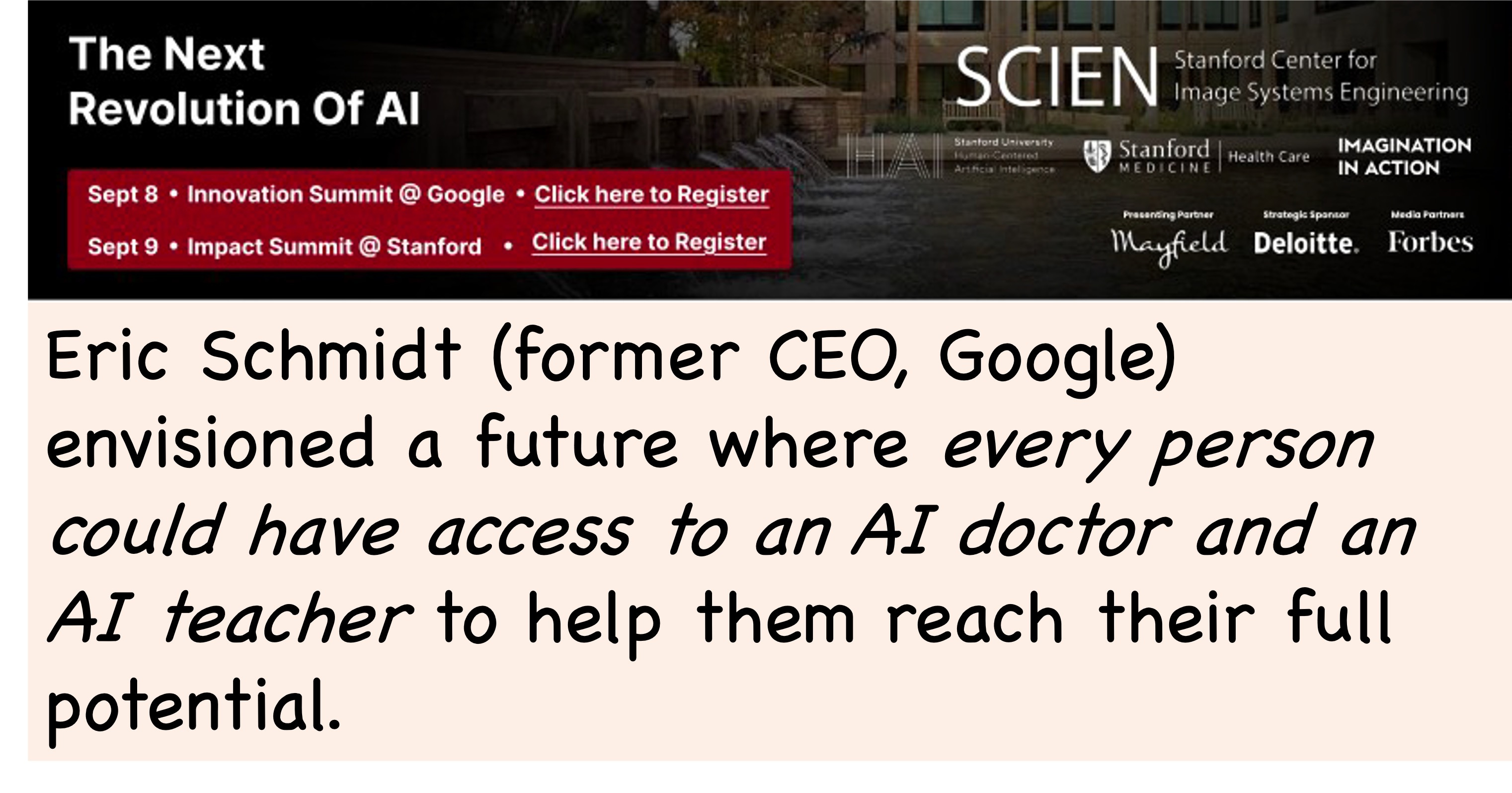
Eric Schmidt (Former CEO, Google) described an AI doctor and AI teacher for every person to reach full potential; Reid Hoffman (Co-Founder, LinkedIn) described AI agents that help people navigate their life journeys.
2) Open questions for the mind and brain.
If these systems observe what we see, hear, and say—and then advise us—how will that reshape cognition and behavior long-term? What will it do to how we work and think?
3) Children and safety.
Discussion of child safety was largely missing in what I saw. For me, that gap is significant and urgent.
4) Thoughtful reflections across sectors.
From an audience spanning industry, journalism, academia, and policy, I was encouraged by the thoughtfulness around designing AI to assist and protect people. There’s broad recognition that AI is here to stay and will expand into daily life and a growing effort and attempt to steer its development toward a healthier balance between technological innovation and humanity.
Closing Thoughts
IIA brought optimism and caution into the same room. I’m encouraged by the potential for scientific AI and by specific, narrow uses that reliably help. I remain concerned about ambient intelligence and the long‑term effects on minds and relationships—especially for children. I’ll continue tracking these themes and welcome perspectives from families, educators, developers, researchers, and other thought leaders.
Thanks for reading Brain, AI, Child! Subscribe for free to receive new posts and support my work.