HTML, CSS, JavaScript and TypeScript for classroom activities in Chatgpt Sites
By Phillip Alcock
Published: 2026-10-18
URL: https://phillipalcock.substack.com/p/vibe-coding-gets-better-if-you-understand
View the vibe coded app site here -
https://year5-equivalent-fractions.philalcock.chatgpt.site/
HTML, CSS, JavaScript and TypeScript handle different parts of a web activity. Understanding their roles helps teachers specify what an AI-generated activity should do, locate problems and review the result.
You can begin by learning each language’s purpose without memorising its syntax. Most changes can still be requested in ordinary English.
Language responsibilities
HTML, CSS and JavaScript provide the structure, presentation and behaviour of web pages. This division is described in Mozilla’s introductory web-development guidance.
TypeScript extends JavaScript with type checks that can identify certain coding errors during development. It does not add a separate visible layer to the page. See TypeScript: The Basics.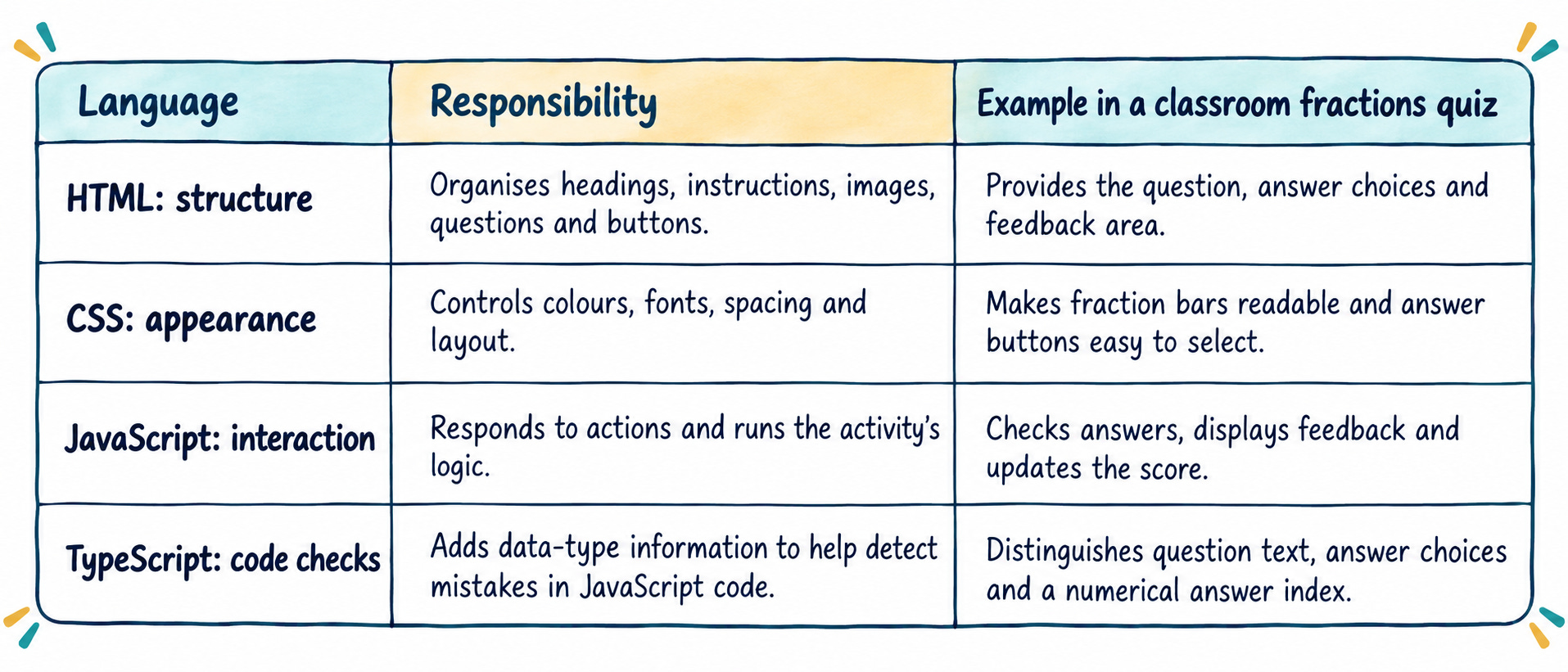
HTML is a markup language, CSS is a styling language, and JavaScript and TypeScript are programming languages. “Coding languages” is a broad beginner’s term for this group.
Build an equivalent-fractions activity
This example uses an illustrative Year 5 activity with the learning goal:
Explain why ½, ²⁄₄ and ⁴⁄₈ represent the same amount when the whole stays the same size.
Prepare the content
Before opening ChatGPT Sites, prepare the questions, correct answers and explanations. Specify what a useful explanation must include. Missing content leaves instructional decisions to the tool.
Submit the build prompt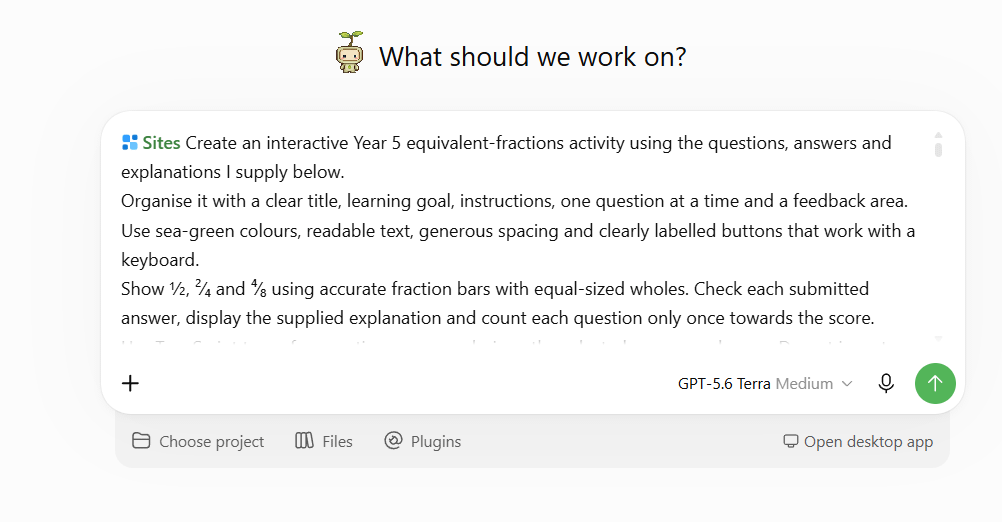 I added information from a daily worksheet at the end.
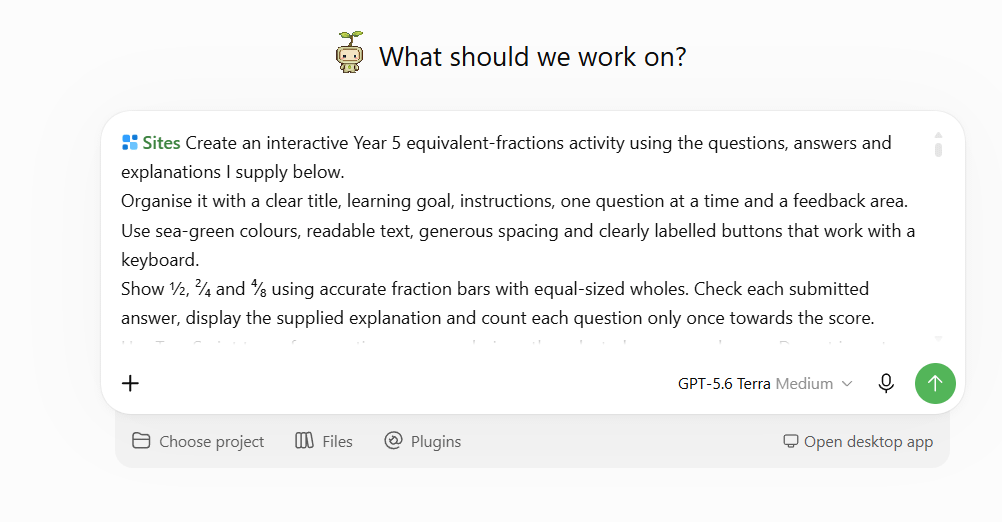
Create an interactive Year 5 equivalent-fractions activity using the questions, answers and explanations I supply below.
Organise it with a clear title, learning goal, instructions, one question at a time and a feedback area. Use sea-green colours, readable text, generous spacing and clearly labelled buttons that work with a keyboard.
Show ½, ²⁄₄ and ⁴⁄₈ using accurate fraction bars with equal-sized wholes. Check each submitted answer, display the supplied explanation and count each question only once towards the score.
Use TypeScript types for questions, answer choices, the selected answer and score. Do not invent missing mathematical content; identify anything I need to supply.
After building, explain briefly where the structure, styling, interaction and TypeScript checks appear in the project. Stop at a preview for me to review.
Questions, correct answers and explanations:
[Paste the teacher-prepared content here.]
Background and supporting examples
Decisions in AI-assisted app development
In an article dated 12 October 2026, Ian Bogost described building small, personal apps with AI. His account included creative freedom and practical barriers, including the need to decide how the software should work. The example is relevant to teachers specifying classroom tools. The Atlantic
Programming and explicit thinking
In Chapter 1 of the first edition of Mindstorms (1980), Seymour Papert writes:
“Programming the Turtle starts by making one reflect on how one does oneself what one would like the Turtle to do.”
For the fractions activity, this means clarifying the mathematical explanation before specifying the computer’s behaviour.
Phil