The yet-to-be-answered question is why.
By Peter Gray
Published: 2026-10-14
URL: https://petergray.substack.com/p/us-teen-mental-health-is-improving
 Creative Commons
Dear friends,
I’m going to start this brief letter with some data, all taken from the U.S. Centers for Disease Control (CDC). Note: To find the CDC data from which I constructed the graph and the two tables below, see, respectively, [Here, Here, and Here.]
Data Indicative of Improved Teen Mental Health in Recent Years
The graph of suicide rates for 15-19-year olds, below, is an extension of a graph I used in my new book, Restoring Childhood, but with the addition of data for 2024, which was not available at the time of final manuscript submission. In the book I note that suicide rate seemed to be on a downward trend after 2018, but the new data point shows that trend even more clearly. This is not just a blip; it’s a significant downward trend in suicide rate. Let’s hope it continues.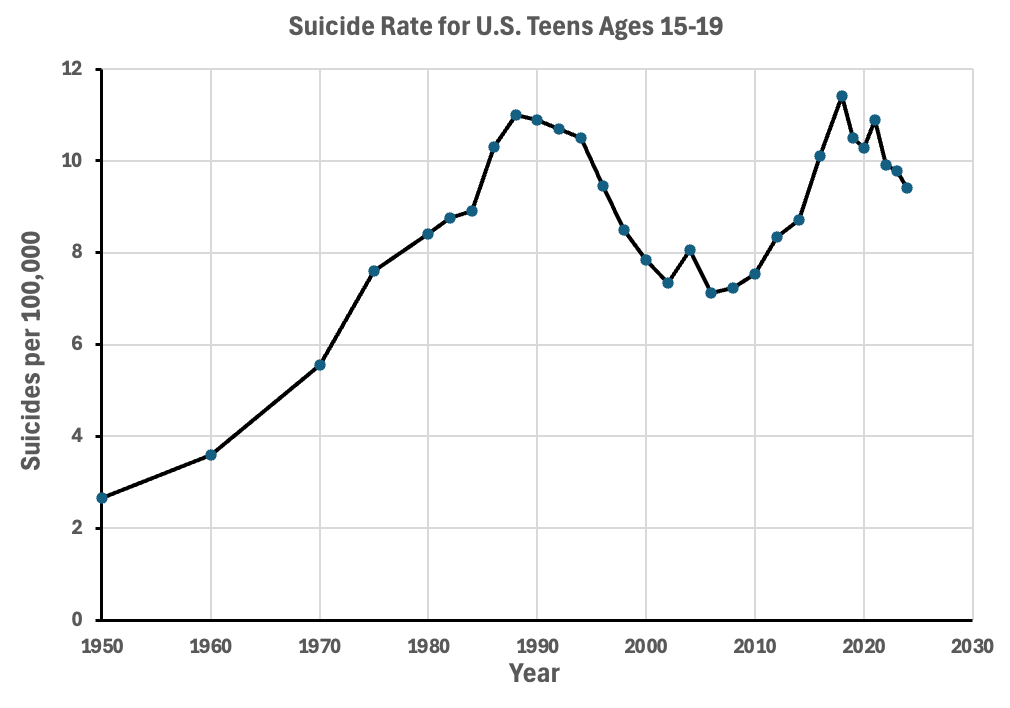
It’s not just actual suicides that are decreasing. As shown in the table under this paragraph, the percentages of high school students who reported—in the CDC’s Youth Risk Behavior Survey—that they had experienced persistent sadness and hopelessness and various levels of suicidality declined continuously between 2021 and 2025, with the biggest drop occurring between 2023 and 2025. (Note: This survey is only conducted in odd numbered years.)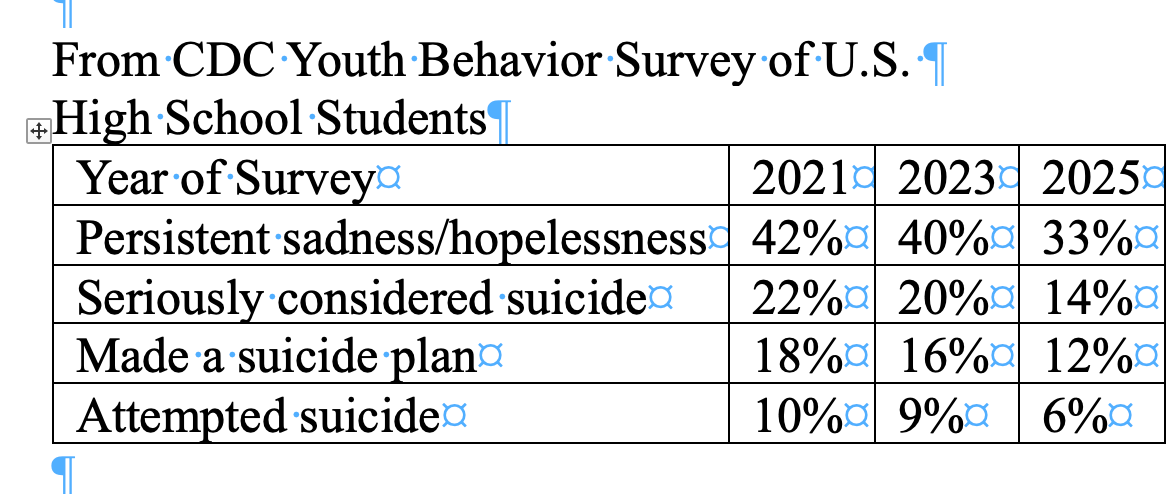
The improvement in mental health found in teens apparently did not occur for older age groups. One illustration of this is found in the table below, which shows changes in emergency visits for suspected suicide attempts, from 2021 to 2025, for various age groups. Teens (ages 12-17) showed a decline of 13.3 % in such emergency visits over these years, while adults age 18-25 showed a negligible decline of 0.9% and older groups all showed increases. Something apparently happened that affected teens in a positive way but not adults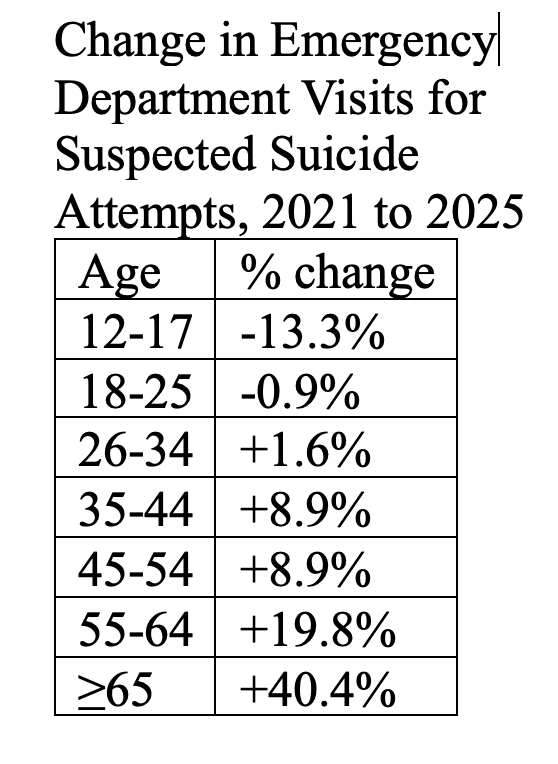
What May Have Caused the Improved Mental Health
In Restoring Childhood, I delve deeply into research relevant to the changes in teen mental health from the 1950s on to 2018. I present, there, extensive evidence that the large decline in mental health from 1950 to 1990 resulted from a set of societal changes that led children to be less free, with each decade, to do the things they must to attain the levels of confidence, or sense of agency, required for mental health.
Then, I present evidence that the subsequent improvement in mental health, from, from 1990 to about 2002, resulted primarily from the computer revolution, which gave children new ways of playing, new ways of communicating with peers, and new ways of demonstrating competence to themselves and others—thereby increasing their sense of agency and mental wellbeing.
Finally, in the book, I present evidence that the decline in mental health from roughly 2010 to 2018 resulted primarily from a radical, nationwide change in schooling instituted by the Common Core State Standards, which made school far less pleasant and more stressful than it had been before. I present evidence that school has always been the major source of anxiety and depression for the population of school-aged kids as a whole and that Common Core made it even more so, and evidence that a comparable decline in mental health over those years did not occur in most other nations, but did occur in nations that made nationwide schooling changes comparable to the U.S. Common Core.
What I have described in the above paragraph is, of course, a simplified summary, without the supporting data and nuance found in the book.
But now we have a new phase of change, an improvement in teen mental health beginning sometime after 2018, or 2021, depending on which set of data one examines. What has happened?
People who hold to the largely discredited belief that the decline beginning in 2010 resulted from increased use of smartphones, or social; media, or screens in general, might like to say that the use of these has declined, but I know of no evidence for that. In fact, the CDC began, for the first time in 2023, to ask teens about their rate of use of social media as part of the Youth Risk Behavior Survey, and found no meaningful change in that between 2023 and 2025, a two-year period of greatest improvement in mental health, as shown in the same survey.
I don’t know the answer to the why. We will need to see how the trend continues and how it relates to other societal changes. But here is my current theory.
Call me an optimist, if you will, but I think parents and educators are gradually catching on to the idea that, for mental wellbeing (and positive development generally), kids need more time for themselves, more opportunity to do things independently, and less pressured schooling.
At this point, my theory is informed only by informal and possibly biased observations. But, at least in my own and surrounding towns, I am seeing more kids outdoors on their own in the last year or two than I did in recent previous years. I am also hearing from some teachers that Common Core may have run its course and is fading out. School personnel may have finally begun to realize that Common Core isn’t working—in fact, it has caused test scores to go down rather than up—and are returning more autonomy to classroom teachers, who in turn are returning a bit more autonomy to kids.
To be happy and mentally well, one needs some freedom. Perhaps we are, as a society, beginning to recognize that to be as true of kids as it is of the rest of us. Are we on a trend of “Restoring Childhood?”
What Do You Think?
Are you seeing what I believe I am seeing? Do you see kids out and about, without adult guards, a bit more than you did a few years ago? Do you hear parents talk a bit more about the value of kids’ freedom? If you have some association with public schools, are you seeing some lightening up there—maybe a bit more recess, a bit more fun, more that is interesting and less that is tedious, annoying, and stress-inducing?
Or, what else are you seeing that might explain the recent improvement in kids’ mental health? Maybe improvement is occurring partly because of an increase, since COVID, in the number of families who have removed their kids from standard schooling for homeschooling, unschooling, democratic schooling, or some other form of alternative schooling. My research and that of others has shown that a major reason why parents have removed their kid from conventional schooling has to do with mental health.
We are at the stage of generating hypotheses, just thinking of plausible ideas that might be tested by systematic research. Share your thoughts below.
And if you want to join with me and others in discussing such thoughts, consider registering for our online meeting, on October 24.
With respect and best wishes,
Peter
Play Makes Us Human is a reader-supported publication. Consider becoming a free or paid subscriber.
Thanks for reading Play Makes Us Human! This post is public so feel free to share it.