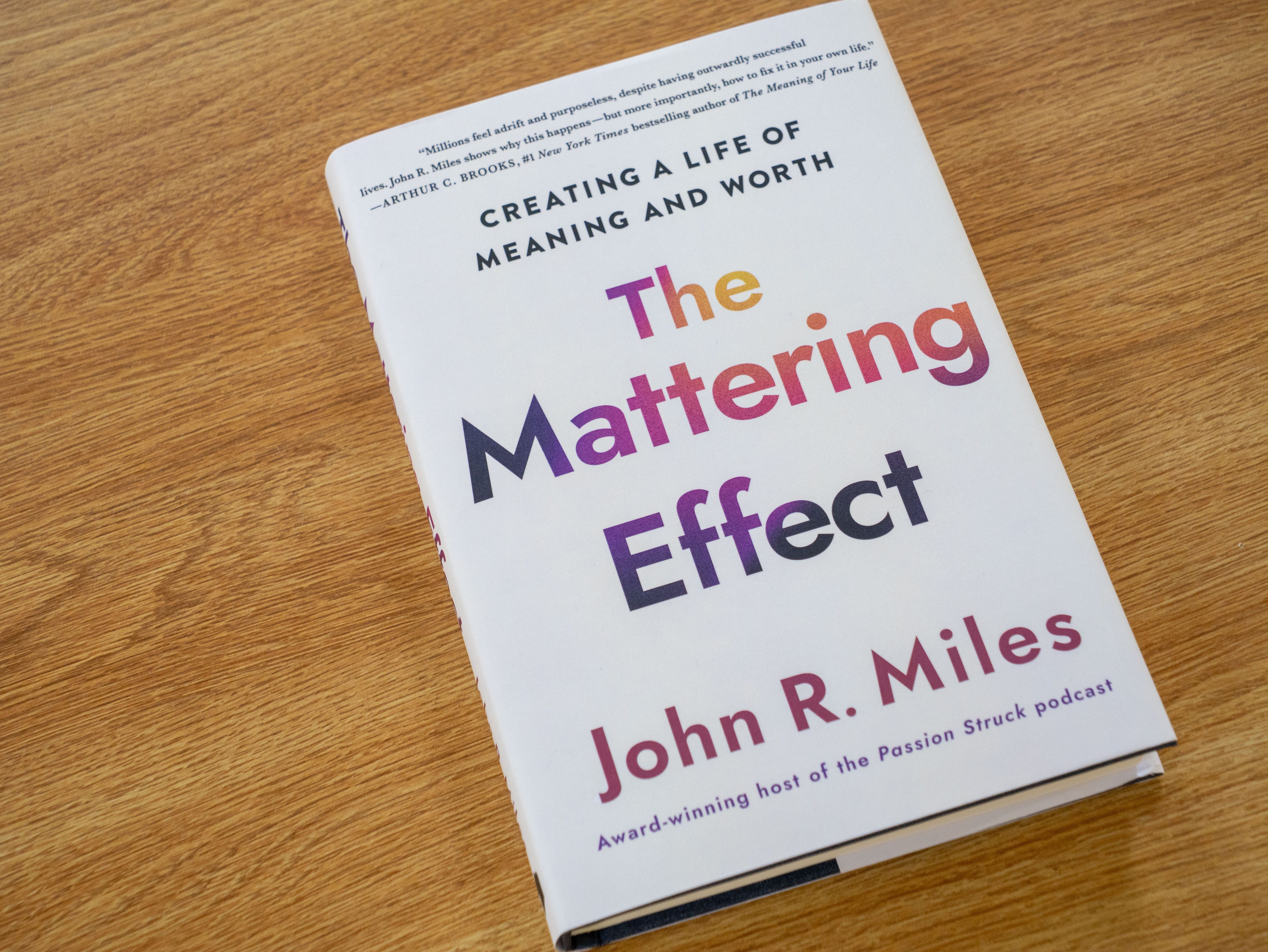
Here is a guest post by John Miles, author of the new book, The Mattering Effect.
By Peter Gray
Published: 2026-10-04
URL: https://petergray.substack.com/p/129-mattering-its-not-the-same-as
Dear friends,
I recently met John R. Miles, when he graciously invited me to be a guest on his Passion Struck Podcast, which ranks as the #1 Health and Wellness podcast on Apple. John and I have evolved as adults via very different routes, but we have come to some conclusions that, better than being identical, are complementary.
John spent more than twenty years inside high-stakes systems. Beginning as a U.S. Naval Academy graduate and naval officer, he went on to serve as a Fortune 50 executive, CIO at Dell, VP at Lowe’s, CISO and SVP at Lendlease, and EVP at Catalina. Over his executive career, he has served as a multi-time CEO and COO, and spent seven years as an operating partner in private equity. His insights come not from academia but from his experiences among people who appear to be extraordinarily successful, but are missing something.
In addition to authoring and hosting the Passion Struck Podcast, John authors a Substack, The Ignited Life, and is author of a new book, The Mattering Effect: Creating a Life of Meaning and Worth, available October 6.
And now, here is John’s essay for you to enjoy and think about:
Why We Disappear: What Twenty Years in the Executive Suite Taught Me About Childhood
A few years ago, I sat in a conference room with a senior leader I’ll call David. (I’ve changed his name and some details.)
David was vital. He was brilliant, always dependable, and carried more responsibility than any other individual I’ve known. When a vital system went down in the middle of the night, David was the one everybody turned to. He knew all sorts of personal things about his people, inquired after their families, and ensured that everybody else mattered.
Yet as I looked across the table at him that afternoon, I realized David was barely there.
His numbers were impeccable, but his voice was flat. He had stopped bringing new ideas, stopped challenging flawed assumptions, and stopped expressing a single personal preference. He was delivering flawless utility, but the human being inside the role had quietly checked out.
When I finally asked how he was doing, he paused for a long time, looked down at his notes, and said something I have never forgotten:
“John, I think if I died at this desk tonight, they’d have my job posted before my family picked out a casket. And honestly, I’m not sure I’d blame them.”
Belonging Versus Mattering
This conversation haunted me because it revealed the contradiction of being totally indispensable to your organization and completely inconsequential to yourself.
Most folks describe this as “burnout.” However, burnout only identifies the symptoms of the injury. David was not burdened with too much work; he was burdened by a mattering crisis.
Laura Kriegel’s guest post on this Substack described a ten-year-old camper who taught a crochet workshop to teenagers. Laura wrote that the girl was experiencing herself as someone who matters to a group, and she added: “That might be the whole thing.” I think she’s right, and it points to a distinction, between belonging and mattering, that the psychologist Isaac Prilleltensky spent decades documenting. Belonging says I have a place here. Mattering has two sides, feeling valued and adding value, and it asks a harder question: would this room be different if I weren’t in it?
David had his place. He had his title, his seat at the table, and his company that needed him. However, he had been so caught up trying to prove himself through his work that he had stopped believing that his mere presence and honest thoughts were worth anything on their own.
This is what I would call the Slow Fade: keep showing up, keep complying, keep hitting all the numbers while everything you say or need gets drowned out.
Where Mattering Comes From
For a long time, I assumed this was an adult problem, a failure of leadership. I can’t say what shaped David, because I never asked about his childhood. But when I stepped back to study developmental psychology, I came to suspect the pattern starts long before a first job.
When I asked Peter on my podcast whether agency and mattering are connected, he answered from his own framework. If you’re in charge of your life and doing what you’ve decided to do, he said, you generally feel you matter. Why did you decide to do it? Because it matters. If it matters to no one else, “at least it matters to you.”
I think that sentence is the root of it. Mattering isn’t mainly something adults deliver to children by approving of them. It grows out of being trusted to act and seeing that your actions have consequences.
That fits what Peter has documented about how children appear to have lived through most of human history. In his survey of anthropologists who had studied seven band hunter-gatherer cultures, children in every one were free to play and explore all day, trusted to educate themselves. My own reading, which goes beyond his data, is that the trust itself was the message: you are one of us, and your judgment is worth developing. Nobody had to say it.
As Peter rightly mentions, agency is inherent. Just observe a one-year-old child. It’s suppression of agency that’s learned.
What Conditional Schooling Swaps in
Readers of Peter’s Substack likely know the mechanisms well, so I’ll be brief. When free time shrinks and children are evaluated by comparison and ranking, something else fills the space. Bernhard Warsitz described watching students he knew deeply become reduced to exam scores and seeing that these young people he cared about “suddenly no longer mattered.” Their test scores mattered, but not them.
In their striving to adapt, some children learn that, to survive, they need to be less troublesome, become invisible, while others learn that, to gain love and acceptance, they need to excel and succeed by standards that they did not choose.
Suniya Luthar’s research provides us with one of the clearest examples. She discovered that teens in affluent high-pressure schools had a much higher incidence of anxiety, depression, and drug abuse than teens attending other schools. She found that affluence itself was not the cause, pressure was. The fortunate teens were those whose parents, whether wealthy or not, didn’t care about the grades and enjoyed their children just as they were.
That is mattering without conditions, and it’s the part I think we underrate.
The Adult Half of the Story
Here is what I can add that may be new to this community. I can’t prove that adults like David were shaped this way, and I doubt that anyone could. What I can offer is what I watched over twenty years of leading large organizations, and the explanation that Peter’s work made plausible for me.
The workplace rewards much of what school teaches us: being collected when stressed, never overtly doubting yourself, pushing yourself until you collapse, equating yourself to your productivity, avoiding telling truths when truthfulness involves danger. Star workers abiding by these lessons sense that the day they stop performing, they’ll cease to exist.
The ones that disappeared were seldom bad workers. They were more often the good workers, who did more than their share, never said no, and quietly accepted their disappearance as an entity beyond their achievements. Most could tell me how their work was assessed, but few could tell me what they’d do if no one assessed them.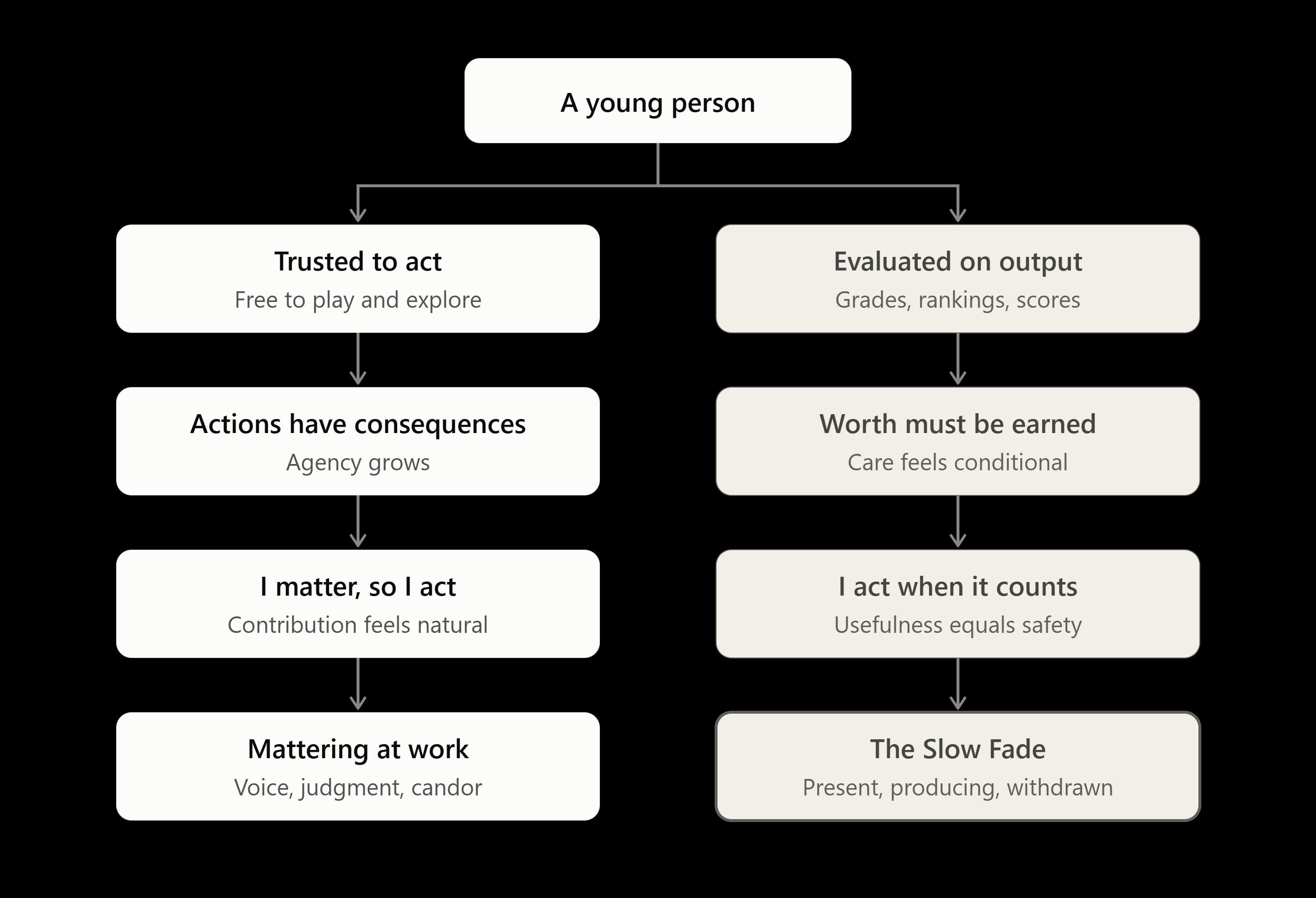
The Brick
David’s story didn’t end in that conference room. It turned in his kitchen.
He had spent his days carrying enormous responsibility, and he brought that home with him. He was physically at the table, but his mind was still scanning the next problem to solve. His children noticed before he did.
They decorated and painted a brick and would place it on the table in front of David if he had begun distracting himself or gone back to his “commander role.” It was a cue for him to stop commanding, trying to fix things, and just be present.
It made him angry at first. Here he was in a room with nothing that needed to be done. But he stayed, and the room transformed itself. He relaxed, spoke less and slower, and the kitchen stopped being an arena. Slowly but surely, he realized that his family didn’t need a performance from him. He mattered to them just the way he was, even if he did or said nothing at all.
That scene makes me think of what Peter is saying about children and their agency. We tend to think that adults are responsible for teaching children they are somebody. In David’s case, for a time, the direction of teaching was opposite to that, because his children felt safe enough to say something.
What Restores It?
The adult form of the problem has the same solutions as the children’s form.
Regard that isn’t contingent. The kids that Luthar found to be protected from the harm of school achievement pressure were enjoyed regardless of having produced anything. A child needs to know their presence matters more than the report card, and an employee needs to know their thoughts and wellbeing are valued independently of the quarterly goal. Notice character, curiosity, and presence, not just output.
Real self-direction. Peter suggests sitting down with a child and asking what they’d like to do independently that they aren’t doing now, then making the list together and negotiating a first step (here). Adults need an equivalent: a decision that is genuinely theirs, in work they are accountable for.
Unmanaged time. Peter’s research on the adult lives of unschooled kids and Sudbury alumni (here) revealed that many were in jobs that stemmed directly from their childhood interests, developed during play. Structures such as Play Clubs, promoted by Let Grow, create time for this. For grown-ups, it is unclaimed time on their calendars, and sometimes, it is a brick on the table.
When these conditions are met, a person stops auditioning and starts contributing from their own heart and head, as their own person, knowing that they matter.
A life isn’t remade by a single grand act. It is remade in the same manner it was worn down. Mattering grows through repeated evidence. Each time we give people freedom, acknowledge the truth they tell no matter how uncomfortable, or recognize them for who they are, we’re giving evidence of their worth.
A Question for You
When have you witnessed someone, regardless of age, rediscover their sense of mattering in a self-directed and playful environment, and what were the circumstances surrounding it? I’ll be hanging out in the comments section, and I’d love to chat with you about this.
—-
Final Comment
Thank you, John. I look forward to reading your book. And, readers, please do address questions and comments here to John, who promises to respond where responses are called for. Your thoughts MATTER.
With respect and best wishes,
Peter
Play Makes Us Human is a reader-supported publication. To receive new posts and support my work, consider becoming a free or paid subscriber.
Thanks for reading Play Makes Us Human! This post is public so feel free to share it.