Why are we adults so unable to see (or say?) that school is a (the?) major cause of children’s psychological suffering?
By Peter Gray
Published: 2026-09-02
URL: https://petergray.substack.com/p/126-sticking-our-collective-heads

Dear friends,
In previous letters, and in my new book Restoring Childhood, I have presented multiple lines of evidence that school has long been a major cause of anxiety and depression among school-aged kids and that a change in school policy, not the advent of social media and smartphones, was the primary cause of the rise of such suffering in the U.S. beginning in 2010 or shortly after.
I am finding that many people agree that smartphones and social media are not a significant cause of the rise of kids’ suffering beginning around 2010. Among those who agree are essentially all the social scientists who have been most immersed in conducting and reviewing research pertaining to that hypothesis. The data simply do not support the social media/smartphone hypothesis (see for examples, here, here, and here).
But even those in authoritative positions who reject the media/smartphone hypothesis have so far almost uniformly avoided examining my alternative hypothesis—that a major change in how we do schooling, instituted by the Common Core State Standards—increased the stress of schooling and thereby elevated the rates anxiety and depression among school-aged kids, especially teens. They neither support nor deny what I say about this; they just ignore it.
Evidence of the Psychological Harm Produced by Our Schools
On the face of it, one would think that a national change in school policy is the first place one would look for a potential cause of a rise in kids’ psychological suffering. Children spend more time in school than in any other setting aside from home, and our schools, by their very nature, are stress-inducing.
In school children are micromanaged, told almost every minute what they must do and must not do. In school they are constantly judged in comparison to their peers—who is better, who is worse? In school they are not allowed to consult with their companions unless they are told to do so, and then they are required to do so. In school they are reprimanded if they are even a minute late, and they must ask permission to go to the bathroom. In school, children are deprived of what the rest of us think of as basic human rights.
As I have said many times before (and so far nobody has contradicted me on this), no adult would willingly accept a job that is anything like the schooling we impose on our kids. We would all see it as a job from hell. On top of all that, many kids are led to believe that failure to succeed in school predicts failure to succeed in life. It is as if their school performance is a measure of their worth as human beings.
The logic of why school would promote anxiety and depression among kids is so obvious that one might consider empirical evidence of that to be redundant. But there is overwhelming empirical evidence. Here, in bulleted form, is some of the evidence I have documented in previous letters (e.g. here) and document further in my new book:
• In surveys in which kids are asked what is stressing them out, school always comes out on top. Nothing else comes close. That is true for school kids of all ages and both genders.
• Every year, when summer vacation from school begins, rates of anxiety, depression, pediatric mental health admissions, and teen suicides plummet, and every fall, when school starts again, those rates go up again. By some measures they double.
• In cross-nation studies, rates of anxiety, depression, and suicide do not correlate with the availability of smartphones or social media for kids but correlate strongly with the stress-inducing characteristics of the school system.
• The Common Core State Standards, adopted by most of the 50 U.S. states beginning in 2010 (and implemented gradually over the next two or three years) dramatically increased the stress of schooling. Common Core dictated that teachers, principals, and whole school districts would be evaluated based on the students’ scores on standardized tests covering a narrow range of curriculum, especially math and literacy. The inevitable effect was reduction in teachers’ freedom to adapt what they were doing to meet the needs and interests of students and truly engage students intellectually, and an increase in boring, time-wasting drill. Recesses and other previously enjoyable activities and courses were cut back for the sake of test drill. In surveys in the early years of Common Core, teachers, school psychologists and others involved with schooling, not just students, reported that these changes increased the stressfulness of school. Many of the best teachers quit or took early retirement.
Let me be clear. I am not saying that school pressure is the only cause of mental suffering among kids, nor am I saying that it is the main cause for every kid. For children suffering from abuse at home, or from drug-addicted parents, or from relentless bullying, or from some sort of serious life trauma, those sources of distress may dramatically outweigh the stress of schooling. But those sources of stress affect only a fraction of the total population of kids, while school affects essentially everyone. That is why, in surveys of the whole population of kids, school always comes out on top as the major source of distress and those other causes are way down the list.
Why Don’t We Face the Facts?
So why are we adults so reluctant to admit what seems to be obvious, that school, for the population of our kids overall, is the major cause of psychological suffering? Why do even the scientists who publish data in academic journals showing the harm of schooling not share their findings more widely? Why don’t journalists pick up on it? Why do parents who see their own kids’ school-related suffering commonly attribute it to something else—maybe “neurodiversity” or some such problem with the kid and not a problem with school? I think it really is a matter of burying our heads in the sand.
We simply don’t want to believe that our public school system, which has long had an undeserved halo around it and where children are compelled by law to be, is a major source of children’s suffering. To do so would be to blame ourselves, as adults who share in responsibility for allowing an abusive system to continue. Moreover, fixing our system of schooling in a way that really solves the problem seems like a monumental task.
It is far easier and more comfortable to blame those greedy social media companies. And, yes, they are greedy; and, yes, they do try to use whatever means available to exploit us and our kids; but they are NOT a major cause of an increase in our kids’ psychological suffering.
Reminder
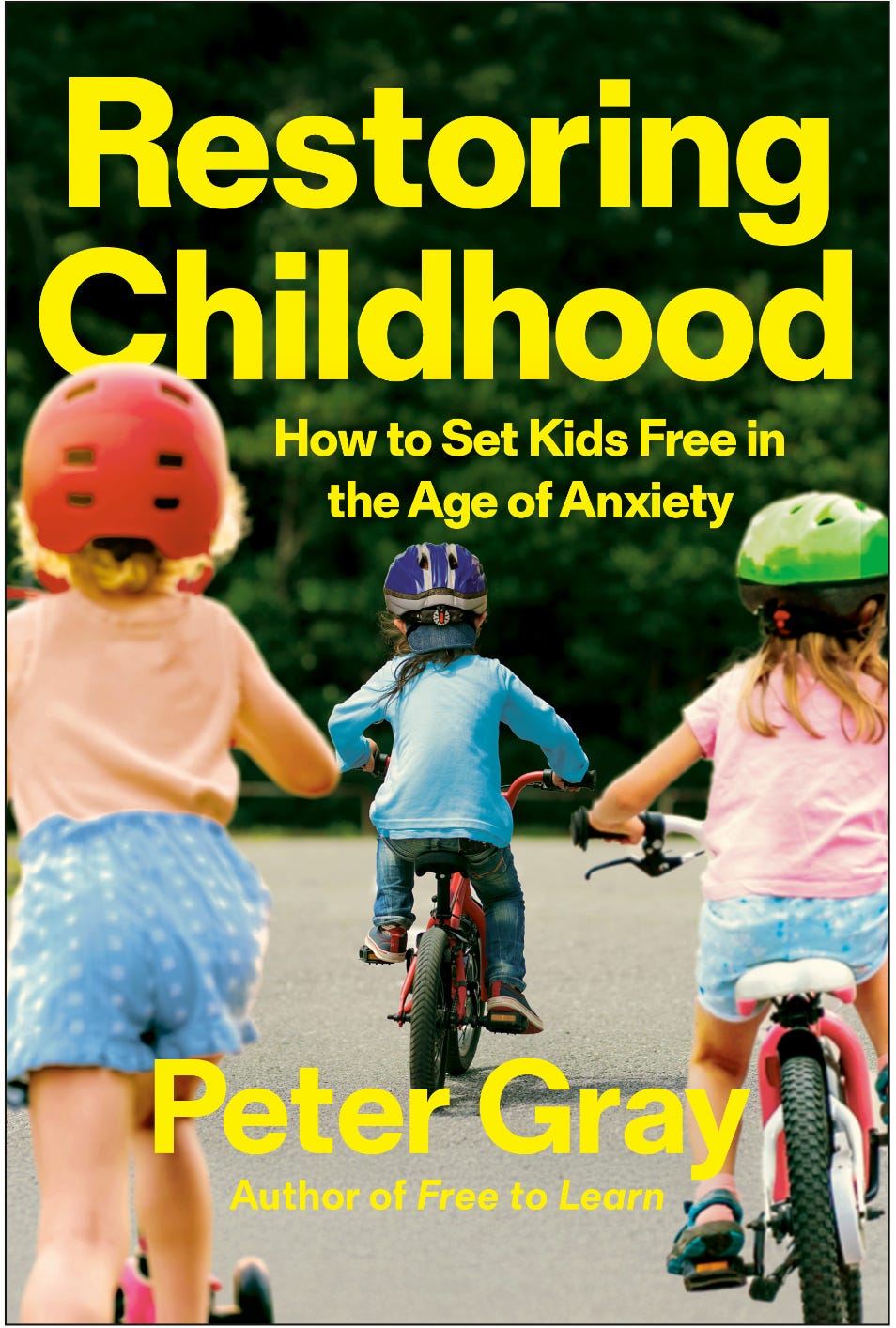
For those who might have missed my previous letter on this, my new book, Restoring Childhood: How to Set Kids Free in the Age of Anxiety, will be released on September 15. The publicists at Penguin Random House have informed me that they will provide a link to the book’s Introduction, so you can get an early start in reading it, if you preorder the book before its publication date. Preorders are valuable, because they help convince marketers that the book will sell well, so they stock up and put the book front and center in their sales procedures. The earlier you preorder the better. Here are links to some places where you can preorder.
Amazon Barnes & Noble Books A Million Bookshop.org Hudson Booksellers Powell’s Target Walmart
And here is the link to claim your small gift, the book’s Introduction.
For more about the book, see here.
Part of restoring childhood involves changes in our school system. But that is only part of it, as you will see in the book.
With respect and best wishes,
Peter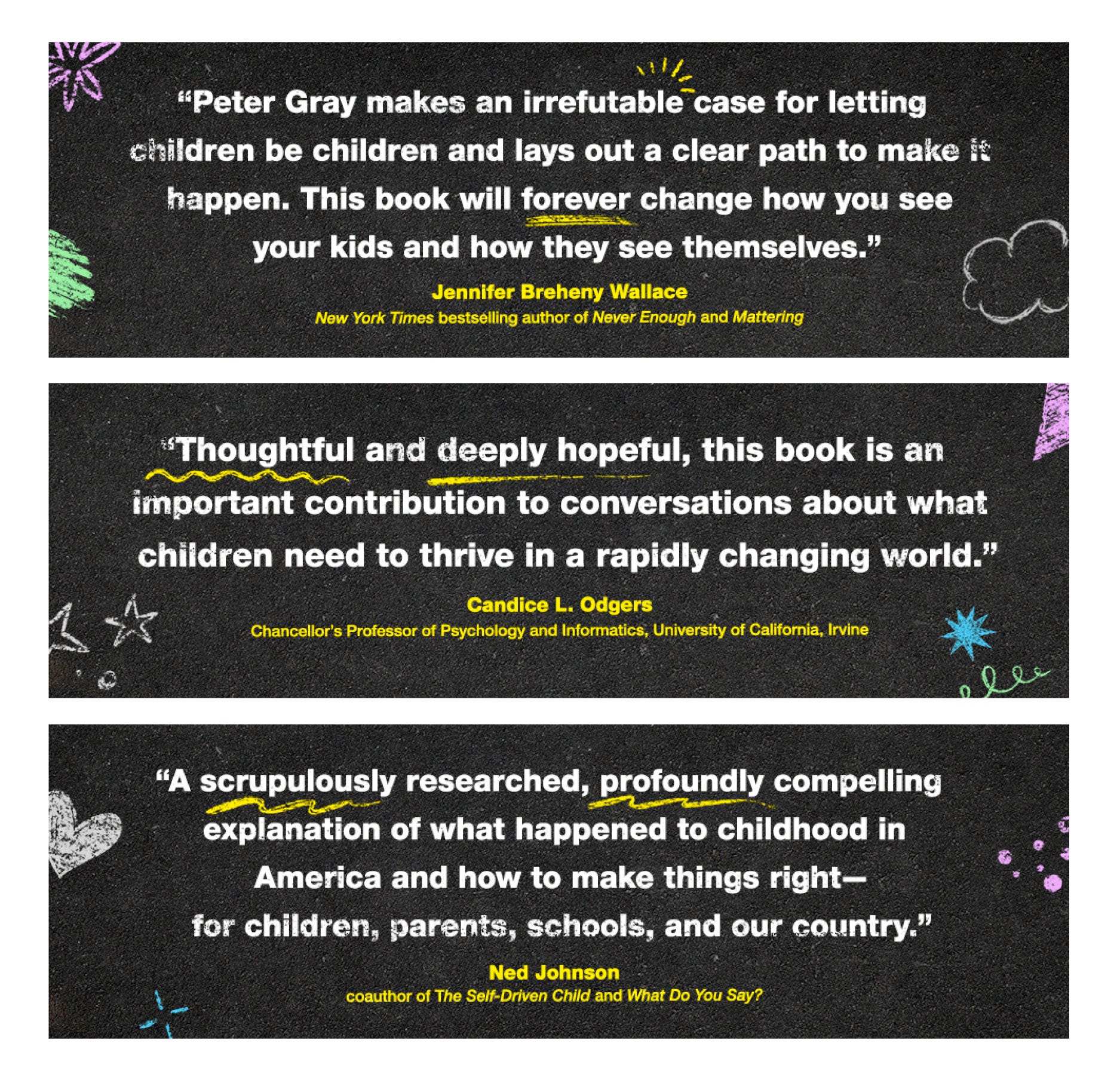
Thanks for reading Play Makes Us Human! This post is public so feel free to share it.
Play Makes Us Human is a reader-supported publication. To receive new posts and support my work, consider becoming a free or paid subscriber. All funds I receive for paid subscriptions are contributed to nonprofit organizations aimed at increasing children’s freedom. Paid subscribers have the opportunity to join monthly “Ask Me Anything” meetings with me. I look forward to seeing you at our next meeting.