3 real-world examples with code
By Pau Labarta Bajo
Published: 2026-02-07
URL: https://paulabartabajo.substack.com/p/what-can-a-small-language-model-do
I’ve spent the last few months curating tutorials that answer one simple question: what can you actually build with Liquid Foundation Models?
- Not benchmarks.
- Not theory.
- Real applications that run on your laptop, process your data locally, and solve problems you’d otherwise throw at a cloud API.
So you reduce costs, decrease latencies and preserve privacy.
Here are 3 tutorials built with Small Liquid Foundational Models (LFMs) that cover text, audio and visual understanding. Each one is designed to get you from “interesting idea” to “working code” as fast as possible.
You can find all these and more in the Liquid AI Cookbook
1. Flight Search Assistant powered by a compact reasoning model
This tutorial walks through building a flight search assistant using LFM2.5-1.2B-Thinking, a tiny model (1.2B parameters is tiny by 2026 standards) that’s been post-trained specifically for reasoning and tool use.
The architecture is a classic agent loop:
- the model reasons about what it needs to do
- executes the necessary tool calls
- processes the results, and
- repeats until the task is complete.
No hardcoded logic. Just a small and powerful model making decisions step by step.
You don’t need a massive model for agentic behavior. With the right prompting and tool-calling setup, LFM2 can handle multi-step workflows that feel genuinely intelligent.
And because it’s only 1.2B parameters, this runs on edge devices, laptops, mobile, even embedded systems. Agentic AI that fits in your pocket.
2. Voice-Controlled Car Cockpit with Local Audio Processing
Voice interfaces in cars need to work offline, respond instantly, and handle both speech-to-text and text-to-speech without cloud dependencies.
This demo combines LFM2.5-Audio-1.5B (running in both STT and TTS modes) with LFM2-1.2B-Tool to create a fully voice-controlled car cockpit.
Say “turn on the AC” or “what’s my fuel level?”. The system
- transcribes your voice
- executes the command through tool calling, and
- responds with synthesized speech.
Built with llama.cpp for inference and vanilla JavaScript for the interface, this is a practical example of how local audio models can power automotive applications without sending data off-device.
3. Invoice Extraction with Vision-Language Models
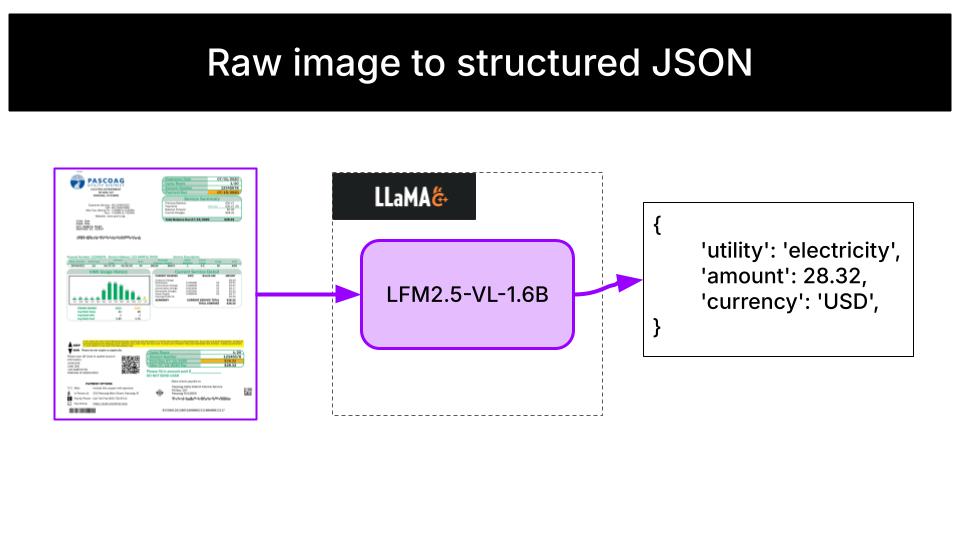
Extracting structured data from invoices usually means chaining together OCR, post-processing scripts, and hoping your regex patterns hold up.
This CLI tool uses LFM2.5-VL-1.6B to extract payment details directly from invoice PDFs and images. Point it at an invoice, get back structured JSON with
- vendor name
- amount,
- currency, and
- utility type.
All inference happens locally with llama.cpp. No cloud costs, no network latency, no data leaving your machine.
If you need better accuracy for your specific invoice formats, the tutorial includes a link to fine-tuning notebooks so you can adapt the model to your use case.
Your Turn 🫵
All the code is open source and ready to run. Pick one that matches your use case, clone the repo, and see what happens when you stop sending everything to the cloud.
If you find these examples useful, give the Liquid AI Cookbook a star on GitHub. It helps more developers discover these resources and keeps the team motivated to add more practical examples.
And if you’ve built something interesting with Liquid Foundation Models, submit your project to the cookbook. You might be featured in the next newsletter :-)
Talk to you next week
Pau