By Olga Safonova
Published: 2026-05-16
URL: https://olgasafonova.substack.com/p/how-does-skills-ecosystem-look-like
The newer the spec, the cleaner the ecosystem
When you ship a new file format into a developer community, the early adopters tend to read the spec. The crowd that arrives a few months later read other people’s files. By the time the format is famous, half the corpus is cargo-culted off whatever shipped first.
SkillCheck has been scanning the public Claude Code ecosystem since v3.18.0. On 12-05-2026, we ran v3.20.0 against twelve community repos. The scan covers two artifact types that live side by side: the older SKILL.md files Anthropic introduced last year, and the plugin manifests added more recently. Same authors. Same repos. Two different specs.
The plugin layer is in much better shape than the skill layer. That’s the story.
The numbers
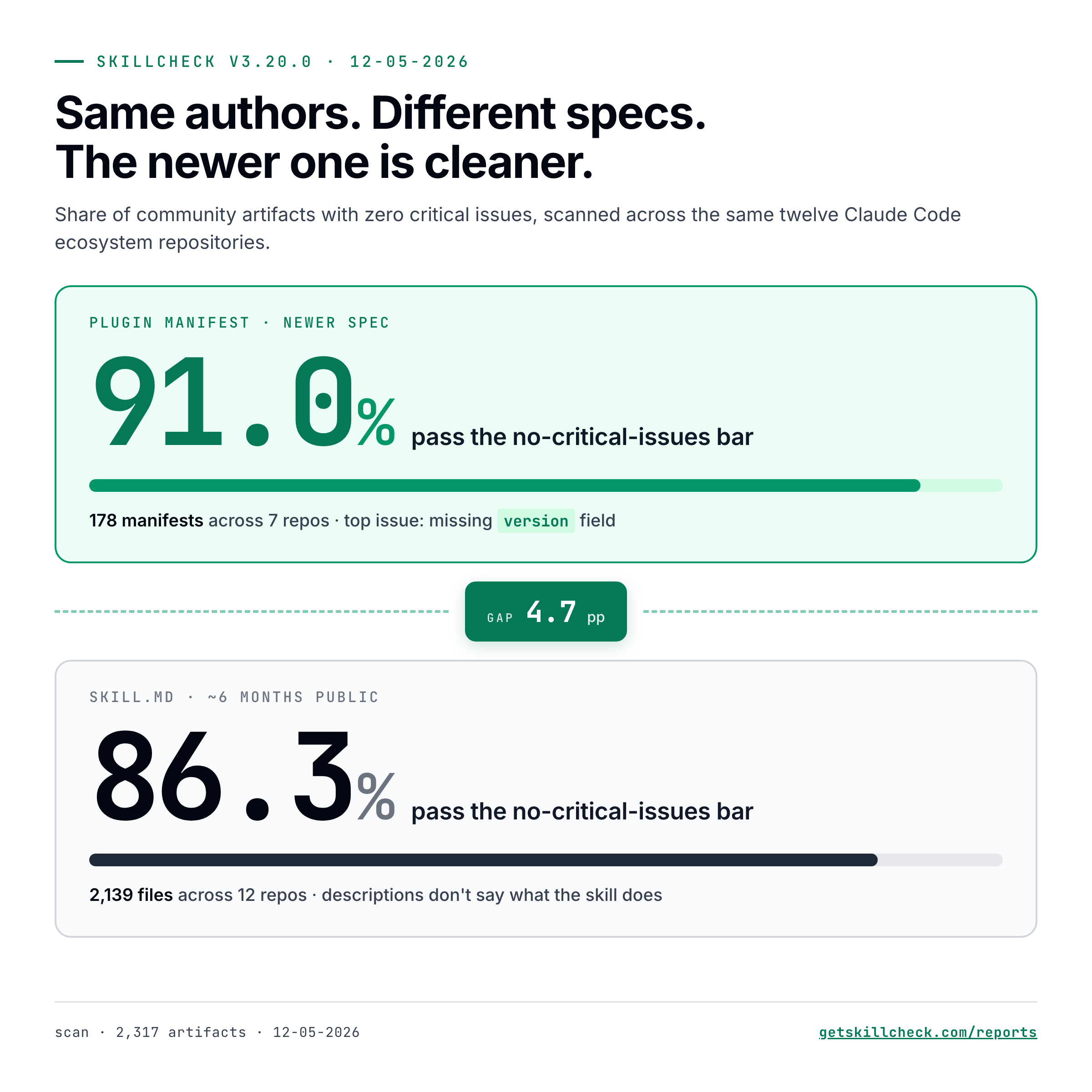
The skill scan covered 2,139 SKILL.md files. Average quality score: 57 out of 100. About 86% pass the no-critical-issues bar. About 3% score 81 or higher. The highest single score in the corpus is 92, which means zero skills score in the 93-to-100 band. The floor is 62 skills scoring 20 or below.
The plugin scan covered 178 manifests across seven of the same repos. 91% are clean. There are 17 total issues across the entire set, and they cluster on two checks: 12 plugins are missing the version field, and 5 keep their marketplace.json file in the wrong location.
Two artifact types. Same author pool. One scores 57 on average; the other scores 91% clean. That gap is the lens for everything else in this piece.
What the warnings actually say
A scan score by itself is thin signal. The shape of the story comes from which checks fire most.
On the skill side, the top warnings cluster around what the skill says about itself. About 1,817 skills present themselves as reviewer-pattern skills but never declare what they’re evaluating against. Another 1,557 have descriptions that don’t say what the skill does. Another 1,427 don’t say when to use it. Another 1,402 don’t declare a clear trigger condition. Another 1,384 omit success criteria.
The warnings rhyme. They’re all variants of the same problem: the skill’s description field is supposed to tell a coordinating agent what the skill is for, and most descriptions don’t do that work. They describe the topic instead of the trigger. They list what the skill contains instead of what calling it produces.
On the plugin side, the warnings are mechanical. The version field is missing or the marketplace.json file sits in .claude-plugin/ when it should sit at the plugin root. These are one-line fixes. They get caught by anyone who reads the spec once.
The contrast matters. A plugin issue is a structural problem with a known fix. A skill issue is a semantic problem with no single answer. To make a skill description say what the skill does and when to use it, the author has to know their own skill better than they currently do. That’s much harder.
Why the gap exists
The simplest explanation is spec age. Anthropic’s SKILL.md format has been public for quite some time at the time of writing. The plugin manifest spec is newer. Every author who ships a SKILL.md today is operating in a community where examples already exist, and most of those examples were written before the current SkillCheck rubric existed. People copy patterns that worked for shipping.
The plugin spec doesn’t have that drag yet. There hasn’t been time to grow a layer of pre-spec patterns underneath it. Everyone who ships a plugin manifest in May 2026 is reading the actual spec, because there isn’t yet a corpus of bad manifests to copy from.
This generalizes. Newer formats look healthier because there hasn’t been time for habits to ossify against them. Older formats look messier because the spec has drifted while the corpus stayed put.
The version-over-version data backs this up. The same scan a month ago, at v3.18.0, covered 1,950 skills with an average score of 58.8 and 90.5% no-critical. By v3.20.0, the corpus grew to 2,139 skills, the average fell to 57.1, and no-critical share dropped to 86.3%. The corpus is getting bigger and slightly worse. Each batch of new contributors arrives without having internalized the rubric, so the average sinks.
A portability footnote worth noticing
One repo in the scan does something unusual. The alirezarezvani-claude-skills repo ships 311 SKILL.md files under .gemini/skills/ paths, and 241 of those have an exact-named sibling somewhere else in the same repo. Same skill, two trees: one for Claude Code, one for Gemini’s agent runtime. The maintainer is shipping agent-portable skills, betting that the SKILL.md format outlives any single agent harness.
Worth flagging because it’s the one of community examples of explicit multi-runtime packaging in the corpus. The hypothesis is “the SKILL.md format will end up cross-vendor”.
What this means if you’re shipping skills today
Read the spec, then read your description back. The thing that gets your skill picked by a coordinating agent isn’t the body; it’s the description string. If yours doesn’t say what the skill does and when to use it, the agent has no signal to fire on.
If the description fits in one sentence that starts with “Use when…” and ends with what the skill produces, you’re already in the top 3% of the corpus. That bar is lower than it should be, which is the whole point of this piece.
Sources
- Full SKILL.md scan: 2,139 entries across 12 repos, v3.20.0, run 12-05-2026
- Plugin scan: 178 entries across 7 of those repos
- Reports landing page: <https://getskillcheck.com/reports/>
- Methodology: <https://getskillcheck.com/methodology>