Selection debt and the discipline of subtraction
By Olga Safonova
Published: 2026-03-11
URL: https://olgasafonova.substack.com/p/fewer-things-better-described

I’ve built lots of tools across several MCP servers. The removals taught me more.
The Paradox
Here’s a number that shouldn’t exist: my Miro MCP server has 88 tools. It didn’t start that way.
The growth wasn’t planned. Each time Claude got smarter, it attempted more ambitious workflows, and more ambitious workflows hit more edges: authentication flows, proprietary JSON schemas, approval chains that require three calls in a specific order, agents that could only read data suddenly trying to write it, agents that handled one API trying to orchestrate five, each expansion creating new integration points that needed new bridges. Every edge needed a new tool.
But here’s what nobody in the MCP ecosystem talks about: of those 88 tools, some are excellent. Some are adequate. And some could disappear without anyone noticing.
The Invisible Problem: Selection Debt
Doug Turnbull, who led Search at Reddit and Shopify, replaced a sophisticated retrieval pipeline with BM25 and a reasoning loop. On public benchmarks (Wayfair WANDS, Amazon ESCI), search relevance went up 15-30% NDCG.
BM25 is a keyword matching algorithm from 1994. It counts terms. It doesn’t understand semantics. And it beat the sophisticated pipeline.
The punchline, from Hugo Bowne-Anderson’s Vanishing Gradients newsletter: the dumb tool won because the agent could understand it. When BM25 returns bad results, the agent knows exactly what happened.
It searched for “bistro table” and got patio furniture. Keywords matched literally, so the agent can reformulate. When a vector search returns bad results, the agent has no idea why. The retrieval logic lives in embedding space.
The agent can’t debug what it can’t observe.
This principle doesn’t stop at retrieval. It lives in your MCP tool descriptions.
Most MCP tool descriptions tell the LLM what a tool does. Accurate, and completely unhelpful. Here’s one from my own server:
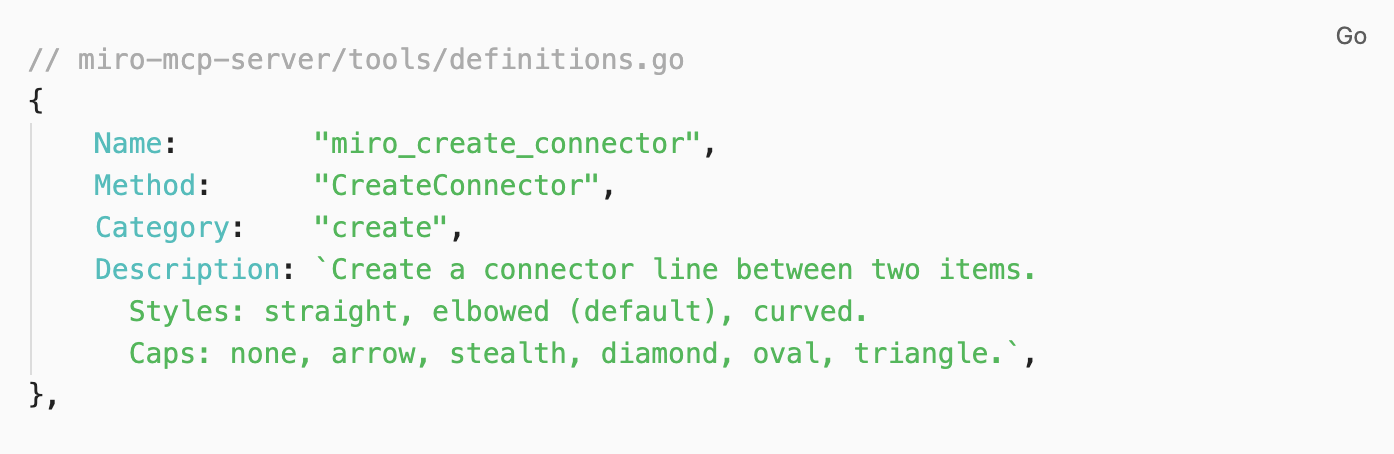
The LLM knows the capability. It has no idea when to pick this over miro\create\shape when someone says “draw a line between these.” It can’t tell what happens when an item ID doesn’t exist on the board. The description is correct. It’s also opaque.
Selection debt accumulates when tool descriptions are technically correct but operationally ambiguous, causing LLMs to pick the wrong tool. Each misselection looks like an LLM mistake, not a tooling problem. You blame the model. You pile on system prompt instructions. The real fix was in the description the whole time.
The clearest evidence came from comparing two of my own servers. Same hands. Different maturity. The gleif-mcp-server has full USE WHEN and FAILS WHEN clauses on every tool:
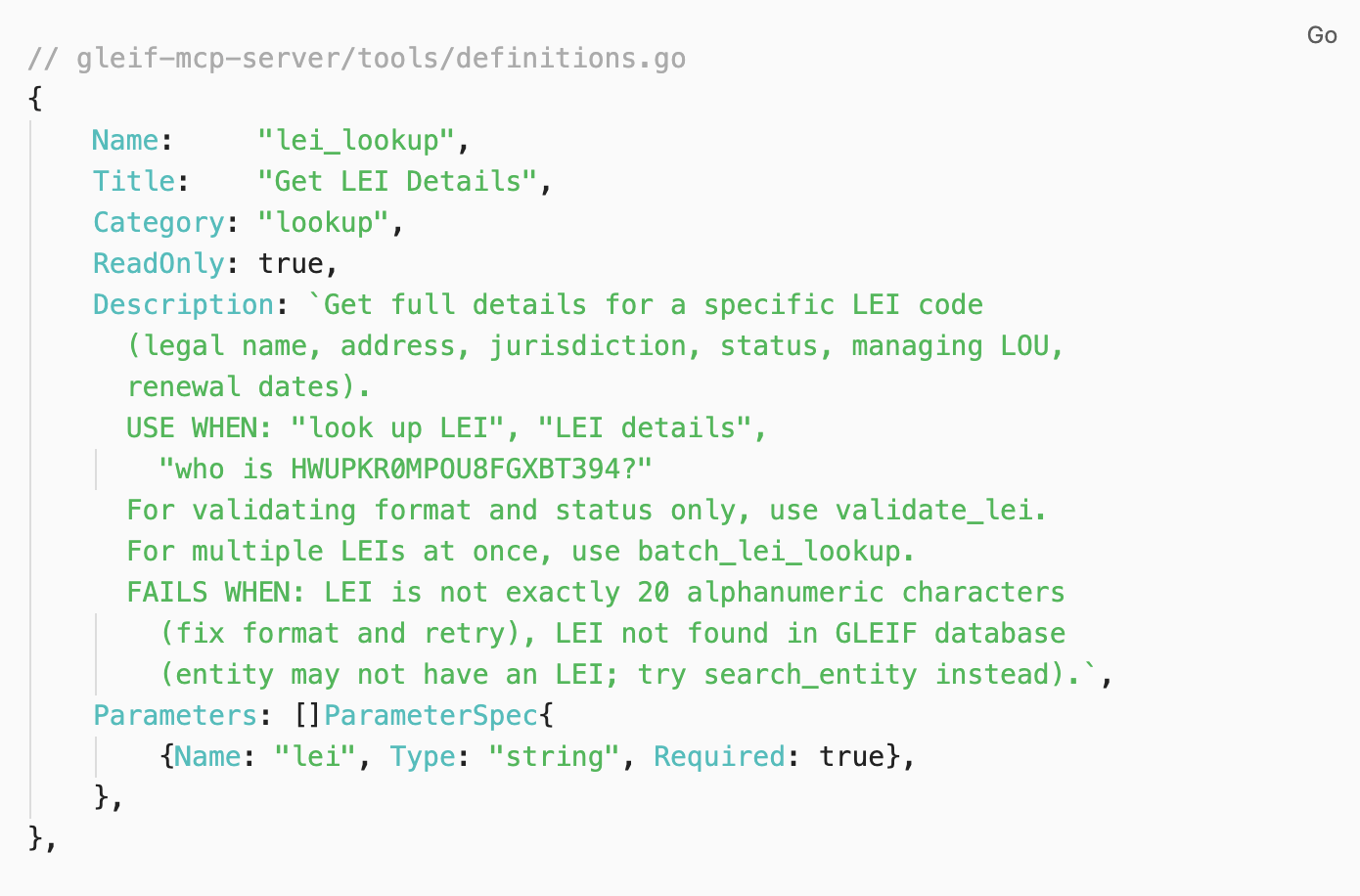
The description doesn’t just describe a capability. It gives the agent a reasoning model: what to call the tool for, what to try when it fails, where to go instead.
The WHY dimension is the most underused. In my nordic-registry-mcp-server, the Danish CVR API returns exactly one company per search query. Searching “Tietoevry” returns TIETOEVRY DK A/S, a company with 11 employees. Searching “Tietoevry Denmark” returns TIETOEVRY DENMARK A/S, a completely different legal entity with 56 employees. Without knowing why, an agent accepts the first result. With WHY embedded in the description:
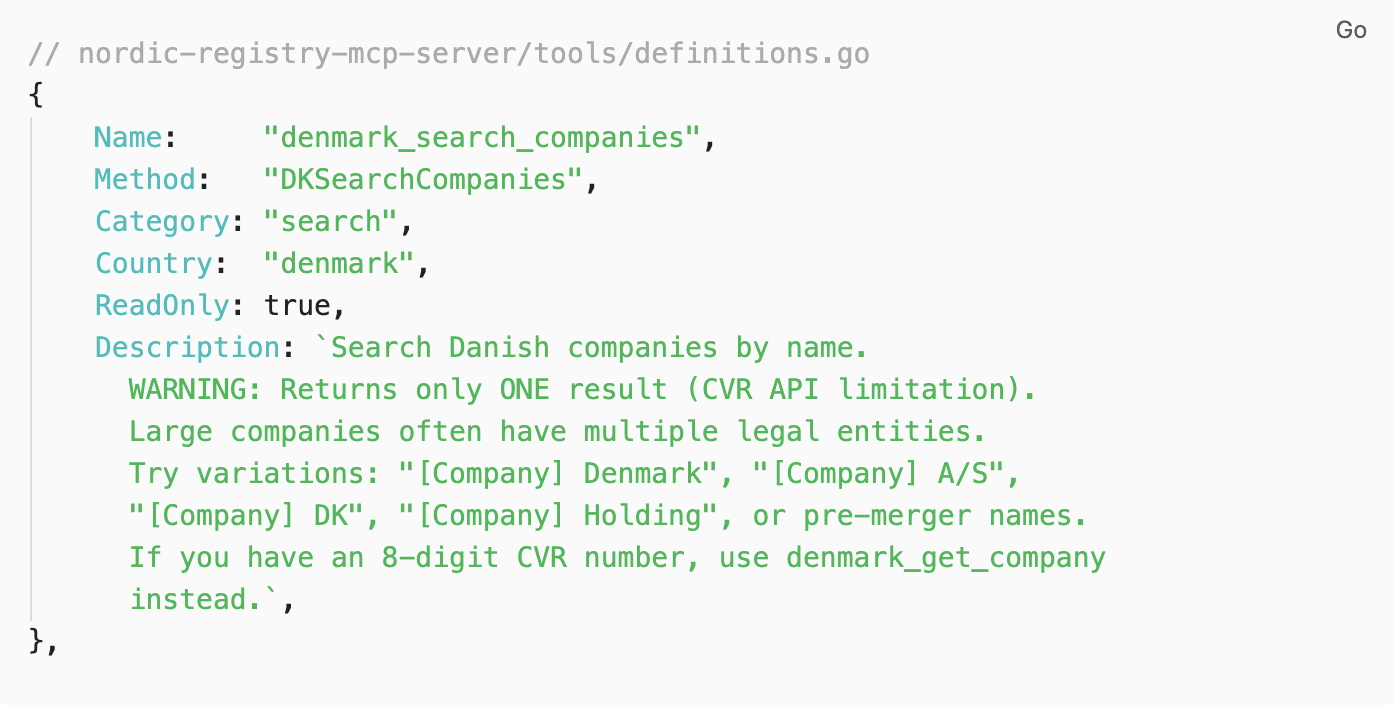
Three debugging strategies from one description. The agent that reads this knows the API is opaque by design, knows to try variations, and knows there’s a direct lookup if it has a CVR number.
The same principle operates at both layers. At retrieval: “this is BM25, it matches keywords literally” - the agent adjusts its query. At the tool layer: “this fails when the LEI is invalid; try search\_entity instead” - the agent adjusts its strategy. Opacity kills reasoning. Transparency feeds it.
Five Dimensions of a Transparent Description
The examples above illustrate USE WHEN, WHY, and FAILS WHEN. Here are all five dimensions, distilled from rewriting descriptions across seven servers:
- USE WHEN tells the LLM which user intents should trigger this tool. Natural language phrases, not technical jargon.
- WHY tells the agent the mechanism behind the behavior, so it can debug failures instead of retrying blindly.
- FAILS WHEN covers specific failure modes with specific recovery paths. Not generic errors; conditions with next steps.
- INSTEAD routes the agent to sibling tools. Without explicit cross-references, the agent cycles randomly through your tool list.
- Limitations states hard boundaries the agent can’t work around: batch sizes, rate limits, field constraints.
INSTEAD is the routing dimension. The mediawiki-mcp-server has mediawiki\edit\page, mediawiki\find\replace, and mediawiki\apply\formatting. Without routing, Claude used edit\_page for everything, fetching and rewriting entire pages for a single text change. With explicit routing:
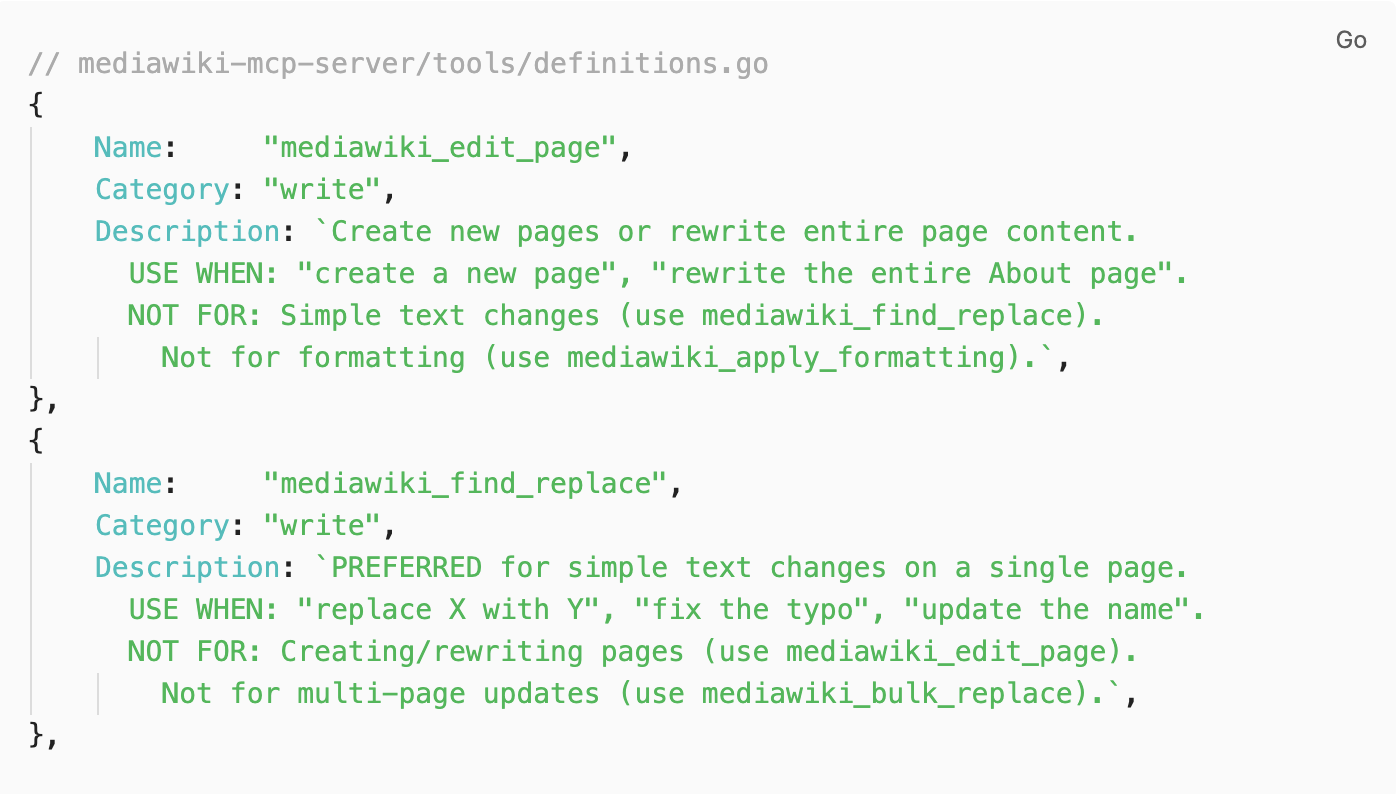
An opaque description gives the agent nothing to work with. It selects, fails, retries, fails again.
The Uncomfortable Audit: Tool-Shaped Objects
Will Manidis, the CEO of Benchling, coined a term that stopped me mid-scroll: “tool-shaped objects.” Things that look, feel, and are marketed as tools but don’t change reality. They produce the sensation of productivity.
I’ve built a few. Embarrassing to admit, but useful to know.
The test is simple. Remove the tool from the chain. Does the final output change? If not, it’s a tool-shaped object. I call this the subtraction test.
I ran it against the Miro server. Most tools passed. One failed outright. Thirteen sat in the middle.
The gradient category is the uncomfortable one. These are tools that sometimes change the output, sometimes don’t. miro\get\board\summary exists alongside miro\get\_board. Both return board info. The summary exists “for convenience.” Does it change the final output? Depends on the caller. Depends on the workflow. These tools aren’t obviously broken. They aren’t obviously essential.
The single fail was miro\_ungroup. I pruned it. No user complained. No workflow broke. It had been dead weight for months, riding along like a vestigial organ.
Tool-shaped objects and selection debt compound each other. Every tool-shaped object in the listing makes the real tools harder to find. The LLM spends tokens considering it. Sometimes selects it. The tool-shaped object didn’t just fail to help; it made every other tool slightly worse by existing.
Perfection by Subtraction
Dieter Rams shaped Braun products for decades and distilled his philosophy to four words: “Weniger, aber besser.” Less, but better.
The subtraction test operationalizes this for tool builders. The audit isn’t finding what to add. It’s finding what to remove until only the essential remains. The gradient tools from the Miro audit sit in the hardest territory: not obviously broken, not obviously essential. The design discipline is having the nerve to remove them anyway.
Pruning is the most underrated practice in tool-building. Removing tools is harder than adding them because every removal feels like losing capability. It’s not. It’s gaining signal. Anyone can add a tool. Knowing which to remove requires understanding the whole system: how tools interact, which ones the LLM reaches for first, where token budgets get wasted on tools that produce nothing.
Removal is where the taste lives.
The Craft Layer: Taste as Specification
Paul Graham defined taste as “intolerance for ugliness combined with the ability to fix it.” In 2026, when AI generates most of my code, taste isn’t about writing beautiful functions. It’s about writing beautiful specifications.
Your ToolSpec descriptions, your routing annotations, your CLAUDE.md constraints: these are your taste, expressed as text the machine reads. Not the handler code; that’s execution. Not the LLM; that’s following instructions. The person writing the description decides what “good” means for this tool.
Each NOT FOR clause is someone saying: “I’ve watched this agent fail fifty times, and here’s what I know about the right path.” Hard-earned judgment, encoded as text.
Pattern drift is the architectural version of losing taste. My miro-mcp-server has generics, panic recovery, and audit logging in its handler wrapper. My newer servers have none of those. Same hands, same year, different maturity. The improvement in one project didn’t flow back to the others. When you stop redesigning, you stop applying taste. The codebase drifts toward whatever shipped last, not toward what’s best.
Graham wrote that “good design is redesign.” The makeHandler wrapper in the Miro server has been rewritten three times. Each time because something broke or annoyed me, not because I had a grand plan.
The Bottleneck Rewards Craft
David Oks argues that AI capability isn’t what gates adoption. Regulations, office politics, API authentication, data format incompatibilities, security reviews: these are the actual constraints. They’re getting proportionally more important as AI gets smarter, not less. William Stanley Jevons saw the same dynamic in 1865: making steam engines more efficient didn’t reduce coal consumption.
It increased it. Efficiency made steam power economical for new applications, and total demand grew.
One layer deeper, the same dynamic plays out. More capable AI agents create more demand for well-structured tools, not less. My Miro server didn’t grow to 88 tools because AI got dumber. It grew because smarter agents attempted more, hit more edges, and needed more bridges to cross them.
The people best positioned aren’t the ones building the smartest AI. They’re the ones who understand both the capability and the bottleneck. The Danish CVR API’s single-result limitation. The Norwegian business registry’s role data quirks. The mediawiki server’s routing logic, learned from watching Claude rewrite entire pages when it should have called find-and-replace. This knowledge is tacit, context-dependent, and earned through reps. No model upgrade gives you this.
Comparative advantage doesn’t require being better at everything. It requires being relatively better at the bottleneck.
The craft of tool-building appreciates as AI improves. Every time a model gets smarter, it attempts more, hits more edges, and needs better-described, better-pruned, better-designed tools.
The intelligence was never the bottleneck. I wonder how many tool-shaped objects are sitting in your server right now, quietly making every real tool a little harder to find.
References
- Doug Turnbull led Search at Reddit and Shopify. His BM25 + reasoning loop results appear in Hugo Bowne-Anderson’s Vanishing Gradients newsletter.
- David Oks, “Why I’m Not Worried About AI Job Loss.” Ricardian comparative advantage applied to AI.
- Dieter Rams, “Ten Principles of Good Design.” Principle 10: “Good design is as little design as possible.”
- Paul Graham, “Taste for Makers.”
- Will Manidis, “Tool-Shaped Objects” (X thread, Feb 2026).
- William Stanley Jevons, The Coal Question (1865). The paradox: efficiency increases total demand.
- Portfolio: miro-mcp-server, gleif-mcp-server, nordic-registry-mcp-server, mediawiki-mcp-server, productplan-mcp-server.
This Substack is reader-supported. To receive new posts and support my work, consider becoming a free or paid subscriber.