Jacob Weisberg on eight prominent knee-benders and why they failed the character test of their generation
By Jonathan Alter
Published: 2026-10-16
URL: https://oldgoats.substack.com/p/profiles-in-cowardice
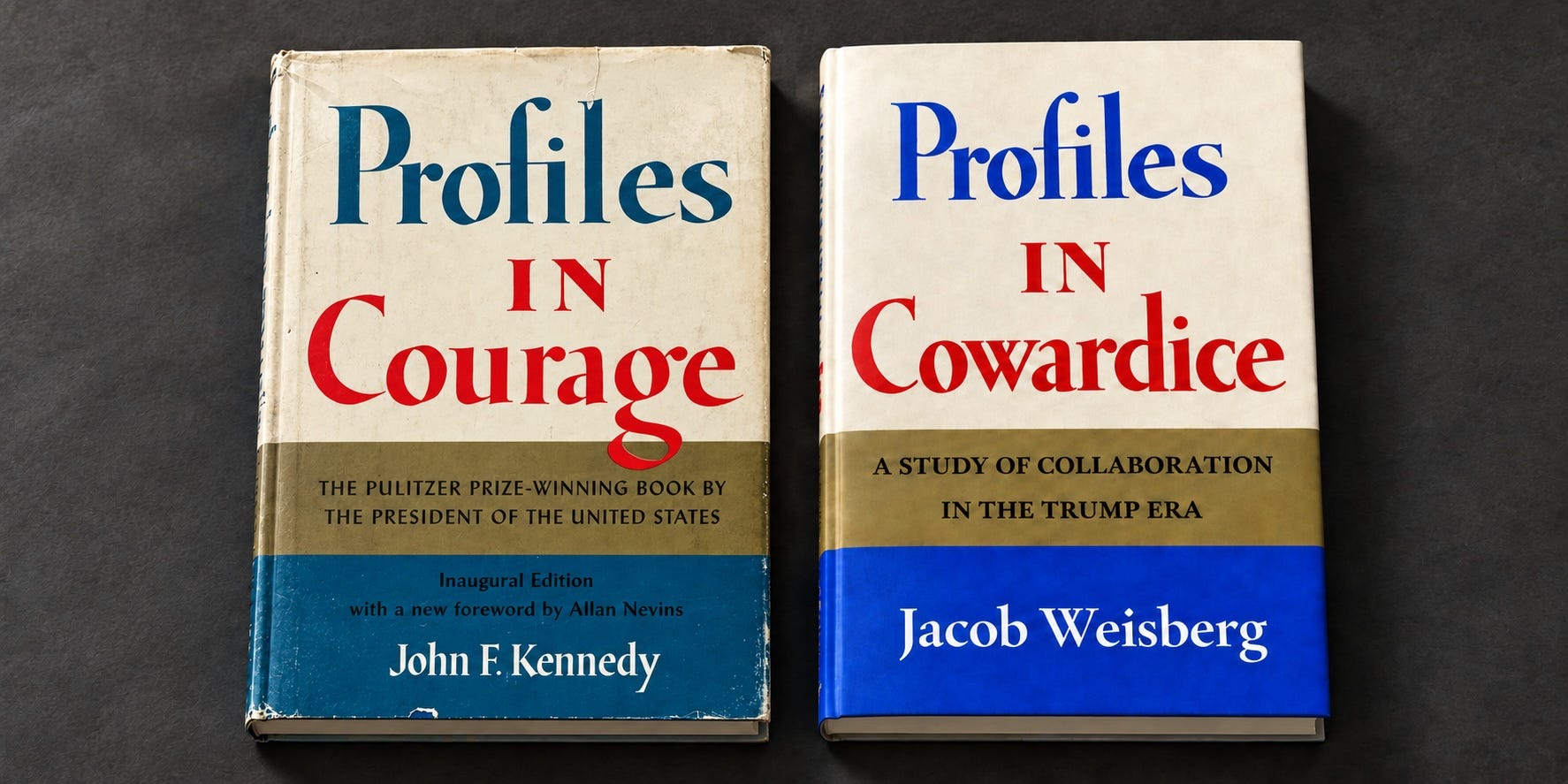
I’ve known Jacob Weisberg for more than 50 years. His parents and mine were good friends and the Weisbergs lived around the corner from the Alters on the North Side of Chicago. Jacob is seven years younger so we didn’t know each other well growing up. But he was a prodigy journalist, writing good articles for The Washington Monthly (where I hired him as an intern) when he was just out of high school. After Yale and a Rhodes Scholarship, Jacob became one of the top political journalists of his generation, writing for The New Republic, Vanity Fair, The New York Times and other publications and eventually becoming the editor-in-chief of Slate. He ghost-wrote Robert Rubin’s memoirs and wrote his own terrific book, The Bush Tragedy, before co-founding Pushkin Industries, a podcast and audiobooks company.
Jacob’s new book, Profiles in Cowardice, uses John F. Kennedy’s Profiles in Courage as a model in reverse. JFK’s book won the Pulitzer Prize in 1957, thanks partly to family connections. Jacob deserves it this year for his. The book is that good and important. Excerpts from our conversation:
JONATHAN ALTER:
Where did you get the idea for Profiles in Cowardice?
JACOB WEISBERG:
I was walking down the street in early 2025, asking the same question that a lot of people were: Why does Trump Two feel so different from Trump One, and why are we living through these waves of capitulation? The law firms and the universities were very much on my mind—these institutions that were following each other and following a pattern. It occurred to me that you could tell the story through individuals who stood in for these institutions.
JONATHAN ALTER:
And through the profiles in courage frame?
JACOB WEISBERG:
I like books built around analytical profiles. It’s maybe a little pretentious, but Eminent Victorians is a great example. Everyone was so sick of yammering about Trump and being yammered at about him. It turned the lens around and focused on how people were reacting to Trump instead of what Trump was doing.
JONATHAN ALTER:
Do you agree that this was the character test of our generation?
JACOB WEISBERG:
Yes, and we failed it. In modern American history, I think it’s only really comparable to McCarthyism. In many ways, I think it’s much worse, both in the nature of the attack—a full attack on democracy—and in the reaction. McCarthyism wasn’t coming from the White House. It was coming from a particularly dangerous and deranged individual.
JONATHAN ALTER:
It was more limited. He had a powerful committee that he could use to terrorize people, and a very large number of people bent the knee, including the Kennedy family.
JACOB WEISBERG:
I agree. I don’t mean to diminish McCarthyism, but the government has become so much more powerful in the intervening 70 years. Look at its role in higher education. If it threatened to cut research grants in the ’50s, that was a relatively small amount compared to a university's overall budget.
JONATHAN ALTER:
But they could get people fired, and a lot of people were fired from universities during the McCarthy era, right?
JACOB WEISBERG:
Yes. You could argue that it’s worse that they capitulated in the ’50s, when the government didn’t have as much leverage to force them to knuckle under. It was very threatening in all sorts of ways, including people being called to testify and sent to prison if they didn’t cooperate with the committees. But now the government has much more explicit leverage over many institutions because it’s the primary funder.
JONATHAN ALTER:
There was name-calling in both cases, but when McCarthy called Harvard “the Kremlin on the Charles,” he didn’t really have much to back it up. When Trump threw out these insults, he had a very powerful way to back them up.
JACOB WEISBERG:
Yes—taking $2 billion away from Harvard. Even Harvard faced a real crisis if Trump could follow through on those threats, as he tried to do.
JONATHAN ALTER:
You profile Dartmouth’s president [Sian Leah Beilock] rather than the leaders of Harvard or Columbia. How do you think those two schools did?
JACOB WEISBERG:
I think Columbia did badly. It made a really indefensible deal. It’s the weakest Ivy League school financially, and it had gone through all the tribulations of the encampments and Gaza protests. It was in the weakest position to defend itself, but I think it also made the worst deal.
When I started writing the book, I thought Harvard was going to cave. The New York Times ran a whole series of stories: Harvard’s about to make a deal. But for various reasons, including a really preposterous demand letter from the Department of Education, they stiffened their spine. At this point, I would be extremely surprised if Harvard makes a deal.
It hasn’t been out there waving a banner, but it hasn’t yielded, and it’s now setting an example for other universities. If Harvard doesn’t yield, I think other schools, including Yale, are very unlikely to. That’s why Trump cares so much about Harvard: It’s the leader in higher education in the country and in the world. The story’s not over, but for now, I think Harvard looks pretty good.
JONATHAN ALTER:
Isn’t some of it about the difference between 2025 and 2026? I tend to oversimplify by saying that in 2025, fear was contagious, and in 2026, courage is contagious. Is that fair?
JACOB WEISBERG:
I agree with the first part.
As for 2026, I hope we’re getting there. It’s certainly better. If Trump showed up with those executive orders now, I don’t think the law firms or universities would capitulate the same way. But at best, we’re at the beginning of the end.
Until elected Republicans in the House or Senate systematically oppose Trump, as they did in Trump One, I don’t think you can say there’s anything like contagious courage. We’re not seeing it in tech or business. We’re seeing a lot of watching and waiting.
There have been some really positive signs in the past couple of months. The networks standing up to defend CNN and the press pool is an important example. It’s exactly what should have happened in 2025: solidarity among institutions.
That’s what I criticized Dartmouth for. Its fault was a sin of omission. Dartmouth wasn’t attacked; it failed to stand up for Harvard. It’s the only Ivy League school that didn’t support Harvard in the lawsuit.
I don’t think it would be very productive to pursue a third impeachment unless politics change enough to make it possible to follow through.
JONATHAN ALTER:
How do you think Democratic control of one or both chambers of Congress will change the zeitgeist?
JACOB WEISBERG:
A lot. It’ll change the narrative. The daily story will be about investigations into Trump for corruption and abuse of power. I think that happens in the House, regardless of what happens in the Senate. If Democrats take the Senate, they can also block nominations. If they control both houses, they can create a joint investigatory committee.
I don’t think it would be very productive to pursue a third impeachment unless politics change enough to make it possible to follow through. But I’m very focused on how Democrats tell the story, and I know you think about this too, Jon. There are so many strands to the Trump family’s abuse of power and corruption. The danger is that it devolves into many committees, each with its own interests and agenda, and becomes confusing and incoherent. The model should be something like the January 6th Committee, which did a good job telling the American public what happened.
JONATHAN ALTER:
Let’s go through the motives you lay out in your introduction and how they apply to the eight profiles in cowardice. The first is peer pressure.
JACOB WEISBERG:
The tech leaders are a really good example because they tend to act almost as a group. After January 6th, they threw Trump off the platforms. They generally agreed he had gone too far, that they had played a bad role in enabling him, and that they weren’t going to do it anymore.
What’s ironic is that these (tech) people think of themselves as independent, original thinkers, and they all think the same thing at any given time.
Come December 2024, the same tech leaders are all on bended knee at Mar-a-Lago, flattering Trump, effectively bribing him in some cases. Bezos is the example I talk about. What’s ironic is that these people think of themselves as independent, original thinkers, and they all think the same thing at any given time. It was such a comprehensive reversal.
JONATHAN ALTER:
You point to a motive for Bezos that many people don’t know about: Blue Origin. What do you mean?
JACOB WEISBERG:
There’s a mystery to be explained. In Trump One, Bezos was admirable. He was a great owner of the Washington Post. He stood up to Trump and took the hit when Trump essentially took a $10 billion cloud computing contract away from Amazon.
In Trump Two, he did exactly the wrong thing: he vetoed the Post’s endorsement of Kamala Harris, ultimately decimating the paper’s editorial staff, and bribed Trump—there’s no other word for it—by buying the Melania documentary. That put at least $28 million in Melania’s pocket and bore no relation to any economic reality. Amazon Prime wouldn't pay that for a documentary of that value.
How did he go from being so good to so bad? I think the most compelling explanation is his lifelong obsession with space exploration. His high school graduation speech was about colonizing space. He got his vision from Gerard K. O’Neill, his guru, whom he studied with at Princeton. O’Neill envisioned orbiting terrariums that would relieve environmental pressure on Earth. It’s a very utopian vision compared to Musk’s, which I’d say is dystopian.
I think it’s the throughline in Bezos’s life. You could argue he started Amazon to get rich enough to pursue his space vision. Today, I think it’s clear he cares much more about Blue Origin than Amazon. He’s actively involved in it.
He was getting killed by Musk, who was building a much bigger business. Because the space business is based on Pentagon and NASA contracts, Musk’s proximity to Trump meant SpaceX was winning the space race. Musk was also brutally mocking Bezos’s failures, the rockets he couldn’t launch. I think there’s a clear line between Bezos’s turnaround and his ambition to win the space race.
I think it’s the throughline in Bezos’s life. You could argue he started Amazon to get rich enough to pursue his space vision.
JONATHAN ALTER:
Wasn’t he worried about losing Blue Origin contracts in the first term?
JACOB WEISBERG:
Blue Origin was very late in the game. It didn’t have a meaningful government-contract business. During the Biden years, the privatized space business grew much larger. Before the first Trump administration, Blue Origin was kind of an expensive hobby. It wasn’t even a real company.
JONATHAN ALTER:
The second motive is fear of ostracism. Who does that apply to?
JACOB WEISBERG:
Quite a few, but I focus on Mitch McConnell. For someone whose whole life has been the Senate and politics, his social world and his political life are almost the same. It’s the Senate cloakroom, the majority leader’s office.
I think he might have been thinking about what happened to Liz Cheney, whom he originally agreed with on impeachment before he backed down. “Ostracized” is really the word for it. The Republican National Committee and the Wyoming Republican Party censured her. She lost friends. In her book, she writes about doors closing to her in the country-club world of the Republican Party.
It may not sound like much—someone might say something rude to you at the country club. But people live in a social world, and losing that, I think, can be very frightening.
JONATHAN ALTER:
Does that apply to Bush too, who’s also on your list?
JACOB WEISBERG:
I think so. Most of the people Bush sees socially in Dallas support Trump. But it goes beyond that. He has to raise a lot of money for his library, museum, and foundation, and much of it comes from Trump supporters. People know he doesn’t like Trump, but attacking him publicly would be provocative.
As an ex-president, though, you have a special status. Ex-presidents generally don’t face the problem of being shunned. That makes it even more pathetic that he wasn’t willing to say what he thought publicly.
JONATHAN ALTER:
You make this point: His reputation was starting to recover after he left the presidency with such low approval ratings. If he had come out strongly against Trump, he would have gained less among Democrats than he lost among Republicans. He’d be back down in the crapper.
JACOB WEISBERG:
I think that would have been a lovely result. He was painstakingly trying to improve his historical reputation and raise his approval rating. Every time Bush says, “I don’t care what history thinks about me,” I read that to mean, “I care a great deal.” I actually think he’s kind of obsessed with it.
He left office historically unpopular, with the failures of Iraq and Afghanistan hanging over him. Trump may leave office more unpopular—we’ll see. Of course, Cheney’s approval was lower, and Cheney did the right thing. Liz and Dick Cheney are the counter example.
Every time Bush says, “I don’t care what history thinks about me,” I read that to mean, “I care a great deal.” I actually think he’s kind of obsessed with it.
JONATHAN ALTER:
History will remember Cheney better than Bush because he did the right thing. Bush is a double loser: He does the wrong thing, and it won’t help him in history.
JACOB WEISBERG:
Do you think so? Cheney is so associated with America’s use of torture after September 11. His endorsement of Kamala Harris was deeply admirable and courageous, but the people who hated him didn’t seem to be in a forgiving mood.
JONATHAN ALTER:
They’re not going to forgive him, but it was in the second or third paragraph of his obit. It doesn’t redeem him, but it puts him in a different light for historians. He ended up passing the character test of his generation, whereas Bush, who didn’t seem as bad as Cheney, didn’t.
By the way, I thought you dealt with Bush’s art really well. I reviewed his book of paintings in the New York Times, and you did a better job of getting beneath the surface of his effort to expiate his guilt. You reveal that he’s painted a huge, ugly picture of Trump that hasn’t been released. Then you suggest he might atone a little by painting.
JACOB WEISBERG:
I was talking about his paintings of wounded veterans from Iraq and Afghanistan. They’re quite powerful. You look at them and ask, “What’s he trying to tell us?” Of course, he says, “I’m not trying to tell you anything. I’m just painting brave veterans.” But there have to be elements of guilt and atonement. These people are missing their legs and arms because of his bad decision to go to war, which he can’t really own up to. But he can paint these pictures.
I also talk about Trump’s destruction of USAID and PEPFAR. I think PEPFAR was the single best thing Bush did as president. The HIV/AIDS program got antiretroviral drugs to people in Africa and elsewhere and probably saved 25 million lives. Bush is very proud of it. But when Musk and Trump destroyed it, he wouldn’t say anything publicly. He spoke privately, including to USAID workers.
At the end, I suggest that maybe he’ll deal with this by painting pictures of some of the people who’ve died because of the effective closure of USAID.
Think about this: The richest man in the world, who runs two of the most important technology companies, took a leave from his job purely to kill this agency.
JONATHAN ALTER:
The blood of those 600,000 people killed by the closing of USAID is principally on Donald Trump and Elon Musk, but it’s also on the Democratic Socialists of America, which has long endorsed abolishing USAID because it’s “imperialist.”
JACOB WEISBERG:
Think about this: The richest man in the world, who runs two of the most important technology companies, took a leave from his job purely to kill this agency.
JONATHAN ALTER:
And he believes empathy is the poison of humanity. You didn’t even have to include Musk because he’s so bad.
Let’s go to the third motive: fear of violence.
JACOB WEISBERG:
Fear of violence doesn’t get talked about a lot. I think it’s embarrassing to be threatened, and people also worry about a contagion effect—that publicizing attacks might encourage more of them.
But this is very real in politics today. When Trump goes on social media and excoriates someone, there’s a digital mob, but there’s also the potential for armed people to go to their house or SWAT them. I’ve heard about incidents that haven’t been publicized: Someone calls the police on a political enemy and says his wife is being murdered inside the house. The police show up with a tactical team and terrify everybody.
Fear of violence doesn’t get talked about a lot. I think it’s embarrassing to be threatened, and people also worry about a contagion effect—that publicizing attacks might encourage more of them.
JONATHAN ALTER:
It happened to Pete Buttigieg.
JACOB WEISBERG:
Absolutely. Elissa Slotkin described in the New York Times how her father was swatted in the last months of his life. They direct attacks against people’s families, not necessarily the politician.
The line that really struck me was Mitt Romney saying that if all the senators could have afforded the private security he had, Trump would have been convicted after the second impeachment.
JONATHAN ALTER:
To me, that’s one of the most chilling stories I’ve read in a very long time. It first came out in a book by McKay Coppins, my former intern, who got great interviews with Romney.
The next motive you cite is money. How is money a motive for bending the knee?
JACOB WEISBERG:
Money is a motive in almost every case—both the desire to make it and the fear of losing it. Think about Republicans considering standing up to Trump. If they lose their jobs and leave office, as approximately 14 Republicans who were real opponents of Trump in his first term did, they often stay in Washington and become lobbyists. I don’t really approve of that, but if you’re on the outs with the Trump administration, you won't get hired. You might want to go on corporate boards, which pay a lot for not very arduous work. But Fortune 500 companies don’t want public Trump opponents joining their boards right now.
Probably the best example is Brad Karp and Paul Weiss, where the average partner makes something like $8 million a year. Karp framed it as a fear that the firm would fall apart. More realistically, I think it was the fear that the average partner might make $4 million or $5 million a year for a few years instead of $8 million.
I’m not sure even that would have happened. Firms that resisted and got injunctions against Trump’s executive orders, like Jenner & Block, have done fine. I don’t think they’ve suffered any meaningful loss in partner income. But the fear of making a lot less money is very motivating.
JONATHAN ALTER:
Is there evidence that the best law students are avoiding Paul Weiss? Have they paid any price for bending the knee?
JACOB WEISBERG:
Oh yeah. I think the firm’s reputation has been essentially destroyed. Brad Karp told me they were having to work harder to recruit the best students.
It used to be the place where an idealistic young law student could do commercial work at the highest level with brilliant lawyers, but also pro bono and political work, particularly around civil rights. Now that’s so restricted. The firm stopped doing the kind of high-profile immigration work and taking many of the pro bono clients and cases it used to. Many of its highest-profile lawyers left—Jeh Johnson retired, and about 30 or 40 others started a kind of Paul Weiss in exile.
I don’t think it can get its reputation back. It’ll be a successful law firm, but will it be any different from Skadden Arps or Sullivan & Cromwell? People will always want those jobs and the money that comes with them, but Paul Weiss no longer has any specialness.
JONATHAN ALTER:
Institutional responsibility is your last motive. We’ve touched on that with the law firms—that was one of Karp’s arguments. But you also apply it to John Roberts. Is he on your list because of a skewed sense of institutional responsibility? How do you explain him?
JACOB WEISBERG:
When I talk about institutional responsibility, I partly mean people define the institution too narrowly—a university president thinking only of their university, rather than their responsibility to speak for higher education as a whole.
Roberts has always seen defending the court's credibility as an important part of his role. Why did he resist overturning Roe v. Wade for all those years? I think he believed it would hurt the court’s credibility, even though he disagreed with the decision. In Dobbs, he lost his effort to take it apart in stages rather than overturn the whole thing.
I think he believes he cares about protecting the court, but he hasn’t really acted that way. He’s shrunk from decisions he should have made to stop Trump, often by deferring cases or hearing things on the shadow docket without issuing an opinion. The court’s credibility has suffered tremendously.
I don’t question that the chief justice has a responsibility to the institution. Surely he does. I think he’s interpreted that responsibility too narrowly, or in too self-protective a way.
JONATHAN ALTER:
Do we know why he made that horrible decision in the immunity case?
JACOB WEISBERG:
One interpretation is that Roberts doesn’t want to be in the minority on cases that matter—that he loses personal credibility as a dissenter rather than as the court's leader. But I think that decision reflected his ideology. His views have been consistent since he was a lawyer in the Reagan Justice Department: extending and expanding executive authority.
People talk about the “unitary executive.” It started around foreign policy, but it’s now been extended to such an extreme. The decision this year invalidating all the independent regulatory agencies, except the Fed—because it’s the Fed, with no other rationale. We had independent agencies authorized by Congress from 1887 to 2026. Now we can’t have them anymore. That was Roberts’s decision. That is his view of a unitary executive.
JONATHAN ALTER:
Why [include] Megyn Kelly?
JACOB WEISBERG:
I wanted to write about someone in the media. She’s an interesting example because I think she was brave to stand up to Trump the first time. At that famous debate, she questioned the things he said about women. He attacked her viciously, and she stood up to him. And then she didn’t.
It’s the mystery of why someone became a quisling in the second term after being a journalist, I would say, in the first. There’s a personal story about bullying—what happened to her growing up, but also how she was treated at Fox News and later at NBC News.
I wanted to tell a story about conservative media, because a lot of us turn on Fox News and think: How can these journalists behave this way? Why aren’t they following their professional responsibility?
JONATHAN ALTER:
Her anger at liberals—the ones she thought bullied her at NBC—was very interesting. Finally, Steve Schwarzman, another Yalie like you. Why was he on the list?
JACOB WEISBERG:
Nobody put the thumbscrews on Steve Schwarzman, which I think makes him worse. Brad Karp was threatened. Schwarzman volunteered. His company, Blackstone, wasn’t threatened—far from it.
I think he needs to be in the center of the action and feel important. He has a deep insecurity that’s only satisfied when the president calls and asks, “What does Wall Street think about this?” And you’re the person who speaks for Wall Street.
He, too, had enough of Trump after January 6th. He said he wouldn’t support him anymore and tried to support other Republicans for president. Then, in 2024, when Trump was going to win the primaries, he said, “Never mind. I guess I’m behind him.”
JONATHAN ALTER:
He’s like a billionaire power whore. Some people just can’t resist power. If he’d been living in Nazi Germany, he would have been like somebody from the Krupp family—people who do what they feel they need to so they don’t lose anything.
They still have billions, but they keep score through money. They act like they have more to lose, when they can afford to lose a lot and still be just fine.
JACOB WEISBERG:
With Schwarzman, I don’t think it’s fundamentally about money. I think it’s about ego and insecurity. Each person is their own story, but he’s characteristic of what happened in business and finance: a failure to stand up for free markets, free trade, the rule of law, and keeping government and business separate.
This is a president who has demanded and received ownership stakes in private companies on behalf of the United States, just because he can. You would think that violates business principles. They don’t like socialism or government owning industry. But Schwarzman represents this attitude: It’s what Trump’s doing. Why would we oppose it?
JONATHAN ALTER:
One of the stories I’m proudest of doing dropped in my lap about 15 years ago. You cited it in the book. Schwarzman said Obama’s attempt to end carried interest—a huge tax favor for the very wealthy—was “like the Nazis invading Poland.” Somebody who heard him say it told me, and I put it in Newsweek. He got shamed. It’ll be somewhere in his obit, which makes me very happy.
Thanks, Jacob.
Here’s my short Then and Now convo with Princeton professor Julian Zelizer, our latest weekly effort to convey some of the historical context of the news: