The former DHS Secretary on masks, administrative warrants, detention centers and asylum, plus Trump's lack of an exit plan from Iran
By Jonathan Alter
Published: 2026-04-03
URL: https://oldgoats.substack.com/p/jeh-johnson-on-where-ice-went-wrong
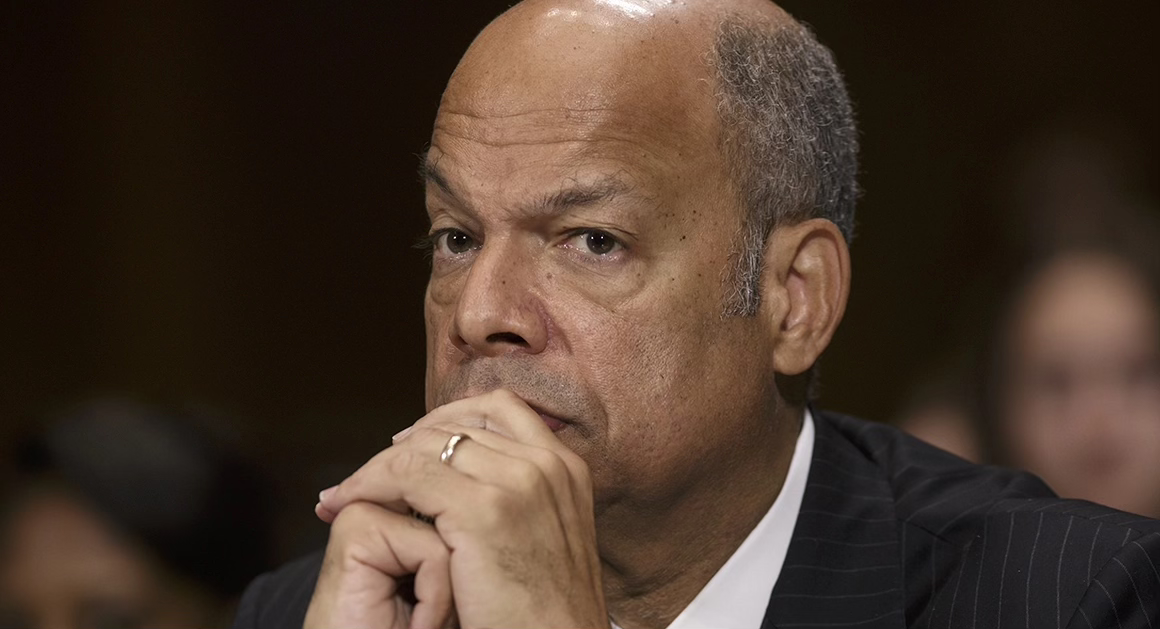 \Former Homeland Security Secretary Jeh Johnson (AP Photo)\
*I met Jeh Johnson, 68, about 25 years ago in Montclair, New Jersey, where we live a couple of miles apart. Ever since, I’ve admired his good judgment, good humor and commitment to public service, not to mention All Things Soul, his radio show. Jeh’s first name comes from a Liberian chief who in 1930 saved the life of his grandfather, Charles S. Johnson, later the president of Fisk University. After graduating from Morehouse and Columbia Law School, Jeh became an assistant U.S.
Attorney in New York, partner in the law firm Paul Weiss (from which he recently retired), general counsel to the Air Force under President Clinton and general counsel to the Department of Defense under President Obama.
In Obama’s second term, he joined his Cabinet as Secretary of Homeland Security.*
*On No Kings Day, Jeh gave a barn-burning speech to the Montclair rally: “The organization I once led, created to protect the American people and their homeland, is now a pariah -- consisting of armed, angry, masked men who patrol the streets of America and terrorize the people. Renee Good did not have to die; Alex Pretti did not have to die.
But there will be no meaningful investigation, no accountability for their deaths. Your government wants you to forget them, or write them off as the perpetrators of domestic terrorism. This is NOT the America you and I know.”*
We covered a lot of ground in this interview. Excerpts:
JONATHAN ALTER:
When you were in government, did Iran have the capacity to use agents in the United States to commit terrorism against us that they didn’t use, or did they not have that [sleeper cell] capacity?
JEH JOHNSON:
I can’t say. Others have opined publicly in response to that question. I don’t believe I am at liberty to do so.
JONATHAN ALTER:
What do you think of Trump’s decision to go to war?
JEH JOHNSON:
I think he’s making a familiar mistake. It’s much easier to start a war than to finish one. Without clear goals or an exit plan, conflicts tend to drag on and become something you didn’t anticipate.
JONATHAN ALTER:
How could he or his advisors have thought the Iranian people would rise up if they didn’t have any guns?
JEH JOHNSON:
Rise up with what? That’s exactly the question I’d be asking in the Situation Room. I’d want an intelligence assessment of what happens among Iran’s roughly 90 million people if the regime is toppled. Is there chaos in the streets? Does public sentiment turn against the West because of what we did?
My suspicion is that whatever assessment was delivered, he either didn’t listen or his advisors were too cowed to tell him the hard truth about what would happen if he took out the Ayatollah.
JONATHAN ALTER:
What do you think of ICE agents wearing masks?
JEH JOHNSON:
I think it’s a bad idea for several reasons. You don’t see big-city police departments wearing masks, even in high-crime areas.
First, it diminishes accountability. If you don’t know who’s arresting you, there’s less accountability. Second, it creates the risk of criminals impersonating law enforcement, since faces and even IDs are obscured. And it simply doesn’t look like America. It looks like an authoritarian system that isn’t accountable to the people it serves.
Only in the most dangerous circumstances should that happen. Even the U.S. military generally doesn’t wear masks in the midst of hostilities.
JONATHAN ALTER:
Is it possible for Trump to use ICE or CBP to interfere in the midterm elections?
JEH JOHNSON:
Legally, I believe the answer is no. Any advance effort to send DHS personnel to polling places would likely be quickly enjoined by a court.
JONATHAN ALTER:
So a court would issue a temporary restraining order and stop it? And they’d respect it?
JEH JOHNSON:
By and large, yes. Despite the rhetoric, I believe this administration has mostly abided by court injunctions, with some notable exceptions that Judge Boasberg could tell you about.
On masks: “First, it diminishes accountability. If you don’t know who’s arresting you, there’s less accountability. Second, it creates the risk of criminals impersonating law enforcement, since faces and even IDs are obscured. And it simply doesn’t look like America. It looks like an authoritarian system that isn’t accountable to the people it serves.”
JONATHAN ALTER:
All right, so Boasberg got involved with CECOT. What do you think of sending detainees to El Salvador?
JEH JOHNSON:
I didn’t realize until this administration, and I was DHS secretary, that you could deport someone from one country to a third country. I had assumed they had a right to be returned to their country of origin, not to some other place. That practice has now been enjoined.
JONATHAN ALTER:
How about administrative warrants? Did you use them?
JEH JOHNSON:
We did, for a range of things. But an administrative warrant is essentially an agency authorizing itself to act. It’s not a judicial warrant. To enter someone’s home, you generally need a judicial warrant.
There are exigent circumstances where that isn’t required. For example, if you had credible evidence that Nancy Guthrie was being held hostage inside a house next door, law enforcement could enter without a warrant. But simply to arrest an undocumented person you believe is inside, no.
JONATHAN ALTER:
What if they were on a list because they were the worst of the worst, like the true criminals you were going after in the Obama administration?
JEH JOHNSON:
First, at the secretarial level, you don’t make those calls. But if someone were truly dangerous, armed, and likely to shoot back, that could be an exigent circumstance where a judicial warrant isn’t required to enter an enclosed space. I’m speaking here as a lawyer, not as a secretary.
JONATHAN ALTER:
So an administrative warrant isn’t issued by an immigration judge; it’s just a bureaucrat signing it?
JEH JOHNSON:
Correct. It’s not a judicial figure.
JONATHAN ALTER:
So this violates the Constitution?
JEH JOHNSON:
The Fourth Amendment, yes.
JONATHAN ALTER:
It’s kind of amazing we’ve gotten to this point.
JEH JOHNSON:
This practice has long existed, but it’s now been brought into the open. My hope is that the next secretary takes a different approach.
JONATHAN ALTER:
Did you ever use arrest quotas when you were in government?
JEH JOHNSON:
Not to my knowledge, though I could be wrong. Tom Homan, who worked for me, may have used them, but I’m not aware of it.
JONATHAN ALTER:
Can you explain what’s wrong with arrest quotas?
JEH JOHNSON:
There are essentially two types of deportation. One is expedited removal, when someone is apprehended at the border. The other involves people in the interior who have been here for weeks, months, or years, and that’s very different in character—very circumstantial—and often that person is hard to find. If that person is released into the community, it can take ten officers instead of two to find and arrest them. That’s not a wise use of resources. That’s why quotas don’t make sense.
I’d much rather see ICE arrest 20 convicted criminals than 50 people with no criminal record. Quotas make enforcement arbitrary.
What I used to tell ICE leadership was: use common sense. One controversial arrest — someone’s grandmother or a high school student — can undermine your entire mission in a community. That’s what we’re seeing now, and it serves no one’s interest.
JONATHAN ALTER:
Did you hire Tom Homan?
JEH JOHNSON:
He was there when I arrived and retired just before I left.
JONATHAN ALTER:
He said during the transition, they’d go after the worst of the worst. That’s what he promised. What happened?
JEH JOHNSON:
They became preoccupied with mass deportations and numbers, which, in my judgment, isn’t a smart approach. I think even Tom Homan knows that.
JONATHAN ALTER:
DHS now has about 70,000 people in detention. How does that compare to the Obama years?
JEH JOHNSON:
When I was secretary, we had funding for about 33,000 beds, as I recall, and that number was consistent year to year.
“What I used to tell ICE leadership was: use common sense. One controversial arrest — someone’s grandmother or a high school student — can undermine your entire mission in a community. That’s what we’re seeing now, and it serves no one’s interest.”
JONATHAN ALTER:
Twenty-three people have died in custody in the past year. How does that compare? Would cases like that have reached you as secretary?
JEH JOHNSON:
I think it was a rare occurrence. If it did happen, I believe I would have known. Not saying it never happened on my watch, it probably did. The number may be higher now simply because they’re detaining so many more people. And it’s also important to distinguish between short-term detention at the border and detention of people in the interior. They’re very different situations.
JONATHAN ALTER:
During the Obama administration, family separation was considered as a deterrent. What happened?
JEH JOHNSON:
It was presented to me as an option, and I rejected it.
JONATHAN ALTER:
Did your people, to your knowledge, ever use bad detention conditions to encourage people to self-deport?
JEH JOHNSON: No, that was not a policy in the Obama Administration.
JONATHAN ALTER:
Do you sense this administration is trying to make conditions so harsh that migrants leave?
JEH JOHNSON:
Yes. I believe deterrence is being pursued very aggressively. When you send a migrant to a hardened prison in El Salvador, where standards of basic decency may be very different, that’s done principally as a deterrent. Publicizing it reinforces that message. A lot of what this administration is doing to make life difficult for migrants is driven by deterrence.
JONATHAN ALTER:
Do you think it’s wrong-headed to arrest somebody while they’re in the midst of their asylum hearing in immigration court?
JEH JOHNSON:
They’re arrested, taken into custody, and put into expedited removal as a deterrent, yet all that does is discourage people from showing up at their own immigration hearings.
JONATHAN ALTER:
Part of the problem stems from a broken asylum system in the Biden Administration. Instead of quickly adjudicating asylum claims at the border, people were allowed to enter the country, making it harder to track them.
JEH JOHNSON:
The overarching problem with the asylum system, which didn’t start in the Biden administration, is the backlog. There’s a tremendous volume of pending claims, and many are ultimately denied.
In some cases, applicants are advised to file anyway because the process can take years, during which they may receive work authorization. For some, the calculation is that spending a few years working in the United States and sending money home is better than staying in their home country.
JONATHAN ALTER:
If the system is too overloaded to handle even the initial screening, couldn’t you add enough retired judges and lawyers and other personnel to make it work?
JEH JOHNSON:
The question is scale. During the Civil Rights Movement, lawyers went south to support that effort. But here, you’d need hundreds, probably far more, for what is a difficult and often thankless job. And the demand fluctuates with migration levels. It’s not a fixed problem you can solve with a fixed number of people.
The legal standard for asylum is specific. You have to show persecution by your government based on your beliefs or associations. Economic hardship — drought, poverty, not being able to feed your family — doesn’t qualify. That’s not asylum under the current law.
JONATHAN ALTER:
Let’s turn back the clock. It’s January 2021. Joe Biden says, “Jeh, you have a lot of experience. What should we do to make sure immigration doesn’t become a political problem again?” What would you have told him?
JEH JOHNSON:
Biden was essentially a moderate on immigration. The challenge is that illegal immigration is highly sensitive to signals. If the U.S. is perceived as enforcing the law, numbers go down. If it’s perceived as weak, numbers rise. Over time, though, flows tend to return to longer-term trends driven by conditions in migrants’ home countries.
So you have to pursue two objectives at once: a secure border and a realistic approach to the millions of people already here. That means clear, visible enforcement, but also working with Congress on a broader solution to bring long-term residents into the legal system, as the 2013 comprehensive bill attempted to do.
The difficulty is political. I’ve long believed only a Republican president could fully accomplish that. And in the Biden White House, from the outside, there didn’t appear to be a single person consistently willing to take ownership of this issue. Roberta Jacobson understood it well, and Susan Rice didn’t shy away from tough issues, but there wasn’t sustained leadership. It became everyone’s least-favored problem, and the president didn’t fully engage until it reached crisis levels.
JONATHAN ALTER:
Let’s talk about Kristi Noem. What kind of job did she do?
JEH JOHNSON:
I think she was in over her head. She didn’t have the right skill set or guideposts for the job. My sense is that she became too focused on the trappings of office rather than doing the work.
The self-promotion, including the ad campaign, became a distraction and even drew criticism from Trump.
JONATHAN ALTER:
But isn’t Stephen Miller really running policy?
JEH JOHNSON:
Stephen Miller and Tom Homan, yes, that’s my impression. If I were coming in as DHS secretary, I’d want to know who’s actually running the show — is it me, Miller, or Homan? You’d need to set expectations accordingly.
On Kristi Noem: “I think she was in over her head. She didn’t have the right skill set or guideposts for the job. My sense is that she became too focused on the trappings of office rather than doing the work.”
JONATHAN ALTER:
Presumably, you would have fired this agent Bovino before things got out of hand.
JEH JOHNSON:
Why is a Border Patrol agent operating in the interior? They’re trained to enforce the law at the border. It’s a fundamentally different mission to conduct immigration enforcement inside the country.
It’s like asking a fighter pilot to fly a bomber. Border Patrol is trained to apprehend people at the border, where there’s a processing component. You’re not chasing people into the interior or looking for them in big cities. ICE does that. It’s a fundamentally different mission requiring a different skill set.
JONATHAN ALTER:
Do you think that’s part of what led to the tragic circumstances in Minneapolis? Those weren’t inexperienced agents.
JEH JOHNSON:
Correct. What’s obvious to me is a lack of deescalation training. The way these agents approach people, there’s anger. It’s aggressive and short-tempered. A good officer knows how to de-escalate a potentially dangerous situation.
You see it all the time. In a New York City subway, officers dealing with an agitated person will slow things down, let the situation cool, and then act. You don’t provoke something into a life-or-death confrontation.
Renée Good didn’t have to die. She was apparently blocking an operation, but there are many ways to handle that. You could have de-escalated and gotten her to move the car. Instead, the situation escalated to the point where deadly force was used.
We’ve seen this before. George Floyd. Eric Garner. Situations that didn’t have to end in death, but did because someone carrying a weapon lost control.
JONATHAN ALTER:
The Alex Pretti shooting was so cold-blooded. It looked from the video like the shooter could see his face.
So what happens now? You have all these agents getting $50,000 bonuses, and many of them are just entering the ICE workforce. If you have a hammer, everything looks like a nail. What are we in for over the next two and a half years on this issue?
JEH JOHNSON:
That’s a good question, because I do worry about the type of person being recruited to this mission and the expedited training before they hit the streets.
For at least a while, if you went to the ICE website and looked at their recruiting material, you’d see a slogan: “Defend your culture. Join us.”
Now, when you’re my age, if your parents saw a recruitment message from the Mississippi State Police in 1963 that said, “Defend your culture,” what do you think that would mean?
That’s a dog whistle to a lot of people, the wrong kind of people. If you’re a Mexican American in Texas and interested in law enforcement, the message is, You Need Not Apply. If you’re a Muslim American in Michigan or Minnesota, same thing.
I think it’s been taken down, but it was up for a long time. And the kind of person attracted by that message is not someone I want to see wearing a badge and carrying a gun.
JONATHAN ALTER:
But you’re going to see thousands of people responding to that message. So what are we looking at now, with all these detention centers they’re building across the country? It’s already larger than—
JEH JOHNSON:
Apparently, 11 detention centers,
JONATHAN ALTER:
Yeah, and how many did you have?
JEH JOHNSON:
Not 11 like that. I mean, there were facilities at the border, but then what often happens is ICE rents space in local facilities, like in Newark, New Jersey, that you don’t really know about.
With these 11 detention centers, there’s a possibility, certainly if Democrats take control after the midterms, Congress won’t agree to fund all of it. Congress has to agree to fund it.
JONATHAN ALTER:
Didn’t they get funding in that big bill? Even if it wasn’t an appropriations bill, didn’t they get billions to build this out?
JEH JOHNSON:
There’s a difference between authorization and appropriation. And even if they’ve acquired the space, they still have to build it out into a detention facility.
JONATHAN ALTER:
You have large numbers of people held there for misdemeanors.
JEH JOHNSON:
Don’t interpret this as defending the practice, but these are misdemeanors committed by people who are not lawfully present in the country. They’re not just people who committed misdemeanors.
JONATHAN ALTER:
But some are. People who came here illegally and then get picked up for something minor, like speeding.
JEH JOHNSON:
[Under Trump] they’re presumably on their way to being deported. Look, I don’t think that’s the wisest use of taxpayer dollars. I can see expanding detention space during a surge at the border to accommodate that surge. We did that on my watch. But I don’t know how much sense it makes to engage in mass detention of people pulled out of the interior.
JONATHAN ALTER:
There have been 15,000 habeas petitions in just the last two months.
At what point do you start calling this something like a gulag? To convey the scale of it. In some ways, it’s worse than Japanese internment, both in numbers and conditions. Sometimes when you’re living through history, you don’t recognize how bad it is.
JEH JOHNSON:
It depends on the circumstances of detention. But I don’t endorse or support that kind of approach to enforcing our immigration laws. And people do have a right to be heard before they’re deported.
Again, I suspect it’s part of an overarching effort to deter border crossings. In other words, you make things look and sound so inhumane that you’re deterring people from coming.
What Stephen Miller and others don’t get is that these people are making a judgment to flee a burning building. They would rather take their chances in the United States, whether it’s under Barack Obama, Joe Biden, or Donald Trump, than stay where they are.
JONATHAN ALTER:
But they’re not coming across now under Trump.
JEH JOHNSON:
That’s a short-term phenomenon. It’s a reaction to his presidency, but the numbers tend to revert to their longer-term trend lines.
JONATHAN ALTER: He could have taken political credit for reducing crossings, but overplayed it.
JEH JOHNSON:
He took credit for it — it was right at the start of his State of the Union. But in doing so, he also exposed some of his flaws as a politician.
JONATHAN ALTER:
He lost that goodwill. His numbers with Latino voters are dropping. Why not use that moment to push for broader reform?
JEH JOHNSON:
He could have had the best of both.
Any other Republican president with those kinds of numbers at the border would be told: You’ve achieved something significant. Now make it your Nixon-goes-to-China moment. Go out and achieve comprehensive immigration reform and claim something Bush or Obama couldn’t do.
But he’s not that kind of politician. He’s incapable of seeing it that way. It’s not in his makeup. He will never be able to achieve that kind of greatness, because it’s not in his makeup — that’s the same reason he’ll never win a Nobel Peace Prize.
.JONATHAN ALTER:
I want to ask you the same question you asked when you came in. Are we going to make it?
JEH JOHNSON:
So I believe in the pendulum effect of American politics. Every eight, maybe even sixteen years, voters want something radically different from what came before — a new generation, new politics, new character, new personality.
And when you look at history, you can see that pattern. Eisenhower to Kennedy. Nixon and Ford to Carter. Reagan and Bush to Clinton. Bush to Obama. That was an exact sixteen-year cycle. We broke it in 2024 because we didn’t have the right choices. But by 2028, I think the American voter is going to be itching for a very different kind of president than Donald Trump.
Swing voters continually want someone who will radically change things, because so many Americans believe the country is headed in the wrong direction. The candidate, whether from the far left or the far right, who convinces those voters that they will really shake things up and change the country’s direction is the one who wins.
So I do believe we’re going to have somebody very different from Trump in 2028, who will likely preserve our democracy.
“So I believe in the pendulum effect of American politics. Every eight, maybe even sixteen years, voters want something radically different from what came before — a new generation, new politics, new character, new personality.”
The big caveat is what bothers me most about the Trump presidency: he is creating new norms. New norms in terms of executive authority. New norms in terms of a lack of compassion in how you govern. New norms in terms of ethics. And new norms regarding the observance of constitutional and legal norms.
So much of our Constitution is gray. The First Amendment is forty-five words. But in those forty-five words are embodied freedom of speech, freedom of assembly, freedom of the press, and freedom of religion. Those principles have been preserved not because they are spelled out in endless detail, but because, up to now, we have had elected leaders who respected the norms they express.
And when you have somebody who does not respect constitutional and legal norms and says, “Well, the Fourteenth Amendment doesn’t say there’s birthright citizenship, so I’ll challenge it in the courts and see what happens. I’ve got six appointees on the Supreme Court,” you end up in a situation like the one we have now.
JONATHAN ALTER:
Is there a corrective mechanism, like after Watergate, in which Democrats would commit to rebuilding guardrails — not just restoring the integrity of the Justice Department but also limiting presidential power?
JEH JOHNSON:
After Vietnam and Watergate, Congress passed the War Powers Resolution in 1973 to rein in the president’s ability to wage war without congressional authorization. Nixon vetoed it, and Congress overrode that veto because there was strong bipartisan agreement that constitutional norms had to be restored.
I don’t know that you could get two-thirds of Congress to do something like that anymore. I don’t think that’s going to happen now — even after the midterms. There’s just too much partisan adherence.
JONATHAN ALTER:
The repair process can’t really begin until 2029. The question is whether Democrats are prepared for that moment.
Just as the Heritage Foundation had Project 2025, Democrats need to be ready with a clear agenda. I’m asking my readers to submit ideas.
One potential silver lining is that Trump relied heavily on executive orders rather than statutory change. He had the political capital to pursue legislation, but he didn’t have the patience.
JEH JOHNSON:
And people told him, You could do this right.
JONATHAN ALTER:
If Democrats regain control, they should have what I call a Codify Agenda. On Day One, repeal most of Trump’s executive orders, keep the two or three that make sense, and then embed the replacement policies into law.
That way, a future president can’t just reverse everything with new executive orders. These reforms would actually be codified.
Thanks, Jeh.