Inside the startup rebuilding the financial infrastructure behind $147T
Published: 2026-11-22
URL: https://nextplayso.substack.com/p/should-you-join-hanover-park
✨ Hey there - this is a free edition of next play’s newsletter. This is part of our series Should You Join, where we go behind the scenes on interesting companies. Our hope is that documenting these sorts of details, which never really make it to big publication press releases, can help you a) discover more interesting opportunities and b) inspire you to think creatively (for any of your own endeavors). You can join our private Slack community here and access $1000s of dollars of product discounts here.
The job of venture capitalists and private equity folks sounds quite glamorous. It’s high status, for one. It typically pays well. You get to meet interesting people. And there’s a lot of money involved: some $147T of investment firm assets exist today. If you close your eyes and imagine the life of a VC, maybe you picture fancy folks in suits on a high floor of a glass building.
Perhaps that image is partly correct. But there’s a less glamorous and very important thing that the picture above is missing: how do you manage all of that money?!
For most funds, the answer is that you pay someone else to do it. Often that “someone” is a big legacy administration company that works slowly and manually. Picture accountants keying data into old systems, and quarterly statements you want right now showing up in a month or two. Funds stick with these, however, because there are not many better options (this is not the most competitive industry on the planet) and because switching costs are high. Oh well.
I’m writing about Hanover Park today because they are a company taking an AI-native approach to fund operations. And theirs is an industry that desperately needs something new: most incumbent fund administrators today are armies of accountants doing manual work. These firms take such a legacy approach that they call their engineers “IT Support”.
Hanover Park is just over two years old, and in that time they’ve already grown from just over $1B under administration at launch to roughly $50B today. “We’re just 0.03% of the way to being the financial infrastructure that changes how capital flows,” Chris Hladczuk, Hanover Park’s CEO and co-founder, told me.
I sat down with the team to learn about their approach to taking on a massive, but relatively un-disrupted, industry. I also asked about their plans for the future, their culture, and crucially, what kinds of people they want to join the company to help them take over such a big market.
The product
One of the reasons AI has been such a slam dunk in software engineering is that code either works or it doesn’t. (Contrast that to something like writing, where whether writing “works” is far more subjective and harder for LLMs to really nail on a feedback or execution level.)
“Accounting has the same core principles,” Chris said (the books either tie out or they don’t), which is part of why Hanover Park is able to be so efficient with a small team, and why an AI-native approach is such a good fit for the kind of company they are building. But maybe I’m getting ahead of myself; maybe you are wondering, hey, what does Hanover Park literally do? What do funds pay them for?

\the hanover park team\
The official term is “fund administration.” In practice this means doing the entire back-office job for a fund: keeping the books, sending the capital calls and distributions, calculating fees and profit splits between LPs and fund managers, writing quarterly statements, preparing for audits. There are more (hundreds, or thousands more!) jobs to do, but those are some of the big ones.
The first pass of all Hanover Park’s fund administration work is done by AI agents. This is not what any of their legacy competitors are doing (in fact legacy competitors may reel in horror at the prospect of using AI for this). Agents collect all the useful information and turn it into entries in accounting software the Hanover Park team wrote themselves (another detail that legacy competitors would not be familiar with). Then, real human accountants on the Hanover Park team review the work before it goes out.
The basic result is that work gets done more effectively, faster, and with a much smaller team than is usually required for this amount of work. That’s good for customers, and for Hanover Park.
Because everything sits in one system, a few other tools come with it that you wouldn’t usually get. Hanover Park’s agents pull ownership and round terms out of portfolio companies’ closing documents, collect metrics from board decks and founder updates, and feed an LP portal that about 10,000 LPs use. Most funds buy all those from separate vendors. “I literally hate the word unbundle,” Chris said earlier this year. “When you unbundle, the products are actually worse, because the systems simply don’t talk to each other”
Hanover Park also takes most of the pain out of switching from legacy providers. Most CFOs are hesitant to move to a new administrator because it’s traditionally a months-long, error-prone process defined by manual accountant workflows. With Hanover Park, by contrast, long-horizon agents work through hundreds of thousands of docs across a multi-decade firm history to ingest, clean, and transform the data with one click. It took Conviction, a $1B+ venture fund led by Sarah Guo (and current “raving fan” of Hanover Park), just one week to move. This is the magic of Hanover Park’s one-click migration.
The big picture
“There are very few companies with markets this big, competition this bad, growth this strong, and a slew of hard but interesting problems to solve,” Chris said. Let’s look at each.
The market is maybe the easiest piece; I don’t need to try very hard to convince you that administering $147T (and more by the time Hanover Park becomes the default option) is a lucrative business. Nor do I probably need to explain the kind of influence and new product opportunities that being connected to all of the most valuable funds in the world would bring.
The competition is where you may be more skeptical, because the legacy players are deeply embedded and haven’t really been disrupted yet. Those “legacy players” are companies like SS&C, Citco, and Apex. But these companies have a problem. Jake Saper, the Emergence partner who led Hanover Park’s Series A, wrote that “the incumbent model scales linearly with headcount. The AI-native model compounds.” In other words, traditional fund administrators are basically services companies with armies of offshore accountants; Hanover Park has productized what has historically been a tedious, human-delivered service with AI, enabling operating leverage.

The easiest approach to building this business would have been to bolt AI and a hungry team onto an already-existing general ledger product, which is what most startups do! Hanover Park, however, built it all from scratch. The team believed that, without this, Hanover Park would just be a UI slapped on top of another system.
Cool, but what about growth?! Chris signed Hanover Park’s first customer by flying to San Francisco, where he “booked hotel rooms every single day and refused to leave until they signed.” Not long after, he flew to Florida and “hung out with the CFO at his house until 2AM,” a meeting that ended with them making a handshake deal to partner on transforming fund administration together.
It took a lot of “doing things that don’t scale” like that until the company hit about $5B in assets, and after that, Hanover Park’s gospel spread through word-of-mouth. The company had 20 engineers before it hired a single sales rep, and Chris was still the only rep at $15B.
Hanover Park went from $1B in assets under administration (AUA, the administration version of AUM) in late 2024 to roughly $50B today. Chris says ARR has grown 20x+ over the past 15 months They’ve raised $31M to date, including a $27M Series A led by Emergence Capital, with Lux and Susa Ventures participating.
“The hardest part of this product is not the AI,” said Louis Sellier, a former Palantir engineer who builds Hanover Park’s KPI and audit systems. “It’s getting the accounting right on messy, real fund data, and being trusted by auditors and LPs when you do.”
Fund administration is only the starting point. “We want to own the core back office, own the middle office, and own all the software tool spend for the investment firm,” Chris said.
The culture
Hanover Park is an engineering-led startup by design. They hired more than 20 engineers before they brought on a single sales rep. Those details may tell you as much about the culture as anything else I can share; this is an engineering-first, outcomes-focused business.
New product is shipped roughly like this: an engineer gets a problem, then sits down with the accountants (who are considered part of the product team) to write the spec. AI then writes most of the code, and the engineer reviews that code before shipping.
Kenny Zeng, who runs one of the accounting teams, spent eight years as a fund accountant at Blackstone. “Here at Hanover Park, I am able to do much more… business development, recruiting, working alongside engineers to pioneer modernized approaches to fund accounting, and leading a large team.”
This experience is not unique to Kenny; everyone, not just the accountants on the team, is taking on a lot of responsibility and scope. Emily Kramer, who is the founding head of strategy and ops, started her career in a more traditional finance role at Goldman Sachs before jumping to the startup world. In her first week at Hanover Park, she was “in a room with ten folks, on an ops team of one (myself), with no background in fund administration, tasked with completing the data migration for our two largest clients…and it worked. We jammed, figured it out, and delivered for the client.”
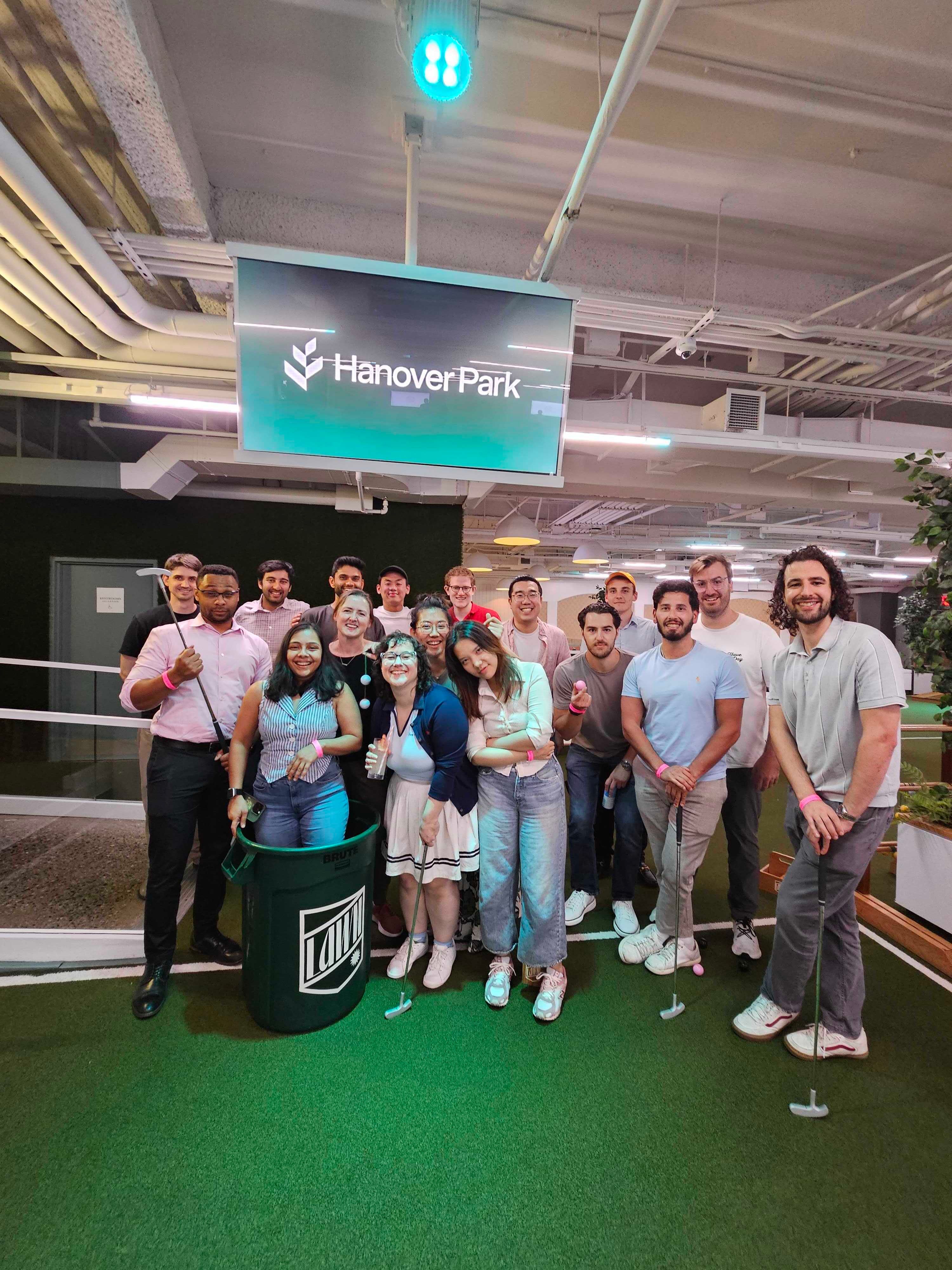
Everyone works from the office in New York. Every morning at 9:00, the office speakers play upbeat EDM music, a ritual that has happened every single day since the company was founded. There is also a gong, demo nights, and a run club that does ten (!) miles on Wednesday mornings. Jon Templeton, one of the founding engineers at the firm, mentioned “random cheering throughout the day when people have breakthroughs that gets us all pumped up.”
Should you join Hanover Park?
Like I mentioned, people are responsible for a lot. They work hard. That means, as Chris told me, “you need the two A’s: agency and autonomy. If you want to be told what to do at all times, you won’t do very well.”
I’d be lying if I didn’t admit that every startup pretty much says some version of the above. With Hanover Park, though, there is real evidence (like their team structure and anecdotes about the job) that indicates to me this is a startup where you actually have ownership as opposed to one where they say you have ownership because that’s what startups are supposed to say.
“If you want to do your best work with a clear brief and a reviewer,” Louis said, “you will spend your first months anxious, and your output will look unfocused… The fit question is whether you want the problem defined for you or want to be the one defining it.”
Hanover Park is currently hiring engineers, members of business staff, fund accountants, and its first GTM team, all in-person in New York. Chris is open to cold outreach, and when I asked what catches his eye, he said he looks for “a personal site with a bunch of 0 to 1 personal projects.”
If you’d like to join, go check out Hanover Park’s open roles or shoot a note out to [email protected] – all emails and messages will be read.
Thanks to Hanover Park for supporting Next Play and making this essay possible.