AI has an execution problem. H Company is fixing it
Published: 2026-10-29
URL: https://nextplayso.substack.com/p/should-you-join-h-company
✨ Hey there - this is a free edition of next play’s newsletter. This is part of our series Should You Join, where we go behind the scenes on interesting companies. Our hope is that documenting these sorts of details, which never really make it to big publication press releases, can help you a) discover more interesting opportunities and b) inspire you to think creatively (for any of your own endeavors). You can join our private Slack community here and access $1000s of dollars of product discounts here.
When I talk to people about the impact AI may have on society, I overwhelmingly hear that it is all about intelligence. And I don’t fully disagree. Intelligence matters, and the models do seem to keep getting better. They’re solving all sorts of fancy math problems now.
But I think there is another topic that’s getting left out of this discussion: execution.
Intelligence in AI models is only useful insofar as it can create value. And going strictly by the numbers, the biggest place it can create value today is inside of very large companies; companies which could perhaps save billions (or make billions) with the effective use of AI, companies with tens or hundreds of thousands of employees all over the world.
You may see where this is going. While the intelligence side of AI seems to be sailing along without too many hiccups, the execution within many of the world’s enterprises is… Less than ideal. 89% of companies say AI has not changed their productivity at all, and CEOs say only about 25% of their AI projects have paid off in the way they expected. (There are 100s of numbers and anecdotes out there, but most of them point to execution being a huge issue.)
The execution problem is especially odd because enterprises, by and large, really want to implement AI! They and their investors have been promised a world transformed by LLMs, and the responsibility now rests on these companies’ leaders to make that world a reality.
So what’s the problem? Well, it’s that executing with AI is really hard. Oftentimes, the places where AI can be the most useful (like enterprises with complex, tedious workflows) are also the places where it’s hardest to implement AI. It’s easy for a startup that runs on a few modern tools to plug AI into all of them, but not for a decades-old enterprise using decades-old tools and workflows. Ironically, these enterprises are the companies that stand to benefit the most.
Who’s helping these companies, then? Who’s solving the execution problem? The answer is H Company. They started in Paris with a $220M seed round, at the time the largest in Europe. Accel led the round, and the backers include FirstMark, Amazon, Samsung or former Google CEO Eric Schmidt and Xavier Niel. Since then they’ve trained their own computer-use models, which they’ve been implementing (with the help of their FDEs) with the world’s largest telecom companies, banks, and more. In June, NVIDIA added H to its Nemotron Coalition, the group of AI labs (alongside Mistral AI, Perplexity and Thinking Machines Lab) that co-develops NVIDIA’s next generation of open frontier models, with H bringing the computer-use expertise. The company’s first offices were Paris and London, but they’re now making a big push into the United States with offices in both New York and SF. (See open roles here.)
So, what is H Company building? What’s it like to work there? And should you join?
The product
There’s so much pie-in-the-sky AI discourse I think it’s sometimes easy to forget the literal work inside of enterprises that AI can automate. Not in 50 years, not in some future where everyone is a WALL-E human and AI is doing everything, but today. What do enterprises need to fix?
Lots of it involves acting as the glue between two pieces of software. Take the process of handling a single customer order at a big company:
-
A request comes in via email
-
Someone types it into Salesforce
-
Someone checks prices in SAP
-
Someone builds a proposal and emails it back
-
Someone in finance types the order into the billing system
-
Someone checks the purchase order against the invoice
-
The invoice is, finally, paid
There are multiple ‘someones’ in this chain of events and all of them are doing fairly tedious, manual work. And while this is one example, there are quite literally hundreds or thousands of similar processes at enterprises that reach similar (or greater) levels of tedium. These are all things that AI could, and should, be automating. It’s just that implementing the AI is hard.
Most of the software enterprises use was never built to talk to other software. “Nobody was going to build APIs [for all of these tools],” Gautier Cloix, H’s CEO, said. “So we built AI that uses software the way a human does - across any system, without rebuilding existing infrastructure.”
That’s the core product at H: their agents look at a screen and click and type the way an employee would. This lets them work across all kinds of systems (like Salesforce, a company’s billing system, etc.) without anyone having to make any changes to those systems first. The agents run on H’s own models, the Holo series, which are trained to use computers. H releases most of them openly, and they score near the top of the main computer-use benchmark at a fraction of the cost per task of the big labs’ AI models.
One other big part of the product is people. H sends forward-deployed engineers (FDEs) to embed with customers, pick real workflows, and get them automated, usually within weeks. “We put our engineers inside customers’ organisations from day one, because that is where the real constraints, systems, and business problems are - and we stay until the impact is measurable,” Gautier said. Once one workflow is solved, they move onto the next.
With H, in other words, AI is finally useful at the enterprise level. At one advertising company, Gautier said that sales staff went from spending 70% of their time on admin to 5%.
The big picture
It is not a coincidence that Gautier Cloix spent a decade working at Palantir, a company arguably best-known for pioneering the FDE model. There’s a lot of this DNA at H Company.
There are thousands of self-service AI products out there, but these often do a bad job of solving enterprise problems because enterprises are all so different and so complex. And sometimes, they don’t even know what they want. “Figuring out the real problem,” Maxime Defauw, who runs H’s FDE team, said, is a big part of the job. “They ask for ABC, but XYZ is often what they need.” This sort of custom problem-solving and implementation is not something an enterprise will get by adopting some sort of plug-and-play tool on the market. And part of the reason the solutions H comes up with can be so effective is that they are built specifically for one company and their problems, not a one-size-fits-all solution.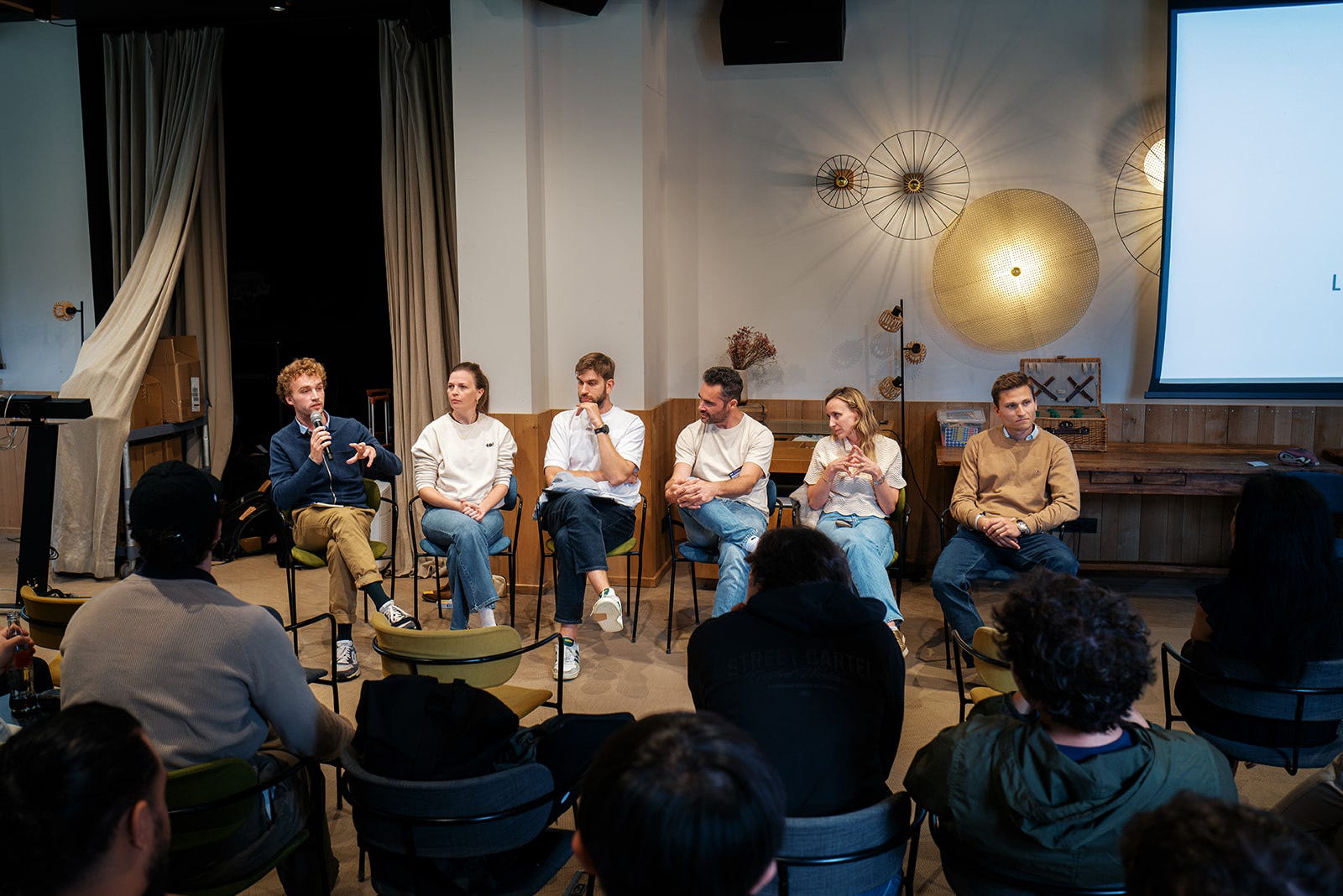
Which raises a rather obvious question. If FDEs are custom-building solutions, isn’t H just a consulting firm of sorts? Maxime told me he knows this is the critique. “Someone might say we’re just a services company in disguise,” he said, and “I strongly disagree. We productize the work we do to get value.” The approach is to “deploy first and productize second. We build the missing layer for the customer, then step back and productize it, so the next customer is faster and more self-serve,” Maxime said. The first time H works with a large telecom company, for instance, might be significantly slower than the next time they sign a telecom contract.
“Each deployment becomes a reference for the next company in the same industry, because the problems are often identical: the same legacy systems, the same manual workflows,” Gautier told me. H currently has a proven playbook for five industries: telecom, banking, energy, healthcare, and manufacturing (a list that I expect to continue growing).
So, why might H win? Gautier’s first reason is that they own the whole stack: the models, the agent platform, and the team that deploys it. “Big labs have great models but don’t deploy inside enterprises, RPA vendors deploy but rely on brittle scripts, and consultancies deploy but don’t own the technology,” he said. The second is that their agents work on any interface, including old systems with no APIs. The third is how they train their models: H starts with strong open-weight models and post-trains them on millions of simulated enterprise scenarios (not customer data). And, with every job their FDEs do, their workflows get better.
While the work H replaces today is mostly rote and tedious, the plan for H is to “start task by task, then entire processes end-to-end, until H becomes the execution layer at the enterprise.” In a couple of decades, Gautier said, “the mouse and keyboard will be long forgotten at work.”
The culture
H Company has about 120 people. They began mostly in Paris and London, but have since expanded around the United States with hubs in NY and SF and team members in Menlo Park, Austin, and Chicago. Not long ago, almost all of them were researchers. When Maxime Defauw joined to set up the FDE team, it was “researchers, engineers, a couple of people supporting research, and me,” he said. Now the two sides work together, and you see “researchers teaming up with FDEs and product people on side quests.” The offices are all quite collaborative.
New folks get onboarded fast; Hector Stanley, a lead deployment strategist who previously led AI implementation at Monzo, was “dropped into a sprint to launch a new product” at the start of his first week. Mel Murphy, who leads people, talent, and culture, set herself a goal of meeting every person in the company one-on-one during her first week. “My calendar looked wild.”
The general vibe is a flat-ish hierarchy where everyone is accessible. “You can walk up and talk to Gautier, and he actually listens,” Maxime said. Gautier believes that the people who perform best at H “treat their scope as a starting point, not a boundary,” and if you see an opportunity for growth or improvement you won’t be looked down on for bringing it up. (Even if out of scope.)
Days can be long (Hector works nine hours a day, Maxime around ten and Mel around 12), but the company understands that people have lives outside of work, and staying after-hours is more a product of people being excited to get work done than anything else. People from the team run together on Wednesdays, and around the office “jokes are taped up” on the walls.
As for who’s not a fit? Mel said some people found the environment “too chaotic, too fast moving.” And the research at H, Maxime said, is now “much more tied to the field,” and “some researchers won’t like it.” Much of the work H does these days is tied to producing real results for real companies, fast. If that is the kind of thing that sounds exciting to you, then you may be a great fit.
Should you join H Company?
I think there are few companies where you can be so close to real AI implementation driving real results as at H Company. “You’ll see [your work] in production at large companies within weeks, not years,” Gautier said. For the FDEs, it’s more like hours or days.
Many of the people I talked to came from jobs they liked. Maxime left Palantir to join, a decision he said was “genuinely hard.” When Gautier became CEO and asked him to build H’s FDE team, Maxime saw it as “a calculated risk: building something new and optimizing for the long term rather than the short term.”Mel had spent four years running people and talent at a Series B company, where she “caught the AI bug” and decided H was a better fit. Hector felt that H was his best shot to “really impact how work is done today.”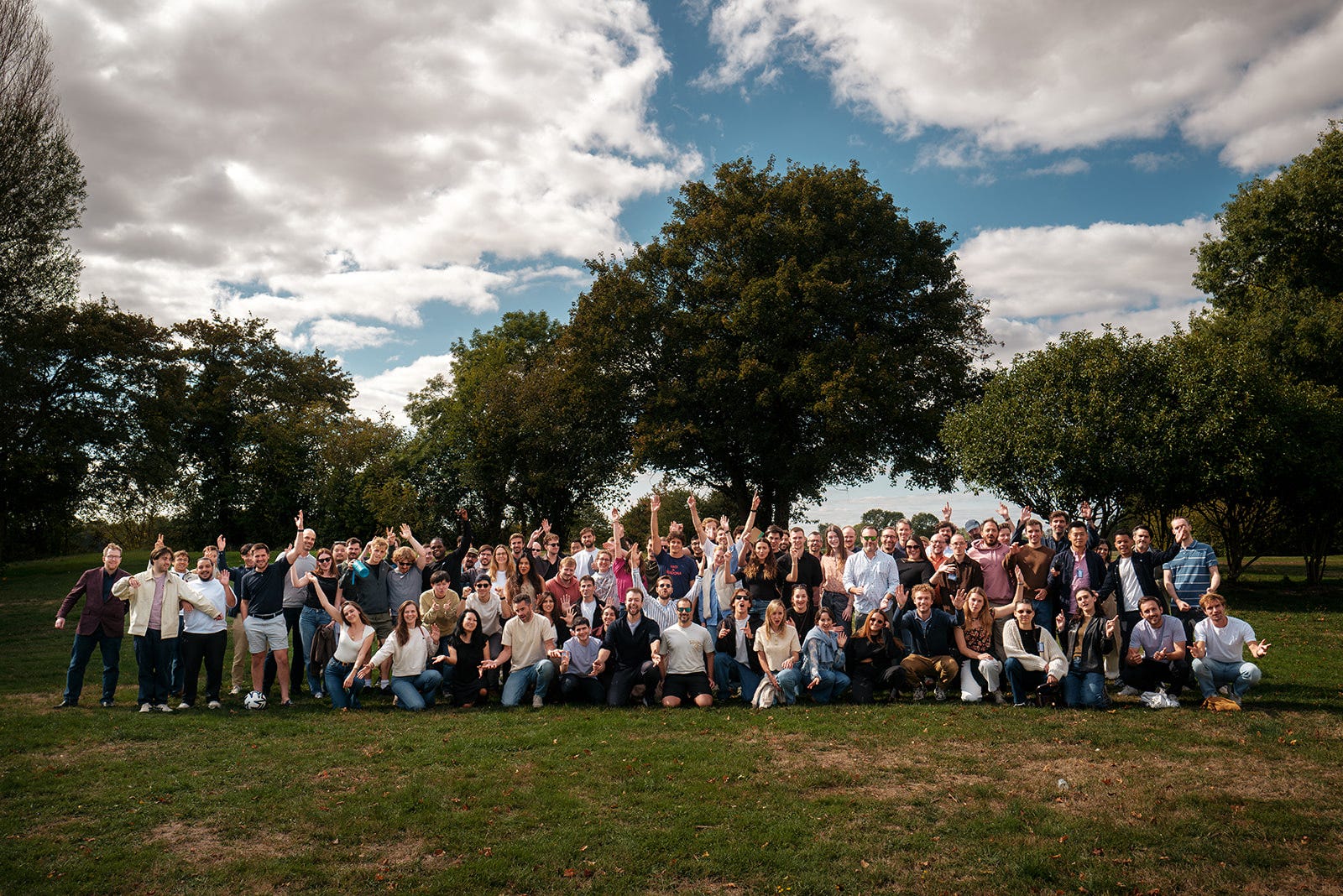
For engineers joining, the job is earlier-stage than something like Palantir. “Palantir’s platform was mature, so FDEs could sometimes lean on it,” Maxime said. “Here it’s much more zero to one. We’ve come a long way in the past year, but there’s still [a lot of work to be done].”
Gautier told me he likes to see “an entrepreneurial streak” in candidates, and prefers people who’ve built something with their own initiative. That could be a project within a previous company or a side project, but whatever it is, you should mention it when you apply. Speaking of, cold emails are fine, though you should be specific. “We read every one,” he said.
There are plenty of AI companies where you can join to work on a theoretical product that you are told (by someone, somewhere) is supposedly useful. There are fewer where you can work side-by-side with the customers who are getting the benefit, and see the change in real-time. H is now building the US into its main market, and most of that team is new, so people joining now get to help build it early on, with a lot of ownership and real equity.
If that sounds interesting to you… H Company is hiring in Paris, London, SF, Austin and New York. They are hiring for all sorts of roles, but they’re especially looking to find Implementation Strategists and founding FDEs (in the US), where you’d help run H’s work with customers.
Explore that role, and others, at H Company here.
Thanks to H Company for supporting Next Play and making this essay possible.