Inside the AI startup cutting hardware development cycles from months to days
Published: 2026-10-22
URL: https://nextplayso.substack.com/p/should-you-join-flow-engineering
✨ Hey there - this is a free edition of next play’s newsletter. This is part of our series Should You Join, where we go behind the scenes on interesting companies. Our hope is that documenting these sorts of details, which never really make it to big publication press releases, can help you a) discover more interesting opportunities and b) inspire you to think creatively (for any of your own endeavors). You can join our private Slack community here and access $1000s of dollars of product discounts here.
It’s Saturday in 2050. Jack, a fourteen-year-old kid in London, opens up his favorite piece of software. He uses it to design a custom e-bike conversion kit for his ‘90s mountain bike. Jack describes what he wants and the software works out the rest. By Monday the parts are ordered, and a print shop is making the brackets that hold them onto his ancient bike frame. He puts it together the next weekend and rides it up the hill to school the following Monday.
Thousands of miles away, in an office ten times more elegant than Jack’s bedroom, one of the world’s leading rocket scientists opens up the same piece of software. They use it to redesign a valve on an engine that launches next month. Thousands of agents, doing work that would previously have taken weeks, work out how the new valve impacts fuel lines, flight software, weight budget, and paperwork. The answer comes back to the engineer by morning.
In this future, there is one powerful piece of software that everyone uses to build great hardware, fast. And that software is made by Flow Engineering, the company we’re writing about today.
Flow is filling a desperate gap in the market. It’s not controversial to say that the past five years have transformed the way software is built. The floor is lower (anyone can code now) and the ceiling is higher (great engineers can do more, faster), and the basic flow for building software has morphed from typing into an IDE to writing a prompt. Hardware, on the other hand, has not had the same kind of revolution. Engineers are using the same tools they did decades ago. Existing AI-powered tools have provided incremental gains, if any at all.
Flow wants to fix that by building the agentic platform for hardware development.
So I chatted with Pari Singh, Flow’s Founder & CEO, as well as many folks on their team to learn about what Flow’s big vision really is, why they’re building it, and what kind of people tend to succeed at the company. By the end you’ll have a good answer to the classic question: Should you join?
The product
It is not a coincidence that hardware engineering has not experienced software’s agentic revolution yet. That’s because building hardware is often more complicated than building software. One way it’s more complicated is that hardware is built by several kinds of engineers at once (including software engineers!), each working in a different tool. Their work all depends on each other, so a small change in one place can break something in hundreds of other places.
There are also the stakes: a glitch in your meeting notetaker software is annoying, a glitch in your rocket potentially loses you billions of dollars (and if you’re unlucky, human lives).
Let’s say you wanted to solve this problem. That you wanted to build a new way for people to build products, all the way from the first requirement to the final test. Where would you start?
Flow’s answer was to start with requirements. In hardware engineering, a requirement is a rule the finished product has to meet: e.g. the battery can’t go above 47 degrees, the brakes have to stop the car within a certain distance, the gearbox has to weigh less than 14 kilograms. A complex machine like a rocket has thousands of requirements, and a small design change by one team can compromise the safety or performance of the entire system.
Right now, most of that information lives in spreadsheets and legacy requirements software. Flow brings it all in one place and links each requirement to the CAD, code, simulations and tests that are supposed to meet it. When an engineer changes something, Flow’s agents check that change across all the requirements,alert engineers of any problems, and propose a solve.
A Claude chat can’t do any of this. “If you say, ‘Design me a valve for my [rocket],’” Pari said, “it doesn’t know what type of valve you mean. It doesn’t know the physical constraints, the 3D constraints, because they live in a different tool, a different realm. It doesn’t understand the timing constraints because that’s in Git, in software, in a different tool. It doesn’t understand the regulatory constraints, or [anything else].” So that’s what Flow solves today.
Part of the reason it makes sense to start with requirements is that hardware teams can actually buy in. If you go to one of the biggest rocket manufacturers in the United States and say “hey, here’s a new AI-driven platform that will completely transform the way you do everything” you’re going to get hit with skepticism. But if you ease into that over time, if you start with something like “here’s an obviously useful tool that will help you move much faster and build better products,” which is effectively the pitch for Flow, it’s far easier to get a yes.
The future for Flow, however, is so much bigger.
The big picture
Flow sees hardware development in three eras. First came analog: engineers designed machines on drafting tables, worked through calculations by hand and tested physical prototypes. Then came digital: CAD and simulation let engineers model, test and refine designs on a computer before building them. Flow believes the next era is agentic: engineers direct AI agents that carry out engineering tasks, trace the impact of changes and continuously check designs against requirements. The company wants to be at the center of that shift.
Pari expects that AI in hardware engineering will both lower the floor and raise the ceiling, just as it has for software. “A small team can now build software that would once have taken an entire engineering department. That changes the economics of what’s worth building. We expect the same thing to happen in hardware. Companies like SpaceX and Rivian will be able to develop more complex machines and iterate much faster. And a small engineering team could build a specialized robot for a factory where the development costs would previously have killed the project. More ideas become viable, and more teams can pursue them.”
When this happens, “you’re going to see how the physical world is completely transformed.”
Of course, there is lots of work to do between now and achieving that world. Flow is focused on three foundations it believes are essential to that future. First, it has brought a range of tools that software engineers have relied on for years to hardware engineering, including version control and automated testing. Second, it has built the context layer that feeds agents the right context for each task. This is hard because a rocket program contains far more information than any AI can process at once, so selecting the relevant slices of information (e.g., requirements, interfaces and design decisions) is critical. Third, it needs to bring specialized agents together to work on the same design. Its systems engineering agent is already in place. The next step is to extend that capability across regulatory, electrical, mechanical, firmware and software engineering, and into tools like CAD, so agents can coordinate changes across an entire system.
Starting with requirements gives Flow a foothold across the entire engineering process, from design through testing. That matters for agents; a smarter model doesn’t help if it can’t see a company’s CAD, code, and test results, and Flow already integrates with all of them. And each new agent Flow ships runs on information customers have already put in place, so the product gets more useful the longer a company uses it. (These customers are also very sticky; switching engineering platforms is not like switching from Claude to Codex).
“We’ve put together what I think is a pretty unique combination of market opportunity, problem, and team, and the product is getting better every day. The challenge now is simply executing on the vision we’ve created,” Adam Mualem, an FDE at Flow, told me.
Flow went from zero to 30 major enterprise customers in the 18 months after it found product-market fit, and 96% of Flow customers have come via inbound Rivian and Anduril are two bigcustomers, though there are plenty more you’d recognize that Flow can’t name publicly. Flow raised a $23M Series A from Sequoia in October 2025 and a $50M Series B at a $750M valuation just last monthThe latest round was co-led by Gavin Baker of Atreides, who invested early in Nvidia, Tesla and SpaceX and Antonio Gracias of Valor, an early backer of Tesla and SpaceX.
The culture
The culture at Flow is all downstream of trust. “Maximum trust,” as Pari calls it. At most companies, he said, the default is that you give each employee as little trust as possible. Keep their scope limited, make sure they don’t do any damage. The inverse is true at Flow; people on the team have full trust from day one. This means they can do whatever they think the company needs without having to ask first. “Go. Just go,” Pari said he tells new hires who spot problems.
On his first week at Flow, one engineer said he thought something was going wrong with one of their customers but wasn’t sure what. Pari told him to “just go,” so he hopped on a plane to LA and spent a week hanging out at the customer’s office. “A week later, he was able to identify all these problems we didn’t even know we had yet, and built all these features they didn’t even know they needed yet, and it completely transformed the relationship,” Pari said.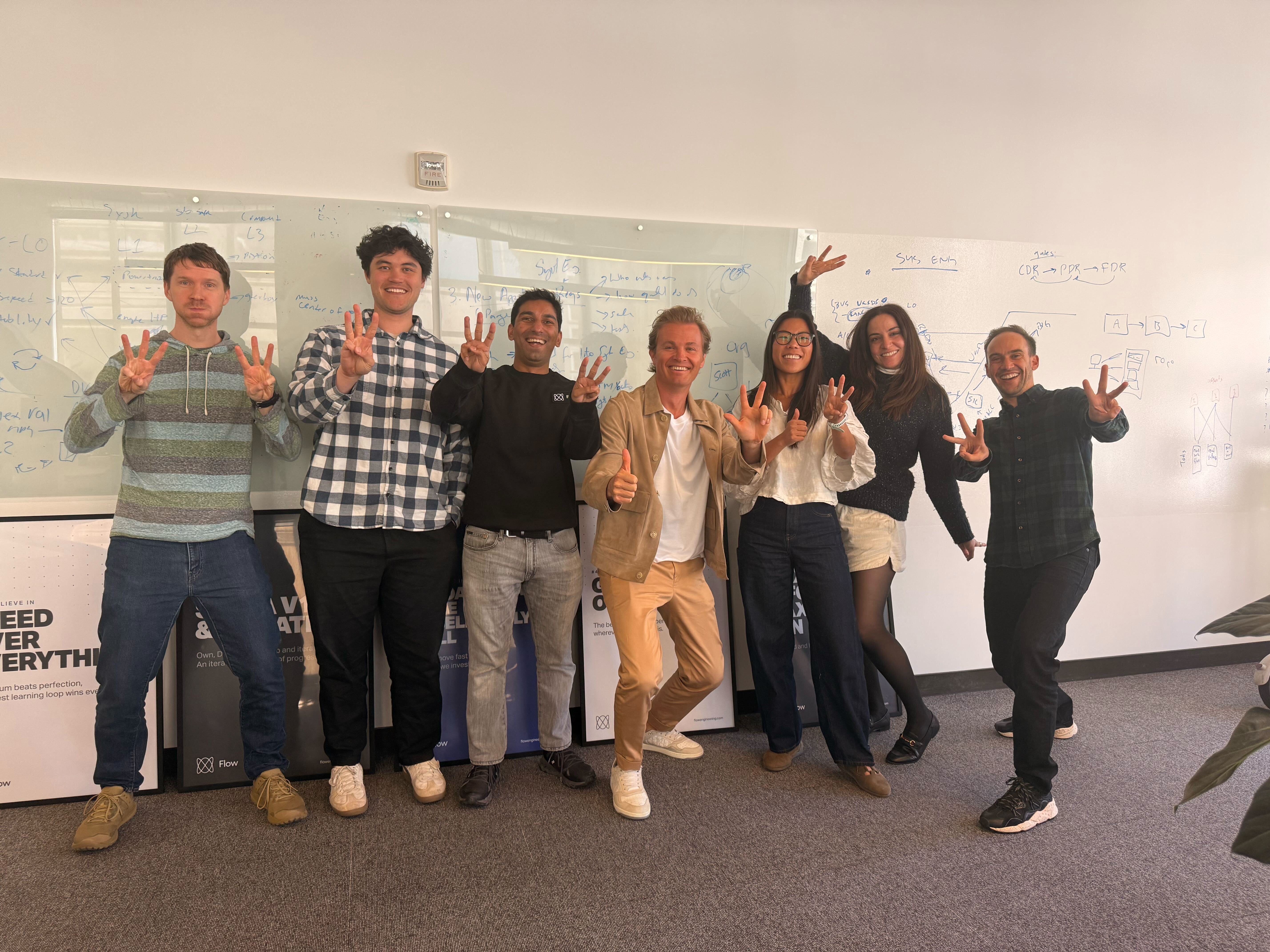
It helps that the team at Flow is way smaller than average for their revenue and fundraising size, and that they’re careful about hiring. Flow was just seven people when they raised their Series A and 25 when they raised their recent Series B. Most companies with the same customers and revenue would probably have 100-plus.
Being “careful” about hiring, in Flow’s case, doesn’t mean conventional. Some of Flow’s best hires have come from unexpected backgrounds. “What we saw in them is that they were weird oddballs with an exceptional spike,” Pari said. “In some cases, Flow built roles entirely around that particular person’s spike. Those bets have largely paid off big.”
“The example I shared about a first-week engineer flying out to a customer isn’t really an outlier; ‘get on a plane’ is quite literally one of the company’s core values.” At Flow you’re working directly with customers (they are FDE-heavy) and getting their feedback immediately. “We don’t have the spec phase per se,” a software engineer said. “Instead engineers get a list of bullet points of a feature/feedback and get to work,” always talking directly with customers.
You would be right to assume all of these details form an intense culture, but it’s “not 996,” Pari said. The general principle is that the team does what needs to be done. If there’s an urgent problem to solve for a customer, people might stay late or work the weekend until it’s done. And then, if the next week isn’t as chaotic, people might work shorter hours and recover. There’s a push-and-pull at Flow and it really depends on what needs to be done on a given week.
When I asked Flow’s Head of Ops, Gabriel Louis-Kayen, what was most different compared to other jobs, he told me: “I have more agency than in the past. There is a lot of trust shared throughout the whole company.” If there’s one thing you take away, I think trust is the word.
Should you join Flow Engineering?
I hope it’s obvious that Flow is solving a unique kind of problem, and that their grand ambition would mean a complete transformation (or upgrade) of the way hardware gets built. If that sounds exciting and you have conviction in Flow and the market, I think there’s little that should stand in the way between you and applying to one of Flow’s open roles.
Pari said that a core part of his pitch to technical and engineer-minded folks is that you are “building products for some of the smartest people in the world. You are getting direct feedback on your work from literal rocket scientists.” And I think if that cross-disciplinary vibe excites you, and if you like the idea of seeing your work being put to use by people who are building things that really matter in the real world, then Flow might be particularly exciting.
“We can literally see our customers’ productivity increase,” Pari said. “And then they manufacture a rocket engine, and they test it, and they tag us in it, and it’s just amazing.”