Inside the startup bringing AI to the home services
Published: 2026-10-01
URL: https://nextplayso.substack.com/p/should-you-join-revin
✨ Hey there - this is a free edition of next play’s newsletter. This is part of our series Should You Join, where we go behind the scenes on interesting companies. Our hope is that documenting these sorts of details, which never really make it to big publication press releases, can help you a) discover more interesting opportunities and b) inspire you to think creatively (for any of your own endeavors). You can join our private Slack community here and access $1000s of dollars of product discounts here.
There are a few ways people like to talk about the role of AI in the labor market. Perhaps the most popular is AI as a job replacer, a technology that is currently in the process of wiping out large quantities of existing human jobs. People also talk about AI as a job augmenter, a technology that you hand to humans who can use it in their workflows to be more effective.
But there is a less-considered angle, which is that in some cases AI is also producing net new labor: it is doing labor which would have simply not been done pre-AI.
Imagine, for instance, that you run a plumbing company. Your business is fixing pipes, but getting that business involves answering the phone. Missing a call or a text might mean losing out on $1,000s. The issue is that there’s no realistic version of the world in which you can immediately answer everyone who contacts you. There are real-world constraints! You only have the margin to employ so many people on the phones; employees sleep at night even when urgent calls are coming in; the office can get overwhelmed with too many calls at once; people make mistakes.
So the base case for a services business, like this plumbing company, is that your front office will always be capped at “good enough.” No, you’ll never take every call. There will be some missed revenue. But you’ll do your best. And maybe that’ll be okay.
However… If there were a well of infinite labor to pull from, then maybe your front office would be better. Maybe it would raise the ceiling for your business. You could book more revenue. Be more efficient. Run more profitably. But that’s just a fantasy. Or, better said, it was just a fantasy.
Revin, the company we are covering today, is making it possible for services businesses to staff their front offices around the clock with AI. So that every call or text is answered, effectively and right away. And so that services businesses can get back to doing the stuff they do best.
“Revin is not selling software. We are selling labor,” Quinn Litherland, the founder and CEO of the company, said. Rather than being about replacement, Quinn said, Revin “is about making sure no opportunity falls through the cracks, and giving sales teams more time to focus on serving homeowners.”
So, how are things going so far? What’s the plan? What would it be like to work at Revin, and what sorts of folks are they looking for? And, of course… Should you join?
The product
The front office of a physical services company can be a chaotic place. Unlike software, where you’re often dealing with self-serve signups and recurring billing with no real human bottlenecks on how much you can scale, physical services have all kinds of constraints.
For one thing, most jobs get booked by phone call or text just a few days (or hours) before the caller wants the job to be done. Having someone to man the phones is hard enough; it’s impossible to predict who is going to call and when, and a missed call is missed revenue. And even if someone does pick up the phone, you have to be smart about scheduling. You have a fixed number of specialists with a fixed number of hours in a day, and they’re probably all busy.
So if the caller has a leaking water heater, the person answering the phone has to figure out what’s wrong, whether it’s urgent, and which nearby technician can get there this evening. Then they have to enter all of that into the scheduling software while, more than likely, they’re already getting another call. And with bigger jobs, like a new roof, it might take weeks of follow-up before anyone signs. The outcome of this system is more or less the following:
-
Lots of calls get missed
-
People forget to send follow-ups
-
Scheduling is unoptimized or messy
-
Texts or form fills sit for hours with no response
-
After-hours calls go to voicemail
-
Technicians show up to the site without complete information
-
Lots more!
All of these roads lead to the same place: lost revenue and smaller margins.
Revin handles it all. Their AI agents work the phones, texts, and email for services businesses (like HVAC, plumbing, and roofers) and book new revenue. Agents run calls just the same way humans would, then book jobs directly into the company’s scheduling software (like ServiceTitan) while the caller is still on the line. A real human can always take the reins. And Revin can send follow-ups proactively for leads that have gone quiet.
Each agent is trained on the company’s own call recordings, scripts, and scheduling logic. Revin assigns a forward-deployed engineer to every single customer. This engineer spends time learning, sometimes on-location, how they take calls, then tunes the AI agents until they’re perfect.
How about some examples? At K&P Remodeling, a $25M remodeler with a 13-seat call center, Revin now drives 32% of all booked appointments. At Action Furnace, one of Alberta’s largest HVAC companies, Revin has sped up lead response time to 2 seconds (and nearly 40% of the appointments it books come in after-hours). And at Del Air, an HVAC and plumbing company, it booked more than 500 appointments within the first two weeks with a 10% higher booking rate than the average CSR. (Plenty more stories here.)
The strategy and growth
Revin is operating in an industry that books $650B+ in revenue per year, and they’d like to be the way every single dollar of that revenue is booked. So perhaps it’s not difficult to see how this could be valuable. Nor is it difficult to picture other ways Revin could expand in the future: running more of the back office, moving into other trades, or eventually becoming a bigger piece of software that these companies fully run on. Lots of possibilities here.
For now, though, picking up the phone (and similar) should be able to make them many millions or billions of dollars. And Revin is doing a good job at it: since raising $10.7M back in August of 2025, they’ve grown more than 8x. More than $2.3B in customer revenue runs on Revin.
It would be naive to write about Revin without acknowledging that they’re not the only company in this space, even more so because we wrote about one of their competitors, Avoca, just a few months ago. (If you read Next Play frequently then you will no doubt have clocked the similarities between the products.) No, front office work for services businesses is not a completely untouched market. What makes Revin different, then? How do they win?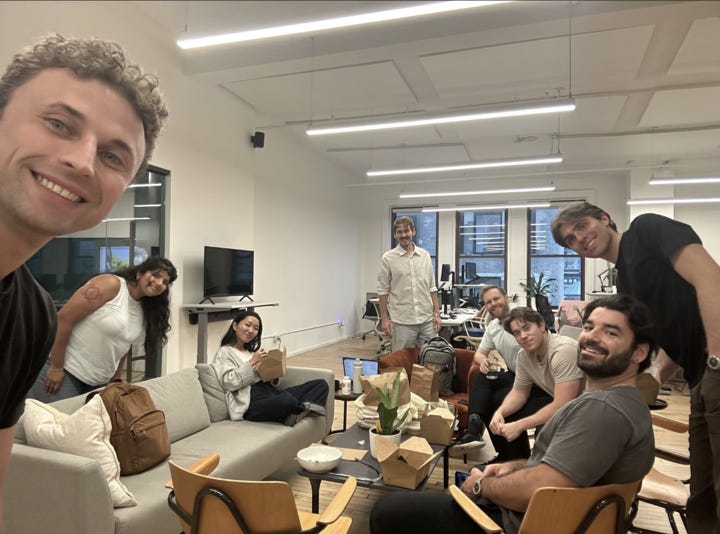
I think one fairly clear differentiator is how deep Revin goes with their customers. And sure. Every company says that. But going deep with customers is literally part of Revin’s business model: every company they work with gets assigned a Revin forward-deployed engineer who does custom work to get them set up. Most competitors, Quinn said, just use a basic onboarding form. Engineers at Revin also earn commission on renewals and expansion. “How do you make sure your FDEs walk into the office every day thinking, ‘I can make a million dollars this year if I renew every account and expand them?’” Quinn said.
Quinn, according to Head of Engineering Stephen Webel, is “on a texting basis with many of the leaders at our customers’ companies.” And Grace McShea, an AE, said that the on-site visits are why customers trust them: “We would not have the buy-in or trust we do without them.” So yes, there are other companies in this space, but none of them are so obviously applying the Palantir-esque FDE model as Revin is.
Another part of the strategy is that, at least for now, Revin is not trying to go replace ServiceTitan or similar companies. Quinn’s reasoning, after watching ServiceTitan cut off Podium when Podium built a competing product, is that “as long as you don’t try to stab the bear, you’re probably going to be fine.” (This of course doesn’t mean they won’t try to expand their product to any of ServiceTitan’s core competencies in the future.)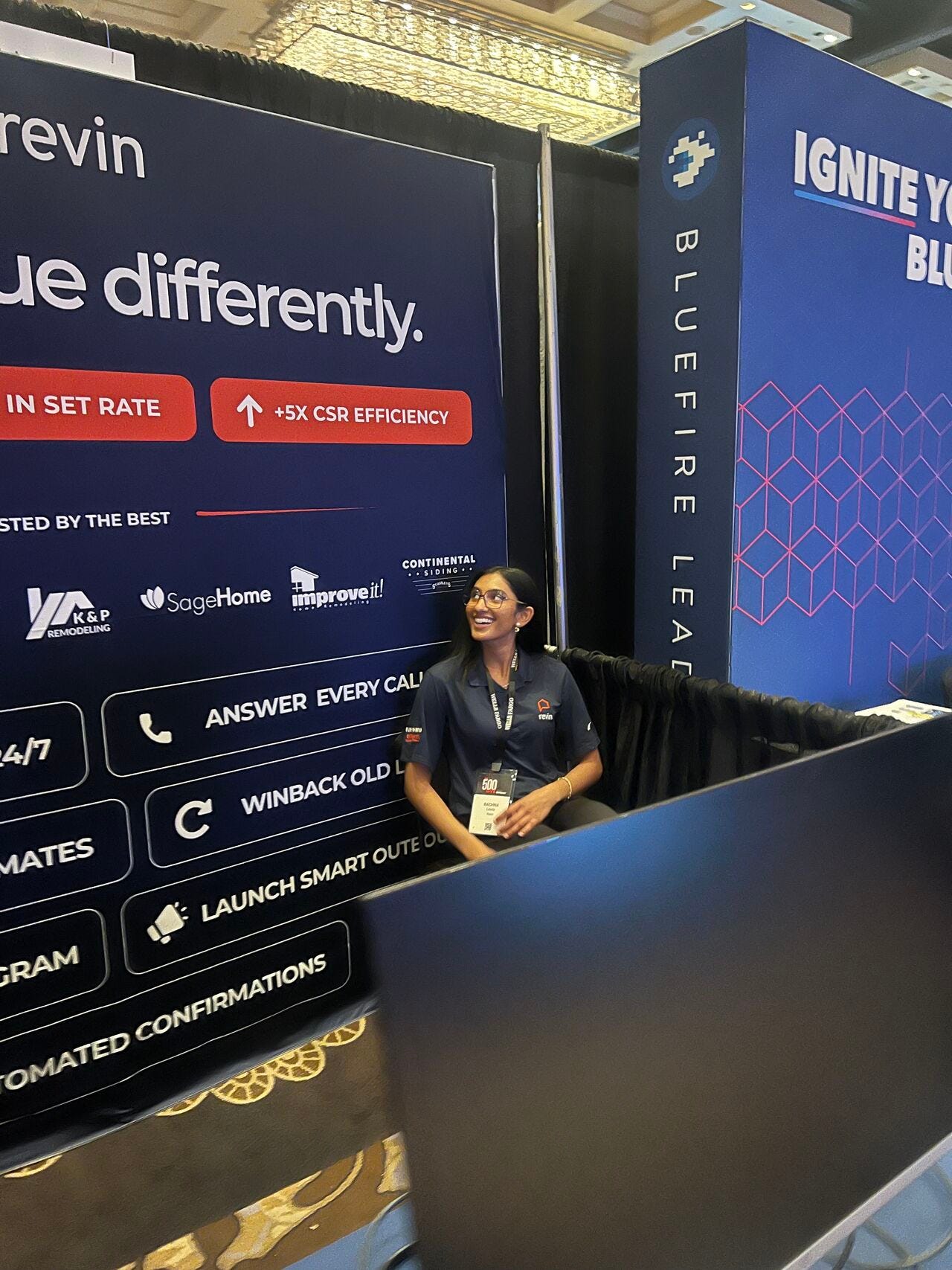
The culture
You might expect a company that goes so deep with its customers to make customers a big part of the culture. And if you expected that, you’re right: customers are a big part of basically everyone’s job at Revin, even roles that traditionally don’t have much customer contact.
“We consider spending time with customers part of an engineer’s job,” Stephen said. “We keep standing internal meetings pretty minimal, but we’re happy to spend time understanding how our customers work and where they’re struggling.”
At Revin, you might feel more personally tied to a customer’s success or failure with the product than you might at other startups. “The customer work is hard, since you are close to it when it goes badly and not just when it goes well, which on top of normal early-stage volatility asks for an even temperament,” Sumanth Rudraraju, an FDE, told me.
What else should you know about the culture? You’re going to work hard, but perhaps that’s not a surprise as a startup as early as Revin. Most folks I talked to said they work about 10 to 12 hours per day, mostly in-person at the New York office. And new hires get lots of responsibility quickly. “Within my first ten days I [owned] seven client accounts,” Sumanth said.
Revin pays for lunch and dinner on office days (a perk you don’t always see). It’s maybe underrated how nice this can be if you’re working hard. “I cannot imagine working until 9 and then having to go home and meal prep afterward,” Grace told me.
As for the vibe in the office, people start the day “heads down cooking,” Stephen said. But in the afternoons, “someone will put on music and the energy picks up. Sales is talking to us about questions from prospects, and product and engineering are jamming about things we’ve learned on customer calls.” Then, dinner. Usually these are working dinners, but once a week, there’s a Family Dinner where everyone closes their laptop, does a big group order, and chats around the couch. You might even catch them cracking a beer. Even when talking about work, the team told me they keep things light-hearted and have a sense of humor. The culture is collaborative and low-ego.
The other slightly unusual thing you might notice in the office is the sound of people talking out loud to AI agents. “We do a lot of our communication and documentation by talking out loud to Claude,” Tiffany said, so ”you’ll hear people talking into their laptops throughout the day. And our documentation is often Claude artifacts.”
“We’re incredibly deliberate about who we bring in,” Jon Epstein, Revin’s VP of Operations, said. “The result is a team that loves being here. We eat together, hang out together, and we’ve all spent real time watching what our customers do every day. When you’ve seen a dispatcher juggle ten calls at once or a tech crawl into an attic in August, you don’t take their business lightly.”
I also came away with the impression that the team likes each other, and their work. “There is simply nothing better than when you look forward to coming back to work when you leave for the weekend on a Friday,” Grace said. And if you can say that honestly… I’d say you have picked a pretty excellent place to spend the majority of your time during the week.
Should you join Revin?
From a business perspective, Revin is a well-funded, fast-growing company bringing a great product and a hot model of implementing that product (FDEs) to a large market. And they’re still early. Joining now is getting in close to the ground floor; early enough that if Revin succeeds in the long run you’d have “early at Revin” on your CV and it would actually be impressive.
You should only join, though, if you’re the kind of person enjoys high autonomy and ownership, and can move on fast timelines. “Someone who needs long runways and stable requirements would find [working at Revin] uncomfortable,” Sumanth said. “AI timelines are short, so the window to win a customer is compressed and that pressure runs through everything [at the company].”
At Revin you’d also get the chance to sell to a space that isn’t getting bombarded with AI pitches (at least not to the extent tech startups are). “It’s extremely special,” Grace said, to have customers “in a space which has yet to adopt AI. Lots of white space.”
“Throughout my career, I kept asking myself, ‘where are my mom and dad in what I’m building’?” Stephen said. “There was never a direct line between them and my work. At Revin, we get to build for everyday homeowners and the people servicing their homes… I joined to build great software for the everyday person.”
Revin is currently hiring across most departments for their office in New York City. You can go look at their open roles here. (If you want to do more besides just filling out the application form, here are some ideas for how you might go above and beyond when you apply.)
Thanks to Revin for supporting Next Play and making this essay possible.