What it’s like to build software for the world’s highest-stakes hardware
Published: 2026-09-17
URL: https://nextplayso.substack.com/p/should-you-join-revel
✨ Hey there - this is a free edition of next play’s newsletter. This is part of our series Should You Join, where we go behind the scenes on interesting companies. Our hope is that documenting these sorts of details, which never really make it to big publication press releases, can help you a) discover more interesting opportunities and b) inspire you to think creatively (for any of your own endeavors). You can join our private Slack community here and access $1000s of dollars of product discounts here.
Sometimes I talk to people who tell me they want to work on something real.
What does that mean? Well, the VC-backed startup world can sometimes feel like an ouroboros, like software all the way down. You look at the outcome of your work and you realize it never touches anyone or anything outside of the tech startup loop. Just startups selling to startups selling to startups. And maybe you’re fine with that. But maybe you want something else.
What about software for real stuff? Important, big stuff? You know, like nuclear reactors. Or rockets. Or factory lines. Or jet engines. The real world needs software too, and building that software is one of the biggest challenges of our time.
And hardware is anything but niche; it’s having a moment right now in venture. One in eight startups in Y Combinator’s Winter 2026 batch is building something physical. Defense and national security startups raised more than $46B last year. Critical hardware is being built by (relatively) small teams that want to move as fast and lean as possible.
The problem is that the software underlying these pieces of hardware is old. LabVIEW, the standard tool for running hardware tests, came out in 1986 (and hasn’t changed as much as you might like to think). Revel, the startup we are covering today, is solving this by building the software that tests and controls complex hardware.
The best hardware teams in the world have “ambitious goals, novel designs, and non-traditional methods,” Hunter Smith, a senior solutions engineer at Revel, told me. “But they are stuck using the test and control software tools literally built in the ‘80s and ‘90s.”
This is a huge and high-stakes market, and the companies in it have never had more money or more urgency. So… What have they built so far? What’s the long-term plan? And what kind of person is a fit for this rather unique startup? I sat down with the Revel team to learn.
The product
Like I said, Revel builds advanced software that is used to test and control important hardware. But you might be wondering: well, what does that really mean? How does it work?
Perhaps the best way to understand this might be to look at one of their customers in particular: Astro Mechanica. This is a company that builds some of the world’s most advanced jet engines, airframes, and flight systems. Not the kind of thing you see in a typical Airbus A320; we’re talking more sci-fi here, like flying at supersonic speed.
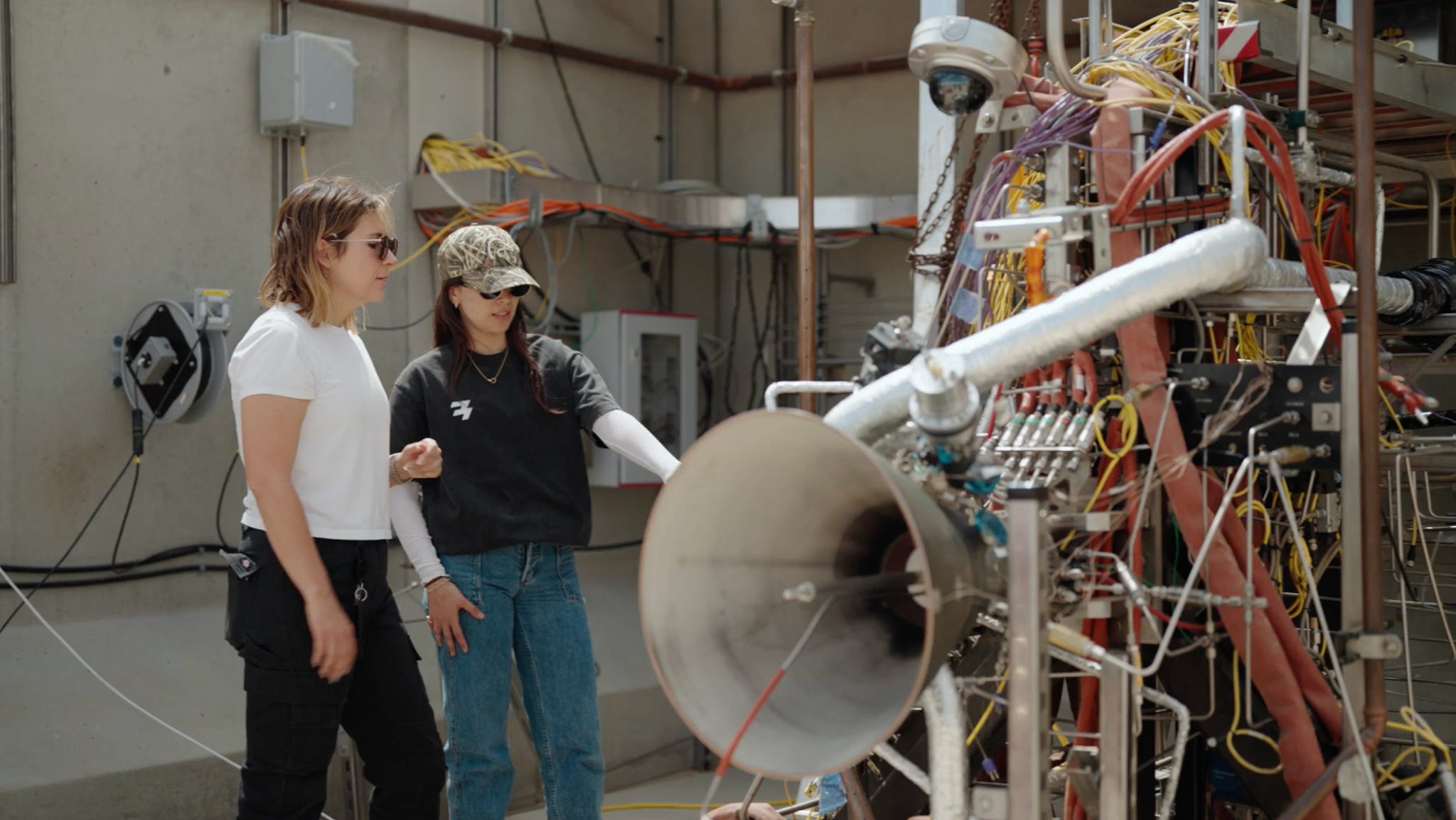
Astro Mechanica has to do a lot of internal testing: Jet engines (literally) get strapped to a test stand and get fired on the ground, over and over, with sensors that record everything (like pressure, temperatures, and flows) before they are allowed anywhere near an actual aircraft. As you might imagine, this testing requires software.
Before Revel, Astro Mechanica was running their tests with software they built themselves. But creating good internal tools to run tests is sort of like incubating a small software company. That’s not something most hardware companies really want to (or even can) do.
So Astro Mechanica got in touch with Revel, whose forward-deployed engineers came out and had the test stand running on Revel’s platform within a day. Some parts of the stand used custom devices on Astro Mechanica’s own in-house protocol, so Revel integrated with those rather than asking them to swap hardware. Then test operators wrote their own automations in RevelCode, built their own dashboards, and more - finally owning the test stand themselves.
The story is fairly similar with other customers:
-
There’s a hardware team testing something important
-
The test stand runs on homegrown or decades-old software
-
One or two people understand that software
-
Revel empowers test and hardware engineers to be self-sufficient
Today Revel offers two solutions. RevelTest is for test stands, where hardware is being developed and fired over and over. RevelC2 is for hardware already in operation, like a reactor, that needs to operate continuously and cannot be taken offline. Both have the following core components: 1/ a hardware configuration layer that connects to whatever sensors and controllers are on site, dashboards, etc. and 2/ RevelCode, the programming language the sequences are written in (it reads like Python but runs deterministically).
Testing is the first product because it’s where hardware companies feel the pain first. But it’s certainly not the limit of Revel’s plans…
The strategy
You always hear about product-market fit. And Revel is finding it: they say that every pilot they have run (where hardware has been plugged in) has converted into a customer.
But what about founder-market fit? Scott Morton, the CEO and founder of Revel, spent nearly a decade at SpaceX. There, he worked on projects including Falcon 9 and Starship, sitting on the console (i.e. monitoring tests in real-time) for high-stakes testing. He spent years living the very problem Revel is trying to solve: engineers relying on software to test and operate complex hardware where small mistakes can come at an extreme price.
“We believe hardware engineers can and should be far more self-sufficient,” Scott told me. “At many companies, software engineers act as intermediaries for hardware teams, building internal tools and writing test procedures on their behalf. Revel empowers hardware engineers to do more of that work directly.” And the goal isn’t to remove in-house software engineers from the picture; Scott said that “it is fundamentally better for the company when their software engineers can focus on difficult, foundational software problems, rather than serving as middlemen for hardware teams.”
So far, Scott’s thesis is landing. Impulse Space, Revel’s first customer, now runs more than 200 instances of RevelTest across its facilities. And Revel has already moved beyond rockets, with customers working on nuclear reactors, jet engines (like Astro Mechanica!), and other complex hardware. “No one has a stack built for hardware configuration/automation and deterministic execution quite like us,” Max Carrera-Newport, a founding software engineer, said. Revel has raised roughly $180M since it was founded in late 2024, including a $150M Series B (led by Index Ventures) in February this year at a $1B valuation.
RevelTest and RevelC2, if things go according to plan, are just the entry point. Scott & co. ultimately want to build a suite of products spanning much more of the hardware development process to serve many industries. “Each will solve a specific problem and work as a standalone product,” he told me, but “the goal is to create a connected system that supports the entire hardware development process.”
The culture
It’s obvious that Revel is a unique company doing interesting work alongside some of the best hardware teams on the planet. But what is it like to work here? What is expected of me? How is it different from other startups?
One difference is that Revel’s software is higher-stakes than the software most startups build. If your AI notetaker has a problem it might be sort of annoying for someone, but if your testing software fails the consequences could be far worse. “Engineers who work on systems that can break hardware have zero tolerance for vaporware or inflated capabilities,” Grayson Gordon, a founding software engineer, said. “Scott doesn’t have any [tolerance for that] either, and it’s obvious within minutes of talking to him.”
Attention to detail is present in everything they do. “I had just left [a large startup in the hardware space] the day prior with thousands of people that would just ship code to the field without any sign-off whatsoever and almost no documentation,” one employee said. At Revel, “almost everything they did had a trade study back to it, and every single change went through stringent review that was littered with comments.” At first, he thought this was overkill (“why not just talk it out?”) but his view now is that “our hit rate on the design of important features has been extremely high.”
You may not be surprised to learn, then, that the pace is rather intense. The team doesn’t work “performatively hard,” said Max Carrera-Newport (i.e. you’re not going to see them posting three times a week on social media about how long they spend in the office). But “we work hard [and] the pace is not for everyone… You’re trusted to set the right pace for you, but the folks around you will be pushing hard.” This doesn’t mean you won’t have time for life; Hunter Smith works about 8 to 5, and picks up his daughter from school every day. Like Max said, it’s hard work, but they’re not LARPing 996.
There aren’t many meetings day to day (“everybody hates them”), Grayson said. “We carry on the SpaceX tradition of having as few as possible, and of simply leaving, or not showing up, if you don’t feel like you’re contributing.” There’s a morning meeting per squad, which Max says they keep under 15 minutes, and the rest is Slack and quick huddles.
Revel’s office is one big open floor with no private offices. “The goal is to maximize communication, and superfluous barriers like doors work against that.” And there’s music. In the early days it was just Scott’s playlist, about thirty songs, so it just looped every hour and a half. That has been upgraded since, I was told.
Should you join Revel?
Working at Revel would put you within a rare density of great talent both inside the company (ex-SpaceX, Anduril, Palantir, etc.) and outside the company (the world’s best engineers at many of the world’s most exciting hard tech companies). And I think that might be one reason to join all on its own. You could expect to learn a lot, and to be pushed hard.
The people at Revel have a deep passion for hardware (and hardware engineers!) and I think you’d need to share some of that excitement to have a good shot at succeeding here. Building the software layer to test and operate things like jet engines and nuclear reactors should sound like a “yes, finally” sort of opportunity.
(Of course, it’s a bonus if you have already worked in testing environments at hardware companies, as many of the people on the Revel team have. But not a requirement.)
You could also consider who is piloting this thing. When Grayson was deciding whether to join, he asked around about Scott. “One of the most well-respected engineers on SpaceX flight software told me [Scott] was the best manager he’d ever had, and I’ve found that to be true: calm and helpful through issues big and small, an extremely high bar for honesty, and SpaceX’s ‘no assholes’ policy implemented in earnest rather than as a slogan...He’s the real deal.”
“We look for builders,” Scott told me. “It is a strong signal when someone builds in their spare time, but we are not looking for people who build purely to tinker. We want people who feel compelled to create something useful and deliver real value.”
Revel is currently hiring across most departments for their Los Angeles and San Francisco offices, with some limited hybrid roles. You can see their open roles here. “Any form of proactive outreach to Revel is an extremely positive signal,” Scott said. “It shows agency. The person is not simply waiting to be contacted, and they care enough about Revel and what we are building to take the initiative.”
My suggestion, if you do send a cold email or otherwise apply to Revel, is that you be thoughtful. A spammy message or hastily vibe-coded side project doesn’t really fit into Scott’s criteria. And I think you’re more likely to get hired if you show that you 1/ care, 2/ are good at your job, and 3/ understand the problem(s) Revel is trying to solve. Good luck.
Thanks to Revel for supporting Next Play and making this spotlight possible.