Inside the AI startup that’s also a financial services firm managing $1B+
Published: 2026-09-10
URL: https://nextplayso.substack.com/p/should-you-join-arca
✨ Hey there - this is a free edition of next play’s newsletter. This is part of our series Should You Join, where we go behind the scenes on interesting companies. Our hope is that documenting these sorts of details, which never really make it to big publication press releases, can help you a) discover more interesting opportunities and b) inspire you to think creatively (for any of your own endeavors). You can join our private Slack community here and access $1000s of dollars of product discounts here.
Imagine a world where everyone had a dedicated financial advisor. Forget all of this robo-advisor and ‘AI financial advisor’ stuff, I’m talking about a real human who would sit down and learn your goals and take good care of your money. Wouldn’t that be nice?
Right. It would be nice. But we’re not in that world. The vast majority of Americans, including people with $100,000s or $1,000,000s, do not have a financial advisor. So… Why is that? Why are we not in that dream world? Why does everyone not have access to a financial advisor?
One simple answer is capacity. There are about 280,000 financial advisors in the United States. That number isn’t growing much. If those advisors are unusually efficient, which by definition most of them are not, they can handle maybe 100 clients at once. That adds up to just a fraction of the total people in the United States who would like personalized financial advice.
But… Why can’t advisors handle more clients at once? Why can’t they do more for the clients they have? They just don’t have time. There’s an insane amount of tedious operational work involved with being an advisor: meeting prep, portfolio analysis, follow-up service work, opening accounts, compliance documentation, and so on. Advisors spend <20% of their time actually in front of clients. So yes, there are $10s of trillions worth of assets in the United States that could and should be managed, but no, the current capacity of advisors doesn’t make it possible to service them.
(The result, of course, is that these advisors reasonably prioritize the clients with the biggest asset pools who will make them the most money, leaving most Americans stranded.)
The grand solution is clear, then. Take the operational work away from the advisor and let them focus on client relationships, so that each advisor can (1) effectively manage a larger number of clients and (2) do much more for any one client than previously possible. That’s the mission that Arca is pitching, at least. They came out of stealth in June with a $64M investment announcement (from General Catalyst, Index, Venrock, and others), an advisory board including the fmr. CEO of Vanguard, fmr. CFO of Schwab, founder of Altruist, and the author of Psychology of Money, and over $1B in client assets already under management. Which is an impressive start, to say the least.
That fundraising announcement raised questions. How? What? Why? And, of course… Should you join? I sat down with the team to find out.
The product
Rron Rexha, the founder and CEO of Arca, made it pretty clear to me what Arca’s goal as a business is: to become “the first AI-native consumer financial services firm managing trillions in AUM and providing services across every aspect of finance, fully operated by agents, while humans do the things only humans can do -- [like] build great customer relationships.”
Arca is building what Nick Beim (an investor) describes as “a highly productized form of services organization.” The advisors stay at the center of client service, and everything around them gets rebuilt with AI so they can serve more clients more effectively. And from the client perspective, Arca just looks like a really great financial advisor with people who can dedicate a lot of time helping you face-to-face. And, well, it is! Or it should be, if they succeed.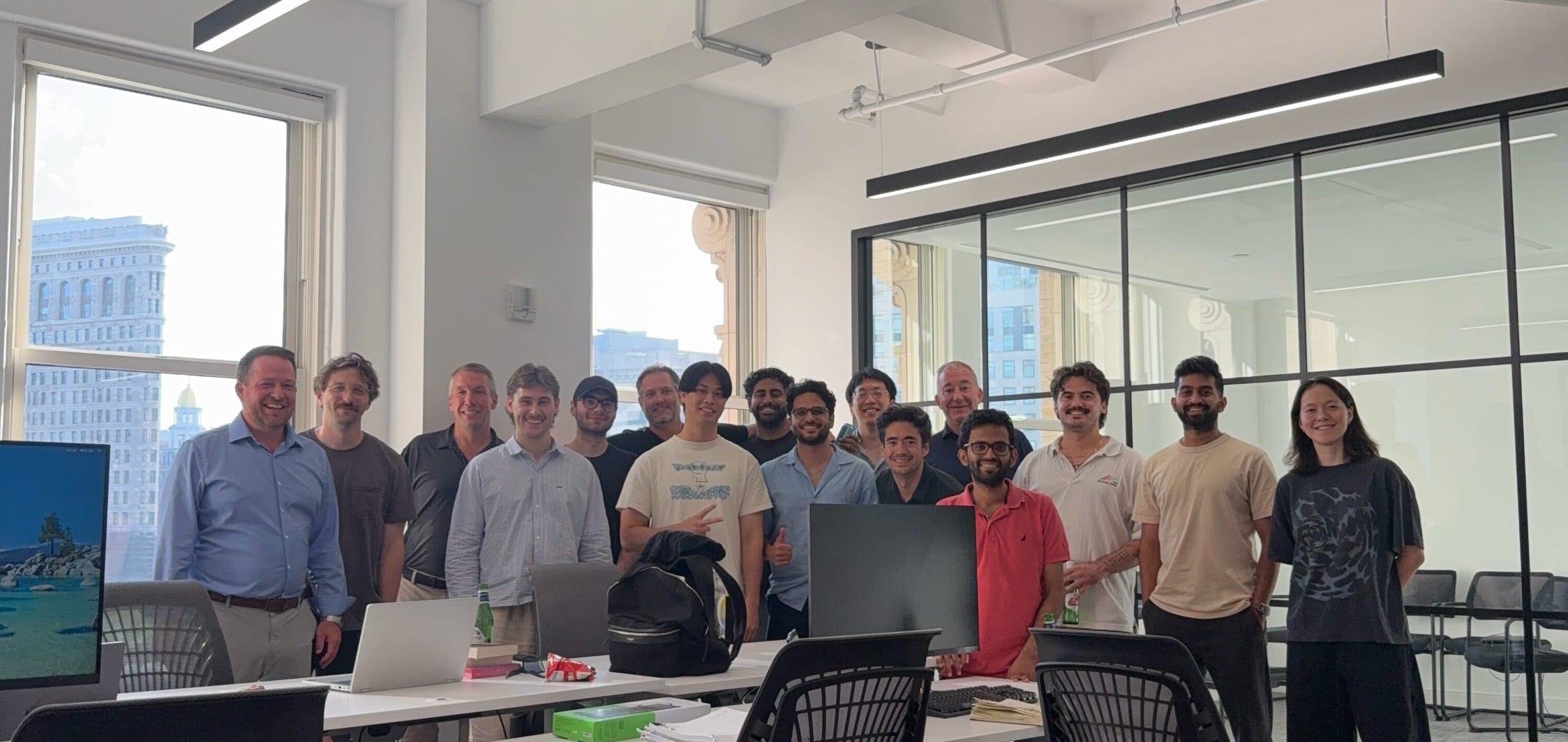
You may wonder how, exactly, Arca is using AI in this product. I think there are two clear ways it’s helpful here. One is the more obvious one, which is that AI can make advisors a lot more efficient by handling all of the routine operational work that consumes most of their time.
AI can, for example:
-
Continuously model financial scenarios to proactively replan a client’s situation
-
Watch the markets for changes that impact individual clients
-
Open accounts (like a 401k for you) in minutes, not weeks
-
Understand employer benefits to allow clients to maximize them
-
Run tax analyses to optimize opportunities
-
Uplevel advisor knowledge on niche financial situations and investment vehicles
-
Give advisors the confidence that nothing will fall through the cracks
-
Take on the full burden of documentation and record keeping
And lots more. Doing this well, as you might imagine, is not easy. Aman Singh, an AI engineer at Arca, told me that “to realize our ambition to run the business with AI, we have to build frontier AI capabilities into our platform.” One example is how Arca built a specialized agent harness for the business which does two things: 1/ it lets agents react to real-time signals from the world (e.g. an email coming in or an ACH landing), and 2/ it gives agents the ability to act on every capability in the platform, so they can do things rather than just flag them.
Another example is how Arca’s AI agents also have access to “sandboxes where they do complex financial planning work,” Aman said. And another is how Arca has “generative UI that dynamically builds beautiful user interfaces based on who’s looking and their context.”
The other, perhaps less obvious, piece of the AI approach is that it can make advisors at Arca more effective. Nick Beim, in his essay on Arca, argues that pooling all of an advisor’s client data in one place lets Arca bring “world class financial judgment to every contextualized financial decision they make,” so planning and portfolio construction get tuned to each client’s goals and priorities in a way that wasn’t possible (or at least, common) before.
You wind up with a clear win-win sort of situation. Arca can probably make more money per advisor than your typical firm, even if they aren’t charging the same rates as the financial advisors around currently (but you certainly still could). Their advisors could make more, too. And from the client perspective, you’d be working with a wealth firm that has lots of personalized, human time for you and is managing your money very effectively.
“Already, agents dictate all the work humans need to accomplish for their clients,” Aman said, which is the first step towards AI running the business. “We have a lot more to build.”
The strategy and growth
So far I’ve made it sound like Arca’s path is rather easy. But it’s not. “Let’s build software to make financial advisors more efficient” is not exactly an original idea; people have spent decades trying to win in this market. (With not-very-great success, in most cases.)
Most of those people and companies, though, have been building financial tools and selling them to advisors. Arca, by contrast, is the business. “Not only do we have top notch talent from Stripe, Plaid, Rippling, Ramp, DoorDash, etc.” said Erlun Lian, a founding member of the technical staff at Arca, “but we also ‘operate’ the business. Most tech startups sell software to businesses, but we ARE the business.”
This approach, Erlun said, offers a few clear advantages:
-
They have SMEs in-house.
-
The feedback loop is tight (users are coworkers).
-
They can leverage the data they get as a moat to improve their agent “exponentially.”
-
They don’t compete directly with other financial services SaaS companies.
-
There’s no implementation bottleneck (a real topic these days).
There’s also the semi-obvious benefit that Arca might make more money this way; they are actually managing people’s money and monetizing that directly. Whereas most of the financial services tools that sell to advisors are taking a much smaller slice of the pie.
In addition to attracting consumers organically, Arca has also been acquiring wealth management firms. This unique strategy for an early stage startup enables them to scale rapidly, both in adding more assets to their platform, but also advisors and data which in turn feeds their agentic platform and exponentially compounds the value of their ecosystem.
Another underrated benefit of their strategy, according to Kushal Cuttari (founding engineer) is that Arca sits “one level above any single piece of software. If a strictly better SaaS solution appears, we are not threatened by it. We can adopt it, integrate it into our stack, and immediately put it to work for our clients.”
Some of the folks who joined Arca also told me they were attracted by the business model and the moat in a market where lots of startups are worried a big AI company might put them out of business. “I was worried about the narrative of AI eating SaaS businesses,” Michael Cypher, a founding member of technical staff, said. “I didn’t want to join a team building a feature without a moat that would be replaced next month by a bigger player… Or that could be replicated inhouse by customers. Arca being the wealth management business itself derisked this entirely.”
So, although Arca builds a ton of software, I think it’s rather clear that joining Arca is a somewhat different bet than joining a software company (even in financial services).
Speaking of joining, it may be useful to know: what’s it like to work at Arca?
The culture
Arca’s working culture seems to be one focused on the same things their actual company is focused on: efficiency and outcomes. They’re all in-person in New York, which they believe is more effective (and is quite a popular policy within the company).
The intensity at Arca shows up pretty fast, by the way. Kushal’s second day was being handed the entire Outlook integration on a tight (weeks) deadline. Erlun Lian shipped something to production on his first day. One engineer’s first week was a hackathon offsite in the Poconos, where his team built prototypes for future versions of the platform. (Every single one of these prototypes has led to real products and platform capabilities.)
Every engineer at Arca does applied AI work, writing evals and reading traces to figure out where their agents are failing. You get high level goals (e.g. from Rron), but how you accomplish those goals is up to you. Kushal’s example of a goal: “get the average email response to a client <30 mins.”
It’s not often, by the way, that you get to work in the same building as your users. Engineers talk to Arca’s own advisors to figure out what actually helps them, and they get feedback on what they build near-instantly. “I’ve personally never had this much autonomy,” Kushal said.
Meetings are light. There is a weekly all-hands, which Michael described as a good time to ask Rron questions about the business. There’s a weekly ‘lunch and learn’ where someone shows what they built. There’s a weekly design crit, there’s some sprint planning, and standups. But people didn’t describe the meeting culture as excessive. Everything else is ad hoc.
As for Rron himself, Kushal described him as someone who “drives ambition in everyone around him. He’s constantly challenging us to raise our ambitions.”
Should you join Arca?
I can think of so many reasons you might want to join Arca. But what kind of person is particularly a fit here? I asked the team. Rron said he looks for people with “extreme ambition and curiosity, as well as deep desire for huge ownership in a small lean team.”
“There’s no space for leaders who don’t execute at our stage,” Michael Cypher said, “and our goal is to keep this as-is as long as possible. We love folks who have led product teams/orgs/more in the past, as long as they can translate that to execution at Arca. We’re relatively flat, which allows us to move quickly, and means ideas are evaluated on merit.”
Kushal reminded me that working at Arca is not really “a standard tech job, and that is both the upside and the downside.” Arca is a startup, yes, but it is also a registered RIA. You’re working alongside financial advisors. The bar is high and the stakes are pretty high, too. You’re going to be talking to customers more than you would in most roles. You definitely need to care about and deeply understand the problem space. “For some people this will be very energizing, and for others a complete misalignment with how they actually prefer to work.”
So… Should you join? I’ll leave you with Rron’s pitch to candidates.
“We’re building the AI-native financial services company of the future. One where the entire stack is completely verticalized, including the service, and our agentic platform operates the business… We’ve gone from zero to well over $1B in AUM in 7 months, and scaling rapidly. Our team is super lean, and each hire owns major areas of our business that they are solely responsible for building and scaling with all the agentic tools available to them.”
If that pitch (and this essay) sounds compelling, go explore Arca’s open roles. They are hiring across most departments for their office in New York City.
Thanks to Arca for supporting Next Play and making this essay possible.