#35 | A walkthrough on the newly released Google ADK
By Victor Dibia, PhD
Published: 2025-04-10
URL: https://newsletter.victordibia.com/p/the-google-agents-sdk-compared-with
Google released an agent SDK today at the Google CloudNext conference - the Google ADK. Having spent considerable time working on the AutoGen multi-agent framework, I was intrigued to see many design decisions we've made in AutoGen mirrored in this new framework.
This post examines the similarities and differences between these two agent frameworks.
Similarities with AutoGen
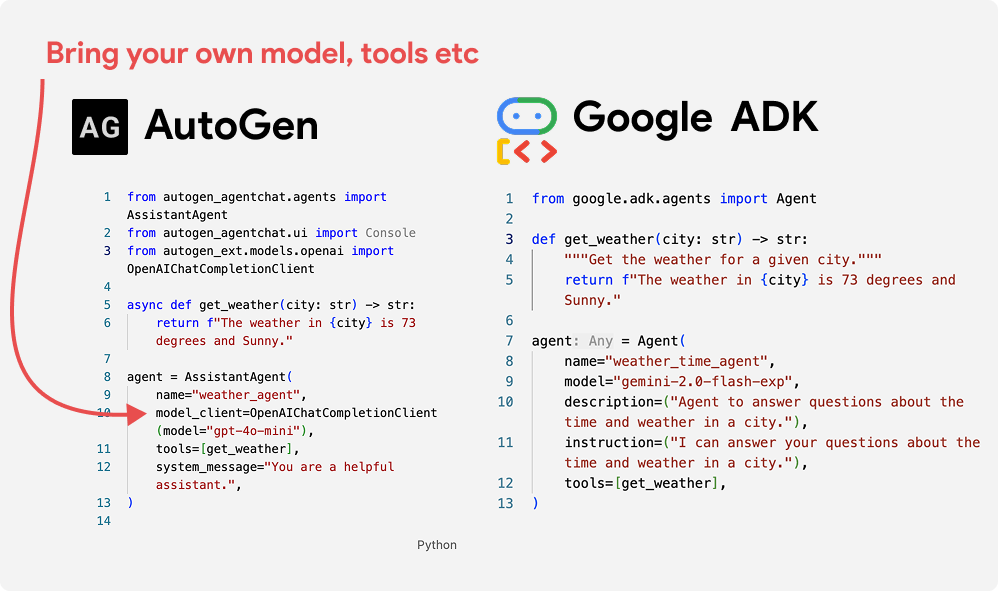
- Similar agent abstraction - Both use the pattern of
agent = Agent(model, description, tools, instructions/system\_message).
- Support for common multi-agent patterns.
Both provide abstractions for common multi-agent control flow patterns - patterns where an LLM drives control flow, or deterministic patterns where control flow is defined in code.
- Google ADK - LLMAgents, Workflow Agents (Sequential, Parallel)
- AutoGen - AgentChat Teams, AutoGen Core (Sequential Parallel). Here, I find the AutoGen teams api to be significantly more parsimonious for implementing
- Use of a FunctionTool
Both implement a FunctionTool abstraction to provide a consistent interface for tools with support for external tools like LangChain tools:
- AutoGen FunctionTool
- Google ADK FunctionTools
- Runtimes
If you would like to compare what the API looks like for AutoGen, LangGraph, OpenAI agents, see this interactive tool I built for comparing implementations of a helloworld agents sample across several frameworks.
Hint: its 32 lines of code in AutoGen AgentChat vs ~72 lines of code in Google ADK to implement a simple agent that calls a calculator tool.
Notable Differences
The Google ADK has some limitations and then some things it does really well IMO.
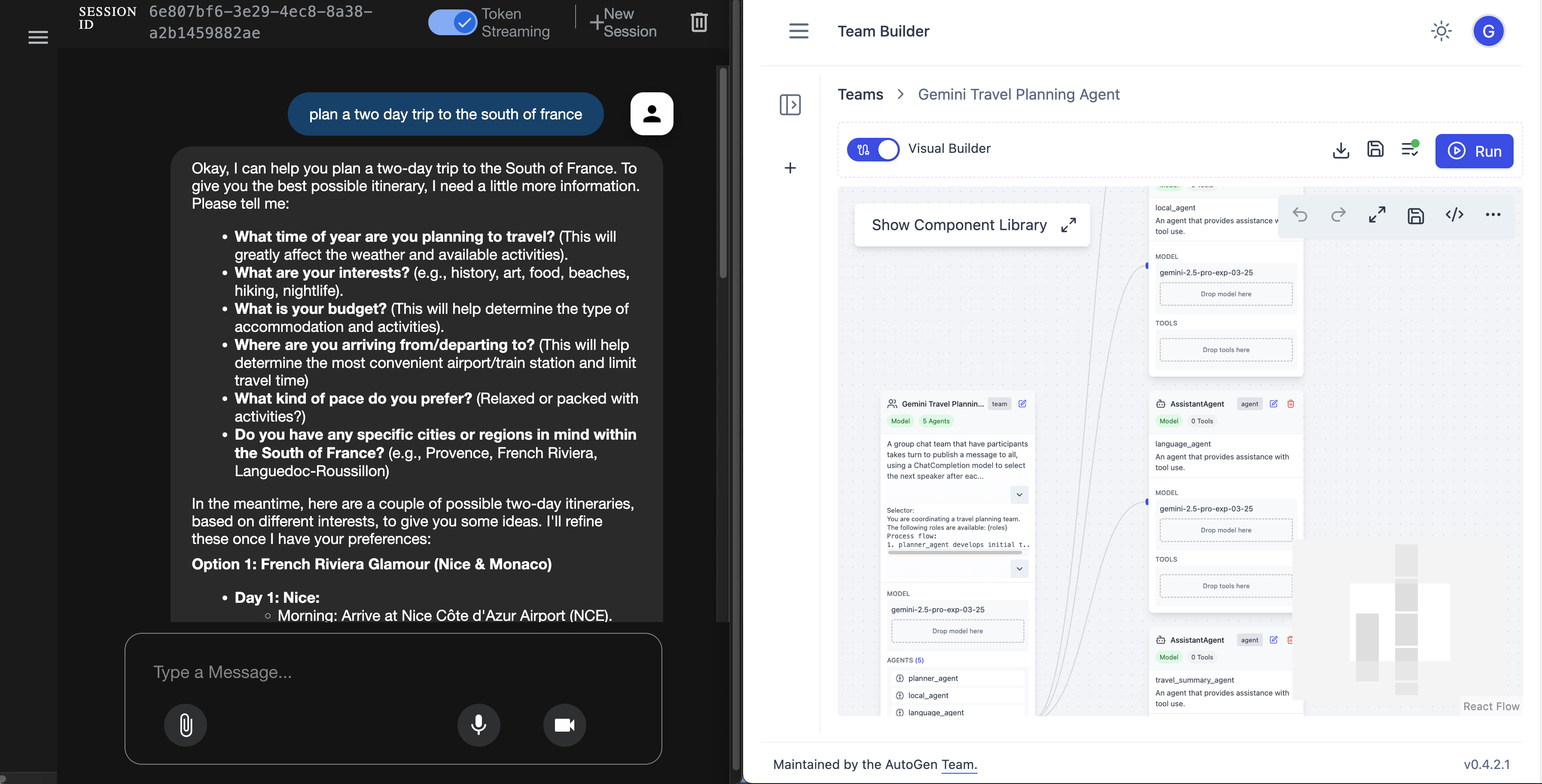
\Left: Google ADK Dev UI | Right: AutoGen Studio UI\
From a quick overview, there are a few ways in which the Google ADK could be improved compared to AutoGen.
- Runtime Management
While Google ADK does have the concept of a runtime/runners, AutoGen has a well defined Runtime that handles message delivery, agent lifecycle management with support for StandAlone and Distributed Runtime.
Google also released the Agent2Agent Protocol which lends itself well to the distributed agent scenario.
- Task Management Abstractions
Limited task management (e.g., task termination abstractions). See example task termination conditions in AutoGen
- Low Code Tooling.
The attached web UI is well integrated but still early/limited in terms of the debugging and rapid prototyping features compared to AutoGen Studio
- Declarative Specs
No support for declarative agent/multiagent specifications. See declarative specification in AutoGen which enables agent building in UIs.
- Observability and Tracing
I couldn't find a good approach for implementing open observability/tracing (e.g., with Open Telemetry). This contrasts with the more robust Tracing and Observability in AutoGen.
Naturally, I expect all of these features to improve as the library matures and garners usage.
There are a few things that I think it also does really well:
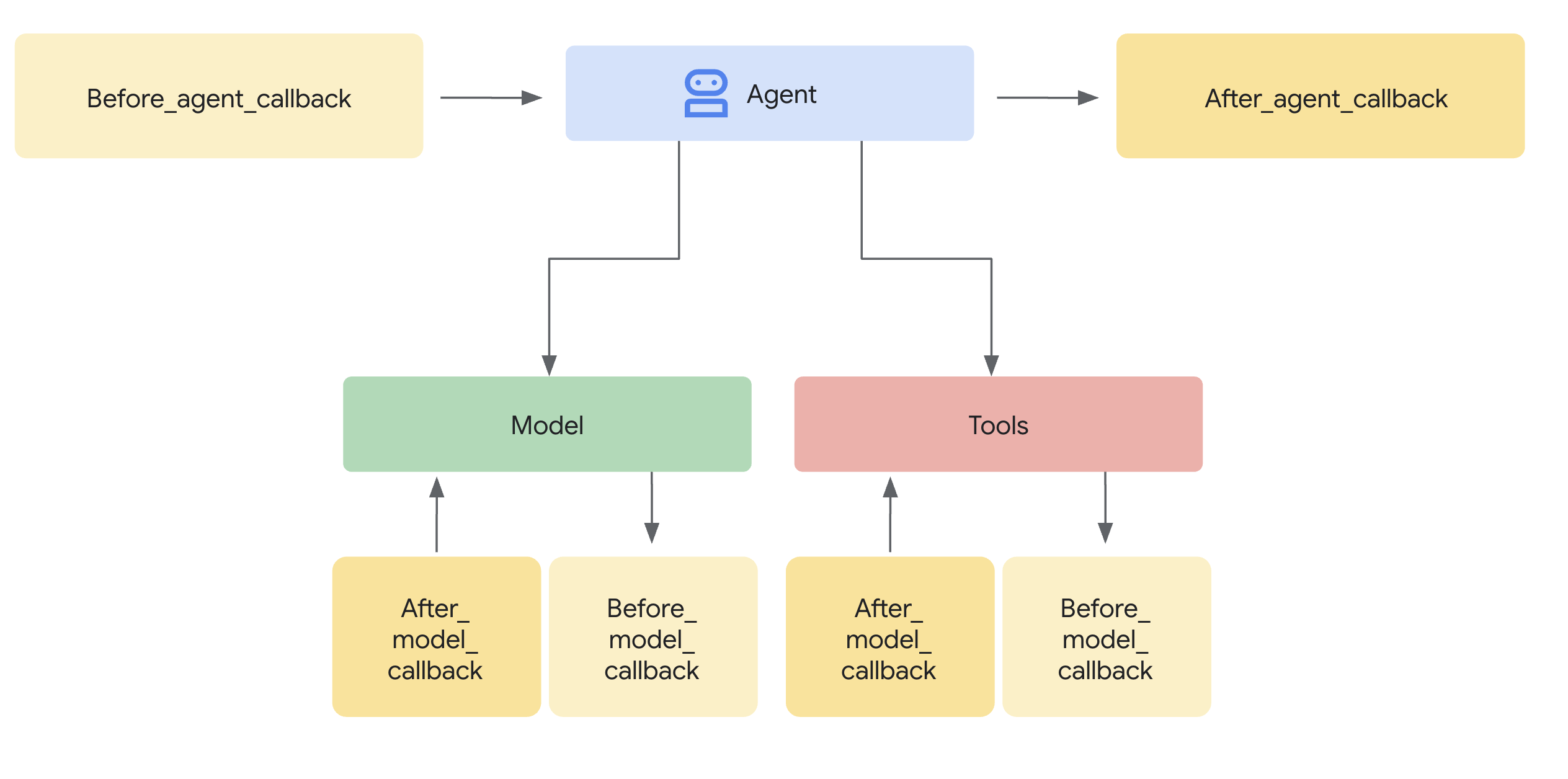
- Callbacks - a mechanism to hook into the agent’s execution process. They support hooks like
before\model\callback,after\model\callback,after\tool\callback,before\tool\callback.
These can be great for implementing guardrails, managing state, modifying control etc.
- Evaluation - there is a good early evaluation story. Currently there is a focus on things like expected tool use (did the agent use the right tools), agent trajectory and final response. Some similarities with AutoGen bench, but with a focus on the developer experience for custom eval tasks and metrics.
- Deployment - strong deployment options including Vertex AI Engine and Cloud Run
Designing with AI is a reader-supported publication. To receive new posts and support my work, consider becoming a free or paid subscriber.
Early Notes on the Agent2Agent Protocol
Google also announced the The Agent2Agent (A2A) protocol - an open protocol designed to enable AI agents to communicate and collaborate across frameworks and possibly organizational boundaries.
A2A follows five key design principles: 1) embracing agentic capabilities for natural collaborations between agents, 2) building on existing standards like HTTP and JSON-RPC, 3) prioritizing security, 4) supporting long-running tasks, and 5) remaining modality-agnostic to support text, audio, and video.
The protocol works by facilitating communication between a "client" agent and a "remote" agent through several key mechanisms: capability discovery via "Agent Cards," task management for tracking progress, structured collaboration through messages, and user experience negotiation to ensure proper format delivery. Google plans to release a production-ready version later this year, with the current specification available as open source.
Again here, I think Google is learning from existing work, especially on the current limitations of MCP (usability, security, building on existing standards). It is still very early.
Conclusion
Overall strong effort from the Google team! If you have tried it, or are trying it, share your experience below.