What has to be true for this stock to work?
By Compound With AI
Published: 2026-07-12
URL: https://news.aiinvestinghq.com/p/a-better-way-to-estimate-stock-returns
Every investment decision starts with one question:
What annual return can I reasonably expect from this stock?
And there are 2 terrible ways to answer it:
- The spreadsheet answer:
- A big DCF model.
- An 8.73% discount rate.
- A 2.14% long-term growth rate
Final answer:
Fair value: $147.32.
I should make exactly 17.52% a year.
Not 17%…Exactly 17.52%.
Because apparently they can predict the future down to 32 cents…
- The vibes answer:
Great company. Huge market.
This can compound at 20% a year.
Maybe.But where does the 20% come from?
Both answers miss the point.
- The DCF gives false precision.
- The vibes answer gives no real explanation.
I use something simpler, but based on how the business works:
I expect about 20% a year:
15% from earnings growth, including 13% from volume and 2% from pricing.
+5% a year from a higher valuation multiple.
Now I know exactly what I am betting on.
- Pricing: Can the company raise prices without hurting demand?
- Volume: Can it really grow 13% a year? From new countries, more customers, or more usage from existing customers?
- Margins: How much margin expansion is still left, and how much can it add to earnings growth?
- Valuation: Does the stock still work if the multiple stays flat?
I taught Claude this way of thinking.
Then I turned it into a ready-to-use Skill called The Expected Return Check.
You can use it whenever you want to test the expected return of any stock.
Start with the return, then work backwards:
Let’s say you are studying Netflix
You want to know whether the stock can return 20% a year over the next 5 years.
- You go to Claude
- You call the skill “Expected Return Check”
- You give it a stock, a target annual return, and a time horizon. ( Netflix exemple: )
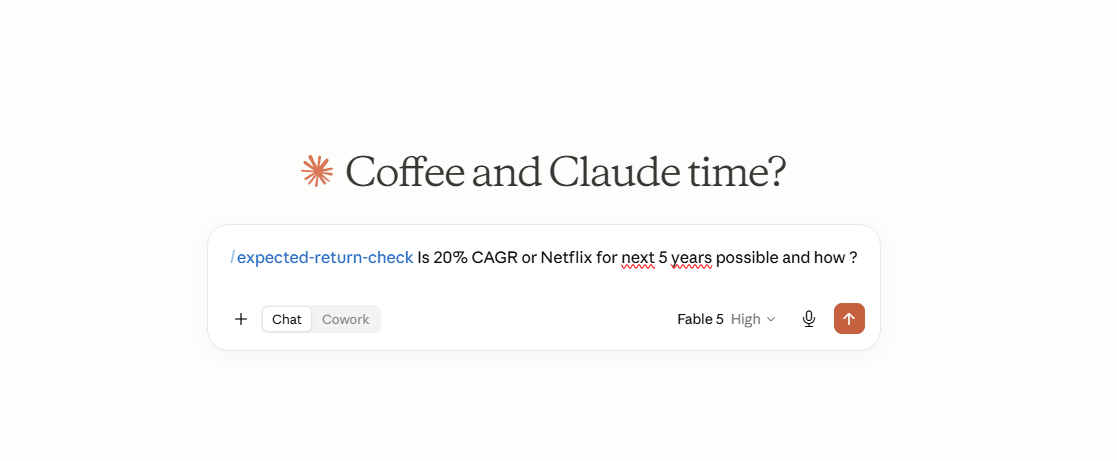
In minutes, Claude creates an interactive web page with:
- The investment case: what the business must do to reach your target return.
- The key drivers: where Volume, Price, Mix, and Margin stand today, and what each one must add.

- a simulator: change the business drivers or exit multiple.
Test Bear, Base, and Bull cases and see the expected return update at once.

Take a look at the Netflix results here: link
How to Use It :
This Skill works in the normal Claude web app.
You do not need Claude Cowork app.
Quick reminder: A Claude Skill is a saved workflow inside Claude. You install it once, then run it whenever you need it.
Upload the Expected Return Check from the Skills Library, where I’ve grouped 20+ ready-to-use investing Skills in one place.

From this link :