Your agent can plan the perfect trip. -- but whether it gets to book the hotel is up to the hotel, and after Black October, the hotel has questions.
By Nate
Published: 2026-10-31
URL: https://natesnewsletter.substack.com/p/ai-agents-website-access
Black October showed how AI is making it easier to break into websites. At the same time, I want AI to use websites for me—to book flights, buy things, and manage my accounts. Businesses need a way to let my agent do that without giving an attacker the same access.
I expect the internet to become more uneven for agents through 2027. Some businesses will build dependable ways to accept them. Others will let them work through the existing website. Some will refuse them. The companies that make legitimate agent activity easier to recognize and accept will gain power because consumers and businesses both need their help.
I’m bullish on that work. We need it. I also want those connections to be open enough that choosing a different assistant doesn’t mean losing access to the places where we live and work online.
I’ve already run into the practical consequence. An agent can put together a trip and then freeze at the hotel’s booking page. The planning was perfect. The hotel still wouldn’t let the agent finish. Now I have to decide whether to complete the booking myself or choose somewhere my agent can book.
That changes which businesses get my money, because I have to figure out how to shop with my agent. A smarter model isn’t going to unlock a door a business has decided to close.
Here’s what’s inside:
- What each trust system does. Cloudflare’s signed agents, Google’s AP2, Stripe’s payment tokens, the Visa pilot, and Meta’s Sentinel each answer a different question, and one table shows which.
- Why your agent stopped. The three zones tell you whether to correct the agent, give it better information, approve something, or find another route.
- How I split work across five agents. What Grok Bot, dots, Instinct, Muse, and Duet each handle for me, and where I’d be careful recommending each one.
- Five controls for a first delegated job. Narrow access, specific approvals, and checking the result where it’s supposed to land.
- A prompt that picks your agent. It researches your services and your country, then hands back one small first experiment you can verify.
Let’s start with who’s knocking.
Paid subscribers get access to the full archive, Nate’s Library MCP, and my Slack community!
Nate’s Library MCP
Your subscription now works inside your AI.
Nate’s Library MCP is a read-only MCP server that gives your AI direct access to my entire published content library. Connect once, and then the archive just shows up in your normal AI conversations. You ask your AI a question during your actual working session and it pulls from everything I’ve published to answer it.
Setup takes just a few clicks.
Join the Slack →
It’s where I’ll be sharing things between articles, where you can get help on builds in real time, and where the fastest conversations in this community are already happening. I’ll see you in there!
If you have any issues connecting to my MCP or Slack, please email [email protected].
Why useful AI agents make websites nervous
In my earlier Black October piece, I covered how AI was exposing weaknesses that had survived for years. Wiz’s PHP research gives a concrete example: the researchers used frontier models to develop and adapt working exploits across multiple applications in hours. Work that required substantial expertise and repeated debugging now takes a fraction of the effort.
NorForge’s investigation of Cairn showed the other side of that capability. Its researchers found exposed control panels showing how attackers directed agents, shared discoveries, and pursued access to systems. The troubling part was the persistence and coordination. Software could keep working through a problem, use what it learned, and try the next step.
Those are also qualities I want in an assistant. If I ask it to sort out a trip, I want it to find the dates, check the calendar, compare the options, and handle the work between those steps. If one approach fails, I want it to understand the failure and find another permitted way to finish.
A business receiving that activity has to distinguish useful work from abuse. Detecting automation doesn’t answer the question. A customer may have deliberately sent the automation. Blocking it can stop a purchase the business wanted, or prevent a customer from managing an account they already have.
The banks are working on this too. NatWest, ASB, Bank of America, Capital One, Commonwealth Bank of Australia, and ING have published joint principles for agentic commerce. They emphasize transparency, safety, privacy and data, choice, and interoperability—the ability of different providers to work together. These are shared principles for developing the market. They aren’t a universal connection your assistant can use to operate every bank account.
And plenty of jobs don’t involve buying anything. Suppose you want an assistant to collect the next six months of school events and prepare them for your calendar. It needs the right school’s information, the right child’s schedule, and a way to distinguish a public event from something that applies to your family. If the school requires a login, the assistant needs authorized access. If you want calendar entries created, that takes permission too.
From your perspective, that’s one request. Underneath it are several decisions about information, access, and authority. That’s why an agent can finish most of a job and leave you with the last, annoying piece.
Three kinds of access AI agents encounter
The three zones I described in the video show what happens after you give an agent a task. They describe the relationship between an agent and a service. The same agent can encounter all three during one assignment.
In the partnership zone, the business provides an accepted way to do the work. The agent can use a supported connection to obtain information or complete an action. The participants have agreed on how that interaction should happen.
Shop Pay inside an assistant is one example. Shopify’s October 28 announcement describes checkout in Muse, Claude Duet, and Instinct, and also names Grok Bot among assistants offering Shop Pay for brands outside Shopify. Competing assistants can share payment infrastructure. You don’t necessarily have to choose the same assistant as everyone else to reach the same merchants.
In the aspiring actor zone, the agent works through the website much as a person would. It reads pages, fills in fields, and tries to complete the sequence. That can be valuable because businesses don’t all have to rebuild their systems before an agent can help.
Google’s Chrome auto browse illustrates this approach. The browser can work through web tasks, with connected Google apps supplying relevant context. Google says it’s designed to ask for confirmation or hand control back for sensitive actions such as purchases. Anthropic also describes Duet using its browser for sites without connectors.
This route depends on the interface continuing to make sense to the agent. A changed page, an account check, an ambiguous button, or an unsupported step can leave work for you. Sometimes better reasoning will help. Sometimes the website is refusing the activity, and more reasoning won’t change its decision.
In the no-go zone, the business refuses the agent or the requested action. Amazon’s dispute with Muse, which I covered in my September article on personal assistants, shows how the customer’s desire to delegate can conflict with the retailer’s conditions for access.
I find that frustrating as a customer. I want to choose who helps me shop. But the retailer also cares about security, how its service is used, and who controls the customer relationship. Those interests don’t automatically agree with mine.
Think about the effect on a holiday purchase. One merchant might make it easy for an assistant to confirm availability, delivery, returns, and checkout. Another might require me to take over halfway through. If both have a suitable product, the first merchant is the one my assistant can actually buy from. Agent access becomes part of competition for my business.
These categories also help you diagnose a disappointing result. An agent that misunderstood your dates needs a correction. An agent that couldn’t find the right school calendar needs better information. An agent waiting for purchase approval needs your decision. An agent refused by a website needs another accepted route, or a human to do that step.
Asking all four to “try harder” wastes time. Before switching products, find out what actually stopped the one you have.
What Cloudflare, Google, Stripe, and Visa are building
Cloudflare, Google, Stripe, and Visa are all dealing with software that can act on someone’s behalf. They need to establish whose behalf, and what that software is allowed to do. Several different problems need solving, and the names in the announcements can obscure which problem a particular system addresses.
Take a simple purchase: you want an agent to find a gift, keep the total below $100, and get it delivered before Friday. The seller needs to recognize the request. You need to approve the purchase or specify the conditions under which it can proceed. The payment system needs to enforce the relevant limits. And the assistant needs to resist instructions from a page that tries to make it do something else.
A protocol is an agreed way for systems to exchange information and act on it. Its value comes from other participants understanding and accepting that agreement. A protocol your merchant doesn’t support won’t complete your order.
Recognizing the agent: Cloudflare and Web Bot Auth
Cloudflare’s signed-agent system uses digital signatures to help identify automated requests. The infrastructure or remote browser sending an agent’s traffic signs the requests, and Cloudflare verifies the signatures through Web Bot Auth. A website can use that evidence when deciding how to handle the traffic.
A signature beats trusting a sentence in a request that says, “I’m a good agent.” The site has something it can verify about the sender.
The hotel still has to decide what that sender can do. Reading public rates, viewing your reservation, and canceling it require different permissions. A business may be happy to let agents compare its prices while requiring much more evidence before they change a customer’s booking.
For a business, identity is a starting point for access rules. For a consumer, a signed agent isn’t a promise that every site will admit it or that every action it takes will be right.
Recording what you approved: Google’s AP2
Google’s Agent Payments Protocol, or AP2, describes signed records of a customer’s instructions and purchase approval. Google calls these records mandates.
Its design covers both a person approving a specific cart and a person giving advance instructions for a purchase under defined conditions. The records connect the user’s intent, the agreed purchase, and the payment, giving the participants evidence of what was authorized.
For the gift: did you approve this item, at this price, under these conditions? A broad instruction to help with shopping is different from approval to buy something.
AP2 provides a way to communicate and preserve that distinction across systems. It’s an open protocol with published specifications. A record can accurately preserve an approval without verifying the product claims behind it, or while the person approving it still misunderstood the return terms.
Limiting the payment: Stripe’s shared payment tokens
Stripe’s shared payment tokens give a seller scoped access to a customer’s payment method. The token can specify a seller, a currency, a maximum amount, and an expiration window. The seller receives the token for payment processing.
For the gift, this can limit payment authority to the intended merchant and amount, which protects the transaction itself. Stripe also documents cases where additional customer authentication is required before a payment can finish.
The payment limit can prevent spending above $100. It can’t, by itself, establish that the gift will arrive by Friday or that the recipient will like it.
So when you hear that an assistant has added payments, ask what the connection can enforce, what you’ll approve, and where the order will appear.
Completing an approved transaction: Visa, BILL, and Billtrust
The October 20 Visa, BILL, and Billtrust announcement shows those concerns coming together in a live invoice-payment pilot.
An authorized BILL agent uses payment credentials and controls tied to a buyer’s approved instructions. Visa’s Trusted Agent Protocol and Agentic Directory support recognition of that agent. Billtrust can then authenticate it and grant access to complete the supplier payment. The transaction is tied to a particular invoice, with visibility into authorization and completion.
The participating companies say the pilot is processing transactions among their own systems, a concrete step beyond describing a possible future workflow.
The reason to care is the work it removes. A person shouldn’t have to reenter an already approved invoice payment just because the receiving website only knows how to admit a human. An accepted agent connection can let that last step happen while preserving the supplier’s control.
Controlling your assistant: Meta’s Sentinel
The website’s protections aren’t enough. Your agent also reads outside material, including pages and emails that may contain instructions intended to redirect it. That problem is commonly called prompt injection: the agent encounters someone else’s instructions in material it was supposed to use as information.
Meta describes Muse’s Sentinel as a separate permission authority. Muse proposes an outside action; Sentinel decides whether it’s allowed, denied, or requires approval. Meta says the working agent can’t override that authority and doesn’t see the real account credentials. The design includes connector policies you set and checks on outgoing requests.
That separation is valuable. An agent under pressure to finish shouldn’t be able to grant itself whatever permission would get the task done. Meta also says the agent will make mistakes, so the question is what can still prevent or limit a mistaken action when it does.
These systems answer different questions:
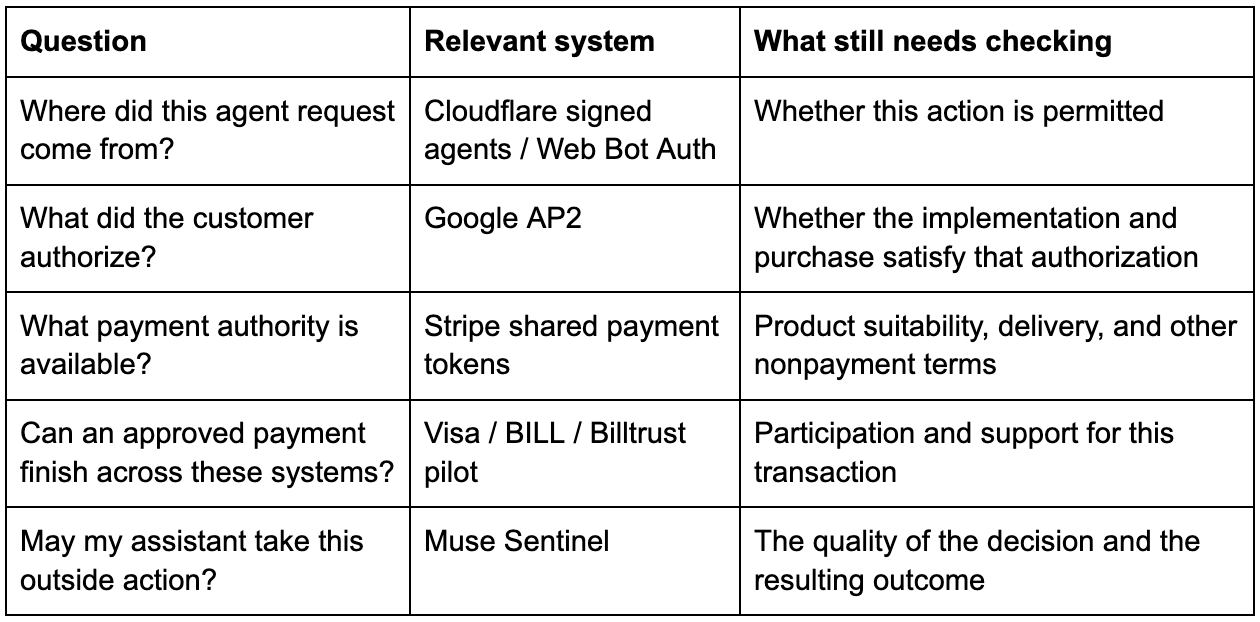
“We support agents” needs a follow-up: support for which agent, doing which action, with whose approval?
Businesses will have to make themselves easier for agents to understand
Getting an agent through the door is only useful if it can find reliable information once it’s there.
A hotel can have a beautiful homepage and make the cancellation policy for a particular room difficult to find. A store can describe a gift enthusiastically while leaving the delivery date unclear. Those problems already frustrate humans. They also make it harder to delegate a decision with specific conditions.
Shopify’s October 28 release includes a way for merchants to review and publish the facts agents receive about their stores, such as return windows, shipping destinations, and gift services. The merchant approves those facts before they reach agents through that system. That gives a store a direct way to improve the information used in a recommendation. Shopify’s merchant announcement describes the feature and its relationship to the catalog.
For the buyer, this is the difference between a plausible gift suggestion and a suggestion that actually meets the deadline. For the merchant, clear policies become part of being considered. If your product is a good fit but your delivery terms are missing, the assistant may move on to a competitor it can evaluate.
I think this can put useful pressure on businesses to improve what they offer and how clearly they explain it. If I can ask an agent to compare the actual terms across several sellers, the differences show up side by side. A shorter return window or an extra fee is harder to overlook when it appears in the comparison I asked for.
An agent’s recommendations still depend on what it reads, which options it considers, and how well it follows my criteria, so bad information or persuasion can still steer it. I want to be able to ask why something was excluded. Was it unsuitable, unavailable, or inaccessible to this assistant? Those answers can lead to different decisions.
The same change creates a problem for the people who publish useful information. An independent gift guide can help an assistant recommend a product without sending the reader to the guide’s website. The publisher supplied value, but may have lost the visit that would have supported advertising or a subscription.
Cloudflare’s agentic-internet proposal includes tools and payment arrangements intended to let publishers admit agents that compensate them. This gives sites another reason to accept some agents and refuse others. Access depends on whether the information source can sustain the exchange.
Stripe and Tempo’s Machine Payments Protocol, or MPP, addresses programmatic payment between agents and services. Stripe describes support for microtransactions and recurring payments, with stablecoins as well as ordinary-currency payments through shared payment tokens.
The practical possibility is that an agent can pay for a small amount of useful information or a specific service without a person going through a full signup and subscription process each time. Whether that becomes a dependable business for a publisher still depends on the price, demand, and cost of producing the information.
This matters to the quality of the answer you get. If careful independent work can’t afford to remain available, your assistant has less useful material to draw on. The economics of publishing become part of the quality of delegated research.
The companies making this work will gain power—and we need them to do it
I wrote in May about infrastructure becoming a source of power in the agent economy. The transactions being built now show what that means in ordinary life. The provider that can make your assistant recognizable, properly authorized, and able to pay can determine how much work the assistant finishes.
Both sides have a reason to use that provider. Businesses want to accept legitimate customers without opening themselves to abuse. Assistant companies want their products to work at more destinations. A small merchant has very little interest in becoming an expert in every agent company’s security system just to accept a sale.
That’s why I’m bullish on companies such as Google, Stripe, and Cloudflare working on this. Solving the trust problem creates real value. People need to know that a delegated purchase will follow their instructions, and businesses need a practical way to accept it.
It also creates dependence. If every assistant must negotiate a private agreement with every important service, a new assistant has a difficult job before its intelligence even enters the comparison. It needs enough connections to be useful. The largest providers can afford more of those relationships.
Open standards can cut that cost. A business should be able to state requirements that multiple agents can meet. An assistant builder could then implement them without first becoming a giant company, and customers could switch assistants and keep using the businesses they prefer.
There’s encouraging evidence here. Cloudflare explicitly advocates open standards and independent choices of identity providers, payment processors, and agent partners. Shopify’s developer expansion extends access to catalog, cart, and checkout tools for builders, continuing work it began in the spring. These are meaningful attempts to let multiple assistants participate.
I want to see that direction succeed. We’ll judge it through concrete results: a new assistant can reach the services its users need, a small merchant can accept customers from several assistants, and a publisher can be paid for useful work without negotiating a special deal with every buyer.
My expectation for 2027 is that we’ll get more of these accepted connections alongside more visible refusals. Businesses have reasons to do both. Some parts of the internet can open up to delegation while others close. That’s the environment in which we’re choosing personal agents now.
What I use five personal AI agents for
I use Grok Bot, dots, Instinct, Muse, and Duet. I’m the weird one here. Most people are going to pick one and use it. They aren’t going to remember which of five assistants handles which errand.
Here’s how I divide the work, what I like about each agent, and where I’d be careful about recommending it.
Grok Bot: harder builds that benefit from coordination
Grok Bot gets tougher coding and build jobs for me. I particularly like its communication between bots. When several pieces of a build depend on each other, I don’t want to relay every discovery from one worker to another.
I have a Chief of Staff in that setup. I can assign work there and have it coordinate with other bots to get the job done. That removes a kind of management work that becomes more obvious as you use several agents on a technical project.
This works best as a recommendation for someone who already has technical projects to manage. You need to explain what a working result looks like and know how to check it. For a relative who wants help choosing a holiday gift, I’d start with a much simpler job.
dots: accumulated context and the connection to my day
With dots, I love the context I have in Codex. It knows the projects, the decisions, and what has changed. I can use that background while coordinating calendars, email, and tasks, including when I’m messaging on the go.
It isn’t super fast. But starting over costs time too. If I have to explain the project and reconstruct the decisions before every request, a quick answer isn’t necessarily a quick way to get the work done. dots connects the work I do in Codex with the rest of my day.
While I was traveling, dots caught that I had a double booking on a flight. It flagged the problem, I canceled the duplicate, and I got money back.
The catch was valuable precisely because I hadn’t thought to ask about it. But the proactive suggestions aren’t consistently that useful. Sometimes they tell me something I need to know; sometimes they don’t. My tolerance for that depends on how much attention they require and whether the useful discoveries are worth it.
Accumulated context is a strength when it helps the agent understand the current situation. It needs to be correct, too. A decision from last month shouldn’t outweigh the plan I’ve just changed. When choosing an agent for ongoing work, I care about whether I can correct its understanding as much as whether it remembers things.
Instinct: travel that’s easier to manage on the go
Instinct has a clear role for me on trips. I travel a lot, and I value texting it while I’m moving around. It has a nice autonomous check-in function. It takes a responsibility I’d otherwise have to keep remembering and handles it.
I also like using it to go deeper on a destination—to understand how to visit a place beyond the obvious tourist itinerary. That combination of planning and practical travel help makes it useful in a recurring part of my life.
Travel is where I’ve found its value. Before relying on it for a trip, check the specific airline, hotel, and steps you want handled. Finding a good itinerary and completing a booking depend on different access. Keep the parts it handles well, and know which parts still belong to you.
Muse: shopping, gifts, and everyday bookings
I use Muse for a lot of preliminary shopping and scoping. I’m already using it to think through holiday gifts. I also use it for restaurant reservations and yoga classes. Sometimes I want it to bring me choices. Sometimes I know what I want and would like the booking handled.
I think its friendliness to less technical users is a real strength. These are recognizable tasks. You can show someone how to find a gift or book a class they already attend, with none of the explaining that coordinating coding agents takes.
The weakness is uneven access to the places where someone might expect it to work. The Amazon dispute is an example of why a broad statement such as “it does your shopping” leaves out a consequential detail. It may be helpful at choosing the product while unable to complete the purchase at the retailer you prefer.
So my recommendation is specific: try it on shopping research and bookings that fit its supported access. Check the merchant and the purchase terms before treating a successful suggestion as a completed order. Its appeal is how much ordinary work it can remove, and that depends on where the work takes place.
Duet: a promising early experience with proactive help
Duet is new, and I’m still figuring out its place in my setup. I like how smart it is. Within the first day or two, it reminded me about something coming up that I hadn’t realized I needed to think about ahead of time. That was immediately useful.
That kind of early warning is one of the things I like most about Duet and dots. They can notice something I need to know without waiting for me to formulate the perfect request. When it works, it takes something I might have missed and gives me time to deal with it.
I’m bullish on Duet, but I haven’t settled which responsibilities will stay with it. There’s also a practical availability limit: Anthropic currently describes it as a US research preview for Pro and Max subscribers, with access through a waitlist. That affects whether it’s even an option for the person you’re advising.
The broader question is whether early helpfulness becomes dependable help over time. An assistant that spots one thing I needed to know has shown something valuable. I’m still learning what it notices, what it misses, and how much supervision its ongoing work requires.
Choose your AI agent by one recurring job
Most people need a clear match between one recurring problem and an assistant that can handle it.
If you spend time reconciling email with your calendar, context and account connections matter. If you travel often, support for your airlines and the ability to communicate on the go matter. If you want help with gifts, the quality of the choices and access to the merchants matter. If you build software, coordination and your ability to inspect the result matter.
Start with the work you already wish someone else would do. Then identify the service where the result has to exist. A calendar task finishes in a calendar. A reservation finishes with the restaurant or booking service. A purchase finishes with an order you can inspect. That gives you a place to check what an assistant actually did against what it says it can do.
For a first attempt, separate getting useful information from taking a consequential action. Ask for a gift shortlist before authorizing a purchase. Have the agent gather school events before giving it permission to contact the school. Let it find calendar conflicts, then decide which meetings you want changed.
Once you see that it understands the job, you can decide how much more to delegate. That also gives you a better first experience to show someone else. They see a result, understand what happened, and retain the decision they care about.
There are a few practical controls I’d keep:
- Give the agent the access the job requires. Use narrower permissions where the product offers them. More connected accounts create more opportunities for useful work, but also more information the agent can mishandle. Reading sensitive email and sending information elsewhere is a consequential combination even if the task began as research.
- Make approvals specific. Before a purchase, see the item, seller, full price, delivery terms, and relevant return or cancellation rules. For a travel change, make clear whether the old booking will remain or be canceled. Use the product’s permission controls when available. A sentence in chat isn’t the same as a control that prevents an action.
- Keep outside material from becoming new authority. A webpage, email, or downloaded file shouldn’t get to rewrite the assignment. Review unfamiliar skills and instructions before installing them. For coding work, use a project folder whose contents you understand, and keep the product’s protections enabled.
- Check the result at its destination. Open the order, reservation, sent message, or calendar entry. An agent saying “done” is useful as a report, but the result needs to exist where you asked for it. If the agent can’t verify completion, treat the outcome as unresolved before trying again.
- Know how to end ongoing access. A recurring assignment may keep running after the conversation ends. Make sure you can stop it and revoke connections when you no longer want the work done. Count the attention you spend supervising it when deciding whether it’s helping.
The instruction-file concern is concrete. Forever Security reported finding a malicious agent-instruction file in a customer’s Downloads folder and stopping a coding agent from installing malware. The researchers didn’t establish how that original file arrived. They separately demonstrated a way for a website to plant a file. The lesson is to be careful about what an agent treats as instructions, especially in a folder that receives material from the web.
All of that is too much to expect from someone trying their first personal assistant, so the products need to make these protections simple to use. Until then, those of us who spend a lot of time with agents should be precise about the jobs we recommend.
If you’re talking about this at Thanksgiving, show the gift research or the travel help. Pick something the person cares about and that the product is equipped to handle. Let them see the result. A first experience that leaves them debugging an unfamiliar website is a poor introduction to a tool that was supposed to remove work.
A prompt to investigate the agent that fits your life
The right answer depends on your accounts, your country, and the work you want done. The prompt below asks an agent to research those specifics, explain what the trust systems mean for your task, and recommend a bounded first attempt.
Use it with an agent that can browse current sources. Replace the brackets. Leave account numbers, passwords, and private messages out of the prompt. The names of the services are enough for the initial research.
Help me choose and use an AI agent for a real recurring task. Research first. Do not take action in my accounts.
My task: [What I want done and how often]
The services or websites involved: [Names or public URLs]
My country: [Country]
My technical comfort: [Low / moderate / high]
Agents I already have or am considering: [Names, or "no preference"]
My subscription budget: [Budget, or "use what I already have"]
The decisions I want to keep: [Purchases, messages, cancellations, changes, etc.]
What a successful result would look like: [A concrete result I can inspect]
If any field above is still in brackets or blank, stop and interview me before you research anything. Ask about the missing fields a few at a time, in plain language, then confirm a short summary of my answers before you begin.
Use current primary sources, including official product documentation and the relevant service's access rules. State the date you checked. If you cannot browse, say so and do not present remembered features as current facts.
First, break my task into the steps that require information, account access, approval, or an outside action. Explain any important missing detail. Ask only questions that would materially change the recommendation.
Compare up to three suitable agents. For each, explain:

- Why it fits this particular task.

- Which necessary features and connections are documented as available to me, including country, plan, and waitlist restrictions.

- Which steps use a supported connection, which depend on working through a website, and which are blocked or unverified.

- The important weaknesses or missing evidence. Do not invent a drawback just to make the comparison look balanced.

- What I would still have to do and how much setup or supervision to expect. Label estimates.
Explain the relevant trust and payment systems in plain English. Distinguish agent identity, my authorization, payment limits, and protections inside the assistant. Discuss Web Bot Auth, AP2, payment tokens, checkout services, or other protocols only where they matter to my task. Do not infer that a product implements a protocol because its company supports the standard.
Separate features available now from pilots, announced plans, and unknown support. Link the sources for claims that affect my choice. A general partnership announcement is not proof that my particular service or action works.
Recommend one agent and one small first experiment. Give me:
1. The exact request I can copy into the agent.
2. The minimum access it needs and the actions that should require my approval.
3. What it should do if a site refuses access or a step is uncertain.
4. How I can verify the result in the destination service.
5. How I can stop the assignment and revoke its access.
Do not purchase, book, send messages, change accounts, install software, connect services, or bypass a site's restrictions. This assignment is research and a recommendation. If the evidence doesn't support a dependable first experiment, say what is missing and suggest a narrower useful task.
End with a short explanation I could give a less technical friend: what this agent can help with, where it may need them, and what they should check.
The prompt should help you find an unsupported website before you spend an evening discovering the limitation yourself. And when the research points to a good match, you have a specific request and a way to check whether it helped.
That’s where I want the next year of agent development to take us. I want someone to choose an assistant, give it an ordinary job, and get the result without learning how five companies exchange authorization. I want the business on the other side to accept that work with confidence. And I want a better assistant to compete without having to negotiate permission to reach the entire internet first.
We have useful agents now. I use them every day. Making their usefulness dependable across more of the internet is the work ahead—and the companies opening that access responsibly are doing something I want to see succeed.
Coming up
Tomorrow’s executive briefing: Microsoft builds the agent, and Salesforce wants to manage it. What happens when one company wants to run everyone else’s agents.
Related reading
- Executive Briefing: What Stripe Sessions 2026 actually means for how you sell: why Stripe’s agent announcements are about commercial intent that no longer has to pass through a seller’s funnel.
- Six agent protocols just launched. Three of them decide which products survive.: how to map your product to the three protocols that form the core stack.
- 11,755 agent runs, and the ones that lied looked the most finished: the three checks to run before you trust an agent’s report of success.
- Executive Briefing: In the Hugging Face attack, one AI agent took a peer’s go-ahead as permission: what should survive when an agent disappears, and how to test who your agents obey.
I make this Substack thanks to readers like you! Learn about all my Substack tiers here