Anthropic heard the complaints about Opus 5. Opus 5.5 and Sonnet 5.5 are both easier to steer, and both make even complex jobs cheaper to run.
By Nate
Published: 2026-09-30
URL: https://natesnewsletter.substack.com/p/claude-opus-5-5-review
With Opus 5.5, I can give the model direction, make a correction, and keep developing the thing I wanted. That sounds ordinary until you’ve spent a session explaining the same requirement repeatedly and wondering why a system this capable is so difficult to work with.
The writing is much easier to steer. The visual work is extraordinary. I’m seeing efficiency improvements that make me think differently about how much I can get done with the intelligence I’m paying for.
There is a lot of intelligence available in these models. The amount we can use depends on how well we can work together. We have to communicate what matters, see enough of the work to judge it, and make changes without losing the decisions we’ve already made. When that gets easier, the next assignment we’re willing to try can get more ambitious.
That’s why I think model ergonomics deserves much more attention. By ergonomics, I mean the fit between the system and the person using it: the effort required to direct it, understand its work, correct it, and decide what to do next. It’s a useful way to understand what I’m enjoying about Opus 5.5. It also connects this release to the much larger story of AI helping build AI, faster development, and companies trying to understand what customers actually want from frontier intelligence.
Sonnet 5.5 just landed, and Anthropic cooked again. I’m still testing, but my early views reinforce a lot of what I’m arguing in the essay below.
Here’s what’s inside:
- Sonnet 5.5 points the same direction. What Anthropic’s newest release says about efficiency per task, and why it may shape how we experience compute availability.
- Why steering decides what you’ll delegate. How corrections that hold, even across connected problems, turn small safe requests into bigger assignments.
- The labs are working through this relationship themselves. What Anthropic and OpenAI report about AI-assisted development, and why faster releases have to preserve what users already learned.
- The business depends on people wanting to keep delegating. Why repeat use is the commercial story to watch as Anthropic reportedly heads toward an IPO.
- The real assignment test guide. Three prompts that turn your own recurring work into a test you can rerun every time a new model ships.
Start with the release that landed while I was writing this.
Subscribers get the full deep dive and guide, plus access to Nate’s Library MCP and my Slack community!
LINK: [Grab the real assignment test guide]
Your tasks are not my tasks. You could spend all day with exactly the same model and get a very different result because you’re asking it to do different work. A launch post can’t tell you which result you’ll get.
The guide covers:
- Find your real assignment. A prompt that reads your AI history and proposes a test built from work you already do.
- Freeze the setup. A prompt that locks in the same files, prompt, and definition of done, then builds your scorecard.
- Score each new model. A prompt that grades the new run against your earlier ones and tells you whether to move the work.
Pick something where you’re going to care if the result is good. Measure it, then come back and measure it again every time a new model ships.
LINK: [Nate’s Library MCP]
Your subscription now works inside your AI.
Nate’s Library MCP is a read-only MCP server that gives your AI direct access to my entire published content library. Connect once, and then the archive just shows up in your normal AI conversations. You ask your AI a question during your actual working session and it pulls from everything I’ve published to answer it.
Set up takes just a few clicks.
If you have any issues connecting, please email [email protected].
Sonnet 5.5 points the same direction
Sonnet 5.5 shipped shortly after I recorded this video and it makes me more confident that whatever Anthropic is using as its teacher model is VERY good. A teacher supplies examples or feedback that help train other models, and we’ve now had two releases in a row come off the presses really hot. The improvements are showing up across capability, efficiency, and the experience of working with the model. That strengthens my thesis about the quality of the intelligence behind this generation.
Good models swing adoption. People move their work when something substantially better arrives. Good models are also becoming efficient models, and Sonnet gives us another example. Its API prices remain $2 per million input tokens and $10 per million output tokens, unchanged from Sonnet 5. Anthropic nevertheless reports costs up to 30% lower per task than Sonnet 5 because it uses fewer tokens, alongside output generation more than 30% faster. You can leave the token price alone and still make the work meaningfully cheaper.
There’s a useful example in Slack’s early testing: better results than Sonnet 5 on almost all of its offline evals, with unchanged prompts, fewer steps, and about 14% fewer output tokens. That’s the kind of improvement I care about. The model gets more of the assignment right without making the person rebuild their way of asking for it.
Sonnet’s input and output rates are also half Opus 5.5’s corresponding rates, which makes it immediately competitive for work where it delivers the result you need. It may, ironically, cannibalize some Opus usage. But I think there’s substantial long-term value in making the behavior stick. If Claude keeps doing useful work at a price that makes me willing to give it the next assignment, I keep building my working life around it. Whether I’m using the API, Cowork, or Claude Code, more value per task gives me a reason to return. The amount of thinking a task requires still matters. Anthropic’s comparisons show Sonnet’s cost advantage narrowing at higher effort settings.
We’re also seeing the visual capability and the return to “fun to talk to” carry across both models. I think that combination matters more than it gets credit for. When you’re developing a visual idea, revising a piece of writing, or trying to work out what you actually want, you spend a lot of time in the conversation. A model that responds usefully to direction makes you more willing to stay with the work and try something ambitious.
There’s a subtler point here around compute availability. I’m forming a thesis that, from the outside, we experience a lot of it through efficiency per task. When the model finishes with fewer retries and less waiting, it uses less of my allowance. That feels like more room. It could also let Anthropic move in a matter of weeks from feeling compute constrained to feeling much less constrained.
I haven’t seen public evidence establishing that a sudden influx of thousands of accelerators explains these last couple of weeks. Anthropic has major capacity expansions under way, and Opus’s launch included higher usage limits, so hardware and allocation changes can contribute too. But the efficiency improvement is already visible in the product. Customers can feel its effect without knowing how much infrastructure changed underneath.
That’s the thought I want to keep testing: efficiency per task may already be how we perceive both value and availability. And when the model also takes less effort to direct, it gives us more room in our own day to use that intelligence—the working relationship that got me interested in writing this essay.
The model has to fit the person
Think about asking a model to simplify a paragraph. You might want shorter sentences and a clearer explanation while keeping one difficult qualification. That qualification could be the whole reason you’re writing. It marks what you know, what you don’t, or the condition under which your recommendation holds.
The model can return something fluent and concise that removes it. You ask for another revision, and it brings the qualification back while restoring all the complexity you wanted to remove. Now you’re managing a tradeoff the model should be helping you work through. You can recognize a better result, but you’re spending your attention getting the system to respect the decisions you’ve already made.
A model that handles this well gives you a different experience. You can point to the qualification, explain why it matters, and continue improving the surrounding prose. The instruction survives the revision. Your next comment can advance the argument instead of repairing the previous edit.
Steerability matters so much to me because writing often involves discovering what you mean while trying to express it. You need room to explore, but you also need your emerging decisions to hold. If every revision reopens all of them, the model consumes the attention you wanted to spend thinking.
I loved working with Opus 4.6. The writing and coding made Claude feel like a system I wanted to keep returning to. Across the releases that followed, getting the work I wanted sometimes became more complicated even as the underlying capability continued to impress me. With 5.5, I feel more of that ease again, with better intelligence behind it.
Anthropic explicitly connects 5.5’s communication improvements to feedback about Opus 5. It describes clearer writing, better adherence to writing instructions, and work that is easier to follow and check. That last point deserves attention. Clear communication helps the person understand what the model did and decide whether the result is acceptable.
A model’s manner of working affects the quality of the collaboration. Does it identify the question you need to answer? Can it explain a conflict between two requirements? When it disagrees, does it give you enough information to reconsider your decision? After you settle the issue, can it proceed without trying to relitigate it at every step?
I want useful disagreement. If I ask for something inconsistent, I want the model to notice. If it can see a problem with my approach, I want to hear about it. But a good objection should help us make progress. It should identify the consequence, let me understand the choice, and leave us able to continue.
There’s a research history behind these concerns. In their 2019 guidelines for human–AI interaction, Saleema Amershi and colleagues emphasized correction, handling uncertainty about a user’s goals, explaining system behavior, and adapting cautiously over time. Those questions have become more consequential as the work we give AI has grown longer and more open-ended.
Some of this fit comes from the model. Some comes from the application around it. A capable model still needs a way to show changes, preserve relevant decisions, use the right tools, and return control at the right moment. When I say a release works better for me, I’m describing the experience of using that system. We should be specific about which improvements come from the model and which come from the surrounding product.
Work arrives as a collection of connected problems
A workplace rarely hands you a neat sequence of identical assignments. You might spend the morning interpreting a customer request, comparing two ways to meet it, revising a schedule, and explaining the consequences to someone who wasn’t in the original conversation. Each part requires different information and a different kind of judgment.
The technical phrase is a distribution of tasks. In ordinary terms, it’s the variety of work that lands on your desk, how often each kind appears, and how difficult it is. A model can be excellent at a category you barely encounter and frustrating at the work that takes up most of your week. Your experience will differ from someone whose work happens to match its strengths.
The connections between tasks make this more difficult. Suppose you’re helping a team plan a product launch (an illustrative example, though the problems will be familiar). A customer wants the launch brought forward. Engineering has a dependency on another team. Support needs training. The proposed date falls during a week when two experienced people are unavailable.
You can ask a model to draft a launch plan. But a useful plan has to account for those relationships. Moving the date affects staffing. Reducing scope affects what sales can promise. Adding temporary help affects the budget and may create a training problem of its own. A solution to one part can make another part worse.
And some of the important information hasn’t been written down. Someone knows that a particular customer will tolerate a delay if it is explained early. Someone else knows that the technically simplest approach will be difficult for the support team to maintain. The model won’t acquire those facts by thinking longer. A person has to bring them into the work. This connects to the problem of information scattered across files, people, and decisions that I’ve explored in software architecture. The information can exist without being available at the moment someone needs it.
There can be enormous numbers of possible arrangements of people, time, resources, and commitments. Finding a mathematically good arrangement is only part of the difficulty. You also have to decide which constraints are real, which preferences can change, and what a satisfactory result would look like. Those decisions often become clearer as you examine possible plans.
The quality of the working relationship starts to matter here. You need to be able to say, “Keep that customer commitment. We can change the internal milestone. Show me what happens if we reduce the initial scope.” The model needs to carry those choices into the next version and explain the consequences it discovers.
A model can be very intelligent and still make this process exhausting. If it forgets the protected commitment, you have to inspect every revision for the same mistake. If it treats every preference as a hard constraint, it may never find a workable option. If it changes the objective to make the problem easier, it can produce an elegant plan for a job nobody asked it to do.
Better ergonomics lets the person contribute context and judgment as the problem develops. It lets the model handle more of the searching, comparing, drafting, and checking. That division can change from one part of the assignment to another. The person might know precisely what to do in one area and want the model to propose several approaches in another.
I think this is an important reason to look beyond a model’s best isolated answer. In a long assignment, your second instruction may depend on what you learned from its first result. A useful system has to support that developing understanding. The work gets better through the interaction, and the interaction needs to remain manageable as the problem becomes more complex.
The Lego build makes the connections visible
The Lego version of my logo is a small example of this kind of connected work. It has the beanie and glasses, with a clear support where a face would otherwise be. There’s a video showing the assembly, a model file, a sixty-three-page instruction booklet with fifty-eight build steps, two forms of the parts list, and a verification report.
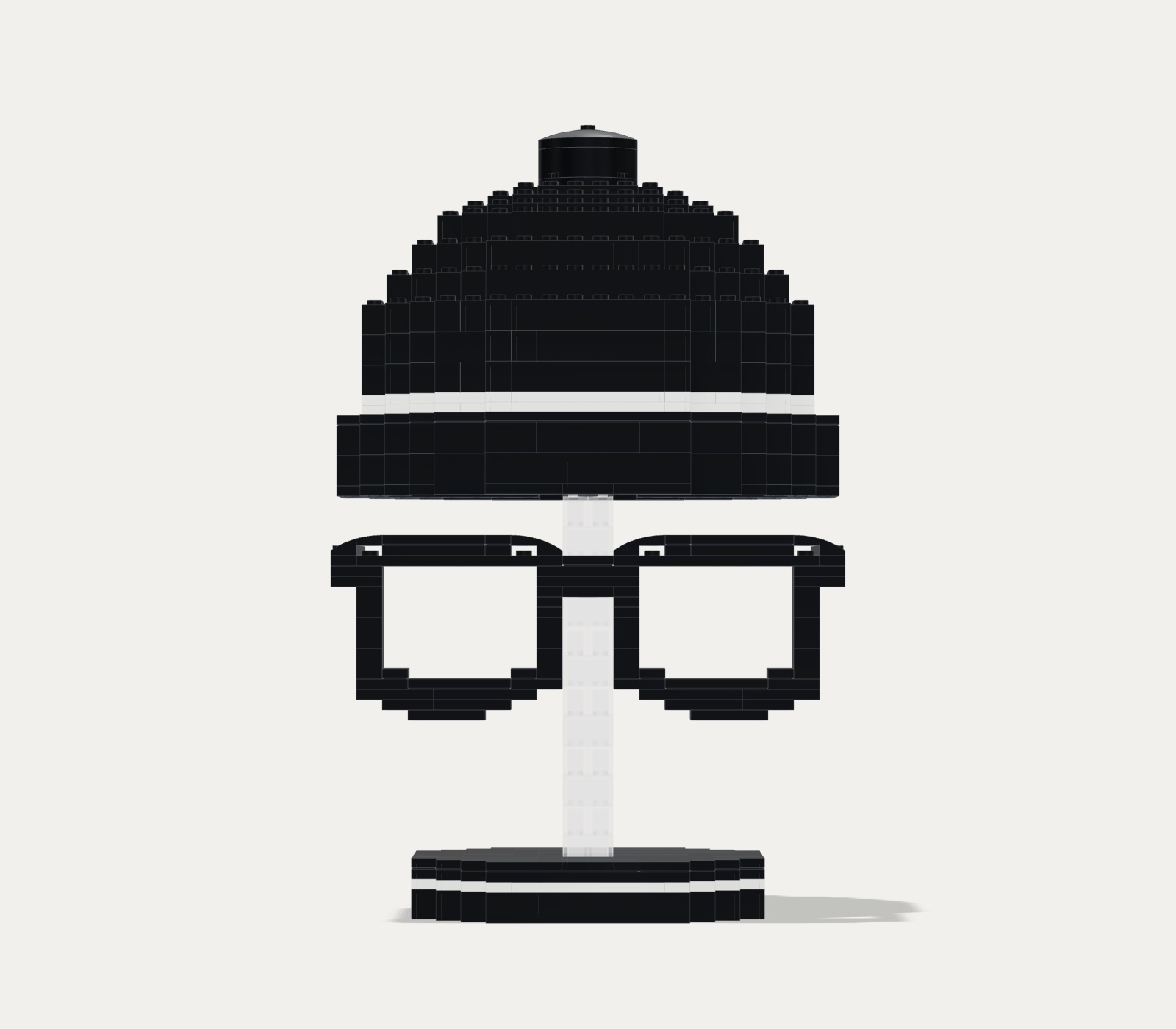
The model and the lists agree on 514 pieces. That agreement gives us something specific to inspect. The booklet shows what to add at each step, including places where pieces attach from below. The files describe a design with relationships between its parts and a proposed way to assemble it.
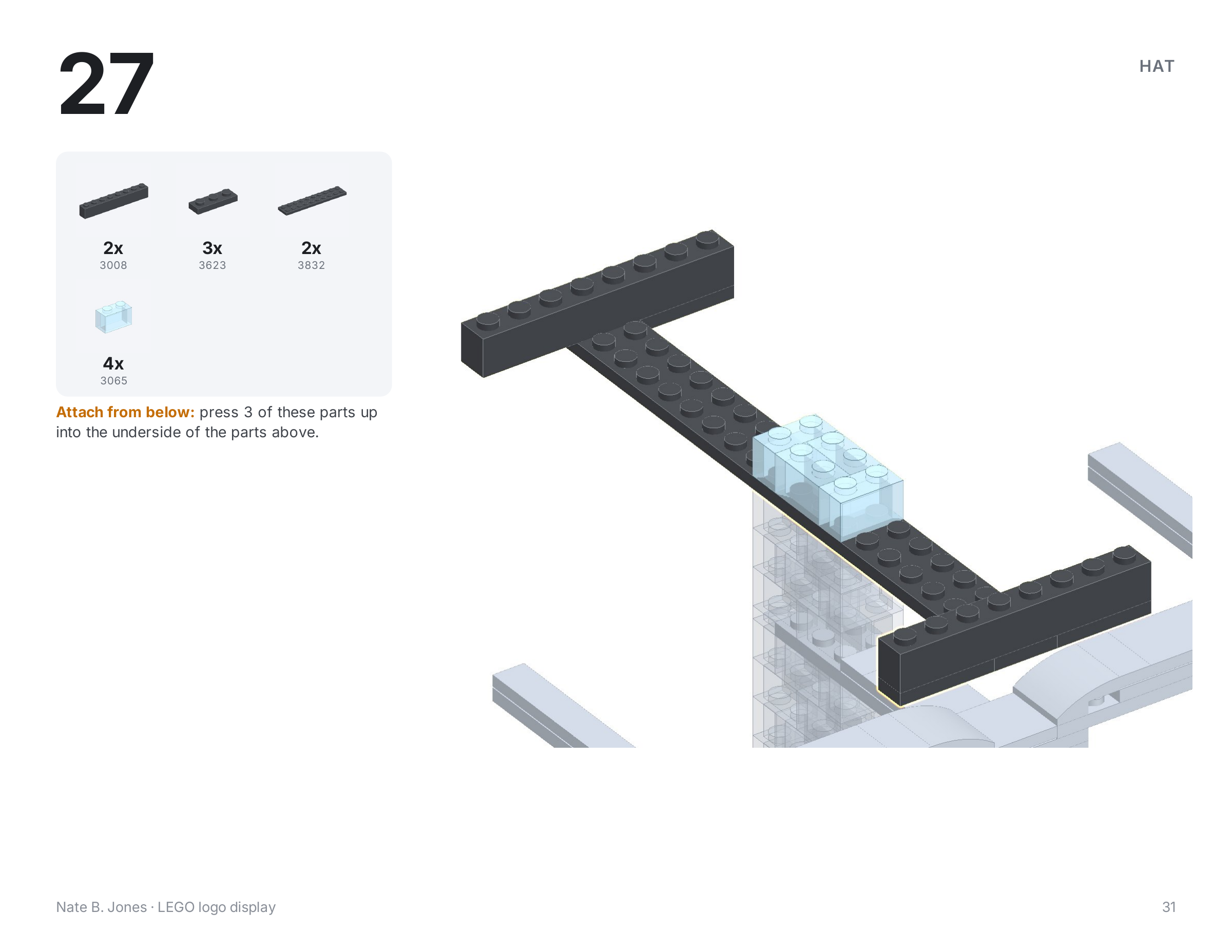
The verification report also makes a useful distinction. It describes geometric checks on connections, assembly, and balance, while stating that no physical copy has been built. We can inspect the digital package and still have a question left to answer with real bricks. Keeping track of that boundary is part of understanding what the work accomplished.
Now imagine asking for a revision. Suppose I want the beanie taller but want to keep the glasses as they are. That request might require different pieces. If the design changes, the parts list and the instructions may need changes too. The animation should still depict the model we’re actually discussing.
This hypothetical revision is more interesting than asking whether a model can make an attractive image. It asks whether the system can keep several representations of the same idea consistent while a person develops the idea. The visible result, the underlying model, and the information needed to build it all matter.
Coding capability is useful here because it gives the model ways to work with the structure of a visual. The model file identifies individual bricks and their positions. In other kinds of visual work, a browser graphics library such as Three.js provides objects, materials, lights, and cameras that can be changed. You can keep directing the work as it takes shape.
That opens up a different creative process. I don’t need to know every implementation detail to recognize that the silhouette is wrong or that the assembly is moving too quickly. I can make those judgments while the model handles the technical changes. But I need those changes to respect the rest of the design. Otherwise, every creative decision creates another round of repair.
The same pattern appears in less visual work. A recommendation, its supporting spreadsheet, and the presentation explaining it should agree. A change to a staffing plan should carry through to the schedule and budget. The appeal of a general-purpose model is that it can help across those forms. The ergonomic challenge is keeping the person able to direct the whole assignment without manually reconciling every output.
Confidence changes what you delegate to AI
There is a practical boundary around the work any of us will give a model. Part of that boundary is capability: can it do the job? Another part is our ability to supervise it. Can I recognize a mistake? Can I correct it? Can I understand enough of what happened to decide whether to proceed?
When the model is difficult to steer, I have a reason to keep assignments small and familiar. I can ask for a paragraph or a short piece of code because I know how to inspect the answer. A larger assignment might be possible, but the prospect of managing it can make it unattractive. I may expect to spend the entire session watching for decisions the model should have preserved.
Now suppose the working relationship improves. Corrections hold more reliably. The model gives a clear account of what changed. It distinguishes a routine implementation choice from a decision that needs my judgment. I can stop it, redirect it, and resume without having to reconstruct the entire assignment.
That makes a different range of work worth attempting. I might give it an investigation that involves several files and an uncertain starting point. I might develop a visual idea whose implementation is outside my usual skills. I might ask it to explore the consequences of a plan before I know which option I prefer.
These assignments can involve more uncertainty without requiring blind confidence. I can be willing to explore because I have a way to inspect the intermediate work and revise my approach. The quality of the collaboration helps me manage what I don’t yet know.
A pleasant manner is insufficient on its own. A model can make a wrong answer easy to accept. Fluent explanations can conceal weak evidence, and enthusiasm can encourage someone to delegate beyond their ability to evaluate the result. Good ergonomics should make relevant uncertainty easier to see and correction easier to perform. The person needs reasons for confidence that survive inspection.
For unfamiliar work, that may mean using another person’s expertise, running a test, or choosing a smaller reversible next step. In the Lego package, a physical build would answer questions the digital checks leave open. In the launch example, the team responsible for a dependency needs to confirm the assumption. The model’s usefulness includes helping identify those remaining questions.
I’m excited about this. It could matter across a whole organization. The person who knows the customer problem may be able to explore a prototype. The person who understands an operation may be able to pull its data and draft a change. They still need expertise. They still need evidence and other people. But the technical work between an idea and something they can evaluate can become much more accessible.
That changes the distribution of work they can undertake. Some assignments become faster. Others become possible to attempt within the attention and time they have. A useful release can expand both how much they do and the kinds of problems they are willing to approach.
The efficiency I’m seeing with 5.5 contributes to that. My rough subscription calculation treats a task using about one percent of a roughly fifty-dollar weekly allowance as about fifty cents of that allowance. Those fifty cents are a slice of capacity I’ve already paid for, and they say nothing about what the lab pays to serve the task. The practical significance is the room it leaves for more work. I can use some of that room to improve an idea, explore an alternative, or pursue a task I would previously have set aside.
Of course, my attention is still finite. A model that generates more work than I can assess just moves the bottleneck to me. So efficiency and ergonomics belong together. More affordable intelligence becomes more useful when I can keep directing it without turning my day into an endless queue of approvals and repairs.
AI labs are working out human-AI collaboration too
There is a connection here that I find fascinating. The companies building these models are also using them to do complex work. AI development involves unclear problems, experiments that fail, infrastructure that breaks, and decisions about which results deserve more attention. The labs have to make the same human–model relationship work inside their own organizations.
Anthropic’s account of AI-assisted development says models increasingly help with engineering and research, while humans remain important in choosing goals and judging directions. By its count, Claude authored more than 80% of the code Anthropic merges into its codebase. The account also describes a consequence of producing more code: human review becomes a bottleneck. Accelerating the production of work creates a new demand for ways to understand and assess it.
OpenAI reports a similar pattern of researchers using agents for more complex work. In its analysis of the last six months, over half of successful tasks estimated to take a person four to eight hours involved at least one intervention. The internal analysis excluded cases with uncertain outcomes and used automated classification. Within those limits, it illustrates that successful work can include human steering.
Consider what that means for the goal of making a model more useful. If a person can identify the important decision and redirect an experiment quickly, the collaboration may succeed. If the person has to read through a confusing account, reconstruct the state of the work, and discover that the model lost a requirement, the same intervention becomes expensive. The quality of the handoff affects what the team can accomplish.
I think AI helping build AI matters right now for a related reason. There is already a large amount of research and engineering work where capable assistance can shorten the time between having an idea and learning whether it works. Someone still has to decide whether the idea is worth pursuing and whether the evidence is convincing.
That gives us a plausible mechanism for faster improvement. A team investigating a user problem can use models to inspect examples, help write evaluations, implement experiments, and examine the results. If those steps become easier, the team may be able to investigate more problems or test more possible fixes. The effects depend on the rest of the process, including compute, review, and decisions about release.
The public accounts describe AI assisting a development process that still involves human direction and judgment. They don’t establish the particular development history of Opus 5.5. My interpretation is that this growing assistance creates more opportunity for labs to respond to the practical difficulties customers encounter.
And the fit between people and models matters on both sides. Researchers need systems they can direct and evaluate while building the next release. Customers need systems they can direct and evaluate while doing their own work. Improvements in that relationship could help the lab learn faster and help its users apply more of the resulting intelligence.
That opportunity makes the choice of what to improve especially important. A team can become faster at optimizing the wrong target. It can train a model to look decisive when the appropriate behavior is to ask a question. It can reward brevity while losing information a person needs to judge the result. The definition of useful behavior still requires human judgment, even when models help produce and assess the experiments.
Faster releases have to preserve what people learned
That’s how I want to think about the steady arrival of new models. Each release gives the company another opportunity to improve the working relationship. It also gives customers another system whose behavior they have to learn. The balance between those two things matters.
Once you’ve worked with a model for a while, you build expectations. You learn how much detail to provide, what kinds of questions it will ask, and where you need to inspect its output carefully. You develop ways of working that let you spend less attention on the mechanics of using it. That accumulated understanding has value.
A new release can make some of those habits unnecessary because it handles the work better. It can also make them unreliable. Perhaps it is more persistent but less responsive to a stop condition. Perhaps it produces better code but explains changes in a way that is harder to follow. The person experiences the whole collaboration, including the effort of learning what changed.
For me, 5.5 is encouraging because the improvements show up in places where that relationship matters. The writing responds more usefully to direction. The visual capability gives me more room to develop an idea. The model’s persistence creates possibilities for larger assignments, provided I define the universe it can work in.
That last condition is important. This thing loves to go and go and go. I like being able to give it room to solve problems. I also want the assignment to remain recognizable when it comes back. If it encounters a choice that changes the purpose or scope of the work, I want that choice brought to me before it spends hours pursuing a different project.
Defining that universe doesn’t require specifying every step. In the launch example, I can protect a customer commitment, set a spending limit, and ask for options before anyone is notified. Within those boundaries, the model can investigate dependencies and propose changes. I’ve given it room to contribute while preserving the decisions I need to make.
The fit matters most when the model knows which questions can wait. Ask me about every small choice and delegation gets tedious. Make every choice alone and the project can end up somewhere I didn’t intend. The right moment to interrupt depends on how much the decision changes the work and how hard it would be to reverse.
Customer feedback can help a lab understand that kind of behavior. “This answer is bad” describes frustration. Explaining that a revision removed a necessary qualification, or that the model continued after satisfying the assignment, identifies a behavior worth examining. So does explaining why one timely question made a difficult task manageable.
Our choices provide another kind of feedback. We decide which model gets the next assignment, which subscription we renew, and which tool we recommend to a colleague. Those choices are imperfect signals, influenced by price, access, and habit. They still give companies a reason to care about the experience of completing actual work.
The connection I’m interested in is between those signals and the labs’ growing ability to investigate and respond. A faster release cadence creates more occasions to improve the product. AI-assisted development could make parts of that response easier. Neither fact by itself proves that a particular complaint caused a particular improvement. But together they make the working relationship between customers and frontier labs worth watching much more closely.
The business depends on people wanting to keep delegating
Anthropic is reportedly pursuing an IPO, with shares possibly trading as soon as November and revenue on pace to top $100 billion a year. As that story develops, I want to pay attention to the connection between model capability and repeated customer use. A model can attract attention with a striking result. The business also needs people and organizations to keep finding work for it.
Better ergonomics offers a plausible path from the first kind of interest to the second. Someone tries a familiar assignment. It works. They learn how to correct it and check the result, then hand it a larger job, then an unfamiliar one. Over time, it becomes useful across more of their actual workload.
That progression matters because a workplace contains so many different tasks. A tool that helps with one narrow activity may remain a convenience. A system that people can confidently direct across planning, analysis, writing, and implementation can become part of how work gets organized. Whether that happens depends on the fit, the reliability, the cost, and the surrounding product.
There is a business question inside the efficiency improvement too. A customer who gets more useful work from a subscription has a reason to keep it. They may use the extra capacity to do more, or they may decide a cheaper plan is sufficient. The company’s cost of serving that work is a separate issue. My subscription arithmetic cannot tell us its margins or whether the economics are sustainable.
What it can tell us is why a customer becomes more interested. I have more ideas I want to try when I expect the model to be useful and the process of working with it to be manageable. That willingness to bring the next assignment is an important part of the commercial story. It gives the company another opportunity to demonstrate value and another occasion to learn where the experience falls short.
Organizations will have to develop their side of the relationship as well. A stronger model cannot decide which commitments matter to a team if the team hasn’t resolved them. It cannot create a shared understanding of who may authorize a change simply by being more intelligent. The people using it need ways to express those decisions and keep the work understandable to colleagues who weren’t present for the conversation.
That’s a useful standard for the output too. If a plan only makes sense to the person who spent three hours in the chat, it may be difficult to use across the organization. The model should help produce something another person can understand, question, and build upon. I’ve written about why the thinking behind work needs to travel with it. As assignments become larger, that ability becomes part of finishing them.
I think the value of frontier intelligence will be tested here. Can people use it to approach a wider range of meaningful problems while remaining able to understand and direct the work? Can the company improve that experience without making customers repeatedly relearn how to collaborate with the system?
I want more intelligence, and I want to be able to use more of the intelligence we already have. Better ergonomics helps those two things meet. As models help build the next generation of models, the quality of the human–model relationship will influence both how quickly the technology improves and how much of that improvement becomes useful in our lives.
That’s what makes this release significant to me. It changes the work I’m willing to bring to Claude, and it gives me a clearer sense of what I want the next release to improve.
Coming up
Friday: Microsoft built OpenClaw for enterprise. If your work lives in Outlook, Teams, Excel, and SharePoint, I’ll show you what Autopilot could change about your day, and how to get more done with the AI your company allows.
Related reading
- Opus 4.7 is smarter, more literal, and more expensive — the release where Claude started doing exactly what you asked, and why that broke workflows built on the old model guessing.
- What if the AI labs are becoming utilities? — the labs are heading to public markets on a story about scarce intelligence, while inside companies the scarce thing may be the structure around the model.
- I tested Chinese models inside my AI swarm — the test I run before moving a workload to a cheaper model, and the work I still keep on frontier models.
- Your tenth message can be much bigger than your first — where the tokens in a long session actually go, and what I cut without making the work worse.
I make this Substack thanks to readers like you! Learn about all my Substack tiers here