Software is about to get intelligent in very different places.
By Nate
Published: 2026-09-21
URL: https://natesnewsletter.substack.com/p/you-cannot-tell-which-parts-of-your
Jev and the Missing Primitive: Why Software Is About to Get Intelligent in Very Different Places
Software had two building blocks to work with. It just got a third.
Within its first 24 hours on Vercel’s AI Gateway, Jev reached more than twice as many paid teams as any previous model launch. Vercel called it the fastest-adopted model in the gateway’s history.
Jev is like an LLM that can only talk in multiple choice. It can read the material you give it, but it can’t write you a sentence. You supply the possible answers. It chooses. That sounds like an extraordinary limitation to introduce in an industry obsessed with making models more capable.
I think developers recognized something that the multiple-choice description barely begins to explain. They recognized a missing primitive: a building block that lets ordinary software interpret language and choose among defined outcomes, without making every little decision a job for a general-purpose generative model.
The reason to understand this goes well beyond your next AI bill. What if intelligence could sit inside every relevant element of a product? Every row in a spreadsheet. Every incoming document. Every step where an agent has to decide whether to continue. Every interaction where software currently makes the human stop and explain what something means.
That’s the possibility I want you to see. I think this is a moment in computing history because the cost and form of language judgment are changing together. We’re getting a different way to build software around meaning.
Here’s what’s inside:
- The companion guide. Installation, a prompt that finds the opportunities in your own work, and a base recipe card for each of the four patterns. Plus four bonus builds below that the base cards don’t cover.
- The enormous category between rules and generation. The work that’s too fuzzy to write down as a rule and too small to hand a frontier model, and why you’re probably routing it to the wrong tool.
- TypeSafe’s origins. Why a team with roots in making language models more responsive to humans built one that won’t converse with you.
- The technical design behind Jev. The three primitives, what calibration does and does not certify, and the confidence field that is easy to misread.
- The architectural patterns, with four diagrams. Four ways to combine a classifier with LLMs and ordinary code, and the tradeoffs that determine where each approach works.
- The historical argument. What changes when language judgment becomes cheap enough to use throughout ordinary software.
First, the category itself.
Subscribers get the full deep dive and guide, plus access to Nate’s Library MCP!
LINK: [Grab the guide]
Start with the part you can use today. The argument comes after it.
Find the Jev-shaped problems in your software is the hands-on companion to this piece. It covers:
- Install, in about five minutes. Account, API key, and a first call that confirms Jev responds, including the key steps most walkthroughs skip.
- A prompt you point at your own project. It returns the places you are already paying a generative model to make a decision, ranked by what they are likely costing you.
- A base recipe card for each of the four patterns. Hand it to your coding agent and it builds that shape in your project, in shadow mode, ending in a test run you can read.
When I ran that first call against Jev 1.13.0 while preparing the guide, three independent questions about one support message came back in about 163 milliseconds, on 510 input tokens, for $0.00002142 in model charges. That proves the example runs. Whether it is accurate on your tickets is a separate question, which is what the guide’s evaluation section is for.
LINK: [Nate’s Library MCP]
Your subscription now works inside your AI.
Nate’s Library MCP is a read-only MCP server that gives your AI direct access to my entire published content library. Connect once, and then the archive just shows up in your normal AI conversations. You ask your AI a question during your actual working session and it pulls from everything I’ve published to answer it.
Set up takes just a few clicks.
If you have any issues connecting, please email [email protected].
Where Jev-shaped work hides in software
An invoice is 30 days overdue. Flag it. A purchase exceeds an approval limit. Send it to the person with authority. A subscription has expired. Remove access.
We have known how to do those things for decades. You can write down the rule, supply the relevant facts, and let code execute it. There’s no benefit in asking a language model to subtract two dates that your database already has.
Now consider a slightly different set of questions. Does this customer sound as if they’re about to leave? Is this badly written email a serious business opportunity? Does the proposed command go beyond what the user asked the agent to do? Which team should handle this support request?
The answer can be small. A category, a flag, a selection from a handful of actions. But getting to that answer requires interpretation. The words don’t arrive in a form that maps neatly to a rule.
I call this semi-determinism. I’m using that term to describe the shape of the work: bounded outcomes, with judgment required to choose among them. The interpretation is probabilistic. Much of what happens before and afterward can be completely specified in code. It does not mean that a model is half-correct, or that repeating a request guarantees the same answer.
Once you start looking for this category, you see it everywhere: moderation, document classification, search relevance, email intent, duplicate detection, escalation, and tool selection. It includes identifying whether a response actually addresses the question and deciding whether a piece of evidence supports a claim.
Classification itself is old. I’ve used classifiers before. Spam filters, fraud systems, recommendation systems, and specialized document models didn’t arrive with Jev. A narrow classifier can also be extremely cheap to run. The cost often sits in assembling training data, getting the labels right, developing the model, and maintaining it as the business changes.
The difficult part is how often the question changes. This week you want to know which support conversations involve cancellation. Next week you want to know which involve a failed migration. The following week you want to distinguish people asking for a feature from people explaining why its absence prevents them from buying. Those are related language problems, but a fixed classifier doesn’t automatically become good at each new distinction.
LLMs gave us a wonderfully flexible way around that problem. Describe the categories in a prompt, give the model some material, and ask it to classify. No new training project required. I’ve literally had LLMs look through my inbox this way. Many of us now rely on that flexibility so routinely that we barely notice we’re using a generative model as a general-purpose classifier.
That raises the important question: how much of the work we give LLMs is actually classification?
A support agent might need to understand a complicated dispute and write a thoughtful response. That’s substantial language work. But determining that the ticket concerns billing, identifying that a refund was requested, and checking whether the customer reports a service outage are smaller jobs inside it. We have often sent the entire bundle through the same general-purpose intelligence because that was the easiest useful tool available.
Jev gives us another option for those smaller jobs. The flexibility lives in the question and its answer choices. The output stays bounded. You can change what you want to classify without training a new customer-specific model.
I would be very careful about turning that into “we no longer need LLMs for support” or “reasoning is unnecessary.” Some classifications require extensive reasoning. Some need information that’s missing. Some look simple until you encounter the exception. The useful discovery is that a large workflow can contain many classification functions, and those functions don’t all need the same machinery as the rest of the workflow.
How TypeSafe got here
TypeSafe was founded in 2024 and emerged from roughly two years of stealth on September 15, 2026, announcing a $40 million seed round led by DCVC. Its cofounders are Diogo Almeida, Sasha Sheng, and Erik Gafni.
Almeida’s background is especially relevant to the choice the company made. He is a coauthor of the 2022 InstructGPT paper, Training language models to follow instructions with human feedback. That work used human demonstrations and preferences to improve how language models followed instructions. It’s part of the research lineage behind the conversational systems that made this generation of AI accessible.
Sheng previously worked as a research engineer at Meta’s Fundamental AI Research organization. Gafni brings a background that includes founding companies and building in computational biology, with experience at Invitae and Freenome. The team combines research on model behavior with experience making complicated systems useful in practice.
The company set out to build AI for use inside software. In DCVC’s account of the founding thesis, Almeida describes intelligence as something that could become a basic utility for developers. Jev is the first model through which TypeSafe is trying to deliver that idea.
I find that history useful because it explains the apparent subtraction. A team with roots in making language models more responsive to humans has built a model that won’t converse with you. The intended consumer is the program. The program already knows what its possible next steps are. It needs help understanding which one fits.
There’s a broader historical pattern here. A capability becomes much more consequential when people can reuse it without rebuilding the entire system that originally delivered it. Developers don’t have to invent a database to give their application durable records. They don’t have to build a payments network to charge a customer. A reusable component removes a large amount of work between an idea and a functioning product.
Language interpretation has been awkward at that level. Traditional classifiers could be narrow. Generative models were flexible, but invoking one for each tiny judgment introduced latency, expense, and more machinery than the result often required. Jev is an attempt to make a broad class of language decisions convenient enough to use throughout an application.
Put plainly, that’s a third building block. Deterministic code calculates and retrieves records, and we’ve been familiar with that one for eighty years. Generative models reason, plan, and write. A general-purpose classifier reads a situation and chooses among outcomes you already defined.
That’s the historical claim I’m making. I’m not saying computing had only two building blocks before this week, or that one launch erases the history of machine learning. I’m saying we may be watching a broadly reusable capability become practical at a much smaller unit of software. The first-day adoption tells us developers are interested. What they build with it will tell us how far the change goes.
What a Jev classifier returns
The multiple-choice explanation is the easiest entrance, but the interface has three forms of judgment. You send state—the text or structured context to examine—and one or more questions. Each question specifies the kind of answer you want.
The current model takes text, including text represented in JSON objects or arrays. A PDF, screenshot, or recording needs another tool to extract the relevant content first. The quality of that extraction becomes part of the quality of the decision.
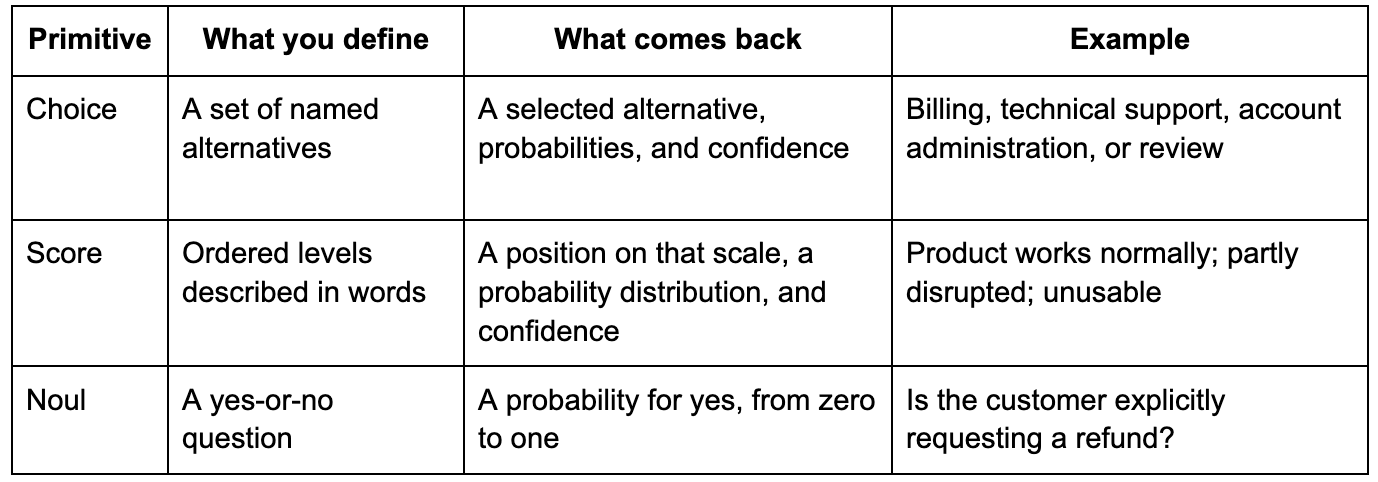
A Choice can select billing because you supplied billing as an option. It can’t decide to write three paragraphs about the history of invoicing. That matters when the next line of your program needs a category it knows how to handle.
A Score deserves a little care. Suppose your levels run from zero to two. The returned score is a probability-weighted position along those levels. It’s not a measurement of the percentage of your customers affected. The descriptions give the levels their meaning. Two different distributions can produce the same average, so the number should not automatically be treated as a complete explanation of the judgment.
Noul is useful when you want a separate probability for a proposition. “Refund requested” and “customer can’t log in” can both be true. Forcing those into one mutually exclusive category would lose information. The queue, the refund request, and the operational disruption are different questions, even though they concern the same message.
Why Jev is not structured output
Generative LLMs can already produce structured outputs. You can constrain a model to an enum or a JSON schema, so Jev is not the first model whose answers can be made compatible with code.
TypeSafe’s claim is that it changed the model and its training around the decision task. Its launch describes a new architecture and parallel sampler, with training called Reinforcement Learning for Calibrated Decisions, or RLCD. The goal is to produce useful probability distributions over decisions rather than to optimize the generation of a response for a human.
Calibration has a specific meaning. Across a sufficiently large collection of comparable predictions assigned a probability of 0.8, you would want roughly 80 percent to be correct. It’s a property you assess across many predictions. Never a verdict on the one in front of you. TypeSafe describes RLCD as training toward calibrated decisions, but the public explanation is not a complete specification of the training data, network, or loss function.
There’s also a difference in execution. An autoregressive language model produces a response as a sequence of tokens. Jev evaluates multiple questions against the same state in parallel. The API serializes the resulting decisions into a response your program can read. There are strings in that response, including the labels you provided, but that’s different from the model composing arbitrary prose.
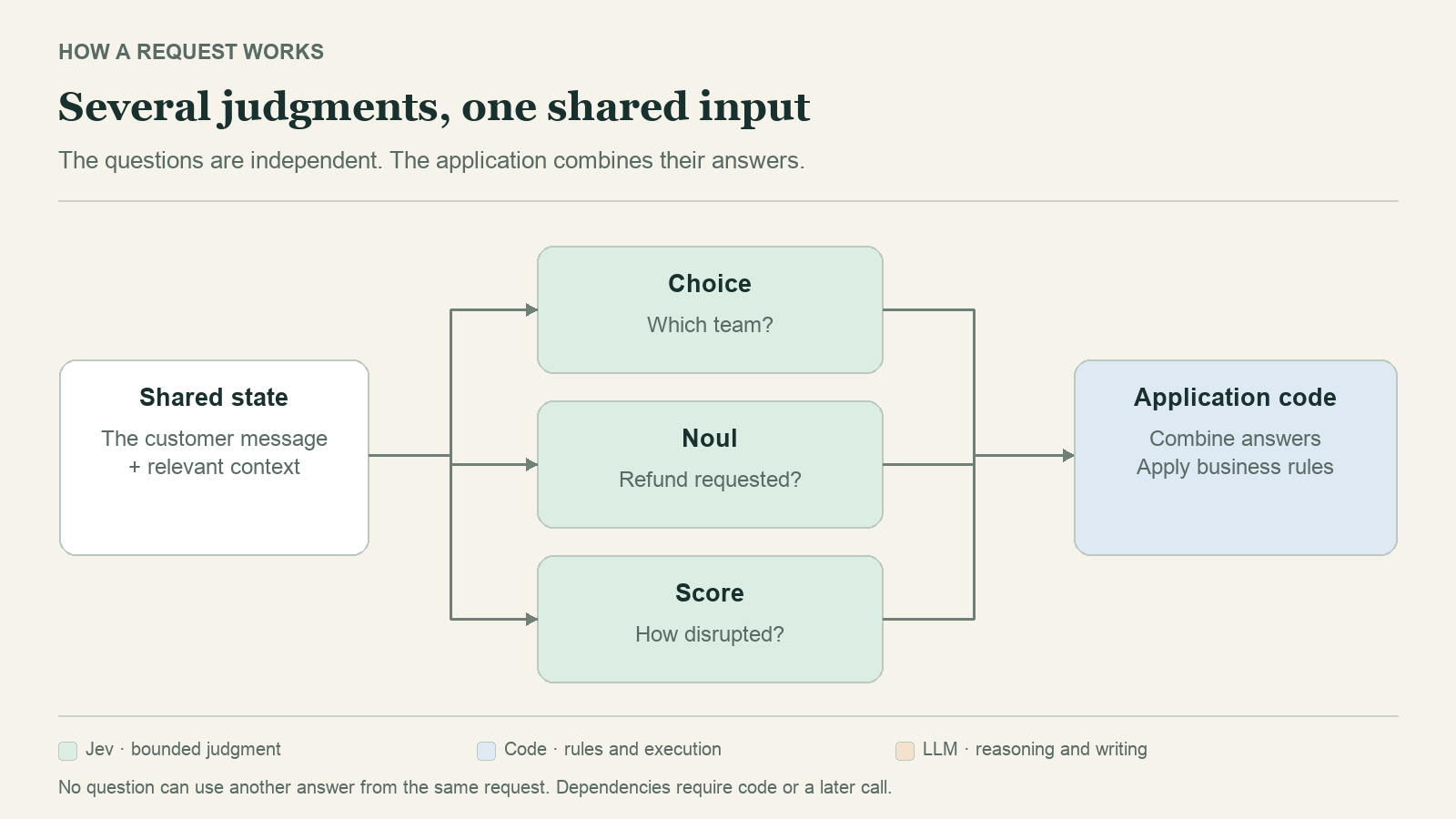
The refund question doesn’t wait for the queue answer. Each question sees the supplied state. Dependencies between answers belong in code or a later call.
This lets you ask several useful questions at once. A ticket’s category, disruption, and refund intent can be evaluated together. If a later decision needs an earlier answer, you still have a dependency. It also doesn’t make additional questions free: their descriptions still contribute input tokens.
One implementation detail is easy to miss: the identifier you give a question is a handle for your code, not the instruction the model reads. A question called urgent still needs a complete instruction explaining what urgency means. This sounds small until you imagine an application full of vaguely named judgments whose meaning exists only in the developer’s head.
Bounded output still requires judgment about errors
Type safety guarantees the shape of the answer. Nothing about its correctness. If the menu contains four wrong options, choosing one cleanly is still a failure. Include “unclear,” “none fits,” or another useful escape where the job requires it, and make the application do something sensible with that answer.
Jev also returns a field named confidence for Choice and Score. That field describes how concentrated the distribution is. A peaked distribution can be wrong; a spread-out distribution can reflect two reasonable options. A universal rule such as “anything above 0.8 may act automatically” skips the work of finding out what errors cost in your application.
The current model has documented weaknesses around arithmetic, counting, dates, indirect reasoning, and confusing or adversarial input. You should also avoid assuming that independently answered questions will obey every logical relationship you intended. The surrounding program needs to enforce those relationships.
This is where the division of labor becomes valuable. Code can calculate a due date. Jev can interpret whether an email is a request to reschedule. An LLM can draft the reply. Code can preserve the user’s approval requirement before sending it. You have placed each capability where it contributes something useful.
Four ways a classifier changes architecture
The interesting thing about the examples appearing around Jev is how different the products look. A tax-document pipeline, a spreadsheet, a browser agent, and an archive analysis seem like unrelated applications. Underneath them, developers are arranging the same capabilities in different ways.
These are early implementations, public demonstrations, and builder reports, with different levels of evidence. I wouldn’t turn that collection into a claim that every example has already survived production at scale. But the variety is exactly what makes it worth studying. You can see several reusable arrangements emerging inside the broader agent infrastructure stack and in applications that don’t need an agent at all.
1. Put a classifier inside a known workflow
Start with a process whose steps are already understood. A support ticket arrives. The system needs to determine who should see it, how urgent it is, and whether it contains a particular request. The classifier supplies those judgments. Existing software retrieves the account, calculates deadlines, and puts the item in the appropriate queue. An LLM can handle a complicated explanation or draft the response when that’s necessary.
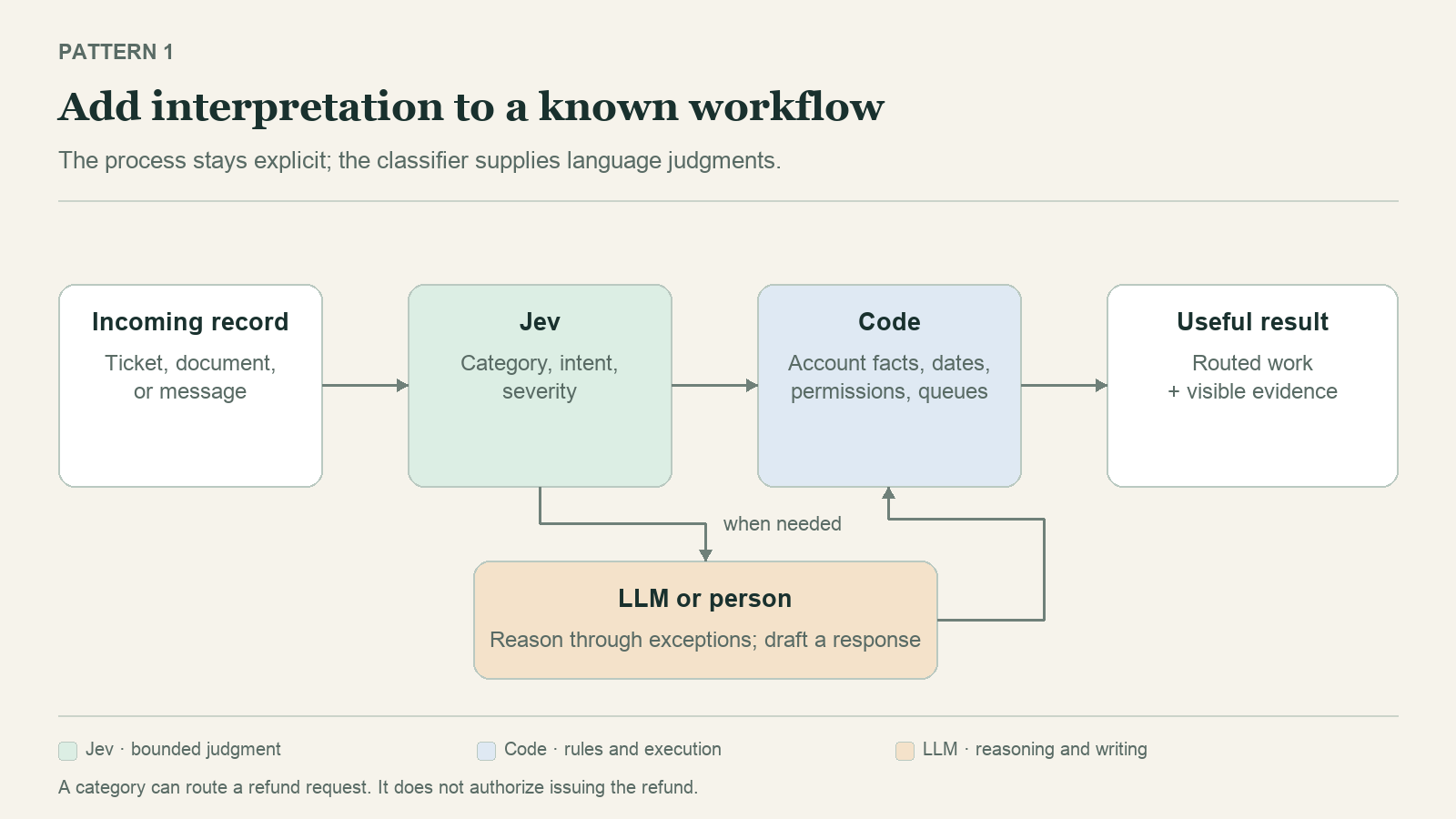
Nakshatra Saxena’s tax-document classifier is a useful example because the underlying work already existed. He describes replacing part of an LLM-based ingestion pipeline and reports a sixfold speed improvement and a 34-fold cost reduction. The open repository includes evaluations and distinguishes confident classifications from low-confidence cases. That distinction matters more than repeating a headline about perfect accuracy. These are his reported results on his documents and pipeline, not a universal model comparison.
Aaron Levie demonstrated a related arrangement with Box. A workflow reads an incident report, evaluates customer impact and severity, moves the file into an appropriate folder, and records metadata. The semantic judgment is small relative to everything the application does around it.
The broader design opportunity is to make a workflow more responsive to meaning without handing the whole process to an autonomous agent. Imagine invoice intake. Code verifies that required fields exist and checks totals. A classifier distinguishes an invoice from a payment reminder or identifies that an attachment concerns a disputed charge. A person resolves an exception. The accounting system preserves its controls.
You have added interpretation to a process whose other responsibilities remain well understood. This is probably the easiest place for many businesses to get immediate value, because the work and its consequences are already visible.
2. Use an LLM to develop the questions, then a classifier to apply them
An archive of customer conversations contains more potential questions than any team knew to ask when it stored the records. You might want to understand which customers are encountering migration problems, where promised functionality differs from delivered functionality, or which objections recur before a lost sale.
An LLM is useful for exploring samples, proposing distinctions, and helping you define what those distinctions mean. A human checks that the categories reflect a real business question. Jev can then apply that rubric across the archive. Code aggregates the results. The LLM returns when it’s time to investigate the pattern and explain it.
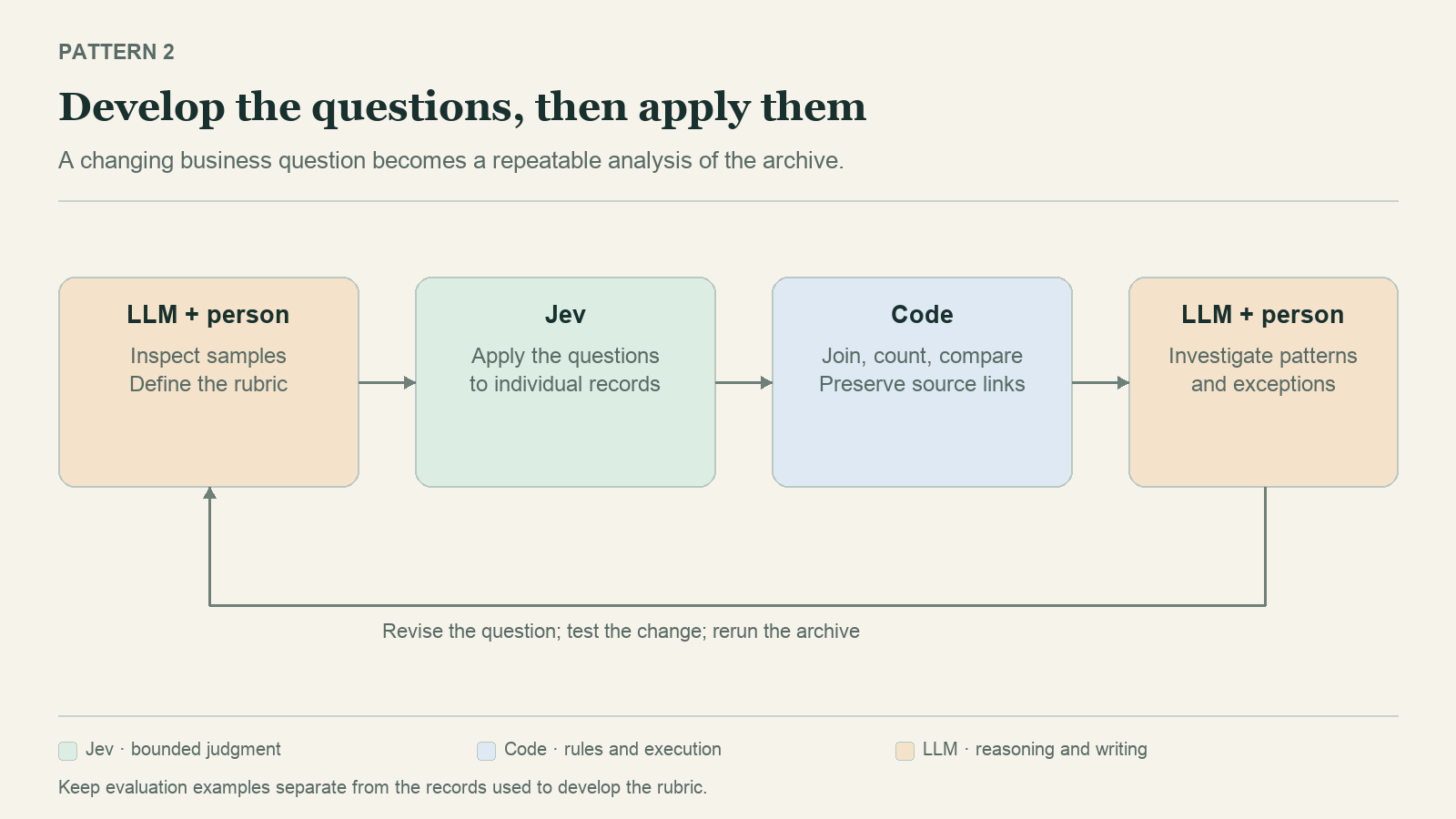
Ian Nuttall applied eight questions to 3,282 of his posts, examining attributes such as topic, hook, and tone, then comparing the resulting groups with performance. That’s a concrete example of turning a messy archive into analyzable columns. It can identify correlations worth investigating, but it can’t establish that a particular tone caused the performance.
The important shift is how inexpensive it becomes to ask another question. In many organizations, the cost of creating a useful new label is high enough that the team chooses a taxonomy once and lives with it. With a broad classifier, a new business hypothesis can become a new pass through the records. You still have to verify the labels and check the interpretation of the result, but you don’t necessarily need another model-training project.
There’s a disciplined way to make this valuable. Write down the question before looking at the outcome you want to explain. Keep some records aside while refining the rubric. Compare the classifier’s labels with human judgments. Then investigate representative examples and counterexamples. Otherwise it’s easy to create a beautifully labeled archive that merely confirms the story you hoped to tell.
This arrangement also connects analysis to operations. If the archive reveals a useful early warning signal, you can test for the same signal when the next customer message arrives. The question that began as research becomes a small function in the live workflow.
3. Put classifiers between an agent’s steps
An agent’s work contains many decisions besides its main plan. Which visible control matches the intended action? Did the last step achieve the expected result? Has the task reached a boundary where detailed context can be compressed? Does the proposed next action appear to exceed the user’s request?
It makes sense to experiment with classifiers at those points. The LLM can retain the larger plan and handle difficult reasoning. Jev can make a bounded judgment from the current situation. Code can execute the permitted action, observe the result, and decide what information the next step needs.
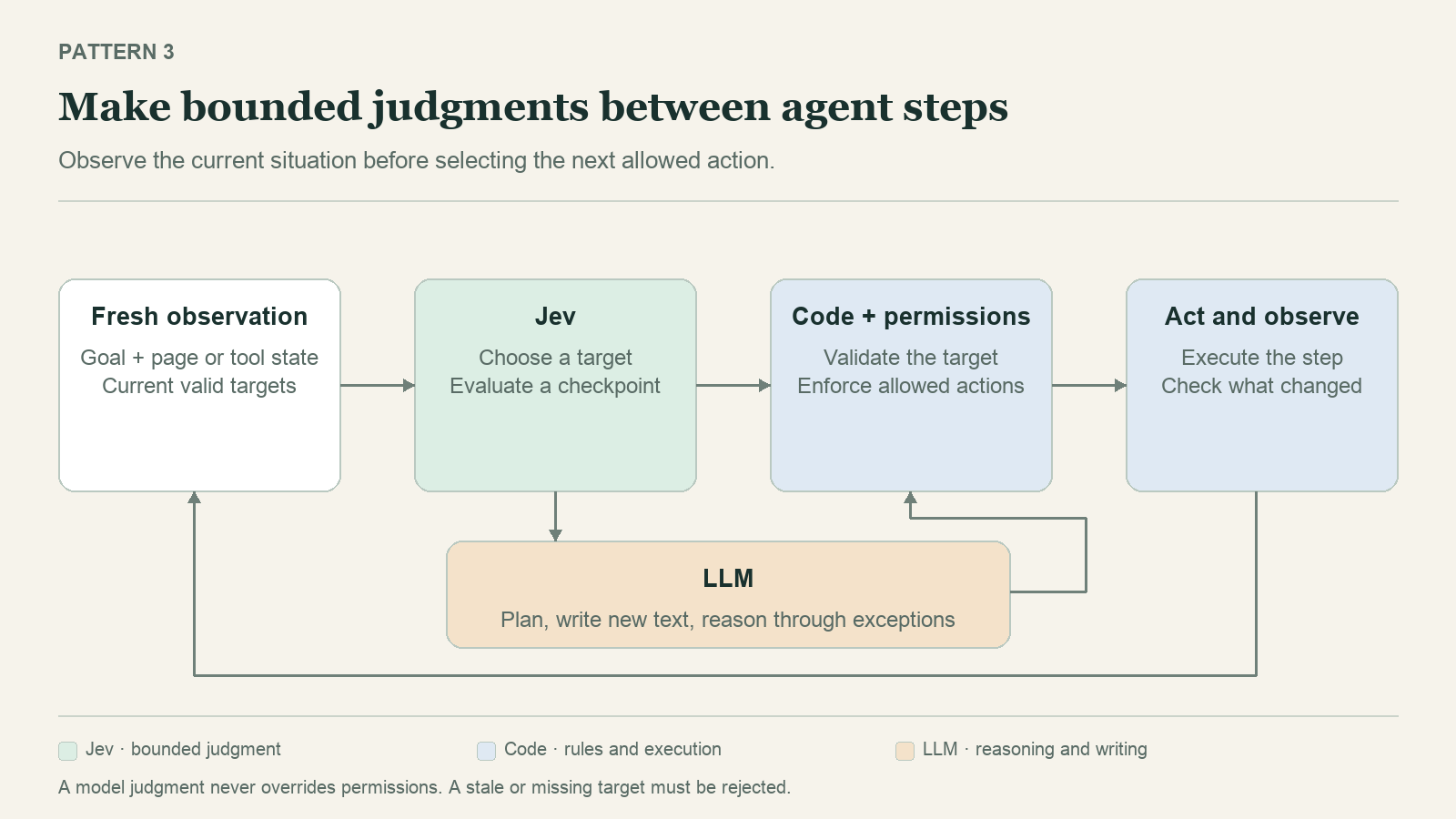
Browser Use’s open-source Jev experiment does something especially revealing: it constructs a new action space from the current browser state at every step, with a small LLM available for typing. Its public flight-search demonstration was reported at about seven seconds. That shows a particular search task in a prototype, not a general guarantee about browser automation or a completed flight purchase.
The fresh action space matters. A classifier can’t select the correct button if that button is missing from its options. If the page changed since those options were collected, a once-correct choice may point to the wrong thing. The model’s judgment is useful only inside a system that observes accurately and checks what it executes.
Kun Chen’s compact-adviser explores a different checkpoint. Is this a good moment to compact? He built an evaluation set from 40 real sessions and describes changing the decision policy as the context window fills. The cost of compacting too early differs from the cost of missing an opportunity when the window is almost full.
That’s a more interesting use of probabilities than choosing one threshold and hoping. The software combines a semantic judgment about the task with a known fact about remaining capacity.
Action review could use a similar arrangement, but the limits are consequential. A model saying that an action looks safe does not grant permission to take it. A destructive command remains subject to code-level restrictions and the user’s authority. A classifier may help detect a mismatch between intent and action, but it cannot guarantee that untrusted input has not misled it. This is part of the larger job of making agent operations safe, where reversibility and control matter alongside intelligence.
4. Put language judgment directly inside the interface
The first three arrangements improve a workflow or an agent. The fourth changes what using ordinary software feels like.
Nader Dabit demonstrated a spreadsheet with an urgency column that interprets the meaning of each row. He also showed intent-based email search, noting that a large inbox would benefit from retrieval first. Chris Tate experimented with Jev and json-render using an existing component and action catalog. Chris Nicholas showed intelligent autofill buttons. These are different ways to put interpretation inside a familiar interaction.
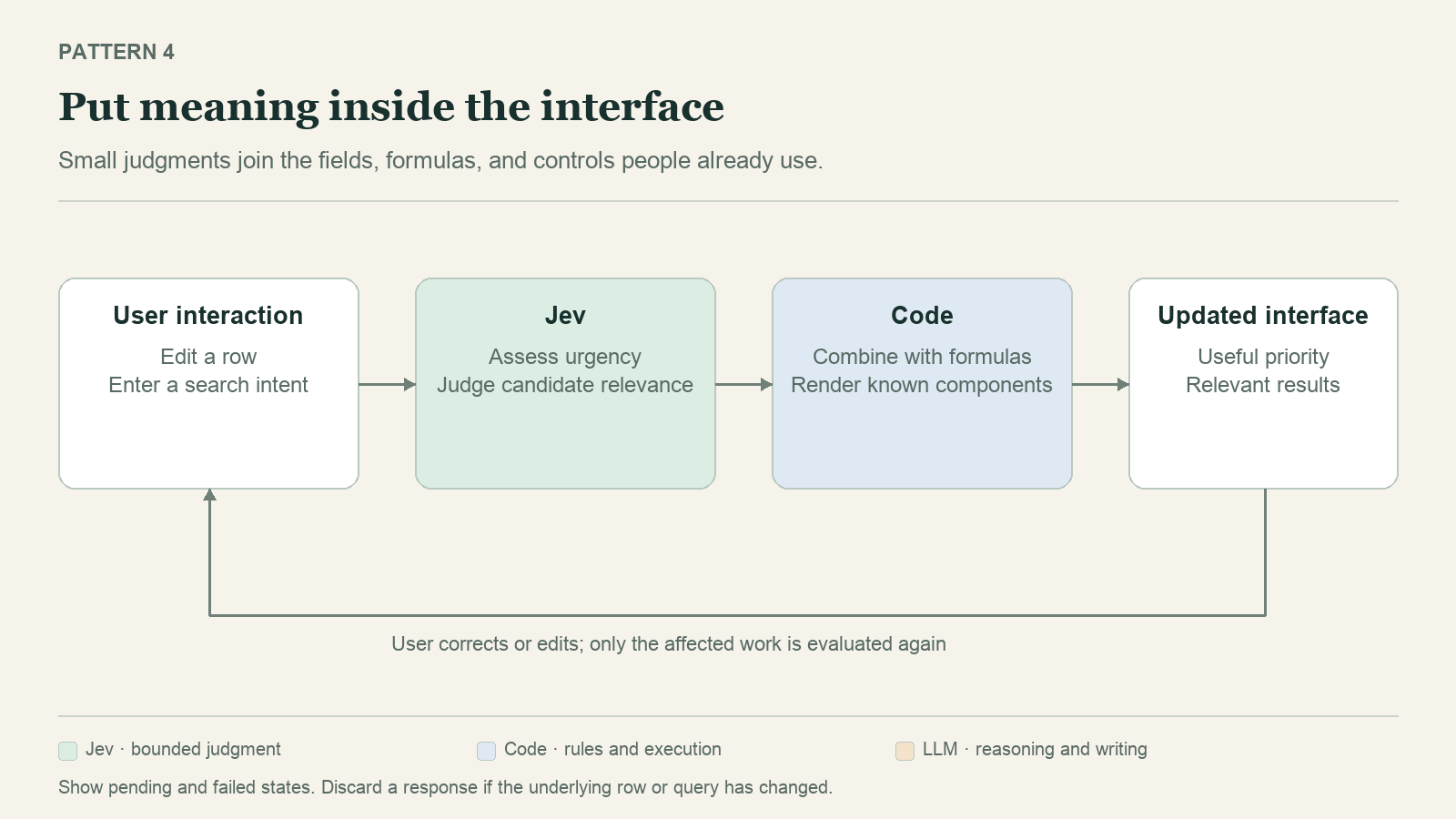
Think about what makes a spreadsheet useful. It combines values and formulas so that changing one part updates other parts. If language judgments can participate in that system, a row no longer has to contain only facts somebody manually structured beforehand. One column can classify the request. Another can assess whether information is missing. Ordinary formulas can combine those judgments with dates, prices, owners, and limits.
The application should still let you inspect the source, correct the classification, and distinguish an unfinished evaluation from a completed one. But the interaction can become much more direct. You don’t have to open a chat and describe the whole sheet every time you want it to notice something.
This is also why the interface example goes beyond cost reduction. A feature that responds during the user’s work can be a different product experience from a feature that sends the user away to wait for an answer. The result may be a suggestion, a relevant control, or a better-ranked list of records.
Across all four arrangements, you can see why Dillon Mulroy described Jev’s appeal in terms of composing AI into products and systems. The ability is useful in many places precisely because the surrounding product supplies the context, the choices, and the consequences.
Why cheap classification changes the opportunity
As of September 19, TypeSafe lists Jev at $0.042 per million input tokens, with no charge for output tokens. At an illustrative 1,000 input tokens per request, the arithmetic looks like this:
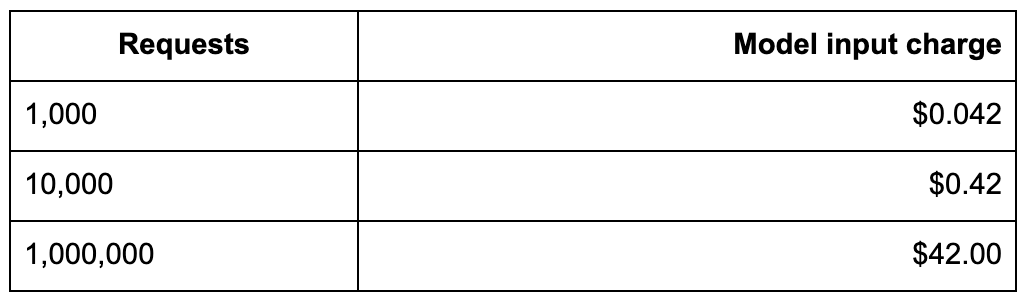
That input includes the material and question definitions. These are model charges, not the entire cost of retrieving data, hosting an application, using an LLM, or reviewing errors.
Still: a million language judgments of that size for $42 is a very different design constraint from the one many teams have been working under. You can afford to test more ideas, evaluate more records, and ask more specific questions within a process.
TypeSafe’s own workflow evaluations report high-end gains approaching 194 times in speed and 445 times in cost. The comparisons use model-derived reference judgments and a structured decision setup for the LLMs. Treat the results as specific to that methodology.
You also shouldn’t multiply a speed ratio by a price ratio and call the result a universal improvement in intelligence. A faster answer and a cheaper answer relieve different constraints. Either can unlock a use that was previously impractical. Together they can change the shape of a product, but the effect depends on what the product needs.
The cost of the judgment is only one part of that. If you spend a minute acquiring the page and 200 milliseconds classifying it, you still have a slow browser workflow. If half the classifications need expensive review, your business cost isn’t captured by the model’s token rate. The right number to optimize is the cost of a useful, sufficiently reliable result, including the surrounding work.
High volume makes the arithmetic compelling, but it’s not the only reason to try a classifier. An occasional decision that interrupts someone, a slow interaction that makes a feature unpleasant, or a new capability that users couldn’t previously access can also justify a build. Look for a useful result and a meaningful comparison.
The strategic opportunity remains enormous because our current systems reflect the old constraints. Companies sample calls rather than examining every conversation. They tag documents once because retagging the archive is a project. They put intelligence at the beginning of a workflow, then let the remaining steps proceed with much less interpretation.
Those decisions tell us what was affordable. They don’t tell us where judgment would have helped.
TypeSafe named Jev for William Stanley Jevons and the idea that efficiency can expand a resource’s uses enough to increase total consumption.
Applied here, the possibility is that cheaper classification creates so many useful new decisions that demand grows far beyond the workload we’re replacing.
That expansion isn’t automatic. Teams have to discover valuable uses, and the results have to be good enough. But it’s the right direction to look. Per document becomes per section. Per customer becomes per interaction. A check at the beginning of an agent task becomes a check at each relevant step. Software begins to notice distinctions that previously required the user to stop and explain.
That’s why I think this launch matters historically. We’re beginning to separate broad language judgment from the requirement to generate language, and to package it at a cost and speed that invite much wider use. Whether Jev remains the leading implementation is a separate question from whether that capability becomes a standard part of how software gets built.
I want people to start experimenting because this is where the new possibilities become visible. The companion guide is built to get you from that idea to a working first implementation.
One call you can read
Before wiring up a large application, use a synthetic example whose intended meaning is obvious. This one asks three independent questions about a duplicate subscription charge.
Save the following as first-request.json:
{
"state": {
"message": "We upgraded to the annual plan yesterday. The invoice shows two charges for the same subscription. Please refund the duplicate payment. Everyone can still use the product."
},
"model": "jev-latest",
"questions": {
"queue": {
"type": "choice",
"instructions": "Which team should first handle the customer's request? Use review if the message is unclear or does not fit another team.",
"criteria": {
"billing": "Charges, invoices, payments, or refunds",
"technical": "A product feature is failing or unavailable",
"account": "Account ownership, membership, or access administration",
"review": "Unclear, insufficient information, or none of these teams fits"
}
},
"refund_requested": {
"type": "noul",
"instructions": "Is the customer explicitly asking for money to be refunded?"
},
"disruption": {
"type": "score",
"instructions": "How much does the message say the customer's ability to use the product is disrupted?",
"criteria": [
"The customer can use the product normally",
"Part of the product is unavailable, but useful work can continue",
"The customer cannot use the product to do their work"
]
}
}
}
The endpoint and response format are documented in the TypeSafe API reference. We ran this exact request against Jev 1.13.0 while preparing the guide. The actual returned values included:
{
"queue": "billing",
"refund_requested_probability": 0.99,
"disruption_score": 0.0,
"input_tokens": 510,
"output_tokens": 78
}
That’s a shortened view of the response, not its full API schema. The single request took about 163 milliseconds, measured around the network call, and reported 510 input tokens. At the listed rate, those input tokens represent about $0.00002142 in model charges. The API also reports output-token usage, although the current price for those tokens is zero.
Now change the message. Make it an access problem, introduce an ambiguous request, remove the relevant information. Look at how the answers change. That’s a much more useful next step than admiring one correct response.
Bonus builds for your agent
The guide gives you the base card for each of the four patterns. These four are extras, one per pattern, pointed at jobs the base cards do not cover. Same deal. Hand one to your coding agent and watch the architecture run on your own data.
These are build prompts, not claims that every recipe has already been implemented and benchmarked. Each starts from a real job and assigns different responsibilities to the classifier, code, and any generative model. Use your own approved data and replace the business-specific names with your actual ones.
Give your agent these shared instructions before the recipe you choose:
Build this as a working implementation using the TypeSafe skill
and the real hosted Jev API. Use the current official docs.
Begin with a useful end-to-end slice of the actual job. Preserve
source IDs so I can inspect the evidence behind each result.
Keep arithmetic, permissions, retrieval, and execution in code.
Use an LLM where reasoning or new writing is required.
Make unknowns, failures, and unfinished work visible. Do not show
an empty result as a successful run. Add bounded retries for
transient errors and respect provider rate limits.
Log the model version, question version, actual token usage,
request times, end-to-end time, and error/review counts. Calculate
model charges from the published rate and identify other costs
separately. Never label an estimate as a measured bill.
Evaluate on representative cases, including ambiguous and
adversarial ones. Keep a held-out set separate from examples used
to refine questions. Choose review thresholds from observed
errors and the consequences of mistakes, not a universal number.
Finish with a runnable interface or command, a real run, source
evidence I can inspect, and an honest comparison with the current
method. Keep external actions in preview until authorized.
Recipe 1: An inbox that notices business intent
Pattern: Classifier inside a known workflow. Useful result: A reviewable list of messages that need a business decision, without turning inbox access into permission to send replies.
Build a read-only email and Slack intent desk for the sources I
authorize. Work from recent messages with enough thread context
to distinguish a new request from a quotation or resolved issue.
Ask Jev for intent: buying inquiry, introduction, scheduling,
customer problem, routine update, or review. Ask separately
whether the latest message requests action from me and whether
the supplied conversation shows that request was answered.
Use code to deduplicate threads, apply source/time filters,
preserve links, and keep an explicit processed count. Dates and
reminder calculations belong in code. If a follow-up needs to be
written, use an LLM to draft it from the source after selection.
Show the messages behind each proposed action, including the
passage being classified. Test forwarded requests, sarcasm,
resolved conversations, and vague inquiries. Compare with a
manually labeled sample. Do not send, archive, or mark messages
read as part of the initial build.
The hard question is whether the classifier helps you notice something worth acting on. Sort your test run by what you would have missed. That’s the number that matters.
Recipe 2: Turn an editorial archive into evidence
Pattern: LLM-assisted rubric, classifier at scale. Useful result: A way to compare content attributes with outcomes while preserving the distinction between a pattern and an explanation.
Build a local analysis of my approved content archive and its
available performance data.
Use an LLM and a small sample to propose concrete definitions for
topic, opening style, reader promise, and level of practical
instruction. Have Jev apply each dimension separately to the
remaining items. Include unknown/ambiguous outcomes where useful.
Join labels to performance by stable content ID in code. Compare
medians and sample sizes, and separate formats, platforms, and
time periods rather than mixing unlike distributions. Flag
missing metrics and repeated or promoted posts.
Return a sortable table and a short memo citing actual examples
and exceptions. Do not claim a hook caused growth because the
posts with that label performed better. Suggest a prospective
test for one promising pattern.
Include a correction interface and a held-out labeling check.
Make reruns resume safely and avoid reclassifying unchanged
records unless the question or model version changes.
The classifier provides analytical columns. What you compare them against still has to measure the same thing in every row, or the table will be confidently wrong.
Recipe 3: An agent checkpoint reviewer
Pattern: Classifier between agent steps. Useful result: A visible warning when an agent’s proposed action and the user’s intent appear to diverge.
Build an advisory checkpoint reviewer for agent tool proposals.
Give it the user's relevant instruction, current task context,
the exact proposed action, and known target/environment facts.
Use code to identify tool types and enforce existing permission
rules. Ask Jev separate bounded questions about apparent scope
match, destructive effect described in the action, and missing
context. Provide an explicit unclear outcome. Do not ask one
vague question such as 'is this safe?' to do all the work.
Combine the answers in a visible code policy that produces
continue-to-existing-checks, request-review, or stop-for-missing-
information. Jev must never grant permission or bypass a block.
Keep the initial integration in shadow mode: show what it would
have recommended alongside the actual review outcome. Include
tests for quoted commands, shell indirection, ambiguous paths,
prompt injection in source text, and an action broader than the
request. Unknown tool behavior must remain unknown.
Measure missed risky actions and unnecessary interruptions
separately. Explain what the classifier cannot establish.
Keep it a detector. The permission check stays in code, where it can actually refuse.
Recipe 4: Intent search over documents or messages
Pattern: Judgment inside an interface. Useful result: Search that can distinguish a precise intent within a manageable set of retrieved candidates.
Build read-only intent search over an approved document or
message collection. Support questions such as 'people asking
for a refund after a migration problem' rather than only words.
Use ordinary search or embeddings to retrieve candidates first.
Have an LLM translate the user's request into explicit semantic
criteria when necessary. Then ask Jev whether each candidate
matches those criteria, preserving an insufficient-context result.
Return ranked source excerpts with links and the criteria used.
Generate any explanation with an LLM from those excerpts, or
show fixed labels; do not pretend Jev authored an explanation.
Evaluate retrieval coverage separately from classification
quality. Include known relevant items that use different wording,
negative mentions, quoted requests, and missing thread context.
If a relevant item was never retrieved, count that as a search
failure even when the classifier judged its candidates correctly.
Expose the searched scope and result count. Let me refine a
criterion and rerun without losing the original query.
This pattern also works for candidate records, catalog items, and known UI components. The classifier’s options come from somewhere. Improving that upstream selection can matter as much as improving the judgment itself.
What to check before trusting a classifier
Start with a small labeled collection that represents the actual work. A few dozen varied examples can expose obvious problems, but they can’t establish a rare failure rate. Include the ordinary cases, the expensive mistakes, the ambiguous inputs, and examples with missing information. Keep a separate set for evaluation after you finish adjusting the questions.
Ask whether your labels are even clear to people. If two knowledgeable reviewers disagree about “urgent,” you may need a better definition, multiple dimensions, or a review path. Making the model more confident about an unclear category doesn’t resolve the underlying ambiguity.
Compare Jev with the current method on the same job. That might be a human queue, an existing classifier, a simple rule, or an LLM. Measure correct outcomes, missed important cases, unnecessary escalations, total completion time, and review effort. Keep model time separate from retrieval and execution. Otherwise you can’t tell what improved.
For code, the failure path matters as much as the successful response. A rate limit or an unavailable service should produce an explicit retry or review state. A missing source should remain missing. A newer model version or revised question should trigger a fresh evaluation rather than silently inheriting an old threshold. The model documentation explains versioned model IDs and aliases. Pin the version once you’ve tuned confidence thresholds against it. The response’s model field always reports which version answered.
You may discover that your existing classifier already solves the problem well, or that the useful judgment needs more reasoning than Jev handles reliably. That’s a useful finding. You can also discover a smaller classification function inside the same workflow that works extremely well. The unit of evaluation should be the job you’re assigning, not a sweeping verdict on the entire product.
The most exciting outcome is finding a worthwhile question you had stopped asking because it was too expensive or inconvenient to apply everywhere. Build that. Make the results inspectable. Find the failure cases. Then decide whether the judgment belongs at a smaller, more frequent point in the work.
What if everything was intelligent? Every element, not just every sentence. I don’t mean everything needs a chatbot. I mean the software we already use could understand enough about the work in front of us to make thousands of small, useful distinctions that it currently leaves to a person.
We’re early enough that nobody has a complete map of those possibilities. The builders experimenting with a spreadsheet column, a document pipeline, or a checkpoint inside an agent are beginning to draw it. Pick a problem that matters to you. Give the classifier a specific job. And if you discover a useful arrangement, I want to hear about it.
Related reading
- Building agents is 80% plumbing: what the Claude Code leak actually reveals — most of a working AI system is the deterministic code around the model, not the model.
- You have three kinds of tasks. AI can only do two of them. — the dispatch rule for what shape of work earns a model at all.
- Which AI should you open first? — routing work to the cheapest model that clears the bar.
- Everyone thinks “agents” means one thing. It means four. — the taxonomy that keeps a bounded component from getting staffed as a full autonomous agent.
Coming up
On Wednesday: a conversation I had last week at the OpenAI offices with two of the people building Codex and ChatGPT work. I tell them I underestimated computer use, they explain why it turned out to be the universal connector, and we get into what happens when every function inside a company hits its own tipping point at a different moment.
I make this Substack thanks to readers like you! Learn about all my Substack tiers here