Better computer use and longer-running agents make more possibilities worth exploring. What to reconsider, and how to give Astra the work.
By Nate
Published: 2026-09-07
URL: https://natesnewsletter.substack.com/p/gpt-6-astra-research-decisions
A lot of what we accept in life is determined by how expensive it is to investigate something better.
We stay with a service we don’t especially like. We keep doing a piece of work in a way that annoys us. We wonder whether a different city would be better for our family, or whether an idea we’ve had for years could become a business. Some of those thoughts become decisions. Plenty of them never get that far. We can see the work we’d have to do just to find out, and there isn’t room for it this week.
There wasn’t room last week either. Eventually, we stop bringing it up.
Astra, OpenAI’s new GPT-6 model, gives us a reason to reconsider those choices. It is better at using computers and carrying an assignment through changing circumstances. The practical question is how much of the work between asking and receiving a useful result we can now leave to it.
I firmly believe that maximizing choice leads to a richer life.
Tim Urban’s life-paths diagram makes that belief easy to picture. Behind the point marked today, a single green line traces the life you have lived, surrounded by the paths you didn’t take. Ahead of today, the green line branches into many possible futures.
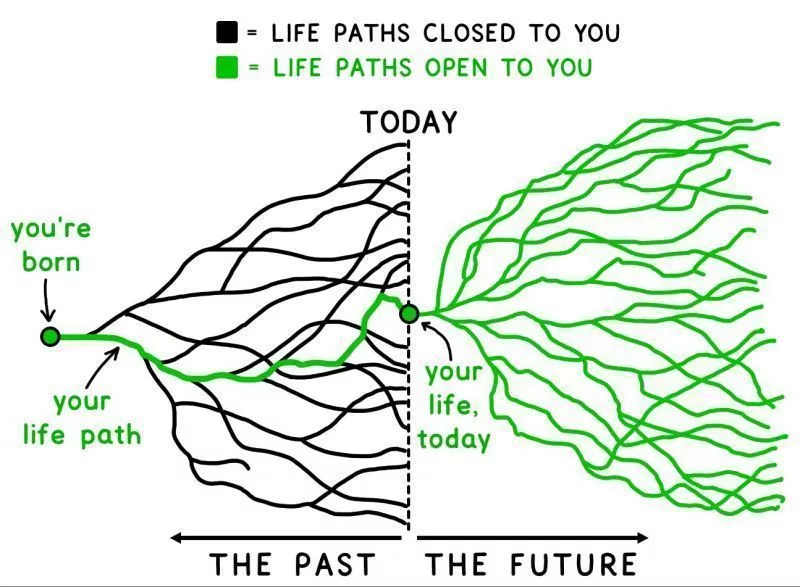
Diagram by Tim Urban of Wait But Why.
A possibility you cannot afford to investigate is barely a choice at all. It can exist in theory while remaining out of reach because finding out whether it would work takes more time, money, or help than you have. Making that investigation less expensive gives you a wider set of futures you can seriously consider. That is what interests me about Astra: more of those green branches becoming practical to explore.
If you still have to organize every search, move the information between applications, and tell the model what to try next, the investigation remains your job. You have help with pieces of it. When an agent can carry more of that work, a question that once demanded your weekend may become worth asking.
I want to consider what changes when we start handing Astra work we weren’t going to do at all. A faster model can save time on an existing task. A more capable agent can change the set of possibilities we live with. The things we never attempted don’t appear on a timesheet, but they can matter more than the things we finish faster.
This piece covers:
- 23 recipe cards for the work you keep postponing. The renewal you haven’t read, the subscriptions you’ve never audited, the quote you never got around to comparing. Each card is a working prompt you can paste as written.
- What the benchmarks actually license. Astra more than doubles its predecessor on business-workflow tasks, and 41.4% is still not dependable completion. Here is what those numbers do and don’t justify trying.
- The assignment to give before you’ve decided. “Help us move” assumes the decision is made; “help us understand whether moving would improve our lives” is different work, and it can succeed by telling you to stay.
- What your customers are actually paying for. Some of them are staying because leaving would be another job, and that reason is now open to automation in both directions.
- How a narrow search can look thorough. The agent decides which alternatives you ever see, so the useful instruction is to have it investigate what would make its own recommendation wrong.
Below: what the evidence actually supports, and the six places I would point Astra first.
Subscribers get the full deep-dive and guide, plus membership to my Slack community!
LINK: [Grab the guide]
Benchmarks tell you the tool got better. They don’t tell you which part of your own life to start with.
The guide covers:
- 23 cards, one per job. Each names the result you’re after, so you can pick the closest match and adapt it instead of writing an assignment from scratch.
- The context that changes the job. Every card names what the agent needs from your life before it can be useful, so you stop discovering the missing piece three hours in.
- Where the agent stops. Each card marks which actions need your decision and which it can take without asking.
- Six moves that work without the cards. Once you can see what an assignment needs, you can write your own in ordinary language.
What GPT-6 Astra can do on its own
For the possibilities to actually widen, the agent has to carry more of the investigation without handing the work back to you. The performance gains give us a reason to try. Two charts make the relevant change easier to see.
AutomationBench tests business workflows across simulated applications, including customer records, calendars, and inboxes. The agent has to leave the records in the right state. Producing a plausible description of the work is not enough.
OpenAI reports 41.4% for Astra versus 18.1% for GPT-5.6 Sol, its previous model: about 2.3 times the score. These are the best reported results, not an equal-cost comparison. OpenAI’s evaluation.
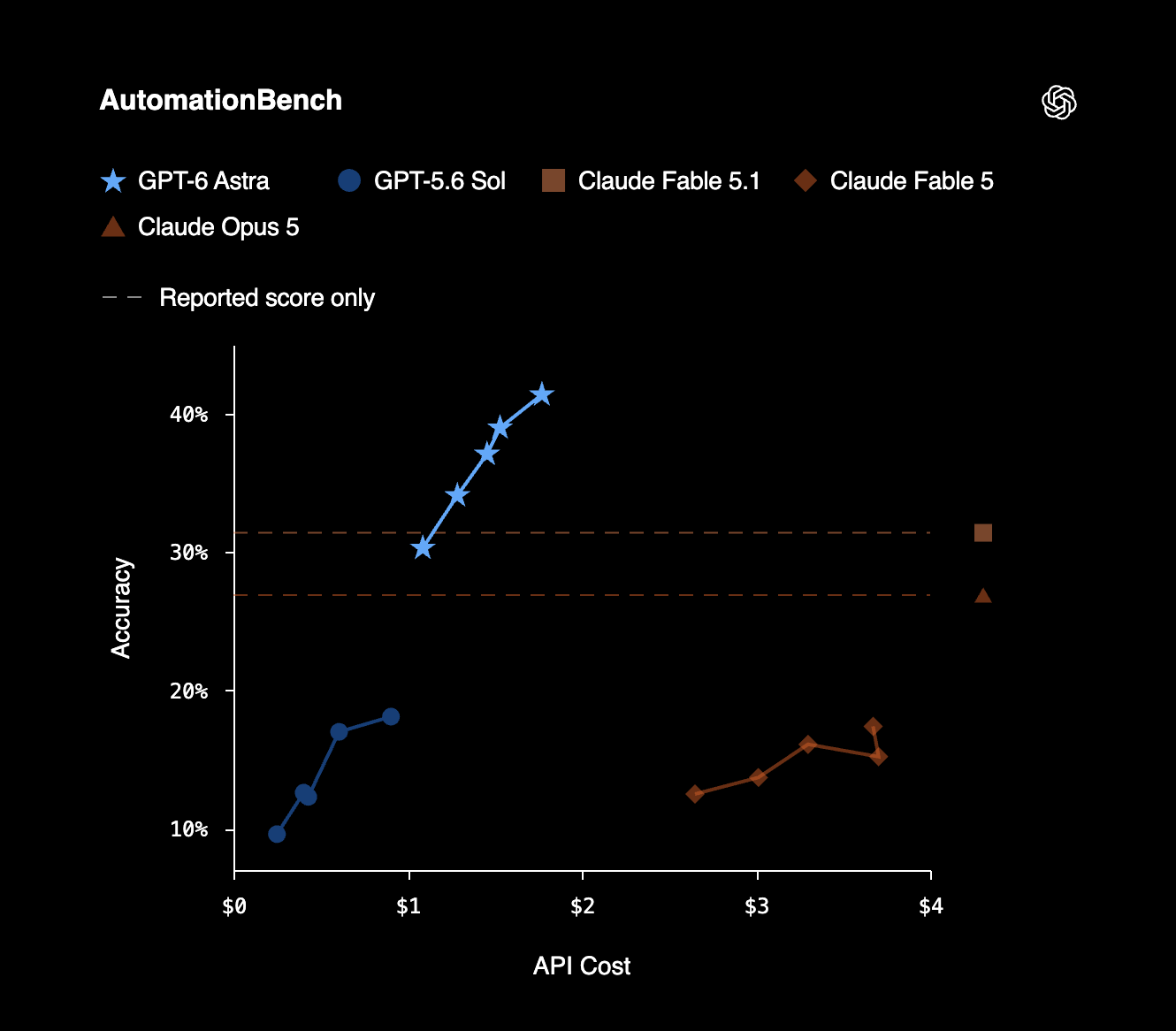
Original chart: OpenAI. Higher is better. The horizontal axis shows model API cost, not the full cost of a business job.
The improvement is large, and 41.4% is still a long way from dependable completion of every assignment. Both facts belong in the argument. There is more work worth trying, and you still need to establish whether the result is usable.
Computer use matters because so much of the work we want done lives inside existing applications. An agent that can work with those applications can reach further into an assignment than one that needs you to operate them on its behalf.
On OSWorld 2.0, which tests work in computer applications, OpenAI reports 72.6% for Astra versus 65.7% for Sol, in roughly half the simulated time. The offline evaluation gives partial credit, so these figures are not percentages of jobs completed perfectly. Results and methodology.
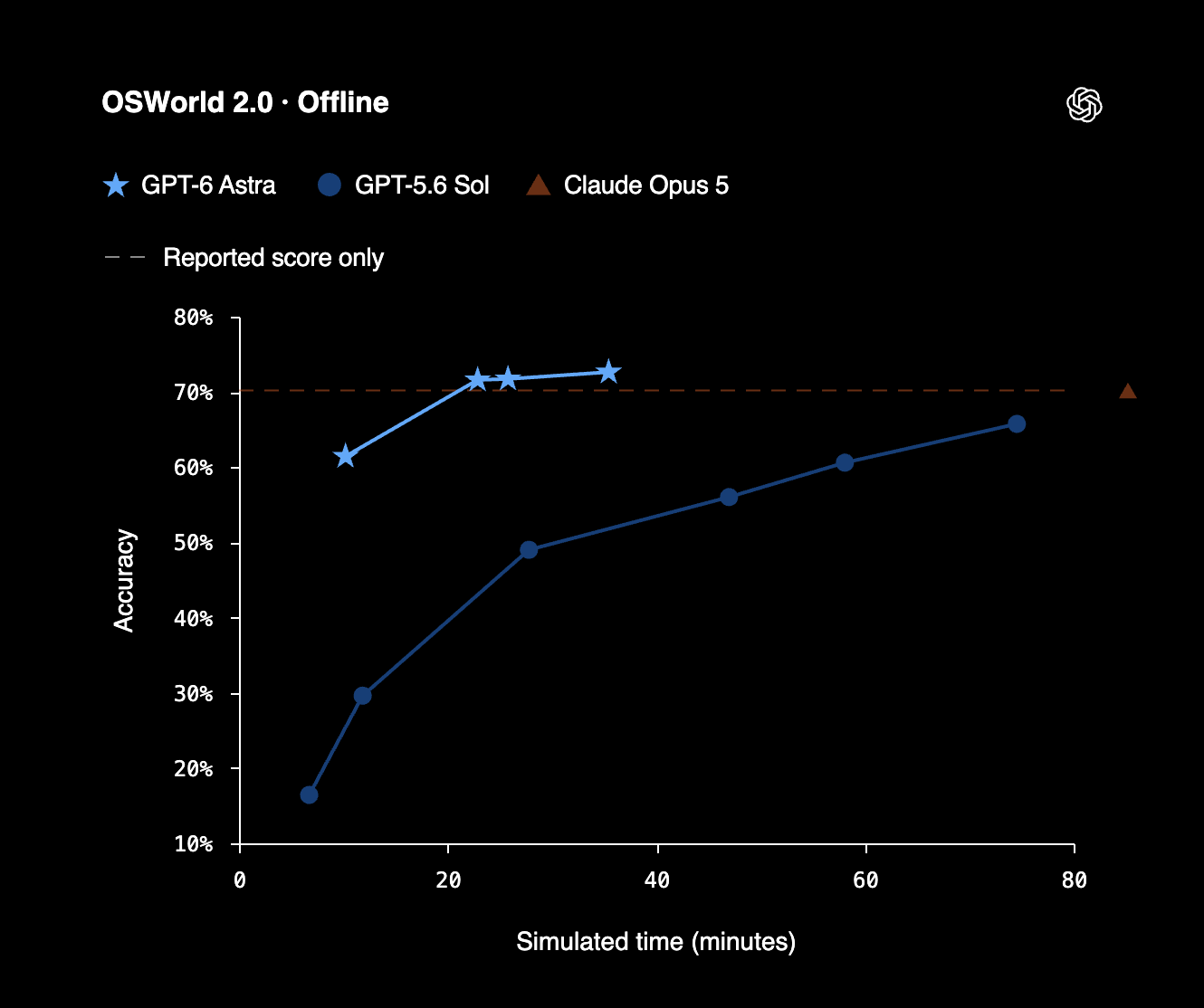
Original chart: OpenAI. Further up and left is better. Timing is simulated; it is not a measurement of hours saved by customers.
Taken together, these results give us a reason to test larger assignments. They don’t establish that an agent can handle your particular problem. They show why an old judgment that the tool wasn’t capable enough may deserve another look.
Independent evaluation adds to that picture. Artificial Analysis’s September 4 update puts Astra four points ahead of Sol on its revised Intelligence Index. It also reports an approximately 85-point Elo gain over Sol on AA-Briefcase, which evaluates linked tasks in complex knowledge-work projects with thousands of source files. That is a relative rating against its own predecessor, not an 85% productivity gain. Claude Fable 5.1 and Opus 5 still lead that benchmark outright. Artificial Analysis’s updated results.
The strengths remain uneven. Its September 3 assessment found stronger analysis but weaker presentation on AA-Briefcase, and a regression on another professional-work benchmark. The older overall index put Astra and Sol level; the revised test mix separates them. Which work you measure changes the picture. A model can become much better at investigating a problem without becoming equally better at the document it hands back.
None of this means every AI job now costs less. The expense I am concerned with includes your time gathering records, repairing failed attempts, coordinating steps, and checking the result. If Astra does the preparation faster but leaves you to rebuild it, the saving disappears. If it gets you to a sound comparison with substantially less of your own effort, an investigation that used to feel extravagant can become reasonable.
That is the frontier moving into ordinary life. More of the branches in that picture become worth investigating, including paths you had stopped considering because the work of finding out seemed too expensive. The next question is which ones.
What if you haven’t decided to move yet?
In the video, I used a simulated household move to make the capability concrete. The family had a destination and a job to get through. Now consider the earlier, less settled question: whether moving would improve their lives at all.
Imagine two parents who have been talking about living closer to their relatives. Their children would see their grandparents more often, and the parents might have more help. Perhaps one parent’s work is flexible enough that the move could make sense.
But they don’t know. They would need to understand what they could afford, which neighborhoods would fit their lives, how schools and work would line up, and what they would give up by leaving. Each answer changes another part of the question. A cheaper house with an impossible commute doesn’t solve the problem. A lovely neighborhood with no workable childcare may create a different one.
So they investigate a little. Someone sends a listing, and they have a conversation after dinner. Then a child gets sick or work gets busy. The question returns to the category of things they might do someday.
We tend to describe this as a family deciding to stay. Sometimes that’s accurate. Sometimes they never obtained enough information to make a serious choice about leaving.
If an agent can do a substantial share of that investigation, the family can get to a different kind of conversation. A few possibilities, examined against their actual circumstances, would give them something to discuss beyond the occasional real estate listing. The financial or personal cost might still be too high. But staying after a considered comparison is a different experience from staying because no one could face doing the comparison.
The model has not made the house cheaper or created a childcare opening. It has helped the family establish whether a workable option exists. If the answer is no, they can understand what would have to change before the move deserves another look.
Give Astra an uncertainty to investigate before committing to a plan.
“Help us move” already assumes a decision. “Help us understand whether moving would improve our lives” opens a different kind of work. The second assignment can finish successfully with a recommendation to stay. It can also reveal that a smaller change would produce much of the benefit the family is looking for.
A capable agent can carry a weak premise a long way. If the premise is that you need a new website, a new supplier, or a new service to sell, the work can become impressively detailed before anyone examines whether that change solves the actual problem. You can give the agent the job of finding out while remaining undecided about what to do.
How to prompt GPT-6 Astra for long tasks
In my recent piece on what your job becomes when the machine picks the method, I argued that a more capable agent changes how much of the assignment you need to specify. You can state the goal and the constraints that matter, and leave more of the method to the model. The work you do when it comes back becomes more important: understanding whether its choices served what you actually wanted.
The ARC Prize analysis of Astra gives a useful example of method-finding. Its benchmark puts agents in unfamiliar interactive environments where they must discover how things work. Researchers observed Astra building compact representations of the game mechanics and using them to plan. It scored 62.7% with the standard setup at maximum reasoning effort and 99.9% at high effort with a provider-specific setup that preserves internal reasoning state between requests. Those are different configurations, not a clean experiment showing what memory alone adds. Nor does 99.9% mean near-perfect performance on ordinary work. What interests me is the observed behavior: the agent developed a way to solve a problem it had not been given a procedure for.
A lighter harness leaves room for that judgment. The harness is the setup around the model: its instructions, tools, context, and permissions. Making it lighter means questioning the accumulated directions that tell the model how to do work it can now figure out. The records it needs and the limits on what it may do still matter. A capable model with no access to your contract cannot check your contract.
If you’ve spent a year getting useful work from less capable models, you’ve probably learned to break a request into small pieces, explain the order, and correct each piece before asking for the next. Those habits came from real experience. But carried into every Astra assignment, they leave you organizing the investigation while the model does the searches. You still have to decide what to try when the first approach fails. For the family that could barely face considering a move, that may still be too much work to begin.
A better starting request could be quite ordinary. Example:
We’re wondering whether moving closer to the grandparents would improve family life. Help us figure out whether it’s worth a serious visit next month. Use the budget and work constraints I’ve shared. Ask me about missing information that would change the answer. Bring back realistic possibilities and the tradeoffs we’d need to discuss. Don’t contact agents or make bookings.
The family hasn’t designed a research process. They’ve described what they are trying to learn, supplied what they already know, and said where the agent’s authority ends. Astra can help discover the rest of the assignment. If the grandparents’ location is missing, that is a useful question. If the budget is already in the conversation, asking the family to type it again wastes the attention the tool is meant to save. The conversation should get the work started without becoming an exhaustive intake form.
Once enough is clear, let the model choose how to investigate. It can work out which housing information to compare, which commute assumptions need checking, and which possibilities deserve more attention. A different order from the one you would have chosen is not, by itself, a reason to interrupt. A plan that assumes one parent can work remotely when they cannot is.
When the work comes back, look for the choices that shaped the answer. Which requirement ruled out an otherwise attractive neighborhood? Did the model treat an uncertain childcare opening as available? Did it assume that a shorter drive to work mattered more than seeing relatives during the week? Those are useful places to spend your attention. You don’t have to supervise every search to question an assumption that determined the recommendation.
The distinction is between facts the agent needs from your life and a method it can develop for itself. Being home for dinner is worth explaining. A requirement to visit exactly twelve websites may preserve your old way of doing the work.
Help changes who gets to be thorough
The work of applying for something can determine whether a person ever gets it.
In the H&R Block FAFSA experiment, researchers offered some families with low or moderate incomes help completing the federal financial-aid application, along with information about available aid. Another group received personalized information without application assistance. Among dependent students in the study, the combined assistance increased college enrollment by about eight percentage points. Information alone produced no measurable improvement in the outcomes studied. The research team’s account of the experiment is worth reading.
This was human assistance, not AI, and it doesn’t establish what an agent would accomplish. But the difference between the two groups shows how consequential the work between an available opportunity and a person’s ability to take it can be.
That makes me think differently about the familiar AI demonstration of filling out a form. On a screen, it looks almost comically ordinary. We have all filled out forms. Yet the consequences of completing one depend on what is waiting on the other side, and on whether the person would have managed to get through it without help.
The internet made an enormous amount of information available to us. It also left us with the responsibility for turning that information into something useful. Knowing that a program exists, locating its requirements, understanding which ones apply, finding the relevant records, and getting everything submitted are different kinds of work. More information can leave the hardest parts intact.
A capable agent has a chance to reach further into that unfinished work. That is why I care about its ability to keep going through an awkward website or a missing piece of information. Those capabilities can sound like details in a product review. For the person trying to finish something, they determine whether the help lasts long enough to matter.
There is also something unequal about who gets to be thorough.
A person with an assistant can ask someone to investigate a problem while they continue doing their own work. A large company can assign people to compare suppliers, examine a new market, or understand why a project failed. Even when the answer is disappointing, someone had the capacity to establish it.
A person doing everything themselves has to decide which questions deserve the time. They may be quite capable of finding the answer. They simply cannot afford to find every answer that might improve their situation.
I think we sometimes confuse the resulting behavior with a lack of curiosity or ambition. Consider a professional who spends all week doing client work and has been thinking about offering a different service. To judge whether it is sensible, they would have to look at their past projects, understand what customers have repeatedly asked for, examine competing offers, and work out whether the new service could pay. That is a considerable amount of unpaid work. All of it before they have anything to sell.
Being busy with the business they have can prevent them from discovering whether they could build a better one.
An early example from game development makes the value of additional exploration tangible. Playco connected Astra to tools that let it build, run, and inspect games. The team made three themed prototypes from one common foundation and reported 50% fewer manual fixes than with the previous model. One version still needed a performance correction. These are company-reported results published by OpenAI, not an independent measurement of total savings. Playco’s account describes the work.
The useful consequence is that the developers had several playable alternatives to judge. Choosing between ideas you can actually try is different from choosing between descriptions of ideas. A professional testing a new service may need a sample deliverable rather than a game prototype. But the reason to care is similar. Less effort preparing each option lets you examine more than the first plausible one.
If agents reduce the cost of that first serious investigation, more people can afford to follow a question beyond the first search. Even asking for a second approach becomes easier when you don’t personally have to do every hour of preparation.
I don’t assume access to that help will spread evenly. A tool can be available and still be difficult to use effectively. Someone who already knows what good work looks like may recognize mistakes that another person misses. Someone with clean records and flexible time may get more out of the same agent than someone trying to piece together documents after a shift.
If a person has an hour to investigate a new business idea, they may spend most of it getting oriented. With more help, they can afford to examine the assumption the idea depends on.
An account of an attractive market can be written without knowing much about your business. Establishing that your customers repeatedly ask for the same thing requires examining what they actually asked for. The useful assignment might involve following a request from an email to a proposal, seeing what the customer bought, and finding out whether that pattern appears elsewhere. This is work an agent can do across your records. And work you might otherwise skip before forming an opinion about the opportunity.
Concentrate Astra’s effort on the unknown that could change your decision.
For the professional considering a new service, the decisive question might be whether existing customers have a recurring problem they’d pay to solve. A report about industry size and trends can leave that question unanswered.
Examining those records might reveal repeated requests for help, a set of complaints that never became purchase inquiries, or promising examples that all came from one unusual customer. Those findings would lead to different decisions about the proposed service. Each would matter more than another page about a large and growing market.
Ask Astra which unanswered question could most change the recommendation, and direct its next effort there. It should distinguish what your records establish from what they only suggest, including whether a different answer would change its advice.
A model cannot establish demand by writing convincingly about demand. Sometimes the investigation needs an actual customer conversation, a supplier’s answer, or a visit to the neighborhood. In those cases, a useful result is a precise understanding of what remains unknown and why it matters.
Why customers stay with a supplier
Some of your customers are staying because leaving would be another job.
You can like a service, trust a company, and reasonably prefer what you already know. You can also be tired enough to tolerate a price increase because investigating alternatives means spending an evening on something you don’t want to think about. From the company’s perspective, both behaviors show up as a customer who renewed.
Those are very different relationships.
A study of the Texas residential electricity market illustrates why the distinction matters. After consumers were given a choice of providers, many continued buying from the incumbent despite cheaper alternatives. The researchers found evidence of both limited searching and a preference for the incumbent’s brand. Their work does not reduce every decision to laziness or paperwork. It shows that having alternatives available does not mean customers will investigate them, and that familiarity matters even when they do. Power to Choose? examines those effects in detail.
Now consider what changes if investigating becomes less demanding. An agent that can examine your current arrangement, understand your actual use, and compare suitable alternatives could make it worthwhile to reconsider a service you would otherwise renew without much thought. If it can also help with the work of changing, more of the apparent advantage of staying disappears.
I am describing a consequence to watch, not claiming that today’s agents can painlessly switch every service. Physical installation, contractual obligations, and disruption to a business can remain substantial costs. But the hours spent gathering facts and getting an intelligible comparison are part of the reason people stay. And that part is now open to automation.
For a business owner, this could work in both directions. Your agent may help you challenge what you’re paying a supplier. Your customer’s agent may help them challenge what they’re paying you.
A supplier who responds when something goes wrong, understands a customer’s needs, and consistently delivers may look better under a thorough comparison. There are reasons to pay more for those things. But if your customers can compare alternatives without spending an evening on it, you need a reason for charging more that holds up when they look.
The same change could create an opening for a small company that struggles to get considered. A buyer may have ignored it because assessing another supplier was too much work. If that assessment becomes cheaper, the company has a better chance to be judged on what it can actually provide.
This does require the investigation to recognize what the alternatives really are. Three quotes from similar suppliers may look like a thorough comparison while missing the cheapest and least disruptive way to solve the problem.
Compare different ways to solve the problem, including staying as you are.
An owner frustrated with a software bill might be able to reduce unused licenses, change the current contract, move to a different product, or stop doing the work that made the software necessary. Those possibilities have different consequences. Replacing the product may require training and disruption. Reducing licenses might preserve everything the staff actually values. Stopping a particular activity might save the most money and sacrifice something important.
Have Astra compare the current arrangement, a limited improvement, and a substantially different approach against the same constraints. Include the cost and disruption of changing. It’s easy to compare an idealized replacement with the worst version of the current supplier. The agent should give that supplier credit for the problems they solve without being asked, and investigate whether the replacement can solve them too.
For the family, the equivalent might be staying with more support nearby, moving closer to relatives, or trying an extended visit before deciding. Cheaper investigation is valuable because these are different lives to consider. A longer list of houses would not, by itself, expose those differences.
Why AI agent research can be incomplete
When we delegate the comparison, the agent becomes influential in deciding which alternatives we see.
A search that looks thorough can still favor whatever is easiest to find, easiest to compare, or easiest for the software to use. If an agent recommends three providers, the user may never learn about the fourth one it failed to investigate. A comparison built around price can underweight the things a person cares about but has difficulty describing, such as whether someone will pick up the phone when a delivery goes wrong.
If the company providing the agent has a commercial relationship with one of those suppliers, we will need to know whether that relationship influences what we see. That is a question about how these products may develop, not an allegation about Astra.
Ask Astra to investigate what would make its recommendation wrong.
If a supplier looks attractive because it promises quick delivery, what evidence would show whether it delivers reliably in the circumstances that matter to you? If the move looks affordable, which uncertain cost could change that conclusion? Have the agent investigate those facts beyond the claims its recommendation already relies on. Asking it to produce an equally polished argument on the other side won’t establish whether either argument is right.
This also helps distinguish different strengths of evidence. A vendor’s page establishes what the vendor advertises, which may leave you with important questions about how reliably they deliver. Three pages repeating the same original claim don’t give you three independent reasons to believe it. Another agent agreeing with the first adds little if both worked from the same incomplete account.
Another run can earn your confidence by finding stronger evidence, resolving a contradiction, or changing the recommendation. More pages built on the same incomplete facts haven’t done that work.
The legal-software company Legora offers an example of what more thorough checking can look like. In a financial-statement exercise, its Astra agent worked across 41 documents and found all four planted errors, including a £500,000 discrepancy. Legora reported nearly 40% improvement on that workflow but about 3% across its broader benchmark. A professional still reviewed the findings. The company-reported results show why the specific job matters more than a general promise that a new model is better.
The equivalent in your own investigation is a result you can check: an unexplained charge connected to the relevant contract term, a calculation you can follow, or a recommendation revised because the evidence contradicted it. That is more useful than an assurance that the agent was thorough.
Your first request is rarely what you want
The investigation can also change your understanding of what you want.
Go back to the family considering a move. They might begin by assuming the most important thing is getting a larger house. After seeing realistic options, they discover that a shorter commute would change their lives more. Or the chance to have dinner with grandparents twice a week turns out to matter more than the house itself.
They didn’t arrive with a perfectly ordered list of preferences. Considering concrete alternatives helped them understand what they valued.
That makes the human part of the work more interesting than approving the winning entry in a spreadsheet. We get to disagree with the comparison. We get to notice that the supposedly better option feels wrong and ask why. Sometimes that reaction reveals a mistake in the information. Sometimes it reveals a preference we hadn’t understood well enough to explain.
A useful investigation can change the question. The professional exploring a new service might discover that customers don’t want the proposed offer, but keep struggling with an adjacent problem they would pay to solve. The work can earn its cost by making the original plan less attractive.
We should leave room for that. Otherwise, cheaper investigation just gives us a faster way to build a persuasive case for whatever we already wanted to do.
Use your reaction to the options to clarify what matters.
Suppose Astra recommends the larger house and you find yourself hesitating. The comparison may have treated travel as a number of minutes while you are thinking about whether you’ll ever get to the grandparents’ house on a weeknight. The hesitation doesn’t prove the recommendation is wrong. It gives you something to explain before the model continues working with the priorities it was originally given.
Example of a useful reply:
Seeing these options, I realize that ordinary dinners with the grandparents matter more to us than another bedroom. Keep the budget and work constraints. Reconsider the options around being close enough to see them during the week, and tell me what we’d give up. Use the research that still applies.
That is steering. You explain what a good result means and leave the model to carry the change through the work. You can make that correction while the work is under way, where the app supports it, or after reviewing what came back. OpenAI describes Astra’s ability to incorporate a change of direction without dropping the broader task. Check that the earlier requirements survived the correction. Steering is a capability to use, not a guarantee that every detail will be preserved.
If you can’t yet name the reason for your hesitation, say that instead. Ask Astra to help separate a factual concern it can investigate from a tradeoff you need to choose. Your first reaction can begin that conversation without having to settle it.
The same thing can happen at work. A new service may look profitable but turn the professional’s week into work they dislike. A cheaper supplier may leave the owner carrying problems that used to be handled by someone they trusted. A plan can satisfy the original request while making the person’s actual life worse.
Knowing when to stop
There is a quieter possibility too: finding out enough to stop wondering.
An unresolved idea can occupy attention for years. You think about going back to school, moving, changing your business, or finally sorting out a problem that returns every few months. Even when you aren’t actively working on it, you revisit the uncertainty. Perhaps you should have done something. Perhaps you are missing an opportunity. You don’t have enough information to act, but you also don’t have enough to let it go.
If help with the investigation lets you decide that something isn’t right for you, that can be a good result. The family who chooses to stay may feel more settled. The owner who confirms that the current supplier is the right one can stop second-guessing the expense. A person who discovers that a course doesn’t fit this stage of their life can put the question down for a while.
That kind of value is easy to miss in a discussion obsessed with how much more work everyone will produce. A decision can improve your life by reducing the number of things you continue carrying.
Decide what you need to know well enough to take the next real step.
Thoroughness can become a way of avoiding a choice. An agent can always investigate another neighborhood, another supplier, or another possible objection. Some of that additional work will matter. Some will only postpone the moment when the person has to choose among tradeoffs no further research can remove.
There is a difference between uncertainty about a fact and uncertainty about how a decision will feel. The family can investigate the commute and the housing costs. It cannot learn exactly how the children will experience moving by commissioning a more elaborate report. At some point, the next useful step may be a visit or a conversation as a family.
Ask Astra which remaining unknown could change the next step, and whether more research can resolve it. The useful result may be the question to ask a customer or the places to visit, rather than another version of the report.
The evidence needed to arrange a visit is different from the evidence needed to sign a lease. You can learn enough to make a modest next move without pretending you’ve settled every question about the next five years.
In that sense, better use of a powerful model can produce a smaller output. You may want a clear account of what changed the recommendation and what remains unresolved. Having the agent do more work needn’t require you to read more work.
Why recipe cards belong in a lighter way of working
The performance gains give us a reason to reconsider what we delegate. They don’t tell us which part of our own lives to start with. The companion guide, Astra: What work can I give this?, gives you 23 recipe cards for household and business work. Some concern things you want to attempt. Others concern things you are tired of tolerating: a missing package, subscriptions you haven’t examined, a renewal you don’t feel prepared for, or a project whose delays nobody has properly explained.
The cards contain detailed prompts, even though I’ve argued for leaving the model more room. Their purpose is to help you recognize what to hand over and what matters about the job. You may know that your supplier is expensive without having thought about what would make competing quotes comparable. You may want to understand why a project slipped without knowing which records distinguish an actual commitment from a tentative suggestion. The cards help you see what a useful assignment needs to address.
The vendor-quote card starts from the fact that prices mean little until the offers cover the same work. A low monthly fee might exclude setup or the support your team relies on. The card helps you ask for a common scope, comparable costs, and an explanation of the differences. The agent still has to find qualified suppliers, examine their offers, and do the comparison.
A short assignment informed by that card could look like this. Example:
Help me decide whether to renew our IT support contract. Use our current contract and the support history I’ve shared. Work out what we actually need, then prepare a common request for quotes and suitable vendors for my review. Compare any existing offers on the same scope and total cost. Ask me about missing requirements that could change the choice. Don’t contact vendors or commit us to anything yet.
That request distinguishes preparation from contact, and existing offers from quotes nobody has obtained yet. When you read the result, check whether the comparison depends on answers the agent hasn’t received. After you approve outreach, the assignment can move forward from the work already done.
Each card starts with a result you can recognize, identifies the context that could change the work, and makes clear which actions need your decision. The model helps gather missing facts instead of requiring a perfect brief up front. When information is missing or an attempt fails, it should tell you what remains unresolved. A prepared form should be ready for you to review. A comparison should leave you able to choose.
The moving card adds another consideration: some decisions change several other jobs. Choosing a different neighborhood can change schools, doctors, and travel. That is where the manager approach from the video, one agent that runs the others, can help if your tools support it. The manager carries the changed decision into the affected work. A contained job, such as examining one renewal, may be better given directly to Astra.
Use a full card when the detail helps, or use its principle to write a shorter request in your own words. The guide’s six moves describe the information an assignment needs, not six mandatory rounds of prompting. As you learn which facts matter and which decisions remain yours, you may need fewer words to give the agent substantial work.
You can open the guide and choose a recipe for work you already need done. Each card includes a working prompt and a separate example, and the guide helps you shape assignments beyond the 23. Pick the one closest to a question or chore you’ve been putting off, supply your own circumstances, and let the agent help establish what else it needs.
More capacity should mean more life
If every possibility becomes cheap to investigate, we could surround ourselves with proposals, comparisons, and half-started projects. A tool that generates more options than we can care about would give us a new way to feel behind. We would have outsourced preparation and filled the recovered time with evaluating everything it produced.
We still get to choose how much we want to take on. Some people will use this capacity to build a bigger company. Some will finally finish a project that matters to them. Others will use it to reclaim an evening and have no interest in turning that evening into another achievement. There is no reason the model’s appetite for work has to become our appetite for work.
In the video, I mentioned a photographer who told me that using AI made her feel like she was more. She could also recognize the work that felt derivative and no longer felt like her. The work has to connect to something you actually care about. Producing more of something you never wanted isn’t much of a gift.
What I hope happens is that you recognize something you’ve been living with and realize you can afford to look at it properly now.
You may find a better option. You may find a reason to be happy with the choice you’ve already made. You may discover that the thing you thought you wanted was only an approximation of something else.
I would like more of those decisions to come from what we discover, and fewer from being too exhausted to find out.
Related reading
- Your AI agent is lying when it says it’s done. 11,755 agent runs, and the ones that lied looked the most finished.
- The jagged frontier was a measurement error. What actually smoothed it, and why the harness mattered more than the model.
- My field notes on scaling agents past the demo phase. Six rules from teams running hundreds of them.
- Five primitives that make agent operations safe. Where an agent’s authority should stop, and how to make its mistakes survivable.
I make this Substack thanks to readers like you! Learn about all my Substack tiers here