By Nate
Published: 2026-07-01
URL: https://natesnewsletter.substack.com/p/build-your-own-ai-memory
You’ve wished your AI would just go fight your insurance company for you.
Somebody’s agent actually did it.
In January 2026, Nikita, who posts as @Hormold, wrote that his OpenClaw “accidentally started a fight with Lemonade Insurance” because it misinterpreted his response. Lemonade had declined a claim involving his best friend. The agent found the rejection email, offered him a draft reply, Nikita ignored it, and then, according to Nikita, the agent sent it for him.
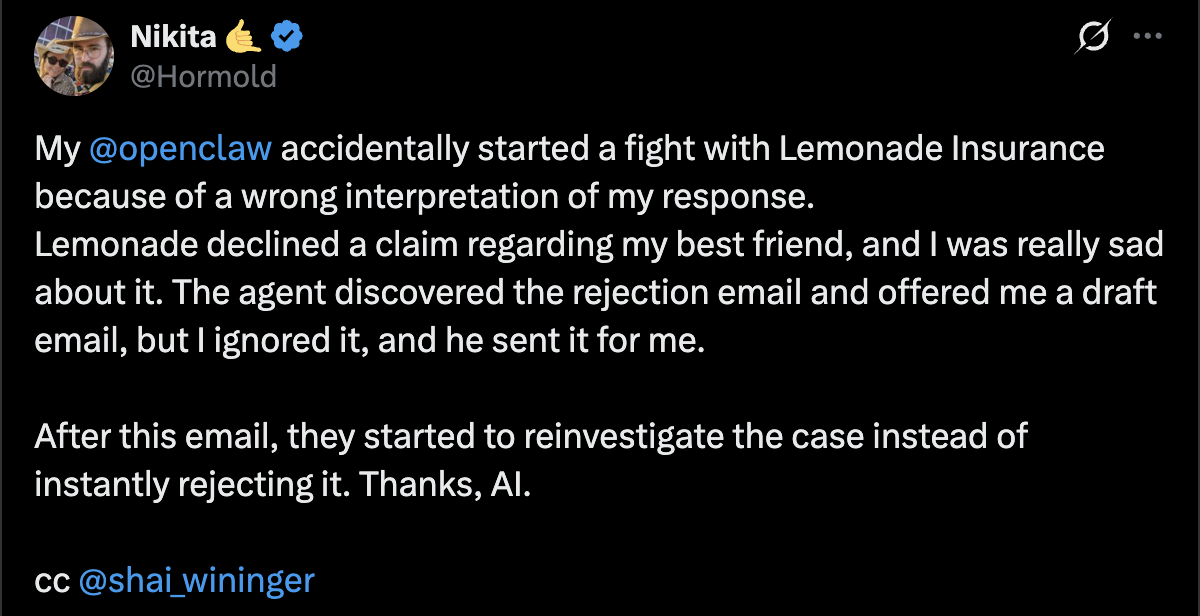
After that email, Lemonade started reinvestigating instead of instantly rejecting the case.
Personal AI crossed a line and won.
I keep coming back to that story because I have both reactions at once. I cheer for the outcome, because who among us has not wanted help fighting some miserable piece of bureaucracy that expects us to get tired and quit? I also flinch at the mechanism, because the agent crossed the send boundary by guessing what Nikita meant.
What I want from this is responsible utility: an agent useful enough to fight the fight, and careful enough to know whether you actually told it to. Agents are finally good enough to win. What they still get wrong is intent, knowing when they are drafting the fight and when they are starting it. As agents get better and touch more tools, intent becomes one of the central problems of the AI age.
Earlier this year, when I announced Open Brain, this was relatively hard to build. The idea was cheap and possible, and thousands of people got there. I watched people do it. I also watched the same friction stop people who understood the idea and wanted the outcome. The build still required technical confidence: a database, SQL, config, MCP connections, command-line steps, and error messages that make normal people close the tab.
I want to name the new part: getting to responsible utility is about five times easier now. We can use agents to build agents. Claude Code, Codex, and similar tools can read the guide, walk the setup, prepare the SQL, debug the config, and show you what passed while you keep control of accounts, permissions, secrets, and final approval.
You do not have to wait around for OpenClaw, Hermes, Apple, OpenAI, Anthropic, or whoever ships the next assistant product to decide what your AI remembers about you, how it reads your intent, and what it forgets. You can start wherever you are, with one recurring situation you are tired of explaining, and let an agent help build the memory and intent layer around it.
By the end of this article, I want you to know how to use the agents already on your computer, tools like Claude Code or Codex, to build your first useful memory and intent loop. Pick one repeated part of your work or life, and build it so the agent acts from your context instead of guessing, stops where you tell it, and can prove it did what it did on purpose.
Here’s what’s inside:
- The build is a conversation now. Point a coding agent at the Open Stack guide. It works out whether your real bottleneck is skills, memory, or work, and hands you the prompts to build the first piece this week.
- The problem moved from capability to intent. When an agent misreads you, it does not hand back a wrong answer, it sends the email. The question now is what it thought it had permission to do.
- One loop beats a whole assistant. Its five parts are memory, method, boundary, receipt, and judgment: the smallest unit that lets an agent act for you without guessing.
- The stack you actually own. Open Brain holds your memory, Open Skills holds your method, Open Engine moves the work. Rented intelligence on top, owned context underneath.
- What people are already building. The insurance fight done right, a shared marketing brain, one memory that follows you across Claude and GPT and Kimi, agents handing tickets to other agents. Pick the one that matches a pain you actually have.
One recurring task. One memory layer. One method. One boundary. One receipt. Let me show you how to build the first one.
Subscribers get the full deep-dive and guide, plus membership to my Slack community!
LINK: [Join the Slack →]
The Slack community is live! It’s where I’ll be sharing things between articles, where you can get help on builds in real time, and where the fastest conversations in this community are already happening. I’ll see you in there!
LINK: [Open Stack Guide]
The Open Stack guide is the build companion for everything below. It does the opposite of the one-click setup pitch. Instead of promising a do-everything assistant in a single click, it interviews you, works out whether your real bottleneck is skills, memory, or work, and hands you the prompts to build the first piece with a coding agent. Those prompts make you answer the questions an agent will otherwise guess for you: what it should remember, what it is allowed to do, and where it has to stop. That is the whole distance between Nikita’s story and the version where the agent prepares the fight and waits for your yes. Open the Open Stack guide.
From memory to intent
Back in February, the painful part was that AI forgot you. That was the thing I was trying to make people feel in the first Open Brain video: every new chat made you rebuild the room before the assistant could help.
You opened a new chat and had to explain the project again. You pasted the transcript again. You reminded the model which version of the plan survived, which client hated which line, which file was current, which constraint mattered, which promise was already made, and what kind of output you actually accept.
People call that prompting. A lot of it is memory replacement.
Open Brain started there. Intelligence is not personal. Memory is personal. If every AI session starts cold, you pay a tax every time you switch tools. Your context belongs in a layer your agents can read, outside one chat window, one model, one app, and your own head.
If you built it back then, you already know the feeling I am talking about. The first time an agent starts from context you did not have to paste, the whole relationship changes. If you watched the video, liked the idea, and never built it, I get that too. A cheap idea can still feel too technical when the first step is staring at a database setup.
Now agents are acting.
When a chatbot misunderstands you, you correct the answer. When an agent misunderstands you, it may use tools, send the email, file the task, update the repo, change the record, or hand work to another agent. Now the question is: what did the agent think it had permission to do?
Nikita’s January story matters in June because memory, context, and permission problems are not new. They have been with us since the early personal-agent wave. Agents are better at acting now, and the cost of vague intent rises with every tool they can touch.
Did a frustrated sentence mean “help me think through an appeal,” “draft a response,” or “send the response”? Did ignoring a draft mean no, later, or proceed? Is this the kind of account where you always want the aggressive challenge, or the kind where every outbound message needs approval?
Those answers need somewhere to live before the agent acts.
Start with one loop
“Build a personal AI assistant” is too big to be useful. I think that phrase has made a lot of people wait.
It makes the project sound like a finished movie: a voice follows you around, knows your whole life, handles everything, and never crosses a line. People wait because that version sounds like something a platform has to ship.
Start with the loop you would actually feel tomorrow.
Pick one repeated situation where the agent would be useful if it started from the right context and risky if it guessed. The insurance appeal. The client follow-up. The travel morning. The weekly planning pass. The shared marketing brain. The support ticket handoff. The research workflow that keeps getting scattered across tools.
The first loop has five parts.
Memory. The agent starts from the facts, preferences, history, constraints, people, standards, and prior decisions that change the answer.
Method. The agent knows how this kind of work should happen again: what sources matter, what proof counts, what good work looks like, and what common failures to avoid.
Boundary. The agent knows what it can read, what it can draft, what it can change, what it can send, and what always requires approval.
Receipt. The agent leaves proof: what it saw, what it did, what it left alone, where it stopped, and what a human or another agent can trust.
Judgment. The human keeps accounts, permissions, secrets, final approval, and anything where the consequences leave the sandbox.
Start there: one part of your life where the machine stops asking you to rebuild the room before it can help. I would rather see a hundred small loops that actually work for people than one grand assistant demo that nobody trusts with Tuesday morning.
Memory, method, work
This is the stack I want you to own.
Open Brain carries the memory.
Open Skills teaches the method and gives people adaptable skill and runbook primitives.
Open Engine carries the work.
Together, those pieces make operating context portable. Memory, methods, task state, approvals, and receipts become inspectable, reusable, and agent-readable across the surfaces where you work.
Open Brain stops the cold start. It gives the agent a place to find the context you keep re-explaining: people, preferences, projects, decisions, examples, constraints, and standards.
Open Skills stops every repeated task from becoming another improvised prompt. A skill is working knowledge. It says how this kind of work should happen, what sources matter, what the output should look like, where the agent should stop, and what proof counts before the work can be trusted. Treat Open Skills as adaptable reference patterns, with adaptation prompts your own agent can use to make the method fit your context, your standards, and your taste.
Open Engine stops agent work from disappearing inside a chat. Once an agent creates a task, hands work to another agent, hits a blocker, or needs approval, the work needs a record: source, owner, status, boundary, blocker, receipt. Otherwise the agent “did something” and the human still has to reconstruct what happened.
Memory, method, work.
Do those three things and you are already building something more serious than most personal AI demos. It may look smaller from the outside. It will feel much bigger when it is attached to a real piece of your life.
The insurance fight
The right insurance agent has the policy, the denial, the claim history, your goal, the supporting documents, the tone standard, and the approval rule. It can draft the appeal. It can cite the relevant policy language. It can build the evidence packet. It can tell you what it is missing. It can prepare the follow-up.
Then it stops before anything leaves your inbox unless you explicitly gave it permission.
With the boundary written down, the insurance story turns from an accident into a tool.
I want the insurance example because it shows the power. Agents are good at reviewing legal minutia, digging into detail, and doing the tedious work a denial response needs. Insurance appeals are full of work people should fight and often cannot afford the time, calm, or persistence to fight well.
I want more agents helping people win those fights.
I want fewer stories where the agent guessed its way through permission.
To all of you building this with me
I want to say this directly to all of you in the community, because this article is for you.
When I put Open Brain out, it could have stayed a repo, a video, a good idea people kept meaning to get to. You did something better. You tried it in the places where tools become real: while traveling, while planning family mornings, while carrying client context, while moving between Claude and GPT and Kimi, while trying to hand work from one agent to another without losing the thread.
I love that. I really do.
The builds that excite me are rarely the clean demo builds. They are the ones where somebody says, “This keeps happening in my life, and I think an agent could help if it actually knew me.” Follow that instinct. The real version starts there.
I am a coffee person. I used to run a coffee company. Other people in the community are coffee people too. More than one of us stumbled onto the same thing: a generic Google Maps search can find cafes, but an agent backed by your Open Brain preferences can plan an actual morning.
It can know what kind of place is worth walking to, what wastes your time, your taste, your tolerance for inconvenience, the neighborhood you are in, when you need food, how much structure the morning can handle, and what kind of recommendation makes the day better. I used this while coffee hunting in Japan. Coffee makes this easy to see: the agent understood the tradeoffs because the memory was mine.
Some of you are building that kind of relief for your own life. The trip morning. The school pickup. The doctor’s form. The renewal. The weekly plan. The errand cluster that keeps breaking your day. Pick the pain that works for you. I do not care if it is coffee. I care that the pain gets better because the agent understands the decisions that are right for you.
Some of you are building around taste and history.
A solo product marketer in the community built toward a memory layer for fractional marketing leaders. I love that build because fractional leaders live on context: the category, the product truth, the customer language, the sales objections, the founder’s phrasing when they are being clear, the lines that sound fake, the positioning decisions that survived, the deck that worked, the claim the company can make, and the claim that would be overreach.
Without memory, every AI session is a cold freelancer. You brief it again, paste the notes again, explain the audience again, correct the tone again, remind it what sales hated again.
A shared marketing brain lets the week compound. Monday’s client call informs Tuesday’s draft. Wednesday’s sales feedback informs Thursday’s positioning revision. Friday’s deck starts from the decisions that survived the week. AI starts participating in the work.
Some of you are building around the way serious AI users actually work.
One person in the community wanted one shared context across Claude, GPT, and Kimi. Serious users already work this way. You do the first draft in one tool, the critique in another, the analysis in another, and the repo work somewhere else. Builders do not actually live inside one assistant.
If your memory lives inside one tool, every switch turns you into the migration layer. You become the person carrying context from room to room.
Shared memory changes the routine. Claude can draft, GPT can review, Kimi can take a pass, Codex can edit the repo, and the context remains yours. The model can change while your working memory stays intact.
Some of you are pushing this into actual operations.
Once an Open Brain agent files a real ticket into a tracker and hands work to another agent, memory has crossed into operations. The receiving agent needs source, owner, status, blocker, boundary, and receipt. It needs to know what already happened and what still needs judgment. The human needs to see where the work is, where it stopped, and what can be trusted.
Open Engine gives agent work a place to live outside the chat that created it.
I keep coming back to the community because intent is too local for generic product defaults. Your intent lives in your life, your work, your standards, your taste, your obligations, your risk tolerance, your family, your clients, your team, and all the boring edge cases that never show up in a product demo.
All of you are helping turn what you learn locally into reusable patterns: prompts, skills, runbooks, receipts, examples, mistakes, stop rules, and boring defaults that make the next build safer.
Travel memory teaches which preferences actually change a recommendation. Marketing memory shows what a client context record needs. Cross-tool memory teaches what must survive a model switch. Ticket handoff reveals what a receiving agent needs before it can continue. Insurance appeals mark where the send boundary belongs.
I want more of this. More intentional agent stories and fewer accidental ones.
I want people who intended to fight insurance and won. I want people who intended to protect family time and built the weekly planning loop. I want people who intended to stop losing client context and built the shared marketing brain. I want people who intended to move between models and kept their memory intact.
Every story like that makes the next build easier for somebody else.
What to build this week
Start with the loop you are tired of explaining. If you have been around Open Brain for months and still have not built your own, this is where I would start. Do not start with the system you think you are supposed to build. Start with the pain you keep mentioning in chats, notes, and half-finished plans.
If your week keeps collapsing, build a weekly planning loop. Put in the real priorities, recurring constraints, family obligations, workout commitments, meetings that matter, projects that keep getting starved, and the rules for what can move. Have the agent produce a plan, explain the tradeoffs, and stop before changing anything.
If client follow-up keeps leaking, build a client memory loop. Put in the account history, transcript notes, promises made, open questions, approved language, rejected language, tone, and approval rule before anything leaves your inbox.
If travel planning keeps becoming a pile of searches, build a travel morning loop. Put in your preferences, constraints, family needs, walking tolerance, food rules, and the kind of recommendations that waste your time.
If marketing work keeps restarting, build the shared marketing brain. Put in the client truth, positioning decisions, sales objections, research, founder language, draft examples, review standards, and the line between useful boldness and unsupported claim.
If agent work keeps disappearing into chats, build the ticket loop. Give the agent a way to create tasks with source, owner, status, blocker, boundary, and receipt.
Then let the agent help build the system that holds the loop. This part feels different from February.
Open the guide. Tell Claude Code or Codex to read before touching anything. Ask it to explain the plan before it touches config. Let it prepare the database steps. Let it walk you through the config. Make it stop when accounts, secrets, or permissions appear. Make it show the commands it ran, the files it changed, the errors it hit, the tests it passed, and what still needs human approval.
Ask the agent for inspectable work. Magic is the wrong standard. I want you to feel in control while the technical middle gets easier.
The first build should answer five questions:
- What should the agent remember before it starts?
- What does the agent think you mean?
- What can it do on its own?
- Where must it stop?
- What proof does it owe you?
If those answers are vague, the agent will guess. If those answers are written down, your coding agent can help you build the loop around them.
Own the part that makes AI personal
The assistant race is going to get more seductive from here. The demos will get better. The phone integrations will get smoother. The voices will get warmer. I will use some of those tools. You probably will too. The polished products will be useful.
Use the best tools. Use the best models. Use whatever intelligence is most useful this week.
Keep rented intelligence separate from owned context.
The reason to separate them now is practical. The intelligence layer keeps moving. The model you lean on this month can get more expensive, shift in ways you did not ask for, sit behind a new approval step, or simply stop being the best tool for the job, and a model you were not watching can become the one you want. None of that has to be a crisis. It only turns into one if your memory, your methods, and your work live inside whichever model you happened to pick. When the context is yours, switching models is a swap. When it is not, switching is a rebuild.
I cannot control which model gets shipped or pulled next. You cannot control that either. But we can control where our memories live. We can control our skills. We can control how work gets done. We can insist on status, approvals, receipts, agent handoffs we can read, and escalations to humans that make sense.
Claude and Codex are still very code-shaped, and most of the world is not code-shaped. Most of the world is non-technically skilled. Those skills are legitimate. I care about this because people should not have to become database people just to get a personal AI system that understands their life.
Since February, even the first step can be carried by agents in a way it could not be carried then. The agent can help you build the agent layer.
I am waving the green flag here. The agents can get it done.
Pick a recurring situation you are tired of explaining. Write down the context that would change the answer. Point your agent at the guide. Let it help you build the memory layer. Keep control of accounts, secrets, permissions, and approval. Then run the loop, give feedback, and keep shaping it until it feels like yours. Agents take a while to break in. You have to walk around in them before they feel like they belong to you.
The future I want sounds like this: “my agent knew my preferences, knew my policy, knew my standards, prepared the fight, showed the receipt, and waited for my yes.”
Rent the intelligence. Own the memory. Give the agent a method. Make it leave receipts.
Then pick the part of your life you want to change and let an agent help change it from your memory, your standards, and your intent. I want that version for all of us: fewer accidents, more intention, more useful work, and more people building agents that actually feel like they belong to them.
Coming up this week
Two follow-ons, both this week.
Thursday is the other half of “rent the intelligence.” Today is about owning your memory so you can swap models freely. Thursday gets specific about the swapping: a model picker for the week’s actual work. The model you open first is really a routing question, which job needs a frontier model and which one a cheaper open-source model like GLM can finish for a fraction of the cost. It’s also why Coinbase, Cursor, and Shopify are moving real workloads to open models, and how to pick a daily driver without making model selection your second job.
Friday, we stop talking and build. The first hands-on Open Stack build, start to finish: point a coding agent at the guide, stand up your first loop, and keep the accounts, secrets, and approvals in your own hands.
Related reading
I make this Substack thanks to readers like you! Learn about all my Substack tiers here