By Nate
Published: 2026-05-21
URL: https://natesnewsletter.substack.com/p/ai-agents-better-communicator
Working with AI agents makes you a better communicator
Most people are still prompting like it’s November, and the model on the other end stopped being the same machine months ago.
Opus 4.7 and GPT-5.5 landed in the last two months. The agents built on top of them now run for hours on a single request — they edit files, search archives, write code and test it, and come back with something close to a finished artifact. That capability jump is the largest single move I have watched in two years of doing this work. Our prompting has not moved with it.
When I look over people’s shoulders, I see the same kinds of requests I saw last September going into a system that is a hundred times more capable. The output comes back polished and mostly useless, and the person at the keyboard concludes the model is mediocre. That is almost never what is actually happening. The assignment is mediocre, and the model is just being honest about it.
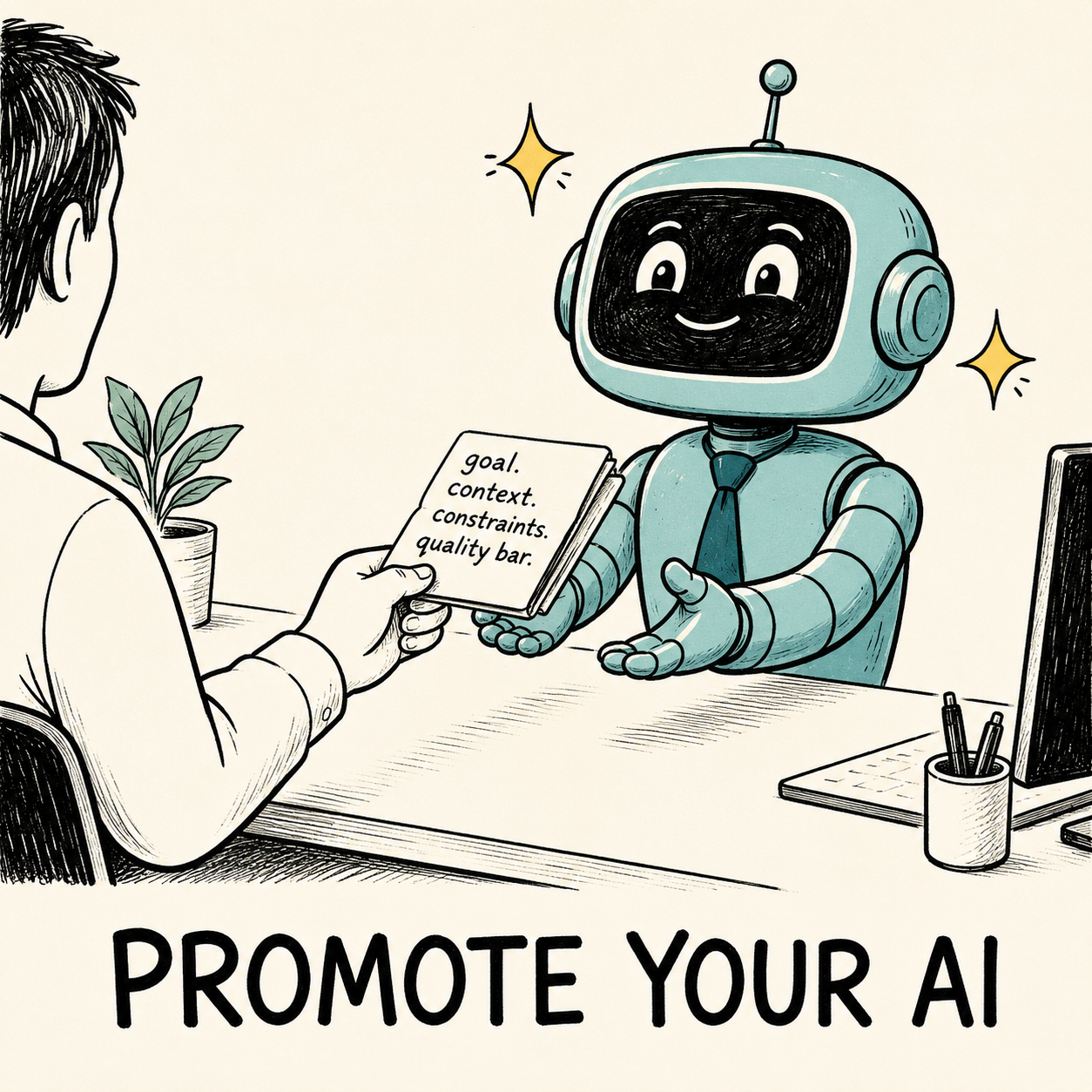
The shift is from prompting to briefing. Last year, the best advice was to talk to AI like a careful junior employee who needed every step spelled out, every format specified, every structural decision made for them. That advice was right for the models we had, and those models needed it. The models we have now do not. A senior partner needs the goal, the context, the constraints, and the quality bar, and then they need room to push back. An agent running on 4.7 or 5.5 works the same way, and most of the leverage in the new models lives in that gap between what you tell a junior and what you tell a senior.
A prompt is something you type into a box. A useful question is the same thing done seriously — work made legible enough that another intelligence can act on it.
Here’s what’s inside:
- The senior-partner shift. What actually changes about your request when you stop prompting and start briefing.
- The generic output trap. Why polished, useless AI work is almost always a mirror of the assignment, not the model.
- The six-field brief. The template that turns a vague ask into something an agent can run with for hours without drifting.
- The same brief, for humans. Why this makes you a clearer manager, a sharper colleague, and easier to work with than most of your team.
- Three prompts that earn their keep. The brief builder for when you do not know how to start, the thin-ask detector for the request you suspect is too vague to send, and the finish line for work that keeps almost being done.
The brief and the prompts are below. So is the part most people miss: get good at this with the agent and you get better with the humans too.
Subscribers get all posts like these!
LINK: Grab the prompts
Yes, a prompt kit. The point of the article is not that prompts are over. The point is that most prompts are too thin — they are vague phrases when they should be compressed work briefs. These three tools help you build the brief. The Useful Question Builder constructs one from scratch when you are starting a serious task. The Vague Ask Auditor takes a request you have already written and shows you, field by field, what is missing and what the AI will likely default to if you send it as-is. The Definition-of-Done Generator handles the part most work drifts on — articulating what “finished” looks like before the work starts, not after it has gone sideways. Run any one of them in ChatGPT, Claude, or Gemini. If you only try one, make it the auditor. Run a request you sent last week through it and see what comes back.
Prompts vs. useful questions
A prompt is an instruction.
A useful question is a small operating brief.
In case you haven’t figured it out already, I use AI to help me research the pieces I write for this Substack. To pressure-test the angle, check the archive, surface evidence I might have missed, and force me to clarify the argument before I draft. The wrong way to do that is to type something like “help me write this article the useful way.” That returns the average of every prompting article on the internet.
The useful question for the same task sounds different. It tells the agent what kind of piece this is, who it is for, what working angle I am holding, what reader problem the piece is trying to solve, what lanes are closed because I have written nearby pieces before, what I do not want it to do yet, and what I want back. Something closer to:
“I want to develop a substantive Substack piece for learners and builders. The working angle is that working with AI agents makes you a better communicator. The reader problem is that people get mediocre AI output and think they need prompt tricks, when the deeper issue is that they have not defined the work. Do not draft yet. Check the archive so we do not repeat earlier pieces. Avoid generic prompt-engineering advice. Produce a research brief, thesis, outline, examples, and a practical template.”
The second version is longer. What matters is that it contains the actual shape of the work.
It tells the agent what job it is doing, what audience the work serves, what prior context matters, what lanes are closed, and what counts as a good intermediate deliverable. It even tells the agent when not to act yet.
That last part matters. A lot of bad AI work happens because the user asks the agent to execute before the problem is ready for execution. The agent starts drafting before the argument is clear. It starts building before the product requirement is settled. It starts summarizing before the audience is defined. It starts optimizing before anyone has named the metric that matters.
The brief slows the work down just enough to make it executable.
Good managers do the same thing. They do not hand someone a foggy desire and call it empowerment. They explain the goal, the context, the constraints, the sources of truth, and the quality bar. They leave room for judgment, but they do not outsource ambiguity and then punish the person for guessing wrong.
Amazon’s 2017 shareholder letter reflects a company built on writing discipline. Bezos banned PowerPoint in executive meetings in 2004, replacing slide decks with narratively structured memos read at the beginning of each meeting. The point is not that every company should copy the six-page memo, it’s that serious work benefits when the person requesting the discussion has to make the context, evidence, and decision legible before the room starts reacting.
AI makes this visible because it has no social cushion. It will not pull you aside and say, “I think you are asking for three different things here.” It may ask clarifying questions if you tell it to, but otherwise it will often do what most eager juniors do: try to be helpful, fill in the blanks, and produce something that reflects the assignment’s vagueness.
Annoying when it happens with personal AI use. Expensive when it happens inside a company.
Agents force managerial clarity
The phrase “managerial clarity” may sound formal, but the concept is simple. It means saying what work is supposed to happen in a way that another person can actually use.
Most people are weaker at this than they think because most knowledge work is full of shortcuts. We say “make the deck better” when we mean “cut the strategy section in half, make the customer evidence more prominent, remove anything that sounds speculative, and make the CFO slide more defensible.” We say “look into this vendor” when we mean “tell me whether this is worth a 30-minute call, using customer proof, integration risk, pricing, and whether they solve our actual workflow problem.” We say “summarize the meeting” when we mean “write notes for people who were not there, put decisions first, extract action items, ignore tangents, and flag anything uncertain.”
The agent cannot know that. But neither can a new teammate.
Working with agents transfers to human work for this exact reason. The same request that produces a better AI answer usually produces a better human handoff. The same clarity that helps an agent write a useful brief helps a team understand what decision is being made. The same definition of done that keeps an agent from wandering keeps a project from becoming endless.
The evidence is directional rather than perfect, but it is not imaginary. Microsoft and LinkedIn’s 2024 Work Trend Index found that AI power users were 68% more likely to frequently experiment with different ways of using AI, 49% more likely to pause before a task and ask whether AI could help, and 66% more likely to redesign business processes and workflows with AI. Those are communication habits as much as tool habits: pause, define the task, choose the workflow, and explain the standard.
The smart counterargument is that some people become good at prompting AI without becoming good at communicating with humans. That happens when the user treats the agent as a private syntax game. The transfer occurs only when you notice that the same brief works for both: goal, context, sources, constraints, quality bar, and definition of done. The social wrapper changes. The clarity does not.
The skill is learning to externalize the work.
That means you stop treating your own intent as obvious. You stop assuming the other side knows what “good” means. You stop using words like “better,” “cleaner,” “sharper,” and “strategic” — which sound concrete but aren’t — without explaining what they mean in this case. You name the sources. You name the audience. You name the tradeoffs. You name the things that would make the output unusable.
This is the least glamorous part of AI adoption, and possibly the one that matters most for careers.
The people who get the most from agents will be the ones who can define work clearly enough that agents can run with it. They will be able to turn fuzzy intent into usable assignments. They will know when a task needs more context, when it needs a source, when it needs a constraint, and when it needs a human judgment call before execution.
That is management. Even if nobody reports to you.
Generic output is often a mirror
When AI gives you generic work, it is tempting to blame the model. Sometimes that is fair. Models still miss context, flatten nuance, invent structure, and produce confident nonsense. But generic output often reflects generic input.
Ask for “a marketing plan” and you will get the average of every marketing plan on the internet. Ask for “a launch plan for a technical audience that already understands the category, is skeptical of vendor claims, and needs to see implementation details before believing the product,” and you have changed the assignment.
Ask for “feedback on my resume” and you will get broad resume advice. Ask for “review this resume for a senior operator moving into AI-native product roles. Focus on whether the evidence shows judgment, shipped work, and ability to use AI in real workflows rather than generic AI enthusiasm,” and you have created a useful evaluation.
Ask for “summarize this transcript” and you will get a chronological recap. Ask for “turn this transcript into attendance-replacement notes for a team that needs decisions, owners, open questions, and next steps. Ignore small talk and flag uncertain attribution,” and you have created an operating artifact.
The difference comes down to whether the second version explains the work.
I dislike treating this as a prompt hack. It makes the skill feel smaller than it is. Real improvemement means that you learned to ask yourself, before involving the agent, “What am I actually trying to get done?”
That question is not always comfortable.
Sometimes you discover that you do not know the goal, or you have not decided who the audience is. You might find yourself asking the agent to make a strategic choice you have not made. Or you see that the source material is weak, the quality bar is vague, and the definition of done is basically “I’ll know it when I see it” — a phrase that has never described work that finished cleanly.
But this is the useful part.
The agent has forced the hidden ambiguity into the open.
Some work also has to be shaped before it can be briefed. Creative work, exploratory research, and judgment-heavy strategy often begin before the goal is fully visible. In that mode, the useful first instruction sounds different: ask questions, map the options, surface the tensions, and stop before drafting. Shape first, then brief.
The posture before the template
The template comes next, and the template is the practical artifact. Before getting to it I want to name the posture that makes the template work, because the same six fields filled in by two different people will land in two different places depending on the posture behind them.
The image I keep coming back to is a flashlight. When you brief an agent, you are not pointing at one thing or sweeping a whole room. You are doing both at the same time. The center of the beam is your intent, your thesis, your point of view, the place you want the work to focus. The edges of the beam are the boundary of what is in and out of scope. Strong briefs name both. They tell the agent where to look hard and where to stop looking entirely.
The part most people skip is the edges. Telling the agent what to leave out is often more useful than telling it what to put in. If you are turning meeting notes into a decision document and fifteen minutes of the meeting were spent on an unrelated project, say so and tell the agent to drop that section. The agent will not infer the absence. The edges of the flashlight have to be drawn.
The useful question template
The template I would use for almost any serious agent task, field by field:
The goal
Start with the actual outcome, not the activity.
Bad: “Help me with this deck.”
Better: “Help me turn this rough strategy deck into a board-ready discussion document that supports a decision about whether to fund the pilot.”
The goal tells the agent what kind of work it is doing. A board discussion document is different from a sales deck, a brainstorm, a memo, or a project plan. If you do not name the outcome, the agent will infer one.
The context
Give the situation the agent would need if it were a smart colleague joining the work late.
Who is this for? What has already happened? Why does this matter now? What does the audience already believe? What are they worried about? What is the political, operational, or product reality around the task?
Context means the relevant background that changes the answer, not a data dump.
If you are asking for a customer email, the context might be that this is the third delay and the relationship is strained. If you are asking for a hiring scorecard, the context might be that polished resumes are less meaningful in an AI environment and you need proof of actual building ability. If you are asking for an article angle, the context might be that you have already published on adjacent topics and cannot repeat yourself.
The sources
Tell the agent what to use.
One of the biggest differences between casual prompting and real work. Real work has source hierarchy. Some documents are authoritative. Some are background. Some are outdated. Some are useful but politically sensitive. Some should not be used at all.
A serious one names the materials and their role.
Use these meeting notes. Treat this transcript as primary. Check the published archive for overlap. Use this customer call only for examples, not for claims. Do not rely on memory if the document contradicts it. If the source is missing, say so.
This turns the agent from a general text generator into a worker operating against evidence.
The constraints
Constraints are the boundaries that keep the work from becoming technically correct and practically wrong.
Do not write the article yet. Do not make broad claims about a partner. Do not use unsupported market numbers. Do not turn this into a prompt-engineering guide. Do not change the user’s voice. Do not include private customer names. Do not optimize for cleverness at the expense of clarity.
Constraints are not there to make the agent timid. They are there to preserve the real-world conditions of the work.
The more serious the task, the more constraints matter. A generic answer can ignore politics, compliance, brand risk, audience sophistication, internal history, and timing. Useful work cannot.
The quality bar
Where many requests fail.
People often say what they want, but they do not say what would make it good. The agent then optimizes for the visible shape of the artifact. It writes something that looks like an article, memo, summary, or plan. But the quality bar was never “make something that looks like the thing.” The quality bar was “make something that does the job.”
A quality bar might say: “This should be useful to a builder, not just interesting to an executive.” Or: “The argument needs to be original enough that it is not just another AI Twitter take.” Or: “The notes should be good enough that someone who missed the meeting can act without asking for a second explanation.” Or: “The answer should separate verified facts from interpretation.”
Taste enters here too. If you hate vague abstraction, say so. If you want full prose, say so. If you do not want one-line slogans, say so. If examples matter more than taxonomy, say so.
The agent cannot meet a quality bar you have not shared.
The definition of done
Finally, say what should come back.
A draft? A research brief? A table? A redline? A ranked list? A recommendation? A plan? A set of open questions? A Slack message? A file?
Then say when it is complete.
For example: “Return a research brief and argument architecture. Do not draft the article until I approve the outline.” A clear definition of done. It stops the agent from racing ahead. It creates a checkpoint. It makes the collaboration cleaner.
A definition of done is not bureaucracy. It is mercy. It tells the agent where to stop.
The practical version
In practice, a single serious request usually names the goal, gives the relevant situation, lists the sources to use first, names the constraints, sets the quality bar, and ends with the exact deliverable. The whole template.
A useful version sounds like this: I need help turning this rough strategy deck into a board-ready discussion document. The audience is deciding whether to fund the pilot. Use the attached financial model, meeting notes, and current operating plan. Do not invent numbers or change the company voice. The quality bar is clear, plain business English with every claim tied to a source. Return a revised outline first, then stop for review.
Use that pattern for a week and your AI output will improve. More importantly, your thinking will improve before the agent ever answers.
The hidden benefit: a useful question forces you to decide what you mean.
What this looks like in real work
Take a normal workplace request: “Can you help me prep for this meeting?”
Not useless, but it leaves too much undefined. What kind of meeting? What kind of prep? Are we trying to learn, persuade, decide, negotiate, or avoid embarrassment? What materials matter? What would make you feel ready?
A useful version might say:
“I have a 30-minute meeting with a potential partner tomorrow. The goal is to decide whether there is enough overlap to schedule a deeper technical session. Use the attached notes and their website. Give me a one-page prep brief with their likely priorities, three questions I should ask, two risks to watch for, and a suggested opening framing. Do not draft a sales pitch. I want to understand fit, not force a deal.”
A better AI request. Also a better request to a chief of staff.
Do not over-specify
There is a trap here. Once people discover structured asks, they sometimes turn every request into a legal contract. Not the goal.
Not every AI interaction needs a six-part brief. Sometimes you are just asking a quick question. Sometimes you are exploring. Sometimes you do not know what you want yet, and the right move is to say, “Ask me questions until the task is clear.”
The useful question template exists to make serious work transferable, not to make every interaction heavy.
The overhead should match the task. Quick exploration can stay loose. A recurring workflow, public article, hiring evaluation, customer communication, product spec, or financial analysis needs the full brief because the cost of a wrong assumption is higher. A useful question is calibration.
The skill is knowing which mode you are in.
Another way agents make you better. They force you to distinguish between thinking, exploring, deciding, and executing. Humans blur those modes constantly. We ask for a draft when we still need a thesis. We ask for recommendations when we have not supplied criteria. We ask for execution when the strategy is unresolved. Then we blame the output for reflecting the confusion.
A good agent interaction often starts by refusing to rush the stage.
Clarify the problem, gather sources, define the quality bar, and then draft. Review and revise after the work has something solid to respond to.
Not prompt engineering. Work.
Where this changes human communication
The deeper reason this skill transfers is that human communication has always depended on hidden context. Inside a company, people share acronyms, history, politics, preferences, old decisions, and half-remembered conversations. That shared context is useful, but it also makes people lazy. We mistake familiarity for clarity, and then work breaks down in predictable ways: the analysis uses the wrong source, the junior person optimizes for polish when the leader needed risk, or the manager gets frustrated because the work is “not what I meant,” even though what they meant was never actually said.
Agents do not create that problem. They make it impossible to ignore. Every disappointing AI answer is a chance to ask: what did I assume it knew, what did I fail to define, what source did I leave out, and what did I mean by better? Answer those questions often enough and your communication changes. You give clearer feedback, write better project briefs, ask sharper questions in meetings, become more explicit about tradeoffs, and become easier to work with.
What changed for me
The old unit of AI interaction was the prompt. You typed something, got something back, and iterated.
The new unit is closer to a work order. Not always formal, not always long, but complete enough that an intelligent system can act. It contains intent, context, evidence, constraints, standards, and a stopping point.
Where the world is moving. Agents are becoming more capable — they read files, use tools, run workflows, search archives, draft artifacts, inspect code, compare documents, and work for longer stretches. As they become more capable, the bottleneck shifts. The question is less “can the model do something?” and more “did you define the right thing for it to do?”
That shift is subtle until you feel it in your own work.
You start with a vague ask and get vague output. You add context and get something better. You add sources and the work becomes grounded. You add constraints and the work becomes safer. You add a quality bar and the work becomes closer to your taste. You add a definition of done and the collaboration becomes manageable.
Eventually you realize the agent did more than help you produce the work. It helped you understand it.
This part is worth paying attention to.
The future of AI at work will not belong only to people who know the newest tools. It will belong to people who can make their intentions legible. People who can turn a messy need into a useful question. People who can define work so that humans and agents can both move faster without guessing.
The whole framework fits on one page. A one-page brief you can paste into any AI tool or send to a colleague: outcome, situation, sources, constraints, quality bar, and definition of done. Fill those in for any consequential task and you will usually know whether the work is ready to delegate.
So yes, learn the tools. Use the agents. Try the new models. But do not confuse the surface skill with the deeper one.
The prompt is what you typed.
The useful question is what made the work possible.
Welcome to the AI Question Age.
I make this Substack thanks to readers like you! Learn about all my Substack tiers here