Google I/O opens today. The protocol map under the demos is what actually shapes the next twelve months.
By Nate
Published: 2026-05-19
URL: https://natesnewsletter.substack.com/p/agent-protocol-stack-mcp-a2a
Google I/O opens today, and most of the coverage will be about the demos. The more interesting story is the protocol race happening underneath them. Six new agent protocols have launched in the past year, and if you are building or buying agents right now, the standards layer reads like a scrum.
The instinct is to ignore the acronyms and wait for the big platforms to absorb everything behind product surfaces. The platforms will absorb a lot of it. But the protocols are not all trying to solve the same problem, and the substrate an agent is built on shapes the customer experience more than the model choice does. Read as a pile of competing standards, the picture stays blurry. Read as layers, three of them snap into focus as the foundation most builders will actually depend on.
Three protocols are forming the core agent stack: MCP for the tools and data an agent can reach, A2A for the other agents it can delegate to, and AG-UI for the controls a human needs to stay in the loop while long-running work is happening. Those three answer the only three questions every real agent system hits within its first week of existence. What can the agent use. Who else can the agent work with. How does the human stay in control. A2UI, AP2, and x402 matter, but they sit in layers where product requirements, trust boundaries, payment rails, and platform incentives are still being negotiated. Treating those three as equal bets with the first three is the most common mistake I see in agent strategy decks right now.
Builders who try to bet on all the layers at once end up paralyzed. Builders who ignore the layer map ship agents that fail at the boundaries that actually matter, like security on tool access, approval on long-running work, and supervision when the agent crosses company lines. Buyers who cannot read the layer map cannot evaluate what they are actually purchasing when a vendor says the word “agent.” The map is the closest thing the industry has to a shared vocabulary, and the next twelve months of agent product strategy will run through it.
Here’s what’s inside:
- The protocol map. A single table that places all six protocols in the layer they actually occupy, so the acronyms stop blurring together.
- The core stack: MCP, A2A, AG-UI. Why these three are converging into the universal foundation, what each one is really for, and where each one fails if treated as a feature toggle instead of a boundary.
- Why payments are not one protocol. AP2 and x402 solve different problems, the payment space carries hidden assumptions about geography and authorization, and “agent can pay” is not a button — it is an audit problem.
- Map, draft, audit, brief. Map any real workflow to the layers that matter, draft the Agent Card boundary another team will integrate against, audit a workflow for the human controls it’s missing, and produce the strategy brief for the leader making the platform bet — four prompts, one per job, with renewal prep as the worked example threaded through.
The acronym pile will keep growing. The layer map will not.
Subscribers get all posts like these!
LINK: Grab the prompts
The hardest part of agent work right now is not picking the right acronym. It is staring at a real workflow — vendor intake, renewal prep, support triage, whatever yours is — and not knowing which of the six layers will actually shape whether the agent ships or stalls. These four prompts exist because that decision is where most teams freeze. The Layer Mapper takes a workflow and tells you which layers are CRITICAL, which are RELEVANT, and which you can ignore for this build, plus the sequence to ship in. The Agent Card Designer turns “what does my agent do” into the operating contract another agent or team can actually integrate against, with the boundaries and approval gates written down before they become production incidents. The Control Point Auditor walks a workflow step by step and forces a verdict on every action — Hard Gate, Soft Signal, Inspection Point, Steering Opportunity, or none — so the supervision layer is designed instead of discovered the week after launch. The Strategy Brief is for leaders deciding where to invest, where to keep an adapter, and where to defer; it produces a 30-day, 90-day, and six-month sequence with watch items that should trigger a reassessment. Start with the Layer Mapper. It tells you which of the other three you actually need.
Software trying to become a worker
None of this is theoretical. Google I/O opens today, and Google is very clearly trying to make the agent stack feel coherent. In March, Google published a developer guide to AI agent protocols that walks through MCP, A2A, AP2, A2UI, and AG-UI in a single supply-chain example. The point of the example is not subtle. A real agent checks internal data, calls remote supplier agents, authorizes payment, and renders an interactive dashboard. Software trying to become a worker, not a chatbot.
When software becomes a worker, the old integration model breaks.
The old model assumed a human was driving the software directly. A person logged in, clicked around, approved the action, reviewed the output, entered the card, downloaded the report, or sent the email. The system could rely on the human being present at the moment of action. That assumption is weakening.
An agent may read a database, ask another agent for a quote, request user approval, assemble an interface, pay for an API call, and return hours later with a result. It may do some of this while the user is away. It may cross company boundaries. It may touch systems with different owners. It may need to prove that it had permission to act.
Protocols are showing up now because of this shift. Not because developers love acronyms, though we do. Agentic software has outgrown the custom-integration era before most companies even finished understanding it.
The protocol map
Read it by layer.
MCP is agent to tools and data. The Model Context Protocol specification defines MCP as an open protocol for connecting LLM applications to external data sources and tools. In practice, MCP lets a host discover servers that expose resources, prompts, and tools. This is why MCP became the first protocol most builders noticed. Claude Desktop supports local MCP servers, Sourcegraph ships an MCP server, Square ships an MCP server, and PulseMCP lists more than 14,000 MCP servers. Agents are useless if they cannot reach the work.
A2A is agent to agent. Google describes the Agent2Agent protocol as the standard way for agents to discover and communicate with each other. Each A2A agent can publish an Agent Card that describes its capabilities and endpoint. Google launched A2A in April 2025 with more than 50 partners, including Atlassian, Box, Cohere, MongoDB, PayPal, Salesforce, SAP, ServiceNow, UKG, and Workday. By early 2026, more than 150 organizations had signed on, and the protocol was donated to the Linux Foundation in June 2025 for neutral governance. That list matters because A2A only matters if agents cross product and company boundaries. The important idea is not “swarms.” It is discoverable delegation.
AG-UI is agent to user. The AG-UI docs describe it as an open, event-based protocol connecting agentic frontends to agentic backends. It is much younger than MCP, so it should not be treated as equal on adoption. But it is the most developed open candidate for a problem every serious agent app hits: how the frontend shares state, events, approvals, and interruptions with a long-running backend agent. CopilotKit is the home ecosystem, and the AG-UI integrations page points to LangGraph, CrewAI, Amazon Bedrock AgentCore, Pydantic AI, Mastra, and others.
A2UI is agent-generated interface. Google introduced A2UI on December 15, 2025 as an open project for agent-driven interfaces. Instead of sending arbitrary HTML or JavaScript from an untrusted remote agent, A2UI sends a structured, declarative UI representation that a client can render using trusted components. This is useful, but it is narrower than the human-control problem. It is a way for an agent to describe an interface, not the whole protocol for managing the user-agent relationship.
AP2 is agent payment authority. Google announced the Agent Payments Protocol in September 2025 as an open protocol for agent-led payments, with more than 60 collaborators including Adyen, American Express, Coinbase, Mastercard, PayPal, Salesforce, ServiceNow, UnionPay International, and Worldpay. The key mechanic is the mandate: a cryptographically signed proof of user instructions. AP2 is trying to answer the hardest question in agentic commerce: how does the ecosystem know the agent was authorized to buy? On April 28, 2026, Google donated AP2 to the FIDO Alliance for neutral governance, alongside Mastercard’s contribution of a companion standard called Verifiable Intent. Same pattern as A2A’s path to the Linux Foundation, and the same signal: this layer is settling fast enough that the founding companies are willing to hand stewardship to a standards body.
x402 is machine-native payment over HTTP. Coinbase launched x402 in May 2025 as an HTTP-native stablecoin payment protocol. Cloudflare now documents and supports x402 in its agentic payments flow. A server can return payment instructions, the client can sign a payment payload, and the server can verify or settle the transaction before returning the resource. That matters for APIs, data, content, MCP tools, and other resources where account setup and subscriptions are too heavy.
On a single map:
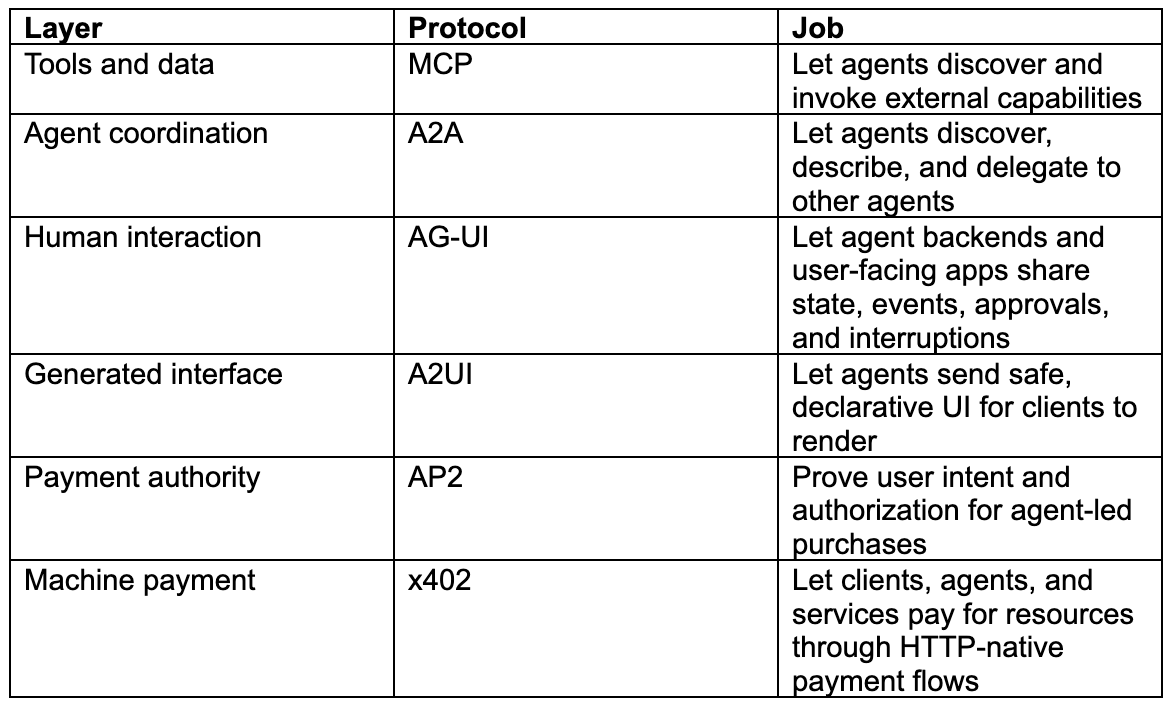
This table is the article. Most confusion comes from flattening it.
MCP is the access layer
MCP won mindshare first because it solves the most immediate pain. An agent sitting in a chat box with no access to the user’s tools is mostly a consultant. It can advise, summarize, draft, and reason. It cannot do very much work.
The first thing every serious agent product needs is a way to connect to systems where state lives: GitHub, Slack, Google Drive, Postgres, Snowflake, Stripe, Linear, Salesforce, a file system, a browser, a calendar, an internal API, a data warehouse. Before MCP, every integration tended to become custom glue. The developer had to write tool definitions, authentication patterns, parameter schemas, error handling, and update logic for each system.
MCP tries to standardize that. A server exposes tools and resources. A host connects to it. The model receives a usable description of what can be done. The system can compose new capabilities without every agent platform rebuilding every connector from scratch.
The story usually stops there, but MCP does not make tools safe just because it standardizes them. The MCP specification itself is careful about that. It says the protocol enables powerful capabilities through arbitrary data access and code execution paths, and that implementors need consent, authorization, privacy controls, and tool safety. Security researchers are already finding why that warning matters. Invariant Labs described MCP tool poisoning attacks, where malicious instructions can hide in tool descriptions and influence an agent through the very metadata meant to make tools discoverable. Tool access is not a feature toggle. It is a security boundary.
The builder takeaway is simple: if your agent needs to work across tools and data, MCP is the default interface to understand. Do not build every connector from scratch unless you have a specific reason. Also do not pretend existing enterprise integrations disappear overnight. Most large companies will run custom APIs, workflow glue, and MCP side by side for years. MCP wins first at the margin: new agent-facing integrations, reusable tool surfaces, and product ecosystems where discovery matters. But do not confuse tool discovery with governance. You still need scopes, approval flows, audit trails, and a way to decide which tools the agent can see in which context. MCP gets the agent near the work, not into it.
A2A is the delegation layer
The second problem arrives once the agent can reach tools. The agent still cannot know everything or own every capability.
A procurement agent may need a supplier agent. A travel agent may need a hotel agent. A finance agent may need a tax agent, a software agent may need a security reviewer, a customer-success agent may need billing. In a large company, no single agent will be allowed to access every system or make every decision. Work is distributed across owners, permissions, domains, and expertise.
A2A matters because it turns that distribution into something agents can reason about.
The Agent Card is the important primitive. A remote agent can describe what it is, what it does, which skills it exposes, where it can be reached, and how another agent should interact with it. It goes beyond documentation. It is a way for agentic systems to route work without hardcoding every relationship.
The standard is more serious than the swarm rhetoric around it. The world does not need ten agents role-playing as a boardroom for every task. The world does need agents that can discover the right specialist, pass the right task, preserve enough context, and return a result without forcing the user to become the integration layer.
The named operators make the distinction clearer. Box wants document agents to participate in external workflows without handing every file to another platform. Salesforce and ServiceNow want enterprise agents to cooperate outside their own product surfaces. MongoDB wants data agents to be callable by the business agents that need application state. Different motivations, same pattern: A2A is about cross-boundary work, not a cute multi-agent demo.
Coordination is not free. A2A adds another surface for latency, failure, permissions, identity, and observability. If an agent asks another agent to ask another agent to do something, the work may become more flexible, but it also becomes harder to debug.
That means A2A is not the right answer for every product. A single product with a small set of tools may not need inter-agent coordination. But any system that crosses organizational boundaries, product boundaries, or specialist domains will eventually need something like it.
The actual question is not “Should I use A2A because it is new?” It is: does this workflow require delegated expertise or authority outside the primary agent?
If yes, design the boundary now. Decide what your agent can advertise, what it can accept, what it cannot share, what requires human approval, and how a downstream result is validated. The Agent Card is the first version of an operating contract, not a marketing page.
AG-UI is the control layer
The third protocol is easier to underestimate because it sounds like frontend infrastructure. It is not. The human interaction layer is where trust survives.
If an agent is long-running, nondeterministic, and capable of touching external systems, the user needs more than a final answer. The user needs to see what is happening, interrupt when necessary, approve sensitive steps, correct course, inspect state, and understand why the agent is waiting.
Traditional web apps were mostly built around request and response. The user clicks. The server returns. The UI updates. Agents break that pattern. They stream, pause, ask for approval, call tools, discover new information, change plans, call sub-agents, and recover after disconnects.
AG-UI exists because the chat box is not enough for that.
Its documentation lists the things agentic apps need: streaming, shared state, frontend tool calls, backend tool rendering, interrupts, sub-agent composition, steering, and custom events. This goes beyond polish. It is the difference between a magic demo and a product that can be supervised without exhausting the user.
This is the layer many teams will ignore until their agents start doing real work. They will wire a model to tools, add a pretty chat component, and discover that users have no idea what the agent is doing. Then come approval buttons, which turn out not to be enough. Then logs, which are not interaction. Then a progress spinner, which is not state.
The user does not need every token. They do need the right control points. What is the agent trying to do. What is it waiting for. What can the user approve, deny, edit, pause, or cancel. Which result is final, and which is provisional.
The AG-UI layer belongs with MCP and A2A in the core stack, even if the specific protocol is earlier in its adoption curve. MCP gives the agent tools. A2A gives it collaborators. AG-UI names the user-control layer that every production agent needs, whether the winning implementation is AG-UI itself or a close cousin.
An agent that cannot show its work becomes supervision debt.
A2UI solves one part of the interface problem
A2UI is one of the more interesting pieces because it addresses a real product limitation: text is a bad interface for many tasks.
If an agent is booking a table, it should not ask twelve text questions. It should render a date picker, a time selector, a guest count, available tables, and a confirmation control. If an agent is comparing vendors, it may need a table. If it is analyzing sales territories, it may need a map. If it is reviewing a policy exception, it may need a form.
The danger is sending arbitrary UI code from a remote or untrusted agent. Google’s A2UI answer is to send declarative UI data that a client renders using trusted components. The client owns the styling and security boundary. The agent can ask for a component from an approved catalog. It cannot simply execute whatever interface code it wants.
That is directionally right, but it also means A2UI is probably not the same kind of universal bet as MCP or A2A. UI rendering is deeply product-specific. Consumer chat, enterprise dashboards, IDEs, mobile apps, desktop agents, and embedded copilots will not all converge cleanly on one rendering model overnight. There will be overlap among A2UI, AG-UI’s generative UI work, MCP Apps, platform-native component systems, and ordinary product engineering.
So the move is to avoid coupling your product too tightly to one generative-UI bet before the ecosystem settles.
Use the principle now: agents should produce structured interface descriptions, not arbitrary executable UI. Keep the client in control of rendering. Maintain a trusted component catalog. Make user actions explicit. Preserve state. Treat remote UI as data crossing a trust boundary.
But keep an adapter between your agent and your rendering system. The interface standards are still moving.
Payments are not one protocol
The payment layer is where the acronym pile becomes truly political.
AP2 and x402 both matter, and they solve different problems.
AP2 is about authorization, intent, accountability, and payment method neutrality. Google describes it as a framework for users, merchants, and payment providers to transact across payment types. Its mandate model matters because agentic commerce breaks the old assumption that a human is directly clicking buy on a trusted surface. If the agent buys something while the human is absent, the system needs proof of what the user authorized.
x402 is about resource payment at the HTTP layer. It is closer to “this API, file, page, or tool costs money. Here is how the client pays and receives the resource.” Powerful for machine-to-machine activity. An agent should be able to pay a few cents for a data source, an MCP tool call, a paid API, a document, a benchmark run, or a temporary resource without opening an account and negotiating an enterprise contract.
Those are adjacent but not identical.
AP2 cares about the commercial trust chain, which means mandates and purchase authority. x402 cares about programmatic settlement, which means HTTP-native metering for resources.
The contested part is that neither lives alone. Stripe has agentic commerce, Shared Payment Tokens, UCP or ACP support for sellers, and machine-payment flows. Stripe’s surface is the one to study most carefully, because its agent-to-link authorization flow is the clearest worked example of treating agentic commerce as a human-trust problem rather than a settlement problem. Mastercard has Agentic Tokens. Visa has Intelligent Commerce. American Express has its Agentic Commerce Experiences developer kit. PayPal is supporting AP2 and building its own agentic commerce layer. Coinbase originated x402. Cloudflare is pushing it into a broader web infrastructure story.
Not a clean winner-take-all standards race. Payments never are.
Payments have issuers, networks, wallets, acquirers, merchants, fraud systems, chargebacks, identity, consumer protection, compliance, and liability. Protocol purity loses very quickly to settlement reality.
For builders, the answer is not to bet the company on one payment protocol this quarter. The answer is to separate your payment architecture into three concepts:
User intent: what did the user authorize?
Payment instrument: how is money actually moved?
Merchant or resource settlement: how does the seller or service know it has been paid?
AP2 is highly relevant to the first question. x402 is highly relevant to the third question for programmatic resources. Stripe, card networks, wallets, and payment processors sit across all three in different ways.
One layer the framework hides is geography. Payments are not uniform across markets, and most agentic payment protocols carry American assumptions about which methods customers reach for, how comfortable they are letting software transact on their behalf, and how often they expect to reauthorize. Consider a customer who has handed an agent a long-running task and does not want to be pulled back into the loop every thirty minutes to refresh an authorization token. A protocol that defaults to short-lived tokens may feel responsible to a US compliance team and intolerable to that customer, who simply wants the agent to keep working. Micropayment behavior is the other quiet default. Several of these protocols assume humans will not transact in fractions of a cent, which is fine until the agent population starts paying for resources at machine cadence. Opinionated defaults are not bad. They are inherited choices. The builder’s job is to know which ones came along for the ride.
If your agent does not touch money, do not overbuild this layer yet. If your agent does touch money, do not treat “agent can pay” as a button. Treat it as an audit problem. Who authorized the spend? Under what limits? For which merchant? With which payment credential? What if the agent retries? What if the cart changes? What if the resource is not delivered? What if the user disputes it?
The payment protocol is not where the work ends. It is where the liability begins.
The stack that is actually forming
The working version I would use today is straightforward.
The core agent stack:
- MCP for tools, data, and context.
- A2A for agent discovery, delegation, and cross-agent coordination.
- AG-UI for human interaction, supervision, state, and control.
The still-contested or domain-specific layers:
- A2UI and related generative UI systems for safe structured rendering.
- AP2 and similar systems for human-authorized agentic commerce, including network-specific frameworks like Mastercard Agentic Tokens and Visa Intelligent Commerce, Stripe’s Shared Payment Tokens, and OpenAI and Stripe’s Agentic Commerce Protocol.
- x402 and similar HTTP-native systems for machine-native resource payments and API/tool metering.
This does not mean the second group is less important. In some businesses it will be more important. If you are building agentic commerce, payments are the whole story. If you are building a user-facing agent workspace, generated UI may become central. If you are selling paid data or paid APIs, x402 may be the most interesting thing in the list.
But if you are building a general agentic product, start with the first three layers. The universal shape of agent work is settling there.
The agent needs to reach systems.
The agent needs to coordinate with other agents.
The user needs a way to remain in control.
If those three are weak, everything else becomes harder. Payment cannot save an agent that cannot understand its tools. Generated UI cannot save an agent that cannot preserve state. A2A cannot save a system whose human approval flows are unusable.
The strongest objection
The strongest objection is not that protocols may disappear into big platforms. That will happen. Most users will not know which protocol is underneath Gemini Enterprise, ChatGPT, Claude, Copilot, Salesforce, ServiceNow, Snowflake, Stripe, or Cloudflare. They will experience products. The protocol layer will disappear into the interface, the same way most people use OAuth without thinking about OAuth.
The harder objection is fragmentation.
Maybe MCP becomes the thing OpenAI and Anthropic converge around for tools, while A2A and AP2 remain more Google-shaped. Maybe OpenAI’s Apps SDK, ChatKit, and Connector Registry pull builders into an OpenAI-native surface. Maybe Anthropic’s Skills, Claude Code, and MCP connectors create a different center of gravity. Maybe enterprise platforms such as Salesforce and ServiceNow support open standards at the edge while keeping the most valuable agent behavior inside their own clouds.
That objection is real. It is also why the layer map matters more than the acronyms.
Even fragmented standards discipline the integration surface. They force builders to ask where tool semantics live, how one agent advertises capability to another, where user approval is represented, and how payment authority is proven. The protocols matter most where the work crosses a boundary that one vendor cannot fully own: a Salesforce agent calling a ServiceNow agent, a Google agent paying a merchant through a wallet or card network, a Claude or ChatGPT workflow reaching a company’s internal tools, a data agent returning governed context to a customer-facing app.
The protocol does not have to be visible to shape the market.
If MCP becomes the common way tools are exposed, then tool providers have to decide how to publish MCP servers, how to scope permissions, how to price tool calls, and how to prevent abuse. If A2A becomes a serious way agents discover each other, then companies have to decide what capabilities their agents advertise and which requests they accept. If AG-UI or something like it becomes the common way agent state flows into applications, then frontend teams have to design for long-running, interruptible, stateful work instead of ordinary chat.
Those are not implementation details. They are product strategy.
What to do this week
The practical move is to stop asking which acronym wins and start mapping your agent to the layers.
Pick one workflow you actually want an agent to complete. Not a demo. A real workflow. Something like vendor intake, monthly close review, customer renewal prep, sales territory analysis, internal support triage, prototype deployment, product research, or procurement.
Take renewal prep for a B2B software company. The CSM wants an agent to prepare the renewal packet before a customer call. The MCP layer is Salesforce for the opportunity, Snowflake for usage and product telemetry, Google Drive or Notion for account notes, Slack for recent internal discussion, and Stripe or the billing system for invoices and payment status. MCP answers the access question: what systems can this agent actually use?
The A2A layer is narrower. The renewal agent probably should not own billing authority or legal interpretation. It may need to ask a finance-owned billing agent for unpaid invoices, a support agent for open escalations, or a legal agent for nonstandard contract language. The AG-UI layer is where the CSM sees the packet being assembled, approves whether billing context should be included, edits the risk narrative, and decides whether the draft goes to a manager. A2UI might matter if the agent renders a contract-diff card or usage chart. AP2 and x402 probably do not matter for this workflow. The framework is useful because it tells you which layers are central and which are not.
Then answer six questions:
- What tools and data does the agent need? That is your MCP layer.
- What other agents, services, or specialists does it need to call? That is your A2A layer.
- Where does the user approve, edit, interrupt, or steer the work? That is your AG-UI layer.
- Does the workflow need structured UI beyond text? That is your generative UI layer.
- Does the agent need to spend money, authorize a transaction, or create a commercial obligation? That is your AP2 or agentic-commerce layer.
- Does the agent need to pay for an API, resource, file, model call, or tool call programmatically? That is your x402 or machine-payment layer.
That exercise will tell you more than another standards-war article.
Most teams will discover that they are over-focused on model selection and under-specified on the operating surface around the model. They will know which LLM they want to use, but not which tools the agent can see. They will have a prototype that calls APIs, but no interaction model for user approval. They will imagine multiple agents coordinating, but no Agent Card, no task boundary, and no audit trail. They will talk about payments, but have not separated user intent from payment method from settlement.
The real work lives there.
The thesis
Agents are moving from impressive demos to operating systems for work. That move requires interfaces between agents and tools, agents and other agents, agents and humans, agents and UI, and agents and money.
The first three layers are converging faster than the rest. MCP is becoming the default mental model for tool and data access. A2A is becoming the default for agent delegation across boundaries. AG-UI is the clearest open candidate for keeping long-running agents visible, steerable, and interruptible inside applications. A2UI, AP2, and x402 matter, but they sit in layers where product requirements, trust boundaries, payment rails, and platform incentives are still being negotiated.
The builder mistake is to treat all six as equal bets. The buyer mistake is to ignore all six because the acronyms are annoying. The better posture is to build against the stable shape of the stack and keep adapters around the contested layers.
Watching I/O today, I am less interested in any one new agent demo and more interested in how Google stitches these layers together. Does Gemini Enterprise become the place where A2A agents, MCP tools, A2UI interfaces, and AP2 payments feel like one operating model? Does Google make the agent stack feel less like a pile of standards and more like a product surface? Does it give developers the missing primitives for identity, permission, observability, and UI control?
That is the real question.
Not whether agents can talk.
Whether the stack around them is becoming legible enough that agents can actually work.
I make this Substack thanks to readers like you! Learn about all my Substack tiers here