Why no breakaway consumer agent has shipped, what the active bets are, and where the breakthrough probably comes from.
By Nate
Published: 2026-05-05
URL: https://natesnewsletter.substack.com/p/consumer-ai-anticipation-gap
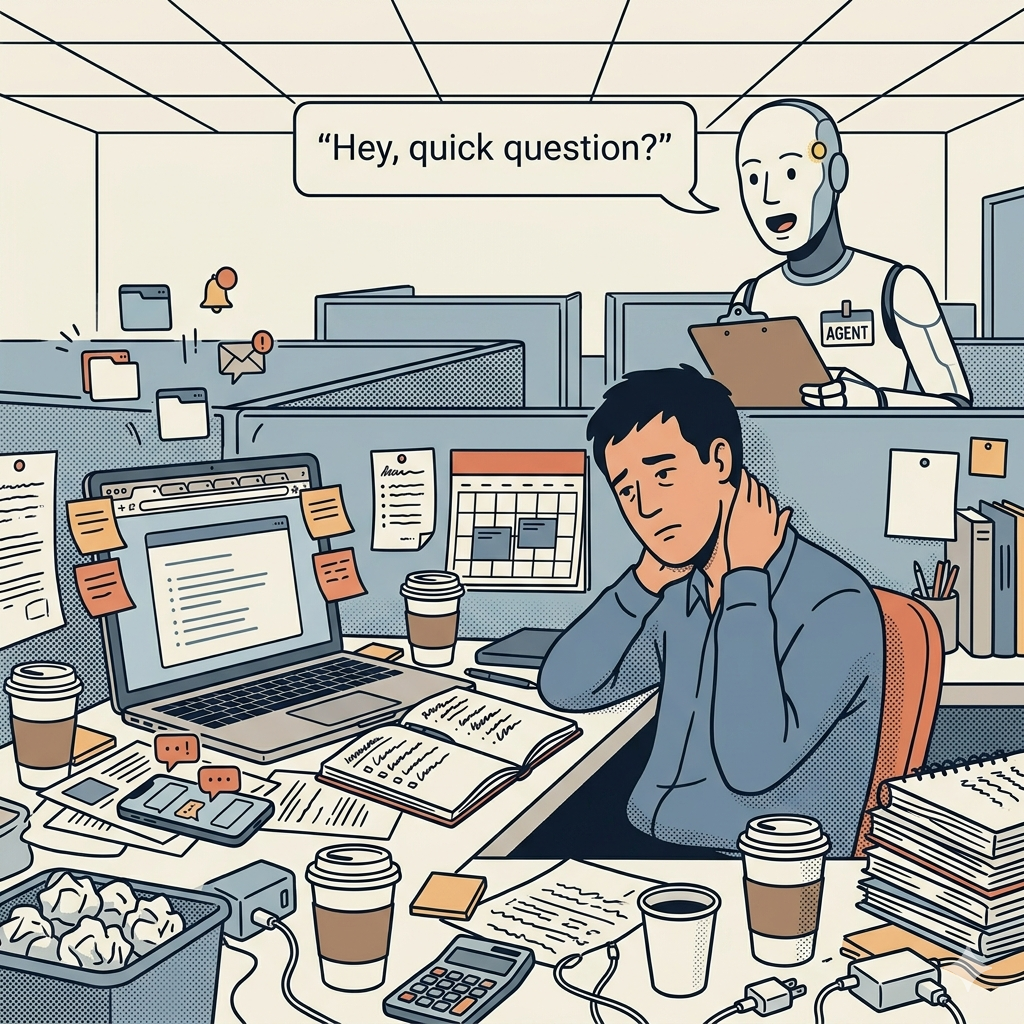
The most 2026 problem in consumer AI is that the software is finally capable enough to help, and somehow it has become one more thing to manage. More tabs, more sessions, more partial tasks, more agents asking which gift to buy and which flight to book and which email to send. The agents are real. They work. And the product they have collectively produced is another inbox.
That is not what consumer AI was supposed to look like in 2026.
Two things are true that almost nobody holds together. Consumer demand for AI is enormous and proven. ChatGPT crossed 900 million weekly users in February, Claude is normal household language, Gemini touches a billion search users daily. And agentic capability is real and shipping. Coding agents ate the developer tooling stack in a year, ChatGPT Agent will book your flight, Manus runs research while you sleep. The demand is there. The capability is there. So where is the consumer agent your parents would use? The household name a hundred million normal people use to delegate the boring parts of their lives?
The polite answer is “it’s coming.” I think the honest answer is that the missing piece is anticipation — the move from a system that responds when you ask to a system that acts at the right moment without being asked. None of the consumer agents shipping today have crossed that line.
Here’s what’s inside:
- The reactive ceiling. Why ChatGPT broke through and consumer agents haven’t.
- The four problems no shipping product has solved. Context, reliability, permission, judgment. And why solving three of four equals zero.
- The bets in the field. A scored read of every active thesis: Poke, Clicky, Cluely, Manus, ChatGPT Agent and Atlas, Cowork, the browser pack, the wearable category, Granola, Wispr, the companion category, the build-on-demand category, and the verticals.
- The four paths to the breakthrough. Probability-weighted predictions, including the contrarian bet that gets the least coverage.
- A working calendar hygiene system you can run today. The closest a normal person can get to what an anticipatory agent should feel like, built out of tools that already exist.
The teams that build against anticipation are the ones who win consumer AI for the next decade. Most of the others are building against the surface narrative.
Subscribers get all posts like this!
LINK: Grab the Calendar Hygiene Guide and Prompts
The reason no breakaway consumer agent has shipped is that nobody has solved context, reliability, permission, and judgment at the same time. You can’t fix that. The labs and indies are working on it, and the breakthrough is probably eighteen months out at the earliest. There is something you can do this week that closes the gap for one specific part of your life.
Calendar hygiene is the closest most people can currently get to anticipation. It is the place in your week where bad scheduling decisions, missed prep, and forgotten commitments accumulate into the feeling that the week is happening to you. The cause isn’t disorganization. The cause is that the calendar surface doesn’t hold the work, the email surface doesn’t hold the commitments, and nothing connects them.
The AI Calendar Hygiene Guide is the place to start. It’s an end-to-end system you can run today against your real calendar, real email, and real messages — built to operate at trust ladder steps one through three so nothing changes without your approval. If you read this article and thought I should be using AI more, but I don’t know where to start, this is the one to open.
The companion Prompt Kit is for the smaller subset of readers building, investing, or covering this space. It turns the article’s frameworks — the four problems, the five-step trust ladder, the prosumer bridge, the four breakthrough paths — into diagnostic and design tools you can run against any consumer AI product, investment thesis, or competitive landscape.
Why ChatGPT and Claude hit the reactive ceiling
ChatGPT is a reactive product. You open it, you type a prompt, and it responds. The user does the work of figuring out what to ask, framing the question, and evaluating the response. The product is brilliant, and it requires a literacy the user has to develop themselves.
This was fine for chat. The chat habit transferred from search, where users had already spent two decades learning to type queries into a box. The cognitive cost of “knowing what to ChatGPT” was low because users were already knowing what to Google. The expansion from search to chat was the smallest possible mental-model shift, which is why it scaled so fast.
It is not fine for agency. The cognitive cost of “knowing what to delegate” is much higher than “knowing what to ask.” Most people, asked what they would have an AI agent do for them, freeze. The honest answer is “I don’t know, what can it do?” That is a failure mode for a consumer product. There is no preexisting consumer literacy for delegating to an autonomous tool. Humans have delegated to other humans for as long as they have had hierarchies, but the mental model for delegating to a person (context-setting, mutual understanding, follow-up) does not transfer cleanly to delegating to a system that has no body, no relationship, no shared history.
The ceiling is reactive. Above it are products that require the user to know what to ask for. Below it are products that act before being asked, anticipate the user’s needs, and offer the right thing at the right time. ChatGPT lives at the ceiling. So does every consumer agent product currently shipping that pitches itself as “tell it what you want and it does it.” The pitch is not wrong, but it is reactive, and the reactive ceiling is exactly the problem.
The breakaway consumer agent has to be below the ceiling: it has to anticipate.
Why coding agents broke through
The contrast that makes the reactive ceiling visible is what happened with coding. Coding agents broke through to genuine economic value within twelve months of becoming usable. They are the largest single productivity unlock in software in a decade. Their users tolerate failure at rates that would be lethal in consumer products. A coding agent that succeeds 70% of the time on real-world tasks is a generational tool. Their users pay willingly. They evangelize aggressively. The agentic coding category has saturated demand inside a year.
Why? The conditions for delegation in coding are unusual, and naming them clarifies what consumer agents are working against.
Coding has built-in verifiability. The code runs or it doesn’t. Tests pass or they fail. The compiler tells you immediately if you got it wrong, and the runtime tells you if you got it almost-right but not quite. This is a complete success signal that arrives within seconds. Consumer tasks do not have this. Most consumer tasks have no clean success signal. Did the agent book the right flight, write a good email, pick the right gift, summarize the meeting accurately enough? The user has to judge subjectively, often after the fact, often without enough information to do so confidently.
Coding has bounded scope. A function, a feature, a refactor, a bug fix. The agent operates inside a defined context with defined inputs and defined outputs. Consumer tasks are unbounded. “Manage my life” is not a task. It is an ambient condition that the agent has to operate inside without anyone, including the user, being able to specify the boundaries.
Coding has domain literacy. Developers know what good code looks like, what they’re trying to accomplish, and how to recognize when the agent has gotten close. They can specify intent in technical language because they have the language. Consumer users have no equivalent vocabulary for what they want from an agent, and most have never had a well-organized digital life that would give them an aspirational reference point. They don’t know what good email management looks like, what kind of calendar hygiene is achievable, or how a delegated week would feel different from a self-managed one.
Coding has fast error correction. A bad output gets caught and fixed in the same session, often within minutes. Consumer tasks have variable and sometimes catastrophic error costs. A wrongly sent email is much worse than a wrong line of code that didn’t compile. A wrongly placed order can be expensive. A misjudged tone in a message to a coworker is a relationship event. The cost of being wrong scales nonlinearly with the agent’s autonomy.
Coding has high task complexity worth delegating. Writing a real piece of software takes hours. A five-minute prompt that saves three hours is an obvious win. Most consumer tasks are short. Sending an email takes two minutes. Booking a dinner takes three. The activation energy for delegation is much higher when the task itself doesn’t take long. The agent has to be 10x faster to overcome the trust friction, and most consumer tasks are not long enough to deliver that ROI.
Coding agents broke through because the conditions favored delegation. Consumer agents have to break through against the conditions, which is what makes the gap structural rather than a matter of better products.
The anticipation threshold: from reactive AI to anticipatory AI
Anticipation is the move from “the user asks the agent to do X” to “the agent offers to do X before being asked.” The anticipation threshold is the level of anticipatory accuracy at which an agent stops being a tool that requires prompting and starts being an assistant that creates space.
Reactive agents have to be summoned. They live in the user’s working memory as “things to remember to use.” This is a high cost and a frequent failure mode. Power users forget to use ChatGPT for the things it would help with most, because the instinct to “ask ChatGPT” hasn’t fully formed. Consumer users almost always forget. The product that requires you to remember it isn’t the product that becomes a habit.
Anticipatory agents are summoned by the situation, not the user. The flight gets delayed and the agent texts: “rebooked you on the 4:15.” The kid’s school sends an email and the agent texts: “field trip permission slip needs your signature, here it is.” The grocery list gets long and the agent texts: “ordered for Wednesday delivery, swap anything?” These agents create a different relationship with the user. They reduce mental load instead of adding to it. They earn frequency without requiring habit, because the situation does the summoning work that the user would otherwise have to do.
There is useful prior art for this in earlier consumer software. Push notifications crossed the anticipation threshold for messaging. The app didn’t have to be open for the message to reach you. Recommendation feeds crossed it for content. You didn’t have to know what you wanted to watch. The feed surfaced things. Search autocomplete crossed it for queries. You didn’t have to know the full query. The system anticipated the rest. Smart replies crossed it for email. You didn’t have to write the response. Three options appeared. Each of these earned its place in the consumer software stack and changed the underlying behavior of millions of users within months.
What those features had in common is what makes them analytically useful. The domain was bounded. Push notifications happened in one app. Recommendation feeds happened on one platform. Autocomplete happened in the search box. Smart replies happened in email. The action was bounded. Notification, suggestion, completion, three options. Each was a small, well-scoped intervention. The commitment was reversible. The user could ignore the notification, swipe past the suggestion, ignore the completion, write their own reply. None of these features asked the user to surrender control of an outcome.
Anticipatory consumer agents are trying to do the same kind of job (surface the right thing at the right time) but cross-domain, with unbounded actions, with commitments that may not be reversible. The agent that texts you to confirm rebooking your flight is making a much bigger ask than smart replies. The reversibility is gone (the booking happens), the domain is wide (it pulled context from email and calendar and a travel site), and the action affects the real world. Each of the prior anticipatory features earned its place by being narrow, bounded, and reversible. Agents are trying to be broad, unbounded, and consequential. The threshold is correspondingly higher, and the failure modes are correspondingly worse.
The gap is not about capability, distribution, or even trust in the abstract sense. The specific gap between “system that responds when asked” and “system that acts at the right moment without being asked” is what no consumer product has cleared yet.
Consumer AI agents in 2026: every active bet, scored
Every consumer AI product currently shipping is making an implicit thesis about how to cross the anticipation threshold. Naming the theses, and scoring them against what each is actually solving, makes the differences visible.
Poke lives in iMessage, SMS, and Telegram. You don’t open an app. You don’t type prompts. It connects to your email, calendar, files, and accounts, then texts you proactively: daily summaries, relevant emails, schedule changes, things it thinks you’d want to know. The Interaction Company’s bet is that messaging bypasses the install and UX cost entirely (consumers already text constantly), the asynchronous format tolerates latency and occasional errors, and the proactive posture moves the product above the reactive ceiling by design. People text more than they do anything else digital, and the cognitive cost of texting an AI is roughly zero. The early data suggests they are onto something. 750,000+ messages exchanged in beta with strong retention. Around $25M raised. A $300M valuation. Explicit ambitions for a billion users. The specific risk is substrate dependency. If Apple changes iMessage behavior, if SMS pricing shifts, if Linq stops being a viable bridge into messaging platforms, the entire substrate disappears. There’s a second-order risk: personalization is hard to scale when the agent has no app to fall back on for richer interactions.
Clicky sits next to your cursor on macOS, sees your screen, listens when you speak, and points at where to click. People open Figma, DaVinci, Excel, Premiere, and silently lose hours to panels they couldn’t name. The pitch is that for any complex software the user doesn’t fully know, an always-on visual companion crosses the anticipation threshold by definition. The agent sees the moment when the user is stuck and can act. The viral demo was DaVinci Resolve. Farza Majeed open-sourced it the day after launch, which is itself a strategic move. Consumer screen-watchers need to be able to defend the privacy story, and open source is the cheapest defense available. The risk is that Apple Intelligence eventually ships a competent screen-aware agent at the OS level, at which point the indie has to be much deeper to survive the platform sweep.
Cluely overlays AI suggestions on whatever screen you are looking at, without the other party knowing. It started as interview cheating, which was both excellent marketing and an obvious legal liability, and is now pushing toward general always-on use. Anticipation through omnipresence. The behavior pattern is unflattering and real: people lie to look competent, and AI lets them lie better. Visible AI use is socially costly. Invisible AI use isn’t. Regulatory and platform pressure could end the product in a quarter, but a sufficient slice of the market is willing to use it despite the controversy. Higher upside than people think because the underlying behavior is durable. Lower legitimacy than people think because the originating use case will keep coming back as a story.
Manus is betting on autonomy. You give it a task, it goes off into the cloud, runs computer-use sessions on your behalf, and reports back. The user does not want a co-pilot. They want a contractor. The frame fits how knowledge workers already operate on research, analysis, and document drafts: set the goal, walk away, check back later. Synchronous agents block the user. Async agents free them. The catch is the long tail of consumer tasks. Real-world tasks fail in ways that matter, and Manus has no good error-recovery path when its computer-use session hits something unexpected. The user may not learn about the failure until much later.
ChatGPT Agent and Atlas are betting that anticipation can be retrofitted into the chat habit. Users already use ChatGPT. Add browser control, action capability, gradual proactive features, and the chat surface becomes the agent. OpenAI’s hiring of OpenClaw’s creator slots into this strategy: bring the computer-use capability in-house, ship it under the ChatGPT brand, tap the nearly-a-billion weekly user base. The advantage is enormous. Distribution, capability, capital, brand. The constraint is taste, speed of UX iteration, and the political ceiling on permission grabs at consumer scale. OpenAI cannot ship aggressively into ambient territory without regulatory and PR risk that the indies don’t face. There is also brand caution. ChatGPT cannot afford to ship a product that takes wrong actions on user accounts at the scale of hundreds of millions of weekly users, because the failure modes would be front-page news.
Claude’s Cowork runs the same play one substrate down, on the desktop. People live in their files. They switch between tools, manage context across applications, and browser agents miss most of it. Cowork sits in a desktop window with file and tool access, and the connector ecosystem (MCP, integrations) lets it learn the user’s tools and patterns over time. Anthropic’s specific advantage is that Claude is sharp on code and structured thinking, which is what a desktop knowledge worker agent should be sharp on. The risk is the same as ChatGPT’s. Lab pace is slower than indie pace. Lab caution limits how aggressively the agent can ship into proactive territory.
Perplexity’s Comet, the Browser Company’s Dia, Opera Neon, Fellou, Genspark are all betting that the browser is the right substrate. Knowledge work happens in the browser. The agent that lives there sees the work in context. Comet pushes hardest on the agent-does-tasks-in-tabs model, with autonomous browsing and form filling. Dia is more chat-companion in a browser shell, using the Browser Company’s UX taste. Opera Neon and Fellou are explicitly agent-first browsers. Genspark combines browser context with a multi-tool agent workspace. A meaningful slice of consumer time is browser time, especially for younger users, and the surface where the user does most of their digital work is the surface where the agent should live. What kills the bet is native AI-powered apps pulling work back out of the browser. If that trend accelerates, browser agents are betting on a shrinking surface. The platform-control risk is real too. Major OS players treat browsers as a controlled distribution channel, which limits what agentic browsers can do without platform-level cooperation.
Limitless, Friend, Bee, Plaud, Omi (the wearable category) are betting that anticipation requires capture, and capture has to be ambient. The agent that hears your meetings, your calls, your conversations has the context to anticipate. The product right now is mostly memory and summarization, with action layers being added slowly. The wearable feeds whatever interface the user prefers downstream (voice, text, app) but owns the upstream context layer. Amazon’s acquisition of Bee in July 2025 and Meta’s acquisition of Limitless in December 2025 are the clearest signals that the platform players think this is the right end of the value chain. Humans already record professionally in some contexts (meetings, depositions, journalism), and the consumer extension is bridgeable but socially fragile. The score on permission is the most interesting in the entire field. The wearable category asks for the most permission and has the smallest installed base, but the users who installed it explicitly chose to be recorded, which makes the permission grant unusually durable. The risk is regulatory and social. The ambient recording norm is not yet stable, and a single high-profile incident could set the category back two years.
Granola wins by going narrow. Knowledge workers attend a lot of meetings, take poor notes, and lose context within days. Existing meeting notes tools are weak. Granola is the fix. The system surfaces prior context during a current meeting, drafts summaries automatically, and routes action items to the right people. Inside that narrow domain, it scores well across all four problems, which is the entire point of going narrow. The obvious threat is Microsoft or Zoom shipping meeting notes that are good enough that switching costs aren’t worth paying. What saves Granola is that existing users have already accumulated meeting history and personalization the platform features won’t replicate. They don’t switch back.
Wispr Flow is making the most invisible bet. The agent is just dictation done well. You speak, it types, it edits, it remembers your snippets. The product is so quiet it does not pitch as an agent. It pitches as a faster keyboard. Everyone types, and some people type more than they want to. Wispr’s score on the four problems is unusual. It doesn’t really play the agent game directly, but it earns the user’s trust at level one (visibility) and level two (audibility) in the permission stack, which is the foundation for any future expansion into more agentic territory. Strong on judgment because it stays quiet — only acts when invoked. The risk is that Apple ships better dictation, or voice-first input becomes broadly normalized in OS keyboards. The opportunity is that Wispr has earned permissions that would let it expand into adjacent territory if it chooses to.
Sesame, Hume, the Inflection-descended Pi, Alexa+ are betting on voice as the consumer interface for AI. Sesame especially has been called out for natural conversational quality. Voice is the most human interface, and humans bond with it differently than text. Anticipation through voice means the agent that calls you when something is up. The constraint is the screen. Voice is structurally important for driving, walking, accessibility, and ambient home, but most productive consumer agency requires a screen for the user to act on what the agent surfaces. Always-listening voice has the recall problem in a different shape. Users have to grant the agent the right to hear them, and that grant is fragile in a way Alexa has demonstrated repeatedly.
Replika, Character.AI, the companion category are betting that anticipation is built on relationship. You delegate to someone you know. Build the relationship first: the emotional, conversational, personality-driven loop. Agency emerges from the relationship. The behavior pattern is uncomfortable to acknowledge but real. A meaningful slice of consumers are lonely, AI fills emotional needs, and the retention numbers tell a striking story. AI companion apps hold somewhere between 13 and 50 percent of users at thirty days, depending on the platform and use case. General productivity apps hold under ten percent at the same horizon. The category that the press treats as a curiosity is, by the only metric that matters for consumer software, retaining users at multiples of the category that gets all of the funding coverage. The pitch is that the user trust curve in companion products eventually allows agentic expansion — “since I trust you, can you also do X for me.” This is a slow path but a real one, and the data on consumer attachment to companion products suggests it is not crazy. The risk is that companion products are governed by social and regulatory dynamics that productivity products aren’t, and they may face restrictions that limit agentic expansion before it can happen.
v0, Bolt, Lovable, the build-on-demand category are betting that the consumer agent is not a single product. It is a builder. The user describes a tool, the agent builds it, the user runs it once and discards it. The behavior is prosumer. People have specific tool needs that off-the-shelf software doesn’t meet, and building custom apps used to require engineers. The agent infers what tool the user needs from a vague description. This is closer to working than most outsiders realize, especially among the prosumer slice that’s one step away from vibe-coding its own utilities. Some of what we call “consumer agents” turn out to be agents that build tools, not agents that do tasks. The long tail of useful software has been undersupplied for decades because building was too expensive.
HeyElsa for crypto, Khanmigo for education, Magic School for teachers, the various health and finance agents are betting on vertical depth. Anticipation is easier in a narrow domain because the agent knows what kinds of things matter. Depth wins over breadth. Specialized domains have specialized needs, horizontal agents serve all of them shallowly, and users in those domains feel the gap. The score within domain is strong on context, strong on judgment, decent on permission (clear use case). The vertical bet is the most defensible against horizontal sweep. The risk is that the addressable market in any one vertical is smaller than horizontal players’ growth narratives require, which means vertical agents tend to produce sustainable businesses rather than category-defining outcomes.
Rabbit r1 and Humane Pin bet that the agent needed its own hardware. Both failed. The lesson got internalized across the industry: do not make the user buy a thing. The substrate has to be something the user already has. The hardware-first consumer agent is dead until and unless the hardware in question is something the user wanted independently. Which is the structural advantage AirPods and the Ray-Ban Display have, and the structural reason the next generation of consumer agent hardware will probably be earbuds and glasses, not pendants and pins.
The range of theses is wider than the surface coverage suggests. Each is a coherent answer to a real question — what is the cheapest way to cross the anticipation threshold reliably? And each is wrong in a slightly different way.
Why anticipation is hard
Crossing the anticipation threshold is hard because four problems have to be solved simultaneously, and most products solve one or two well.
The first is context. To anticipate, the agent has to know what is going on in the user’s life. Chat agents have almost no context. Browser agents have the current tab. Wearables have audio. Screen agents have the current display. Cross-account agents like Poke have email and calendar and files. None of them have all of it. The user’s life is fragmented across surfaces, and the agent that has the deepest cross-surface context can anticipate the best — and is also the most invasive to install. The asymmetry between what an agent needs (everything) and what the user will give (a bounded slice) is the central design tension in the entire category.
The second is reliability. An anticipatory agent that suggests wrongly creates more friction than no agent at all. Users tolerate a chat being wrong because they asked for it. They do not tolerate an agent texting them about something they didn’t want, taking action they didn’t approve, or repeatedly surfacing things that don’t matter. The reliability bar for proactive action is significantly higher than for reactive answer — by my read, an order of magnitude higher. Frontier models on long-tail consumer tasks are not yet at that bar. The gap between current model reliability and the bar required for trustworthy proactive consumer use is what is gating the category, more than any single product decision.
The third is permission. Anticipation requires standing permission. The user has to grant the agent the right to act, message, capture, store, and decide without being asked each time. Standing permission is psychologically expensive to grant. It is also what makes the agent useful. Every consumer agent product is fighting the trade-off between “ask for everything up front and lose users at install” and “ask for nothing and become useless.” Poke’s onboarding bouncer is one approach to negotiating this. It makes the install feel like a relationship rather than a permission flow. Apple’s tightly-scoped permissions are another. Wearables ask for the most permission and have the smallest installed base.
The fourth is judgment. An anticipatory agent has to know when not to anticipate. The product that texts you twelve times a day fails differently than one that texts you twice. Knowing when to surface and when to stay silent is a taste problem more than a capability problem, and very few products have it dialed. Most current anticipatory products fail in the direction of too much, because more notifications look like more value when you are demoing the product and look like more noise when you are using it for two months. The agents that earn long-term permission are the ones that demonstrate restraint, and restraint is hard to optimize for because it doesn’t show up in launch demos.
A product that solves three of these and not the fourth does not break through. ChatGPT Agent has reliability problems. Wearables have permission problems. Voice agents have judgment problems. Browser agents have context problems. What separates current consumer agents from a breakaway product is the requirement to solve all four at once.
The 5-Step trust ladder for consumer AI agents
There is a sub-frame inside the permission problem worth naming explicitly. Permission isn’t binary. It’s a ladder. The five steps, in roughly increasing order of trust required, are:
Read. The agent gets visibility into the user’s data and screens. ChatGPT memory operates here. So does Cowork’s connector layer. So does Wispr’s keyboard integration. This is the lowest-trust step and the easiest to earn.
Suggest. The agent surfaces things proactively without taking action. Granola surfacing prior context during a meeting. Limitless reminding you of a conversation. Poke nudging you about an email. The agent makes proposals; the user disposes. Most current anticipatory products live here.
Draft. The agent prepares actions for the user to approve. ChatGPT writing an email for you to send. Cowork drafting a document. The agent does the work; the user signs off.
Act with confirmation. The agent does things on the user’s behalf, reports back, and accepts intervention if it got something wrong. This is where ChatGPT Agent, Manus, and the more aggressive autonomous browsers operate. The scope of action is bounded but the agent is operating in the world.
Act autonomously, including transactions. The agent commits the user without per-action confirmation. Books the flight without asking. Buys the gift. Signs the document. Pays the bill. This is the step that no mainstream consumer agent has crossed credibly, and the company that crosses it first either defines the category or gets sued out of existence.
Most products today live at steps one through three. ChatGPT is at one and three. Cowork operates at one through three with experimental four. Granola operates fully at one through three. Wearables operate at one and two. The few products attempting step four (full ChatGPT Agent, Manus, the autonomous browser agents) are the ones with the worst reliability and trust profile, because they’re operating at a step where errors cost the user more.
Step five doesn’t really exist in mainstream consumer products yet. The first agent to credibly operate at step five — that books, buys, signs, schedules without per-action approval, and gets it right — is the one that defines the category. The legal and regulatory questions get serious here. Whose fault is it when an agent buys the wrong thing? Whose card got charged? What happens when an agent commits to something the user wouldn’t have? These are not solved problems, and the consumer agent that crosses step five will need answers.
The four problems and the five-step ladder interact. Earlier ladder steps are easier on context, reliability, permission, and judgment. Later steps require all four dialed in. The breakaway consumer agent is the one that operates reliably at step four across at least three meaningful domains, with a credible path to step five. None of the current products meet that bar.
The prosumer bridge
There is a pattern in consumer software adoption that gets understated in current coverage. Most of the consumer products that broke through in the last fifteen years entered through prosumers: knowledge workers using something for work that bled into personal use. Slack entered through engineering teams. Notion entered through PMs and designers. Figma entered through product teams. Superhuman entered through executives. Each one started as a prosumer tool, accumulated enough professional usage to fund the product, and the consumer narrative attached later, sometimes implicitly through the prosumer’s habits at home rather than through deliberate consumer marketing.
This pattern matters for consumer agents because the active products have very different exposure to the prosumer bridge. Granola is a prosumer product that will likely bleed into personal meeting notes (recordings of family conversations, doctor’s appointments, parent-teacher meetings) over the next two years. Wispr is a prosumer product with the same trajectory: once you get used to dictating at work, you keep doing it at home. Cowork is explicitly aimed at knowledge work, with consumer drift expected. Limitless, despite being marketed at consumers, gained traction first among knowledge workers who wanted better meeting recall.
Poke is the interesting outlier. It is positioned as a pure consumer play from day one. Texting an AI for life admin. The thesis assumes the prosumer bridge is not necessary, that the messaging interface can capture consumers directly without needing to come through professional adoption first.
Both paths have prior art. The pure consumer entry point worked for ChatGPT, which is the largest counterexample to prosumer-first adoption in recent memory. The prosumer-bridge path worked for nearly everything else that became a default. ChatGPT’s exception is instructive: it worked because the underlying behavior (asking questions, getting answers) is universal across consumers and prosumers, the cognitive cost of the new behavior was nearly zero (it transferred from search), and the product was useful enough on day one that no professional adoption was needed to subsidize the consumer launch. Whether Poke can replicate ChatGPT’s path or has to follow Notion’s depends on whether there is enough killer-use-case gravity in messaging-based agency to pull consumers in directly without prosumer subsidy.
The likely outcome over the next twenty-four months: prosumer adoption produces several sustainable indie businesses (Granola, Wispr, Cowork-adjacent plays, Limitless, possibly Clicky depending on how its enterprise flank develops), and one of them eventually expands enough to qualify as a consumer-relevant agent. The pure-consumer attempt (Poke and similar) either succeeds quickly enough to break out, or gets absorbed into the prosumer fleet through acquisition or pattern matching. The “breakaway consumer agent” might end up being a prosumer agent that consumers also use, rather than a thing that was built for consumers from the start. This is the most likely outcome and is being underweighted in current coverage of the category.
Where the consumer AI breakthrough probably comes from
The path to a breakaway consumer agent has four plausible shapes. Naming all four and ranking them is the most useful predictive exercise.
The first is that one of the labs ships incremental anticipation into a product that already has consumer scale. ChatGPT crosses hundreds of millions of weekly users. Add proactive notifications, cross-account memory, and a permission ladder, and the breakaway agent already exists — it just looks like ChatGPT with new features. This is the safe bet. The labs have the capital, the capability, and the distribution. The constraint is taste, speed of UX iteration, and the political ceiling on permission grabs at scale. OpenAI hiring OpenClaw’s creator and shipping ChatGPT Agent are exactly this play. Anthropic’s Cowork is the same play in a different posture. My read on probability: 35%, conditional on the labs shipping more aggressively on the permission ladder than they have to date, which is itself an open question.
The second is that an indie crosses the anticipation threshold first, the way Notion crossed ahead of Microsoft on a different category. Of the active bets, the messaging-plus-proactive shape is the structurally strongest, because it solves context (cross-account integration), interface (zero install via SMS), and partly judgment (asynchronous tolerates restraint). The reliability problem is still hard but solvable as models improve. Poke is the clearest exemplar of this shape and the highest-conviction indie bet in the space at the moment. The risk is that the labs catch up fast enough that the indie’s window closes before they reach the scale that makes them uncopyable. Probability: 15-20%, with the upside outcome being acquisition rather than independent dominance.
The third is the combination most likely to actually crack it: the messaging-style asynchronous proactive agent paired with a wearable or always-on capture layer. The wearable supplies context that no app-based product can match. The messaging interface supplies reach and frequency. The combination crosses the anticipation threshold because both the input and the output sides of the loop are solved. Limitless plus Poke, conceptually, is the breakaway product. Whichever team ships both layers first, or stitches the two best products together via a clean connector layer, has the highest upside in the category. Amazon paying for Bee and Meta paying for Limitless are more strategic than the prices suggest. They are buying optionality on the input side of exactly this loop. Probability: 20-25%, weighted toward 2027 rather than 2026.
The fourth is the prosumer-bridge path. Granola, Wispr, Cowork, or a similar prosumer-first product expands its scope enough to qualify as a consumer agent without ever pitching itself as one. The product accumulates so much workflow value and earned permission that adding adjacent capabilities (calendar management, personal email, household admin) becomes natural rather than forced. This is how Notion went from PM tool to “the place I run my life.” The breakaway consumer agent on this path looks less like a single new product and more like a successful prosumer product that consumers also use. Probability: 25-30%.
The pessimistic read, for completeness, is that the breakthrough is gated by reliability advances at the model layer that have not happened yet. Anticipation requires the agent to be right around 95% of the time on long-tail consumer tasks. Frontier models are at seventy to eighty-five percent depending on how you measure. Closing that gap takes another twelve to eighteen months of model and infra work. Until then, the consumer agent is a developer concept dressed for a public that is not ready to delegate at the level the product requires. This is less a path and more a constraint that affects all four paths.
There is also a fifth, more contrarian reading worth flagging. The breakaway consumer agent never arrives as a single product. The pattern is the opposite of search — many specialized winners, each anticipatory in a narrow band, none of them dominant. Granola anticipates meetings. Wispr anticipates typing. Limitless anticipates memory. ChatGPT anticipates questions. The user runs all of them in parallel and never thinks of any of them as “their agent.” The “consumer agent” turns out to be a category that exists in analyst slides and not in user mental models. This is the most likely outcome over the next twelve months and probably the wrong frame over the next thirty-six.
If forced to commit to a specific scenario, the most likely path is this: ChatGPT or Claude crosses the anticipation threshold first by virtue of distribution and shipping cadence, sometime in late 2026 or 2027. The cross is incremental, a series of features that compound rather than a launch event, and the user notices it as “ChatGPT got really good” rather than “ChatGPT became an agent.” Around the same time, Poke or a Poke-shaped product hits the ten million user mark and either holds its own or gets acquired by one of the labs or platforms. Granola, Wispr, and the wearable category continue to grow on the prosumer bridge path and eventually produce one of the most valuable companies in consumer AI without ever winning the “consumer agent” framing fight.
The interesting upside, the contrarian bet, is the indie that beats all of these by combining the messaging interface, cross-account context, ambient capture, and reliability-first product taste in the same product. That team probably exists already. They are quiet and they are not the one with the most attention right now. If they ship in the next eighteen months and execute well, they take the category. If they don’t, the labs win by default.
The real puzzle
The question “where is the breakaway consumer agent” has been asked for two years and the answer keeps being “next quarter.” The honest answer is that the gap is the anticipation threshold, and the threshold is hard to cross because four problems have to be solved at once and the category requires the kind of cross-domain anticipation that no consumer software feature has previously achieved in a single product. The active bets in the field are different theses about which of the four problems is the binding constraint. They are mostly wrong individually and probably right collectively, in the sense that the breakthrough will combine elements of several current bets rather than crowning one of them. Whatever shape it takes, the test is the same as the diagnosis. If the product makes the user the manager of more sessions, more outputs, more decisions, it has not crossed the threshold. The breakaway consumer agent is the one that subtracts from the user’s mental load instead of adding to it.
The breakthrough, when it ships, is going to look obvious in retrospect. The pieces are visible right now. Messaging as the interface. Wearable as the capture layer. Cross-account context as the foundation. Proactive as the posture. Standing permission as the trust contract. Reliability as the gating constraint. The agent that combines all of these wins consumer AI for a decade. The teams that are missing one or two of these are running expensive experiments that will mostly produce learning rather than businesses.
The most important question for anyone building, investing, or covering this space is which of the active products has a credible path to combining all of the pieces. The diagnostic is the four problems plus the trust ladder plus the prosumer bridge, scored against any individual product. Most score badly. A few score well enough to be worth watching. None score high enough yet to be the answer.
Until that changes, what we have is an enormous demand signal, a capable agent stack, a user population that does not know what to ask, and a category that keeps almost shipping its breakthrough. That gap is the interesting story in consumer AI in 2026, and it is wider than the funding rounds and the launch posts make it look.
The teams that name the gap correctly and build against it are the ones who win the category. The teams that keep building against the surface narrative are the ones who get acquired for parts.
I make this Substack thanks to readers like you! Learn about all my Substack tiers here