What do to when your company's AI tool is bad at your job.
By Nate
Published: 2026-04-30
URL: https://natesnewsletter.substack.com/p/wrong-ai-default
Your company’s default AI tool is bad at your job, you know it, your team knows it, and the moment you say so out loud you stop sounding like the person trying to get the work done and start sounding like the problem. That is the trap. If you are reading this and feeling a small tightening in your chest, it is warranted. Leadership wants frontier results. IT picked a default that cannot deliver them. You are stuck in the middle, paying the cost in thirty-minute chunks and five-minute corrections and the small flinch you feel every time the corporate assistant gives you something plausible and unusable. Every time you push back, it lands as taste.
Preference, not performance.
It lands as taste because that is the shape of the argument. “Copilot is bad” is not a thing IT can act on. Neither is “I need Claude.” Your IT organization has heard six versions of each from six different teams that all want a different product, and the only honest move available to them is to nod and do nothing. The argument that breaks through is different. It is specific, it is bounded, and it has a number attached to it. Almost nobody is producing that argument because nobody told them how.
The thing that strikes me about Jaana Dogan’s post is how immediately she could judge what she was looking at. She is a principal engineer on Google’s Gemini API team. In January she posted that Claude Code reproduced in an hour what her team had spent a year building, and the post passed five million views in January alone. She recognized the delta the moment she saw it because she knew how to judge the output. You are the same kind of expert about the work you do every day. The unfiled ChatGPT Plus on your expense report and the Claude Code license your colleague is paying for personally are evidence, not embarrassment. The piece below is how you turn that evidence into something your company has to act on.
Here’s what’s inside:
- Why your argument is bouncing. The shape of your case matters more than the strength of it, and almost nobody is making the right shape.
- The one-job, one-week test. Pick one job. Run it through both tools. Log four columns. The data is the argument.
- What the ask sounds like at three altitudes. Your manager wants one thing. Your CTO wants something completely different. Wrong altitude, wrong answer.
- If you are the one picking the default. The leader-side version, including the procurement model that skips the whole problem.
- Grab the prompts. Two prompts that turn this article into the actual moves: the Measurement Designer picks the right job and hands you the log; the Altitude Translator turns your log into three ready-to-send asks with objection responses pre-loaded.
This is the third in a short series on the agent layer. The first was field notes on ChatGPT Workspace Agents. The second was the filter for deciding which agent launches matter. This one is the step most people skip. What to do inside a company that picked the wrong default and does not know it yet.
Subscribers get all posts like these!
LINK: Grab the prompts
The article above is the strategy. These two prompts are the moves. Most ICs who read a piece like this agree the measurement is the right play and then never run it — not because they don’t believe in it, but because picking the right job to measure and writing the right version of the ask are both their own skills, and neither one is taught anywhere. The Measurement Designer pressure-tests your weekly workflow against the four criteria above, picks the single best job to compare, and hands you a log template with your success criterion already written in your own words. Run it before you open a spreadsheet. The Altitude Translator takes the log you produce a week later and writes the three versions of the ask — manager, director, executive — using your actual numbers, with the four most common objections already answered. The discipline both prompts enforce is the one that makes this work: the ask is always smaller than the evidence. Walk in with five rows of data and a request for one license for one job class, and the conversation is different from the one you have been having.
Why your AI tool complaint is bouncing off IT
The reason your pushback is bouncing is that you are making it in the wrong shape. “Gemini is bad at coding” is not a thing IT can action. It is an opinion, and your IT organization has already heard six versions of that opinion from six different teams who all prefer a different product. Treating every version of it the same way — as feedback to be acknowledged and not acted on — is how the organization stays coherent in the face of a constant stream of individual preferences that do not converge.
The actionable argument looks like this. Our team does three specific jobs weekly. Here are the inputs. Here is what each of them costs us in time and rework under the default versus the specialist, measured over two weeks with the same tasks. That kind of measurement is the only currency that moves a procurement decision, and most organizations have never produced it because it does not exist in any dashboard they already run. Your company is not choosing to ignore it. It is operating without it, which is a different problem and one you can actually solve.
The mistake most people make is trying to produce the measurement after the escalation rather than before it. They take their frustration to their manager, get told “we picked Copilot, let’s stick with it,” and give up. The order is wrong. You produce the measurement first. Then you escalate, with the measurement in hand. The first conversation goes differently than you expect when you walk in with data that did not exist when the decision was made.
The reframe that works
Asking the company to rip out the default loses every time, and it deserves to, because it is asking the company to undo a decision that had legitimate reasons behind it. Vendor consolidation. Volume discount. Compliance review already completed. Integration work already paid for. Those reasons did not stop being valid just because your team’s specific work does not fit the default.
The version that works is the opposite shape. Within our commitment to the default, what specific subset of work is the default doing worse than a specialist? What would it cost us to add the specialist just for that subset? The first question keeps the company’s prior commitment intact. The second gives the company a bounded, measurable addition rather than a reversal. IT organizations can hear the second question because it does not threaten anything they already built. They cannot hear the first question because it does.
This is the description of what the right answer actually looks like, not a rhetorical trick. If your team does seven things and the default handles five of them well, you should not switch. You should add a specialist for the two jobs the default fails, and leave the default alone for everything else. Running all seven jobs through a specialist because two of them need it is the same category error as running all seven through the default because five of them work.
The one-job, one-week measurement test
Here is the exact move. I have watched it work inside three separate enterprises in the last quarter, and the structure of the move is what makes it work. Pick one job your team does every week. Not three. One. The one where you have the strongest hypothesis that the default is mediocre. Run it for one week through your default agent and through one challenger agent, with the same inputs and the same success criteria.
Picking the right one job is the step most people stall on, so I want to be specific about it. The job should meet four criteria. It runs at least weekly, so you get multiple data points inside a week. It takes at least thirty minutes of your time each time, so the delta is meaningful. You have done it by hand long enough to recognize a good output from a bad one instantly. And the output has a legible audience — a team channel, a customer, a manager — so quality has a real referent and not just your own judgment in a vacuum. The jobs that fit these four criteria are usually the ones you are most frustrated by in the default, which is not a coincidence. The frustration is signal. The measurement converts the signal into evidence.
Keep a log. Four columns. Time spent producing the output. Rework required after the first draft. A quality score, one to five, with a one-line note on why. A binary: would you have sent the result as is, yes or no. That is the whole log. Five minutes of your time at the end of each task. By the end of the week you have somewhere between five and fifteen rows of data depending on how often the job runs, and it is more real evidence than any vendor demo produced when the procurement decision was made.
The success-criteria piece is where most people mess up. Do not measure what the vendors measure. Measure what your team actually cares about. If the job is a weekly customer digest, the success criterion is “did this replace the thirty minutes I used to spend scrolling Slack.” If the job is a code review pass, the criterion is “would I have merged the PR based on this agent’s review.” The question is always whether the agent did the job well enough to substitute for the work you were going to do by hand, and the only person who can answer that is you.
To make this concrete, consider a sales ops lead inside a company that defaulted to Copilot. The weekly job is a pipeline hygiene report: pull deals without next steps, flag the ones where the close date has slipped more than twice, summarize the risks, and post the brief into the revenue leadership Slack channel every Monday morning. Under Copilot, the lead spends about ninety minutes each Monday getting the report to a quality she is willing to send, mostly because Copilot struggles to reason across the deal-history structure and keeps surfacing the wrong slipped dates. For two weeks, she runs the same job through a ChatGPT Workspace Agent wired to the same data sources. The first week’s Workspace Agent draft needs twenty minutes of tightening. The second week’s needs ten. The log reads: five rows across two weeks, Copilot averaging ninety minutes and a quality score of three, Workspace Agents averaging fifteen minutes and a quality score of four, would-you-send flips from no to yes on three of five runs. That log is the ask. Not a speech about Copilot. The log, with a one-sentence request for a single ChatGPT Business seat so the job can stay on the specialist.
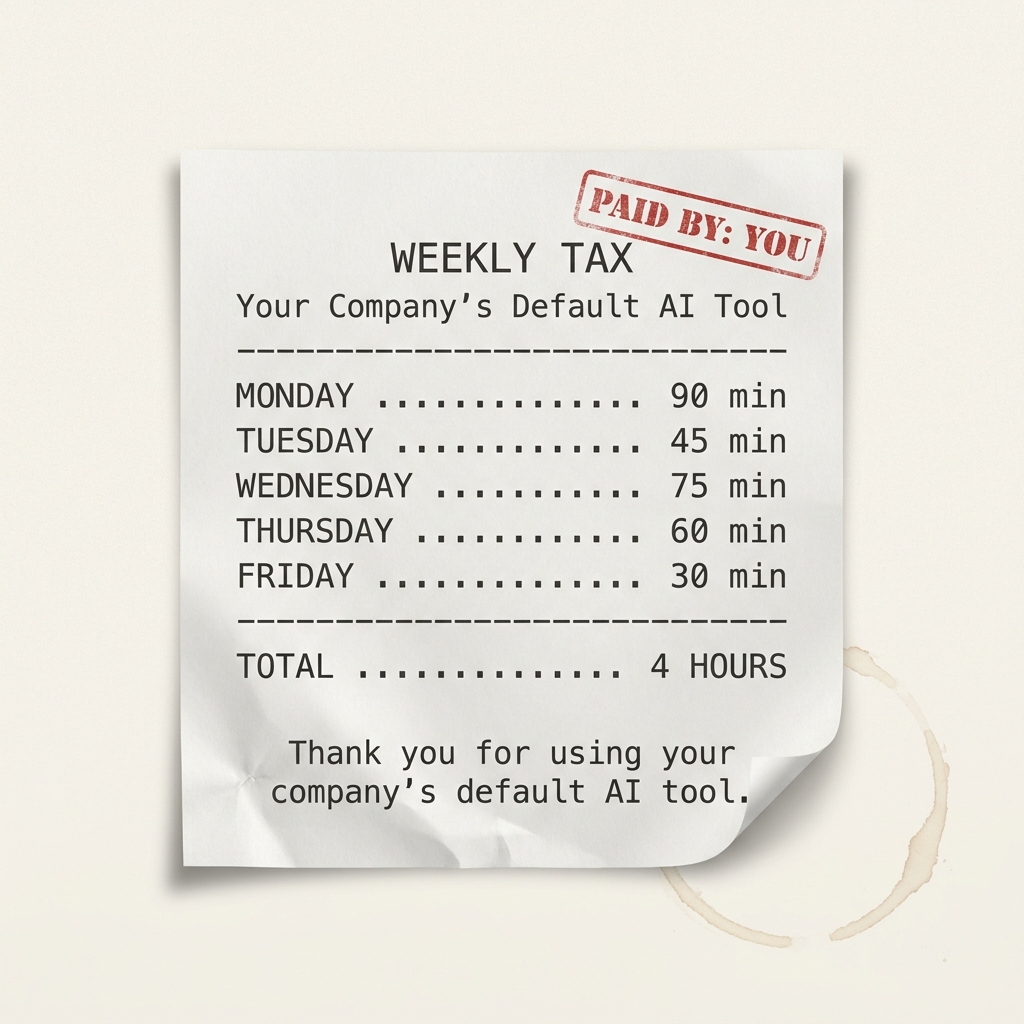
At the end of the week you have something nobody produced for you during the procurement review, because neither the vendor demo nor the IT evaluation measured your actual work. You have evidence. Take the data to your manager. The conversation is “for this one job class, the default costs us roughly four hours a week more than the specialist. Here is the log. Can we add the specialist for this one job.”
The shape of this move scales. In February, Gergely Orosz reported at Pragmatic Engineer that Wealthsimple, a Canadian fintech with around 600 engineers, had rolled out Claude Code to all of its engineers as the default coding tool after a structured selection process. Their CTO, Diederik van Liere, ran a two-month structured shootout for AI code review tools, and made a separate, conviction-driven call to roll Claude Code out to all engineers as the coding tool, backed by usage telemetry from Jellyfish showing which tools engineers were actually using and what they were doing with them. Both calls were measurement-backed in different ways. The Copilot to Cursor to Claude Code migration path Wealthsimple followed is a path Pragmatic Engineer described as well-trodden across the ten companies in its deepdive. This pattern is not rare. It is the dominant pattern of agent-tool evolution in enterprise engineering orgs in 2026, and most of it was driven by ICs running exactly the kind of informal tests I described above, then escalating with the data. The CTO does not run the first measurement. The engineers do. The CTO runs the structured version once enough engineers have shown the shape of the answer.
What to say to your manager, director, and CTO
The ask changes as it moves up the organization, and understanding it at each altitude is half the game.
At the IC-to-manager level, the ask is small and specific. I ran our weekly customer digest through Copilot and through Claude for the last five weeks. Here is the log. Claude saved me four hours a week on this specific job. Can we get a Claude license for me to run this one thing. Most managers will say yes to that if the data is honest, because the scope is bounded and the case is quantified. If they say no, they usually have a reason you can probe — procurement friction, security review cost, team precedent — and you can work with the reason rather than argue against it. One step that strengthens this conversation, and that most ICs skip, is sampling across the team before walking in. Talk to five or six peers who do similar work. Ask them the same questions you answered in your log. If the pattern holds, you are no longer walking in with one person’s data. You are walking in with “I checked with six of the sixty people in this org doing this work, and five of them are paying the same tax.” That is a different conversation. It moves the ask from a personal exception to a team-level signal, and a manager who would say no to one license will often say yes to a small pilot when the sample shows the pattern is real.
At the manager-to-director level, the ask is about extending what the IC found to the team. Three of my people independently ran this measurement for the jobs they spend the most time on. Two of those three show the same pattern. I would like to pilot a specialist tool for two specific job classes across my team for the next quarter and report back. The director cares about team-level productivity and procurement precedent. Frame it as a pilot with a defined end date and a report-back, not an open-ended new vendor.
At the director-to-executive level, the ask changes shape entirely. You are no longer asking for a tool. You are asking for the company to commission the measurement. The executive version is this. The cost of the wrong default is not the license fee. It is the invisible tax paid by every IC on every task the default handles worse than the alternative, distributed across the organization so it never shows up as a line item. In a knowledge-work business, that tax is almost certainly the largest category of unmeasured waste on the P&L. The ask is to commission the measurement across the top five job classes the company depends on, by the teams who do those jobs, with the log structure above. If the honest answer to “how would we know if our default is costing us” is “we would find out through attrition when our best people leave,” that is also the answer, and it is worth hearing out loud in an executive meeting.
Four objections IT will raise (and how to answer each)
Four objections come up almost every time, and each has a specific response pattern that works.
We already paid for the default. The license fee is sunk cost. The question is not whether to unwind the existing spend. It is whether an incremental specialist license for a bounded set of jobs returns more in reclaimed time than it costs. Show the math from the log. Four hours a week per person, times the number of people doing the job, times the fully loaded hourly rate, compared to the monthly cost of the specialist license for those people. The per-seat cost ladder for enterprise coding tools, as documented by Pragmatic Engineer, runs roughly $40 for Copilot, $65 for Cursor, and $150 for Claude Code on team plans. Those numbers look large in isolation. They stop looking large the moment you multiply four hours a week times a fully loaded engineer rate and put it next to them. The ratio is usually not close.
This is shadow IT. Shadow IT is when an employee adopts a tool without disclosure and without a security review. Disclosing the measurement, asking for the license through the right channel, and offering to run the specialist through whatever security process IT requires is the opposite of shadow IT. It is the sanctioned path. Framing it that way matters, because it gives your manager and your security team a way to say yes without feeling like they lost control of the stack. The version that trips the shadow-IT alarm is the unfiled ChatGPT Plus expense report. The version that does not is the written ask with the log attached.
We need to standardize. Standardization has real value and should be honored in the argument, not dismissed. The response is that standardizing on one tool for every job is not the same thing as standardizing on one tool for the jobs it handles well. Most mature enterprises already run Excel and Tableau and Looker depending on the job. They do not demand one analytics tool for every workflow because they learned that was false economy a decade ago. The agent layer is no different. Standardize on the default where it wins. Use specialists where the work demands them. That is a standardization policy, not a violation of one.
IT will not approve another vendor. Sometimes this is true and sometimes it is a reflex. The way to tell is to ask for the specific blocker. Is it a security review cost? A contract minimum? A vendor-count cap? Each of those has a workable path. Security review cost comes down if the vendor already completed SOC 2 and a DPA is on the shelf. Contract minimums can be met by aggregating across teams. Vendor-count caps are often honored in the breach once a business case is in writing. The only version of this objection that is unworkable is “no, because no,” and that one is a signal that the conversation needs to move up an altitude.
If you are the one picking the default
Most of this piece is written for the person inside a company stuck with the wrong default. The other version of this reader is the IT leader, the CIO, the head of engineering platforms — the person who picked the default in the first place, or who is about to. The advice for that reader is shorter and harder. Pick the default that wins your dominant use case, and then pick a vendor whose model and harness are both shipping fast enough that the answer in nine months is not embarrassing. If you are primarily an engineering shop, the strong default options are Anthropic and OpenAI, because the coding harnesses around their models — Claude Code and Codex — are evolving on a weekly cadence and the underlying models are competitive. If you are primarily a knowledge-work shop, the question opens up: how much of the work is research, how much is finished artifact production, how much is workflow automation. Each of those weights different vendors differently. The point that matters across both is that a strong model with a weak harness is not a strong product, which is why Gemini has lagged in production despite a capable model — Google has not shipped the harness at the same cadence as the model. In 2026, the vendors worth defaulting to are the ones capitalized well enough to ship both the model and the harness on a fast clock.
There is a more fundamental version of this for any company brave enough to consider it. The companies that are AI-native do not have this conversation at all. They do not run the procurement gauntlet every time a new specialist appears, because their default is not a vendor — their default is a permission. ICs are budgeted to acquire tools that make them productive, with light data-and-compliance gates rather than heavy procurement gates, and the company standardizes after the fact, once usage patterns reveal which specialists earned their place. That model is uncomfortable for traditional procurement organizations because it inverts the order: you let usage prove the case, and then you formalize. But it is a strictly better way to run the agent layer, because the agent layer is fragmenting too quickly for any traditional procurement cycle to keep up with. If you are a leader who can flip even part of your procurement model in this direction, the IC-side measurement work in this article becomes unnecessary for your team. They will simply pick the right tool for the job and tell you what they learned.
Why running the measurement is not shadow IT
One more thing worth saying out loud, because it is the part that keeps people from running the measurement in the first place. The ICs doing this work are not being disloyal. They are producing the data their company should have asked them to produce before the default was picked. The right frame inside the company is not “why are you using an unauthorized tool” but “what did you learn that procurement missed.” Most of the time companies do not want to ask that question because they do not want to hear the answer. That discomfort is real, and it is not yours to solve. Your job is to produce the data. The company’s job is to decide what to do with it.
Microsoft, the company behind the Copilot most of these teams are stuck on, has reportedly told thousands of its own software engineers to run GitHub Copilot and Claude Code side-by-side and report back on what works. If the company that sells you the default is running the measurement on its own engineers, your asking to run it on yours is not shadow IT and it is not insubordination. It is the sanctioned way this decision is being made in 2026 by the people who built the default in the first place. The only difference between the Microsoft version and your version is that theirs has executive sponsorship and yours does not yet. You are trying to produce the evidence that gets you executive sponsorship.
The people I watch get traction with this are not the loudest or the most senior. They are the ones who walked in with the log. Data travels differently through an organization than opinion does. A paragraph of measurement, with dates and times and honest notes on what worked and what did not, changes the nature of the conversation you are having with your manager. Suddenly it is evidence they did not have, instead of your preference against their decision.
The pattern I see break down, and I want to flag it, is when the IC who ran the measurement uses it to vent instead of to ask. The measurement is an asset. It is worth as much as the smallest ask it supports. Walking in with five weeks of data and a request for one specialist license for one job class converts the data into a decision. Walking in with the same data and a speech about why Copilot is bad burns the data and costs the IC the credibility they earned by running it. The discipline is to keep the ask smaller than the evidence. Always.
What to do this week
If you are the person quietly noticing that the default tool is not good at your work, start measuring this week. One job. Two tools. One week. A log with four columns: time, rework, quality one to five, would you send. At the end of the week, you will have something nobody produced for you during the procurement review, because nobody measured your actual work. The data is the argument. Nobody is going to produce it for you, and nobody will act on it until you do.
The broader point for the rest of 2026 is this. The agent layer is going to keep fragmenting. New launches will keep passing the filter and new specialists will keep emerging for specific job classes. Companies that develop the habit of measuring actual work against actual tools will route work to the right products as the market shifts. Companies that do not will keep defaulting to whichever vendor their procurement department aligned with two years ago, and they will keep losing their best people to companies that did the measurement. One of the underrated themes of 2026 is that talent is concentrating, not just leaving — the engineers and operators who care about their tools are clustering at companies that have already crossed over to AI-native procurement, and the companies on the wrong side of that line are not just losing individuals, they are losing density.
Wealthsimple moved its engineering org to Claude Code in February after a CTO call backed by usage telemetry. Microsoft is running the same measurement on its own engineers. Jaana Dogan posted the comparison from inside Google and the post went viral that January. The pattern is public now. The only question is how long your company takes to start doing the same thing, and whether the data that gets it there comes from you or from somebody else.
Push back on bad defaults with measurement instead of opinion. That is the game.
I make this Substack thanks to readers like you! Learn about all my Substack tiers here