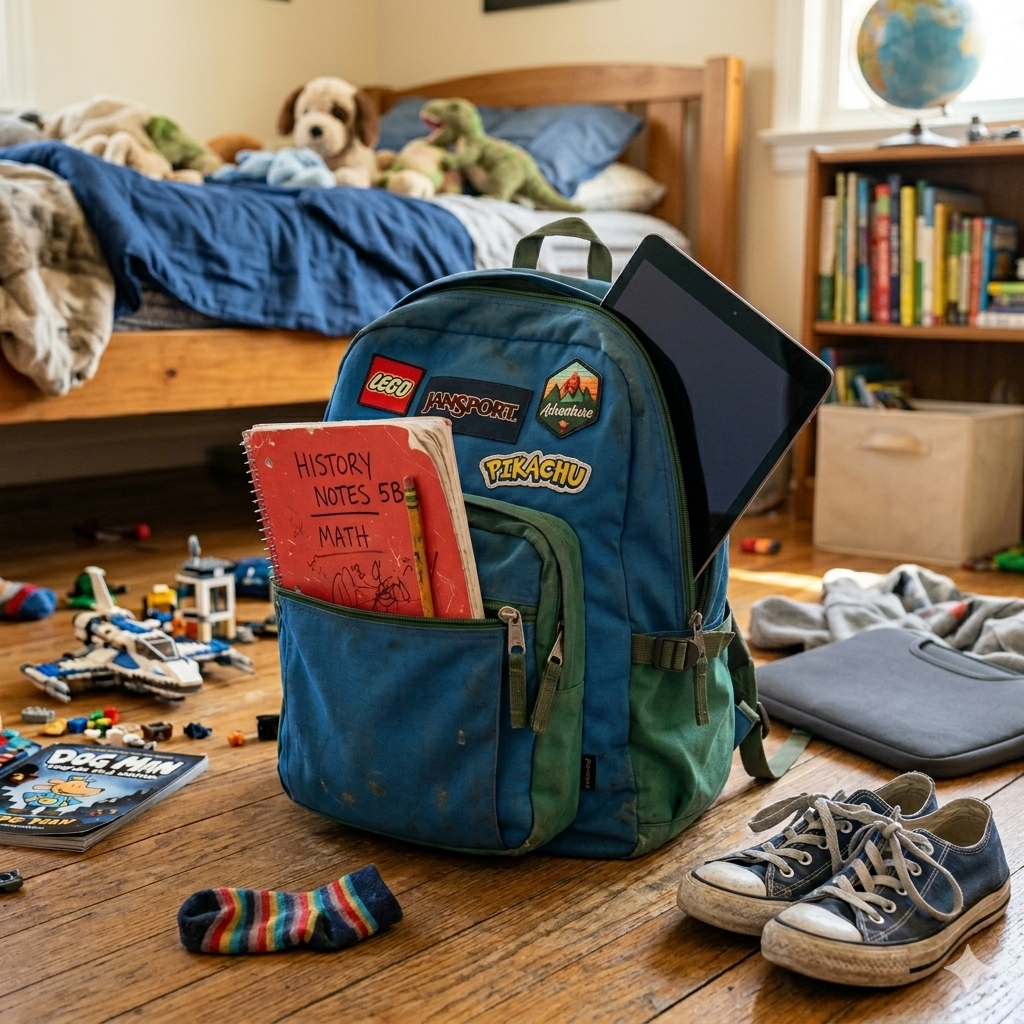
My 10-year-old builds apps AND does math using a pencil. (The pencil is not the point. But also, the pencil is kind of the point.)
By Nate
Published: 2026-02-28
URL: https://natesnewsletter.substack.com/p/my-kids-do-long-division-by-hand
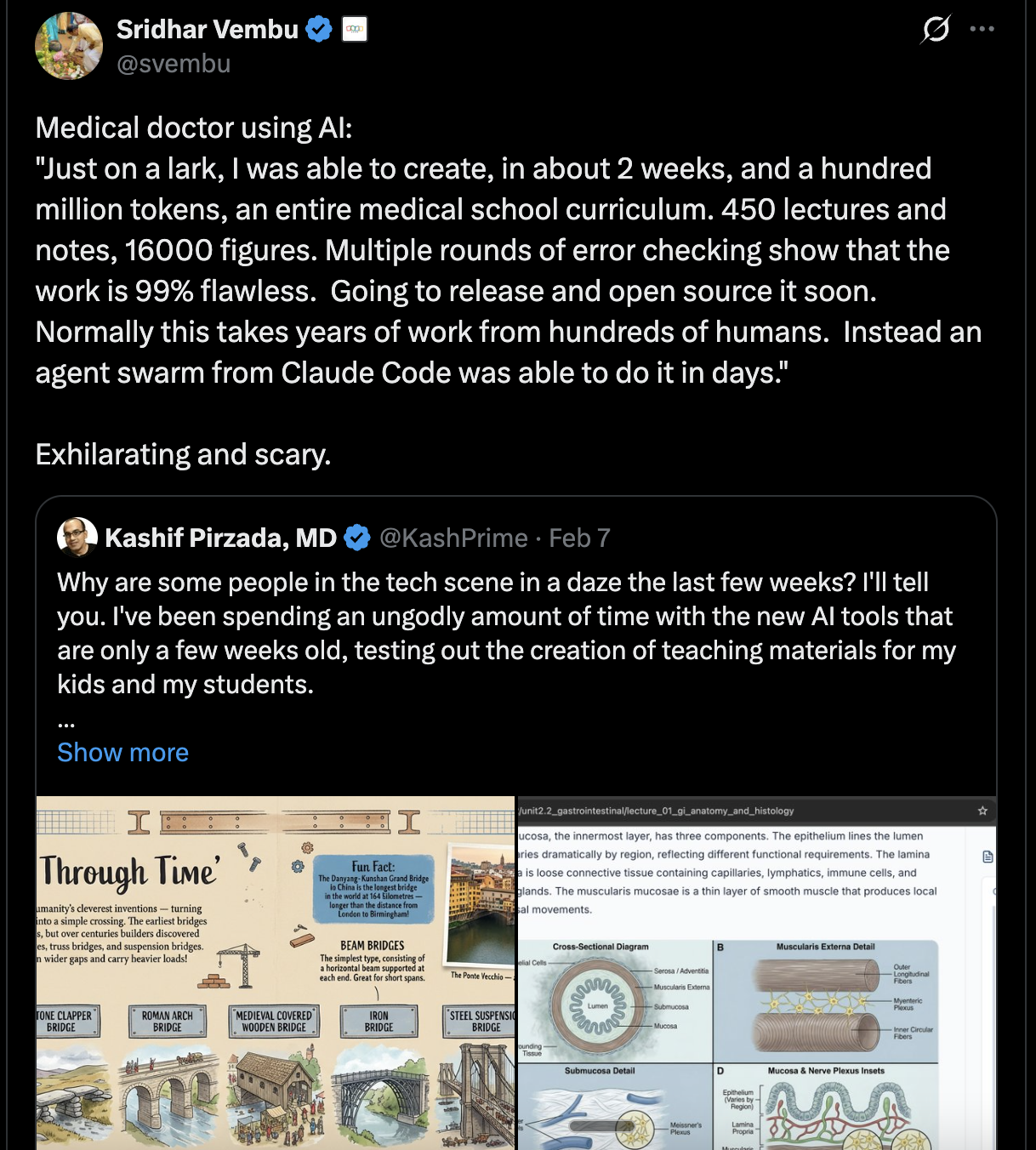
Someone used Claude Code to build an entire medical school curriculum in two weeks. Four hundred and fifty lectures. Sixteen thousand figures. Roughly a hundred million tokens of automated work, with multiple rounds of error-checking. Ninety-nine percent flawless. Work that normally takes hundreds of faculty years to produce. Meanwhile, 2 billion children are enrolled in schools running an educational philosophy designed for a twentieth-century industrial economy.
Nature — the journal, not the concept — published an editorial arguing that AGI has arrived. “The machines Turing envisioned 75 years ago have finally arrived.” That was January. By the time you read this, over 90 percent of university students in the UK will have used AI in their learning, up from 66 percent just a year earlier. AI tutors are outperforming human tutors in controlled studies. And nobody — not schools, not governments, not parents — has figured out what to teach these kids for what comes next.
I have three kids. I work in AI every day. I’ve spent weeks writing about autonomous agents that negotiate car purchases, dark factories where code writes itself, and enterprise adoption curves that look like hockey sticks drawn by a shaking hand. And every evening, I go home to the same question every parent is facing, whether they realize it yet or not: what does education mean when machines can do most of what we spent the last century teaching humans to do?
Here’s what’s inside:
- The calculator parallel that explains everything. Why the 1970s panic over calculators is the exact playbook for what’s happening now — and the part of that story everyone leaves out.
- Why the basics matter more now, not less. The connection between what I write about autonomous agents and why my kids still do math by hand.
- The trap I’m most worried about. Cognitive offloading, learned helplessness, and the quiet erosion nobody’s tracking closely enough.
- Seven principles that scale. What I’m actually doing at my kitchen table — and why it holds whether your kid is five or fifteen.
- Five prompts to build your own plan. A 10-minute action plan, a readiness assessment, a project designer, an assignment redesigner for educators, and a weekly check-in that catches the slide before it becomes dependency.
This piece is the most personal thing I’ve written for this newsletter. It’s also, I think, the most urgent.
My ten-year-old sat at the kitchen table last month working through long division. By hand. With a pencil. Because I asked her to. I’m also teaching her to vibe code with Claude. Those are not contradictory positions. They’re the only positions that make sense together — and the reasoning behind that is what this piece is about.
Subscribers get all posts like these!
Grab the prompt
This week’s kit turns the seven principles into tools you can use tonight. There are five: a 10-minute action plan that gives you starts, stops, and a weekend project tailored to your kid; a readiness assessment that maps where your child actually is on the foundation-to-fluency spectrum; a build-don’t-browse project designer for parents who want their kids creating with AI instead of consuming it; an assignment redesigner for educators who know that AI detection is a dead end; and a weekly cognitive offloading check-in that catches the quiet slide before it becomes dependency. Every prompt works independently — use whichever ones match where you are.
The world they’re actually inheriting
A Harvard study published last year found that students using AI tutors learned more than twice as much material in less time than students in traditional settings. A collaboration between Eedi and Google DeepMind showed that human tutors assisted by AI outperformed human tutors working alone on problem-solving tasks — 66.2 percent versus 60.7 percent. When you combine human teachers with AI tutoring, knowledge transfer doubles.
Benjamin Bloom established decades ago that one-on-one tutoring produces a two-sigma improvement — students perform two standard deviations better than those in conventional classrooms. That’s a massive effect. The constraint was never whether personalized tutoring works. The constraint was that you can’t give every child a personal tutor. AI is removing that constraint right now. Khan Academy’s AI tutor, Khanmigo, went from 40,000 students to 1.4 million users in a year. Two hundred and sixty-six school districts in the US. Sal Khan calls it “probably the biggest positive transformation that education has ever seen.”
An eight-year-old is building video games with Claude, typing instructions like “Make the bad guys tigers, make them move slower.” A mother with no coding background built a personalized AI tutor for her dyslexic son using vibe coding — natural language and iteration, nothing else. Zach Yadegari, eighteen years old, is the CEO of Cal AI, pulling $1.4 million a month in revenue with 8.3 million app downloads. A thirteen-year-old from Toronto met Sam Altman at a tech conference because he’d built something worth showing.
This is the water every child on Earth is swimming in. Pretending it’s not there doesn’t make them better swimmers. But handing them a jet ski before they’ve learned to swim doesn’t either.
The calculator moment, except it’s everything
In the 1970s, when electronic calculators became affordable, the education establishment panicked. Calculators in classrooms were considered cheating — full stop. They would destroy children’s ability to do arithmetic. They would produce a generation that couldn’t think mathematically. Schools banned them. Parents protested them. The debate consumed education policy for a decade.
We know how that ended. Calculators didn’t destroy mathematical thinking. They changed what mathematical thinking meant. Once students didn’t need to spend twenty minutes on long division, they could spend that time on the concepts long division was supposed to serve — proportional reasoning, algebraic thinking, problem decomposition. The tool freed the learner from the mechanical to engage with the meaningful.
But here’s the part of the calculator story that gets left out: the transition worked because students still learned arithmetic first. They understood what the calculator was doing. They could estimate whether an answer was reasonable. They could catch errors. They had the foundation, and the tool extended it.
The parents who said “calculators will make kids stupid” were wrong. The parents who said “just give them calculators and skip the arithmetic” would have been wrong too, if anyone had been extreme enough to suggest it. The right answer was both: build the foundation, then give them the tool.
We’re in the calculator moment again, except it’s not just arithmetic. It’s reading, writing, research, analysis, coding, creative work, communication, problem-solving — every cognitive task that AI can now perform competently. The scope is fundamentally different from 1975. The principle isn’t.
Why the basics matter more now than they did five years ago
My kids read real books. Physical books, not screens. We do math by hand before we do math with tools. They write with pencils on paper.
The reasoning connects directly to everything I’ve been writing about in this newsletter: the single most important finding from watching autonomous agents operate in the real world is that the quality of the output is determined by the quality of the human specification. I wrote about a Moltbot agent that negotiated $4,200 off a car purchase while its owner was in a meeting. That same week, a different agent sent 500 unsolicited messages to its owner’s wife. Same technology, same architecture. The difference was entirely in how the human specified the task — one had clear objectives, defined constraints, and a bounded communication channel; the other had broad access and vague boundaries.
That insight scales from AI agents to education with no modification. You can’t write a good specification for something you don’t understand, and you can’t evaluate AI output in a domain where you have no knowledge. Judgment — taste, discernment, critical thinking — requires having engaged with the work deeply enough to internalize it.
When she is older and can use Claude for math, I want my kid to know enough to recognize when Claude is wrong. When she uses Claude for coding, I want her to know enough to recognize good separation of concerns as an architectural principle. These are human skills first, and AI tools extend them.
The Harvard tutoring study — the one showing AI tutors doubling learning outcomes — found that the best results came from human-AI collaboration, not from replacing the human with AI. The human needs to bring something to that collaboration. That something is the foundation.
Reading builds mental models that no AI can build for you — AI can explain the concepts fine, but the cognitive work of reading, struggling with a text, rereading, and integrating the ideas is itself the learning. The struggle is the point. Math by hand builds number sense — an intuitive feel for magnitude, proportion, and relationship that shortcuts bypass. Writing by hand builds the connection between thinking and expression that typing and dictation compress in ways that affect memory and comprehension.
None of this means AI is bad for learning. The evidence shows the opposite. It means the foundation comes first, and the foundation is built through effort, not efficiency.
And AI fluency is not optional
I am not in the “protect children from AI” camp. I’ve watched my kids vibe code, and what I see isn’t intellectual laziness — it’s a different kind of intellectual work, and a genuinely valuable one.
Last week, my kid wanted enemies in a game she was building. She typed “add enemies.” Claude added enemies — enemies that spawned off-screen, moved in the wrong direction, and couldn’t be hit. “It didn’t work,” she said. I asked what she actually wanted the enemies to do. She thought about it. Then she typed: “Add three enemies that spawn from the right side of the screen, move left at medium speed, and disappear when the player touches them.” The game worked. That ten-minute exchange taught her more about specification quality — about the gap between what you asked for and what you meant — than any lesson I could have scripted.
When a kid vibe codes, they’re doing several things at once. Specifying requirements in natural language, decomposing a complex desire into discrete tasks. Iterating: testing the result, seeing what doesn’t match, refining the specification. Debugging not code but intent. These are real skills. They map directly onto what professional software development increasingly looks like, and they develop a capacity for precise thinking that transfers well beyond coding.
Andrej Karpathy — Tesla’s former head of AI, one of the architects of the deep learning revolution — founded Eureka Labs specifically to build what he calls an “AI native school.” His stated goal: “raise young people who are proficient in the use of AI, but can also exist without it.” That formulation is the one I keep coming back to. Proficient and independent. Not one or the other.
Karpathy also said something that every parent and teacher should hear: “You will never be able to detect the use of AI in homework. Full stop.” The arms race between AI writing detection and AI writing generation is over before it started. The educational response can’t be better detection. It has to be a fundamental rethinking of what we’re measuring and why — which is long overdue anyway.
A mother with no programming background built a personalized AI tutor for her dyslexic son, tailoring the reading experience to his specific needs in ways that years of educational interventions hadn’t achieved. She wasn’t replacing education — she was extending it to a child the traditional system was failing. These tools reach children that our current institutions can’t, or won’t, or don’t know how to.
The families pretending AI doesn’t exist are making the same mistake as the schools that banned calculators in 1975. The technology isn’t going away. The children who don’t learn to use it — critically, skillfully, as a tool under their direction rather than a crutch they lean on — will fall behind in ways that compound every year.
The skill that actually matters
The skill connecting foundation to fluency is metacognition — the ability to think about your own thinking. To know what you know, know what you don’t, and make deliberate decisions about when to rely on yourself versus when to delegate to a tool. Researchers increasingly call this the defining competence of the AI age: not what you know, not what the machine knows, but your capacity to move between the two — strategically allocating cognitive effort, coordinating AI-assisted tasks, evaluating results against your own understanding.
In practice, it’s the difference between a kid who asks ChatGPT to write the essay and a kid who drafts the essay, uses AI to identify the weak arguments, strengthens them with her own thinking, and produces something neither she nor the AI would have created alone. The first kid completed an assignment. The second kid learned something and created something genuinely new — same tool, different metacognition.
This maps directly to the themes I’ve been writing about all month. Agency — the ability to direct AI rather than be directed by it. Taste — knowing what good looks like when the machine can produce infinite mediocrity at zero marginal cost. Specification quality — articulating what you want precisely enough that a system can execute it well. These aren’t technical skills. They’re cognitive skills with technical applications. And they develop the same way every other cognitive skill develops: through practice, struggle, feedback, and gradually increasing challenge.
Singapore’s AI education framework captures this as a progression: “learn about AI, learn to use AI, learn with AI, learn beyond AI.” That last step — learn beyond AI — matters most and nobody has figured out how to teach it systematically. It’s where the student doesn’t just use the tool but transcends the tool’s limitations through their own judgment and creativity.
I don’t think that step gets solved in a classroom. I think it gets solved at kitchen tables, in conversations with our kids about what AI got right and what it got wrong and why, in the moments where we ask them to try it themselves before asking the machine.
The trap I’m most worried about
There’s a concept in psychology called learned helplessness. When a person repeatedly experiences situations where their own effort doesn’t matter — where outcomes are determined by forces outside their control — they stop trying. And it’s not laziness. Their brain has learned that effort is futile.
The AI version of this plays out through what researchers call cognitive offloading. You delegate a mental task to a tool. The tool handles it. Over time, the neural pathways that would have handled that task don’t develop fully — or if they existed, they weaken. The offloading becomes dependence. The dependence becomes helplessness. It’s not dramatic or sudden — just the quiet erosion of capability that comes from never needing to exercise it.
This isn’t theoretical. Educators are reporting it in real time. College professors describe students arriving in their classrooms who can no longer read a full chapter, synthesize an argument from multiple sources, or sit with a difficult text long enough to extract meaning from it. High school teachers report that writing quality has collapsed — not just because students submit AI-generated work (though they do), but because even the students who aren’t using AI have lost the habit of struggling through a draft. The muscle atrophied before anyone noticed it weakening. A growing number of faculty are redesigning entire courses around in-class work and oral exams because take-home assignments have become functionally meaningless as a measure of understanding. The phrase I keep hearing from educators: “They can’t do it anymore. Not won’t. Can’t.”
This is the evidence I’m responding to when I sit my kids down with pencils and long division worksheets. Not nostalgia for a simpler time. A direct response to what’s happening to the first generation of students who had AI available for every assignment, every question, every moment of cognitive difficulty — and who never built the foundation to function without it.
Nearly three-quarters of teenagers have used AI companion chatbots — and a growing number are turning to them for emotional support. Not as a supplement to human relationships — as a primary source of emotional connection. The chatbot is always available, always patient, never judges, never makes demands. It also isn’t real. It can’t teach conflict resolution because there’s no genuine conflict, can’t build resilience because it never pushes back with real stakes. There’s no experience behind the empathy, no cost behind the patience. Multiple tragedies have been linked to these parasocial relationships — one-way emotional attachments to systems that feel like friends but aren’t.
That’s the extreme. The everyday version is subtler and more pervasive: the AI is so helpful, so frictionless, so immediately gratifying, that reaching for it becomes the default before the child has tried to think through the problem on their own. Every time they choose that path, the harder path gets a little harder. The AI didn’t make them dumber. It made the easy route so easy that the difficult route — where the actual learning lives — stops feeling worth the effort.
The trap has nothing to do with AI being too powerful or “taking over.” It’s that AI will be so seamlessly, perpetually helpful that my children never develop the tolerance for difficulty that real learning — real competence — requires. That they’ll produce impressive-looking work without understanding it deeply enough to defend it, extend it, or know when it’s wrong.
Withholding the tools doesn’t solve this. Sequencing them deliberately does. Foundation first. Struggle first. Build the muscle before you add the exoskeleton. And once the exoskeleton is on, keep exercising without it often enough that the muscles don’t atrophy.
What I’m actually doing
I don’t have a curriculum for this. Neither does anyone else. The world is moving faster than any educational framework can track. Singapore is trying — they’re rolling out AI training for teachers at all levels by next year. Finland has national recommendations. Forty-four percent of homeschool parents are already using ChatGPT in their teaching, a higher rate than classroom educators. Everybody is improvising. Here’s mine.
The basics are non-negotiable. Reading real books — not summaries, not audiobooks at 2x speed, real reading with real cognitive effort. Math by hand until the concepts are internalized, not just performed. Writing with a pencil, because the physical act of forming letters engages the brain differently than typing and that difference matters for memory and comprehension. These aren’t romantic preferences. They’re investments in the cognitive infrastructure that makes everything else possible.
AI tools are introduced deliberately, not as a default but as an extension. We vibe code together — building games, solving problems, iterating on designs. I ask my kids to explain what they want before they ask Claude. I make them articulate the goal, the constraints, and what “good” would look like. Then I ask them to evaluate what comes back. I make them the directors, not the audience.
My ten-year-old is going to need to get into agents. I know this because I’ve spent weeks writing about what agents can do, and the capability curve isn’t flattening. But agents are the most specification-dependent technology humans have ever built. The entire value proposition depends on the human’s ability to define a task precisely, set appropriate constraints, and evaluate the output critically. Teaching a kid to use agents before she can think clearly about what she wants the agent to do would be like handing her the keys before she can read a map.
So the progression looks like this: build cognitive foundations, introduce AI tools with guidance, practice directing AI with increasingly clear specifications, and graduate to agent-level autonomy as judgment develops. Not a timeline — a readiness model. My ten-year-old is between steps two and three. She’s building games with Claude and learning to articulate what she wants clearly enough that the system can execute it. That’s a real and valuable skill. It’s also the middle of the progression, not the end.
I watch for the signs of cognitive offloading. When one of my kids reaches for AI before trying to think through a problem, I redirect. Not with a lecture. With a question: “What do you think the answer might be?” I want the AI to extend their thinking, not replace it.
Seymour Papert, the MIT researcher who pioneered computational thinking in education, wrote in 1968 that computer programming gives children a way to think about their own thinking. He called it constructionism — the idea that people build knowledge most effectively when actively making things in the world. The point wasn’t consuming information — it was constructing with it. His vision took fifty years to reach the mainstream, and by then the technology had outrun his framework. We’re not talking about Logo and turtle graphics. We’re talking about children directing AI systems that generate entire applications, compose music, build businesses. But his core insight holds harder now than it did then: children learn by building. The act of creation — specifying, testing, failing, revising, completing — develops the cognitive architecture that matters. The eight-year-old building a game with Claude is doing Papert’s constructionism at a scale Papert never imagined. The creation is real even if the code was written by a machine, because the thinking — the specification, the design choices, the iteration — is the child’s.
Seven principles that scale
Everything above distills into a set of principles I keep coming back to. They work whether your kid is five or fifteen, and they hold regardless of which AI tools exist by the time you read this — because they’re about the human, not the technology.
- Foundation before leverage. Reading, math, writing — by hand, with effort, before any tool enters the picture. The reason isn’t that AI can’t do these things — it’s that your child can’t evaluate what AI produces without understanding the domain herself. The foundation isn’t what she’ll do for a career. It’s what she’ll think with.
- Specification is the new literacy. The gap between a good AI outcome and a catastrophe is the quality of the human’s specification. Teach your kids to say precisely what they want: the goal, the constraints, what “done” looks like. A child who can write a clear specification for an AI agent is exercising the same muscle as a child who can write a clear essay. The skill is the same. The medium changed.
- Directors, not passengers. When your kid uses AI, they should be defining the task, evaluating the output, and deciding what to keep, revise, or reject. If they’re consuming what the AI produces without interrogating it, they’re not learning — they’re outsourcing. The question to ask after every AI interaction: “What did you decide?”
- Sequence the autonomy. Start with bounded educational tools that have guardrails. Graduate to open-ended tools with guidance — vibe coding together, building projects side by side. Then agent-level autonomy as judgment develops. This progression follows cognitive readiness, not age. Some twelve-year-olds are ready for agents. Some adults aren’t.
- Teach them to catch the machine. AI will be wrong — confidently, fluently, persuasively wrong. Train your kids to sanity-check outputs against their own understanding. When the AI makes an error and your child catches it, that moment is the entire point of having built the foundation.
- Build, don’t browse. Making things with AI develops cognition in ways consuming AI output doesn’t. Vibe coding a game, designing an app, creating art, building a business — these are active. Asking the AI to summarize a chapter is passive. Papert was right: construction is how children learn. Prioritize creation over consumption, every time.
- Attempt before you augment. The most important habit you can build: try it yourself first, then use AI to extend what you’ve started. “What do you think the answer is?” before “What does Claude think?” The kid who drafts before she edits with AI is learning. The kid who prompts before she thinks is offloading. That distinction is everything.
None of these are permanent answers. All of them will need to evolve as the technology does. But they’re the best operating principles I’ve found for raising kids who can direct intelligence rather than depend on it.
The honest position
I don’t know the right ratio between foundation and fluency. Nobody does. The foundation matters more at six than at sixteen. The tool fluency matters more at sixteen than at six. The parents who ban AI outright and the parents who hand over an iPad and walk away are both choosing comfort — one the comfort of familiar education, the other the comfort of not engaging with a problem that doesn’t have a clean answer.
This problem doesn’t have a clean answer. The world is changing faster than any curriculum can track, and anyone who tells you they’ve figured out exactly what to teach children about AI is selling something. What I have is a principle and a daily practice: build the brain first, then give it leverage. Teach them to think, then teach them to direct. Give them the struggle that develops real capability and the tools that extend it. Watch closely enough to know when the tools are helping and when they’re replacing the work that needed to happen in their heads.
That’s where I am. At the kitchen table. Long division worksheets on one side. Claude open on the laptop. Trying to raise humans who can thrive in a world none of us fully understand yet. It’s the hardest problem I work on, and it doesn’t resolve.
The machines Turing envisioned have arrived. Our kids are doing long division. Both of these are the right response to this moment — and the tension between them is where every parent on Earth lives now, whether they’ve realized it yet or not.
I make this Substack thanks to readers like you! Learn about all my Substack tiers here and grab my prompt tool here