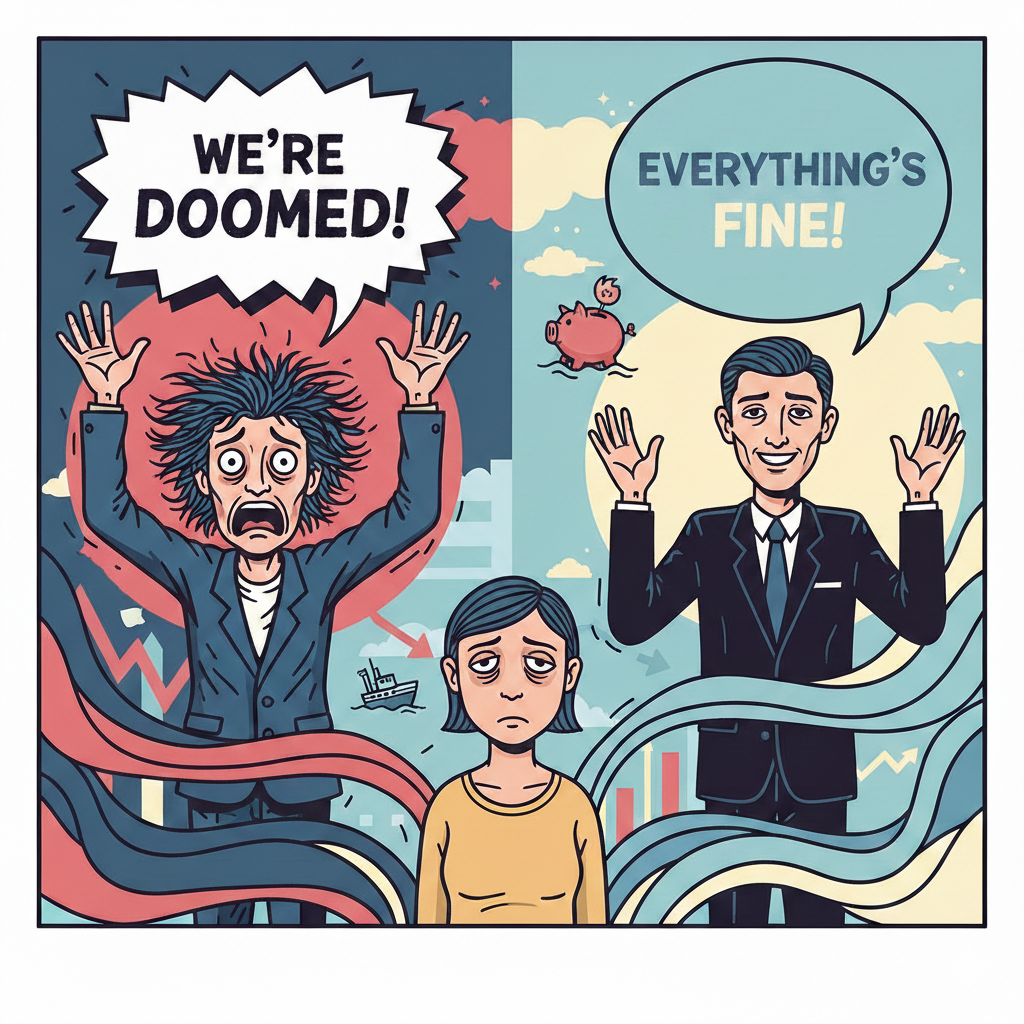
Well, the stock market continues to do interesting stuff. The bear case, the bull case, and the force that makes both wrong.
By Nate
Published: 2026-02-26
URL: https://natesnewsletter.substack.com/p/a-fictional-recession-just-crashed
A fictional memo from 2028 just wiped over $200 billion in real market cap. IBM had its worst day in 25 years because Anthropic wrote a blog post about COBOL. And the doom narrative driving all of it is probably wrong — not about the technology, but about the economics.
This piece steelmans both the bear and bull cases, walks through the formal academic math on whether AI can actually cause economic contraction, and introduces a framework you haven’t seen elsewhere: the Capability-Dissipation Gap — the widening distance between what AI can technically do and what the economy has actually reorganized around AI doing. That gap explains why the market is incoherent, why both doom and boom timelines are wrong, and why the economic rewards for early adopters are larger and more persistent than anyone is currently pricing.
The companion prompt kit operationalizes everything in this post. Use it to audit where you personally sit on the capability-dissipation curve, stress-test the AI narratives crashing your sector, build a Lütke-style eval framework for your domain, and generate the credible briefing that makes you the most valuable person in a room full of panicking executives.
Here’s what’s inside:
- The doom meme, at its strongest. Why the Citrini scenario is internally consistent, emotionally resonant, and probably too extreme to hold — and what the formal economic math actually says about the conditions required for AI to cause contraction.
- The bull case with purchasing power math. The mechanism neither side is discussing: when AI compresses service costs 40–70% and services are 70% of spending, a household earning less can afford more. Real numbers on what this means for median households.
- The market’s incoherent bet. Why Wall Street is simultaneously pricing AI as too weak to justify infrastructure spending and too strong for any incumbent to survive — and why the organizational damage from that paradox is already self-reinforcing.
- The four forms of societal inertia. Regulatory, organizational, cultural, and trust drag that neither narrative accounts for — and why this force changes every timeline, doom and boom alike.
- The capability-dissipation gap. A framework for the widening distance between what AI can technically do and what the economy has actually reorganized around AI doing — and why the people operating at the frontier are capturing outsized, persistent returns.
- Five prompts to operationalize all of it. A personal gap audit, a narrative stress test, a domain-specific eval builder, an executive briefing generator, and a 10-minute quick version.
I’m going to make the best case for both sides, walk through the math, and explain why the force nobody is modeling changes everything about the timeline.
Subscribers get all posts like these!
LINK: Grab the prompts
The failure mode I keep seeing is smart people making career and investment decisions based on whichever AI narrative went viral that week. A fictional memo crashes the stock market and suddenly everyone’s a macro bear. A purchasing power thread gets traction and suddenly everything’s fine. Neither reaction survives contact with the actual economic models — but most people have never read the economic models, so the memes win by default. These prompts exist because I built them for myself first. The Personal Gap Audit forces you to score your own position across four dimensions instead of guessing. The Narrative Stress Test runs any doom-or-boom headline against the conditions required for it to actually play out — the same conditions Imas formalized and Citrini’s scenario depends on. The Eval Framework Builder gives you a Lütke-style test harness calibrated to your domain, so every model release immediately reveals what’s newly possible in your actual work. And the Briefing Generator turns your tested knowledge into the executive presentation your organization needs from someone who’s done more than read a Twitter thread.
The bigger story behind the panic
A Substack post written as speculative fiction from 2028 wiped over $200 billion in market cap on Monday. IBM fell 13.2% — its worst single-day drop since October 2000 — because Anthropic published a blog post about COBOL. Michael Burry shared the Citrini piece and commented, “And you think I’m bearish.” This is the latest in a string of AI-triggered sector selloffs. The iShares Expanded Tech-Software Sector ETF (IGV) is down roughly 27% year-to-date, on pace for its worst quarter since the 2022 bear market. Wedbush is calling the whole pattern the “AI Ghost Trade.”
You’ve seen me cover the individual selloffs. This piece is different. Because the doom narrative driving all of them is probably wrong — not about the technology, but about the economics.
The formal academic work modeling whether AI can actually cause economic contraction has been done. The math is public. The conditions required for the nightmare scenario are so extreme that they read like a thought experiment, not a forecast. Meanwhile, the most compelling version of the bull case — not the hand-wavy “technology always creates more jobs” version, but the one with actual purchasing power math and historical deflation data — is getting approximately zero airtime. And the force I think matters most — societal inertia, the massive drag between “AI can do this” and “the economy has reorganized around AI doing this” — isn’t in anyone’s model at all.
That force changes everything. It means the doom timeline is wrong. It means the boom timeline is wrong. And it means the economic rewards for people who adopt AI aggressively right now are higher and more persistent than anyone is pricing.
I’m going to steelman both sides, walk through the math, explain why both narratives are wrong about the same thing, and propose a framework I haven’t seen anywhere else — one with specific implications for your career and your investments.
The doom meme and why it hits so hard
Let me steelman the bear case properly, because it deserves it.
Citrini Research and Alap Shah wrote a piece called “The 2028 Global Intelligence Crisis” — framed as a fictional macro memo from two years in the future. The scenario: AI capabilities keep compounding. Companies rationally cut white-collar headcount to protect margins. Displaced workers spend less. The consumption hit cascades through mortgages, private credit, and ultimately the financial system. The S&P drops 38% from its October 2026 highs. Unemployment hits 10.2%.
The mechanism they describe is internally consistent and well-constructed. White-collar workers make up roughly 50% of U.S. employment and drive an estimated 75% of discretionary consumer spending. The top 20% of earners account for about 65% of all consumer spending. These are the people who buy the houses, the cars, the vacations, the private school tuition. If AI structurally impairs their earning power, the consumption math gets ugly fast. A 2% decline in white-collar employment could translate to a 3–4% hit to discretionary spending.
They identify a feedback loop they call the “intelligence displacement spiral.” AI gets better. Companies cut payroll. Savings go into more AI. AI gets better. Companies cut more payroll. The displaced workers don’t come back because AI is improving at the exact tasks they would redeploy to. There is no natural brake.
The financial contagion chain is plausible, too. Private credit has grown from under $1 trillion a decade ago to over $3 trillion by 2025 — according to Morgan Stanley and the Alternative Credit Council — and a meaningful slice of that capital went into leveraged buyouts of SaaS companies at valuations that assumed perpetual revenue growth. Those assumptions are dying in real time. Zendesk, in the scenario, becomes the poster child — a $10.2 billion LBO whose debt was underwritten against annual recurring revenue that stopped recurring when AI agents replaced the customer service workflows Zendesk existed to manage. The chain runs from software defaults to insurance-linked balance sheets — specifically, the life insurers that alternative asset managers acquired and turned into funding vehicles for the very private credit now defaulting — to the $13 trillion residential mortgage market.
And the most haunting line in the piece: “In 2008, the loans were bad on day one. In 2028, the loans were good on day one. The world just... changed after the loans were written.”
As Alap Shah put it in a follow-up interview: “What is the thing that drives our entire economy? It’s wages. Most of those wages that are ultimately driving all the discretionary spending are coming from the white-collar worker. The problem is we made all these assumptions on loaning money to all these companies. Two mortgages, everything else. If you all of a sudden just take a leg out of that economy, it has a contagion effect. Basically, every asset in the world.”
I get why this went viral. I get why Burry shared it. I get why the markets convulsed. The scenario is vivid, well-argued, and emotionally resonant. It activates the same dread that made “The Big Short” a cultural touchstone — the feeling that the system is fragile, that nobody in charge sees what’s coming, and that the smart money is already heading for the exits.
But doom narratives are dramatically more viral than nuanced analyses, and there is a well-documented reason for this that has nothing to do with whether they’re correct. Negativity bias is one of the most robust findings in behavioral psychology. Humans are evolutionarily wired to pay disproportionate attention to threats. A headline that says “AI Could Crash the Economy” generates ten to fifty times the engagement of a headline that says “AI-Driven Deflation Could Raise Real Purchasing Power for the Median Household.” Both headlines describe plausible futures. One of them gets millions of views on X in a day and crashes the stock market. The other gets ignored.
This asymmetry matters because it distorts the information environment people use to make career and investment decisions. The doom narrative is not wrong because it went viral. But the fact that it went viral while the countervailing evidence barely registers should make you suspicious about whether you’re getting the full picture.
You’re not.
The economic model nobody is sharing
Alex Imas is an economist at the University of Chicago Booth School of Business. He read the same intuitive arguments about AI-driven demand collapse that Citrini formalized as fiction, and he did what economists are supposed to do: he built a model and solved it.
His question was precise. Under what conditions does AI automation actually cause GDP to shrink — not slow down, not disappoint expectations, but turn negative?
The answer was instructive. You need several conditions to hold simultaneously. Labor share has to collapse almost entirely, not just decline — we’re talking about a drop from roughly 60% to under 5% in the numerical example that produces contraction. Preferences have to be satiated, meaning that when prices fall, people don’t actually buy more stuff. The wealthy capital owners who capture the gains from automation have to have a dramatically lower propensity to consume than workers. Investment has to be unable to absorb the excess savings, meaning interest rates hit a floor and can’t drop further. And there has to be essentially no policy response — no sovereign wealth fund, no fiscal transfers, no institutional adaptation whatsoever.
Each condition on its own is at least theoretically defensible. Full automation displacing most labor is the premise of the thought experiment. Satiated preferences have precedent — the price of artificial lighting fell 40,000x between 1800 and 1990, and we didn’t consume 40,000 times more light. Heterogeneous consumption propensities across income levels are empirically well-established. Interest rate floors are a real phenomenon — the secular stagnation literature has been talking about this for a decade.
But the probability of all these conditions holding simultaneously, in the real world, with functioning democratic institutions and a political system that reacts to mass unemployment with the self-preserving panic of elected officials facing re-election? Imas’s own conclusion: “My view is that this model captures a real force that will moderate AGI growth expectations, but the specific conditions for negative growth represent an extreme case that policy and behavioral adjustment would prevent.”
He also examined a second pathway to contraction — what economists Seth Benzell and colleagues call “immiserating growth” — where automation doesn’t crash demand directly but instead erodes savings rates across generations, slowly depleting the capital stock even as technology improves. The mechanism is subtler: AI shifts income from patient young savers to impatient older consumers, savings drop, capital investment shrinks, and the economy gradually contracts despite improving technology. But even here, the simulations show the effect is highly sensitive to savings rates and requires an extended period without policy adaptation.
Read the conclusion again. An economist with the technical chops to actually formalize the doom scenario tells you, after working through the math, that the conditions for true economic contraction are probably too extreme to hold in practice. But — and this is the critical nuance — the underlying forces are real and will likely push growth toward the lower end of forecasts. The story isn’t “everything is fine.” The story is “the economy probably doesn’t break, but the transition is genuinely painful, and the gains may be unevenly distributed in ways that matter enormously for your life.”
That conclusion is far less shareable than a 38% market crash written in the present tense from the future. So nobody shares it.
The bull case with actual numbers
Michael Bloch wrote a direct response to the Citrini piece — same format, same fictional 2028 framing, but modeling the opposite outcome. It deserves more attention than it’s getting, because unlike the generic “technology always creates jobs” hand-wave, Bloch’s argument hinges on a specific economic mechanism that has a two-hundred-year track record.
The mechanism is purchasing power. Not wages. Purchasing power.
The bear case assumes that when white-collar wages fall, consumption falls. Bloch’s counter: consumption is a function of both wages and prices. If AI compresses the cost of services by 40–70% — and services are 70% of consumer spending — then a household whose nominal income drops 10% but whose non-housing expenses drop 20% is actually better off. Their real purchasing power increased. They can afford more with less.
This distinction turned out to be the entire ballgame in Bloch’s scenario.
He runs the numbers. The average American household spends roughly $8,000–$12,000 per year on services whose primary value proposition is navigating complexity on the consumer’s behalf — tax preparation, insurance brokerage, travel booking, financial advice, real estate commissions, subscription fees for products with cheaper alternatives. AI agents compressing these costs by 40–70% delivers a $4,000–$7,000 annual gain per median household. Tax-free, requiring no legislation, and compounding as agents improve.
The real estate example is instructive. The bears flagged the compression of buy-side commissions from 2.5–3% to under 1% as evidence of economic destruction. But the median home price in 2027 in Bloch’s scenario was $420,000. A 2-point commission reduction saves the buyer $8,400. Multiply that across 5 million annual home transactions, and that’s $42 billion per year flowing to homebuyers instead of to intermediaries. Those homebuyers spend the money on furniture, renovations, moving costs. The economic activity didn’t disappear. It was redirected from rent-extractors to the people doing the actual work and the people actually buying the homes.
The same math holds for DoorDash. When the take rate collapsed, restaurants kept more revenue and consumers paid lower fees. Delivery drivers, liberated from the duopoly’s 40% rake, earned more per delivery on fragmented platforms competing for their labor. The Citrini piece characterized this as destruction. Bloch characterized it as a transfer from rent-extractors to producers and consumers. Both descriptions are technically correct. Only one of them gets shared on X.
And then there’s the labor market data that nobody in the doom camp is discussing. The Census Bureau reported 532,319 new business applications in January 2026 alone — up 7.2% from December. This continues a trend that’s been accelerating since 2021, when the U.S. set a record with 5.5 million new business applications. The applications keep climbing. Every single month.
In Bloch’s 2028 scenario, new business formation hits 7.2 million applications annually, shattering all records, driven by displaced professionals who now have the skills, the tools, and radically lower overhead to build something on their own. He tells the same story Citrini tells about a displaced Salesforce product manager — but instead of driving for Uber at $45,000, she spends three weeks building a niche AI-powered compliance tool for small healthcare practices, a market her former employer would never have served because the deal sizes were too small to justify the sales team. Two hundred paying customers within four months. Revenue exceeding her former salary within eight.
Was she an exception? In 2025, yes. But the cost of launching a business — software, legal, accounting, marketing, design — has fallen by 70–80% in eighteen months. The “minimum viable ambition” has dropped to nearly zero. You don’t need funding, a team, or an office. You need a laptop, a credit card for inference costs, and a problem you understand.
The historical pattern Bloch points to is unambiguous: technology-driven deflation has coincided with more economic activity, not less, every single time it has been tested over two centuries. The falling price of automobiles, televisions, air travel, computing, mobile phones. Each instance triggered predictions of economic destruction. Each instance delivered broader prosperity. The bears have been making the same argument since the Luddites, and they have been wrong every time — not because their mechanism was wrong, but because they systematically underestimated how humans and markets adapt to cheaper inputs.
The bears will respond: “This time is different because AI is a general intelligence that improves at the very tasks humans would redeploy to.” That’s a real argument, and I take it seriously. But it depends on the speed of displacement outrunning the speed of adaptation. And that brings me to what I think is the single most underrepresented force in this entire conversation.
Two beliefs that can’t both be true
Before I get to societal inertia, let’s talk about what the stock market is actually doing, because it’s important and it’s insane.
Bank of America’s senior analyst Vivek Arya spotted the contradiction nobody else has named. The market is currently holding two beliefs simultaneously. Belief one: AI infrastructure spending is unsustainable and the return on investment is weak — which is why chipmakers and hyperscalers are under pressure. Belief two: AI adoption will be so pervasive and so productive that it will destroy established business models across every industry it touches — which is why SaaS companies, insurance brokers, wealth managers, cybersecurity firms, logistics companies, and now mainframe businesses are getting crushed.
Both beliefs cannot be true at the same time. If AI capex is deteriorating because the technology isn’t delivering real value, then the disruption fears are overblown and the incumbents are fine. If AI adoption is so powerful that it can obsolete entire sectors, then the infrastructure spending is justified and the capex concerns are overblown. The market is pricing in a world where AI is simultaneously too weak to generate returns on investment and too strong for any existing business to survive.
Arya called it “internally inconsistent.” I’d call it incoherent. Wedbush calls the whole phenomenon the “AI Ghost Trade” and says the selloffs “will prove to be the wrong reaction in the long-term for clear winners.” Goldman Sachs CEO David Solomon said the selloff was “too broad.” JPMorgan strategists see potential for a software rebound based on an “overly bearish outlook on AI disruption and solid fundamentals.” Barclays called the logistics reaction “disproportionate to the risk.”
But here is the part that the Wall Street notes don’t say, and it’s the part that actually matters: the paradox doesn’t need to resolve for it to do real damage. Markets don’t wait for logical consistency before they reprice risk.
The market is pricing AI implications exclusively on the sell-side. Every announcement gets parsed for who loses. Anthropic publishes a blog post about COBOL — the market immediately asks “which company dies?” and IBM drops 13%. Nobody asks the buy-side question: what happens when the companies that spend billions on legacy modernization suddenly get the same work done at a fraction of the cost? What do they do with the savings? Do they hire? Invest? Expand into new markets? Nobody is pricing that, because it’s a slower, more diffuse, less headline-friendly process.
This is why a former karaoke company with $6 million in market cap can wipe $23 billion from global logistics. The sell-side story is vivid: “AI replaces freight brokers.” The buy-side story is complex: “Companies that ship things save money on brokerage, reinvest in growth, and the overall economy benefits from more efficient logistics.” The first story fits in a tweet. The second requires a paragraph. The market trades on tweets.
And the organizational damage is real and self-reinforcing. When a company’s stock drops 15% on AI fears, the technology didn’t change overnight. But the organizational response did. That’s a board meeting next week. A hiring freeze next month. A roadmap torn up and rewritten around “AI strategy” whether or not the company has a coherent one. The stock drop doesn’t just reflect reality. It creates reality. The correction — if it comes — won’t undo the hiring freeze, the roadmap pivot, or the performative AI partnerships. The market can recover in a week. The strategic damage takes years.
The force that changes every timeline
Now here’s what I think both the doom camp and the boom camp are getting wrong, and it’s the thing I’ve been thinking about more than anything else in the past month.
Both narratives assume that AI capabilities translate rapidly into economic impact. The doom narrative assumes rapid displacement. The boom narrative assumes rapid adaptation. Both assume the conversion rate from “AI can technically do this” to “the economy has reorganized around AI doing this” is high and fast.
It isn’t. And the reason it isn’t is the most underrepresented force in this entire conversation.
There’s a long chain between capability and economic impact, and every link — deployment, adoption, integration — introduces its own friction and delay.
Societal inertia is a massive force, and it is dramatically underrepresented in every analysis I’ve read — bear and bull. Here’s what I mean, concretely.
Regulatory inertia. Financial services firms that want to use AI for compliance work need approval from regulators who haven’t finished writing the rules. Healthcare organizations need to navigate HIPAA, FDA clearance, and institutional review boards. Government agencies run procurement cycles measured in years, not quarters. The COBOL systems that Anthropic is talking about modernizing run an estimated 95% of ATM transactions in the United States, according to Anthropic’s own blog post — the one that crashed IBM’s stock. Hundreds of billions of lines of the language run in production every day, the company wrote, powering critical systems across finance, airlines, and government. Nobody — nobody — is migrating those to a new codebase because a startup published a blog post. IBM’s own CEO, Arvind Krishna, said last year that their mainframe AI coding assistant “has got very wide adoption” — for understanding existing COBOL codebases and deciding what to modernize. Not for replacing them. For understanding them. The distinction matters. IBM’s stock dropping 13% doesn’t change the fact that its clients’ switching costs are measured in years of institutional pain, not API calls.
Organizational inertia. The Citrini scenario assumes companies cut headcount rationally and rapidly as AI capabilities improve. In practice, large organizations don’t work that way. Headcount decisions are filtered through HR policies, employment law, union agreements, severance obligations, institutional knowledge preservation, management politics, and the simple fact that most executives have never managed an AI transition and don’t know what they don’t know. The gap between “Claude can technically do parts of this job” and “we have reorganized our workflows, retrained our remaining staff, built quality assurance processes for AI output, and confidently reduced headcount” is enormous. I’ve seen this firsthand with Fortune 500 clients. The conversations about AI strategy take six months. The pilot programs take another six. The actual workflow integration takes a year. And these are companies that are actively trying to move fast.
Cultural inertia. Most people still don’t use AI in their daily work. The adoption curves are real, but they’re far slower than the capability curves. When Tobi Lütke — one of the most technically fluent CEOs in the world, running a company whose entire business is technology — has to issue a company-wide mandate in April 2025 saying “reflexive AI usage is now a baseline expectation at Shopify” and build it into performance reviews, that tells you something important about how slowly even high-performing organizations change behavior. Lütke was explicit about this on the Acquired podcast: “Using AI well is a skill that needs to be carefully learned by using it a lot.” He maintains what he calls a “Tobi Eval” — a personal folder of prompts he runs against every new model release, systematically probing capabilities like a QA engineer running unit tests. He says the core competency for using AI well is what he calls “context engineering” — the ability to state a problem with enough surrounding information that the task is plausibly solvable without the model needing to go fetch additional context. That skill, he says, has made him better at everything else too — better emails, better specs, even better at diagnosing company politics, which he attributes to “buried disagreements on assumptions that nobody surfaced.”
If that’s what it takes for the CEO of Shopify to maintain his edge — personal eval frameworks, systematic model testing against every release, a 15-year personal archive he mines with AI — imagine the adoption curve for a regional insurance brokerage. A mid-market manufacturing firm. A state government procurement office. The capability frontier is racing ahead. Most of the economy hasn’t left the starting line.
Trust inertia. Enterprises don’t trust AI output by default, and they shouldn’t. When I advise Fortune 500 companies on AI integration, the recurring bottleneck is not capability but verification. The model can generate a contract analysis, a financial forecast, a compliance review. The question is always: who checks the output? How do we know it’s right? What’s our liability if it’s wrong? These are not irrational concerns. They’re the concerns of organizations managing billions of dollars of risk. And building the institutional trust to deploy AI at scale — with appropriate guardrails, audit trails, and human oversight — takes time that no benchmark improvement can compress.
These four forces don’t mean AI won’t transform the economy. They mean it won’t transform the economy on the timeline the stock market is pricing, in either direction. The doom scenario requires a speed of labor displacement that societal inertia simply won’t permit. The boom scenario requires a speed of adoption and integration that organizational reality won’t permit. What actually happens is slower than both, messier than both, and far more unevenly distributed than either narrative allows.
The capability-dissipation gap
Here’s how I think about it. Imagine two curves on the same chart.
The first curve is AI capability — model intelligence, reasoning depth, agentic endurance, cost efficiency. This curve is steep and accelerating. Gemini doubled its reasoning score in three months. Costs are falling by an order of magnitude per year. Anthropic ships a new capability — COBOL modernization, code security scanning, legal workflow plugins — every week. The capability frontier is moving at a pace that surprises even the researchers building it.
The second curve is societal dissipation — the rate at which those capabilities actually permeate the economy and change how work gets done, how money flows, how institutions operate. This curve is much flatter. It’s governed by the inertia forces I just described: regulatory, organizational, cultural, and trust. It compounds over time, but it compounds from a low base, and the compounding rate is limited by fundamentally human constraints — learning curves, institutional decision-making, political processes, risk tolerance.
The gap between those two curves is where we live right now. And it’s the gap that explains almost everything that seems confusing about the current moment.
It explains why AI capabilities are stunning and economic disruption is still modest — and why the stock market is confused, pricing capabilities on one hand and actual earnings impact on the other, getting whipsawed between the two because the gap makes it impossible to calibrate the timeline. The doom narrative and the boom narrative both sound compelling and both feel premature for the same reason. A blog post can crash a stock and a trillion-dollar industry can keep humming along the next day as if nothing happened.
And most importantly, it creates a specific and very large economic opportunity.
The opportunity exists precisely because the gap is wide. If AI capabilities were immediately and uniformly deployed, there would be no advantage to early adoption — everyone would adopt simultaneously and the competitive benefits would be zero. If AI capabilities were irrelevant, there would be no advantage to adoption at all. It’s the gap — the fact that the tools are powerful but unevenly distributed, understood by few, and integrated by fewer — that creates the asymmetric returns.
The people and firms operating at the capability frontier while the rest of the economy moves at the dissipation rate are capturing an outsized share of the economic benefit. And because societal inertia is so strong, this advantage doesn’t erode quickly. It persists and compounds — and may do so for much longer than the models predict, because the models don’t account for how slowly societies actually change.
This is not the same as saying “learn AI and you’ll be fine.” It’s more specific and more structural than that. The capability-dissipation gap means that the economic rewards for early, aggressive adoption are higher and more persistent than anyone is currently modeling. The bears assume the gap closes fast (rapid displacement). The bulls assume the gap closes fast (rapid adaptation). Both are wrong about the speed. The gap stays wide. And while it stays wide, the people on the right side of it accumulate advantages that compound with every model release.
Where capital helps and where speed wins
The implications of the capability-dissipation gap play out very differently depending on your scale.
Large firms have capital advantages. They can deploy AI agents at significant per-seat costs — $20,000 a month for OpenAI’s top-tier agent offering is a rounding error for a Fortune 500 company, but it’s a company-defining investment for a startup. They have data advantages — decades of proprietary information for domain-specific applications. They have distribution advantages — existing customer relationships that create deployment surface area. And they have the budget for the extensive verification and compliance infrastructure that enterprise AI deployment requires.
But large firms also carry the full weight of organizational inertia. Every new AI workflow has to survive the procurement process, the legal review, the security audit, the change management program, the stakeholder alignment, the pilot phase, and the rollout plan. A Fortune 500 company can take eighteen months to go from “this AI tool could save us $10 million a year” to “it’s actually deployed and saving us money.” I’ve watched this happen. Multiple times. The larger the organization, the wider the gap between capability awareness and operational integration.
Small firms and individuals have the opposite profile. They lack capital, data, and distribution. But they have speed. The capability-dissipation gap creates an asymmetric advantage for anyone who can collapse the integration timeline. A solo consultant who fully integrates AI into their workflow this month — not next quarter, this month — is operating at the capability frontier while their competitors are still discussing it in committee meetings.
The practical heuristic I’ve been using with clients: Can you get this done in a day? If the answer is yes for an AI-native operator and “we’ll need to schedule a kickoff meeting” for a traditional firm, the AI-native operator captures the entire value differential. That differential is currently enormous and growing, because capabilities are racing ahead while most organizations are still standing still.
Tobi Lütke understands this instinctively. His entire AI philosophy at Shopify is designed to collapse the gap. The mandate isn’t “use AI when it’s convenient.” It’s “demonstrate why AI can’t do this before you’re allowed to ask for a human to do it.” He frames this not as punitive but as a fairness issue: the people who adopt AI early will otherwise sequester the best careers for themselves, so mandating it for everyone is the equitable move.
He treats model evaluation as a personal discipline — running structured evals against every new model release, building a growing test harness over time. He requires AI exploration in the prototype phase of every project, not because the output will be production-quality, but because even if AI fails at the task, you now have an eval for the next model.
That last point deserves emphasis. When Lütke makes a junior employee test their project against an AI tool, he’s not expecting the AI to succeed. He’s building organizational muscle memory. He’s ensuring that when the next model release drops — and it will, and it will be better — his company has a pre-built evaluation framework that immediately reveals what’s newly possible. He’s investing in the rate of dissipation within his organization. Every other company is trying to run the same race with the same tools. Lütke is shortening the track.
He made a sharp observation on the podcast that stuck with me. The best chess game every year for the past twenty years has been played by machine versus machine, and nobody watches those games. Everyone knows who Magnus Carlsen is. We don’t actually care about chess — we care about humans playing chess. Lütke sees this as the key insight people get wrong about AI: the tools are instruments to be played, not replacements for the player. The craft still matters. The judgment still matters. What changes is the ceiling of what a skilled player can achieve.
What you should actually do
If you’ve read this far, here’s what you should walk away with. Three things.
First: recontextualize the stock market activity. The AI scare trade — the Ghost Trade — is creating mispriced assets in both directions. Some of the companies getting hammered will face genuine disruption, but on a timeline measured in years, not the weeks the market is pricing. IBM’s clients aren’t migrating off COBOL this quarter. CrowdStrike’s enterprise contracts aren’t getting cancelled because Anthropic published a research preview. PYMNTS, citing research on agentic coding models including the CoAct-1 study, reported that AI models perform best when human developers review outputs at key checkpoints — without that oversight, they produce longer, harder-to-maintain codebases and miss security constraints entirely. The selloff priced in full displacement. The reality is augmentation. That’s an opportunity for patient capital, not a reason to panic.
Meanwhile, the market isn’t pricing the buy-side at all. What do companies do with the savings from a 40% reduction in software costs? What happens to the $42 billion that gets redirected from real estate commissions to homebuyers? What new markets open when the cost of starting a business drops 70–80%? The U.S. had 532,319 new business applications in January 2026 alone, continuing a trend that’s been climbing for five consecutive years. Nobody on CNBC is talking about that number. The doom narrative doesn’t have a place for it.
Second: recontextualize the doom narratives. The bear case for AI is built on real economic forces — demand-side effects of income redistribution from workers to capital owners, potential savings gluts, wage compression in exposed sectors. These forces are real, and they will moderate AI-driven growth expectations. But the conditions required for actual economic contraction — the full Citrini scenario — are extreme. When an economist formally models those conditions and concludes they’re “likely too unrealistic to hold in practice,” that’s not dismissiveness. That’s rigor. The doom narrative is useful as a policy warning — we should absolutely be thinking about sovereign wealth funds, broader capital ownership, and transition support. Imas is right that inalienable citizen stakes in AI infrastructure are the most promising policy response. But the doom narrative is not useful as a career planning framework or an investment thesis. It’s a meme that’s ten to fifty times more viral than the counter-evidence. Calibrate accordingly.
Third — and this is the big one — map the capability-dissipation gap as it applies to your specific situation. The most valuable thing you can do right now is not “learn AI” in the abstract. That was 2024 advice. It’s table stakes now. The valuable thing is to figure out where you sit relative to the two curves.
Are you operating at the capability frontier — testing new models regularly, integrating AI into your actual workflows, building evaluation frameworks for your domain? Or are you operating at the dissipation rate — aware that AI exists, maybe using it occasionally, but fundamentally working the same way you did two years ago?
The gap between those two positions is where the economic value concentrates. And because societal inertia is so strong, that gap won’t close quickly. The person who spent the last year building genuine AI fluency in their domain didn’t just learn a tool. They built an asset that compounds. Every model improvement makes that asset more valuable, not less, because each new capability lands on a foundation of practical understanding that takes months to develop.
The career move right now is this: become the person in your organization who can walk into a room of panicking executives — and they are panicking, every company that watched its sector get hammered is panicking right now — and say with genuine authority: “I’ve tested this. Here’s what AI can actually do in our workflow. Here’s what it can’t. Here’s the implementation plan. Here’s what it costs. Here’s the realistic timeline.”
That person doesn’t exist in most organizations. The technical people understand the models but not the business workflows. The business people understand the workflows but haven’t tested the tools on real work. The consultants understand frameworks. The gap between “I’ve heard AI can do this” and “I’ve tested it and here’s exactly what it does and doesn’t do in our context” is a canyon. And every AI-triggered stock selloff makes crossing that canyon more urgent and more valuable.
The fog hasn’t lifted, but the shapes are clearer
A fictional recession from 2028 just crashed the real stock market in 2026. A former karaoke company just wiped billions from global logistics. A blog post about a sixty-year-old programming language just gave IBM its worst day in a quarter century. A cybersecurity research preview just sent CrowdStrike and Zscaler into double-digit freefall. And an economist in Chicago formally proved that the conditions for the nightmare scenario everybody’s terrified of are probably too extreme to actually happen.
These facts coexist. They coexist because we are living inside the capability-dissipation gap — a period where AI tools are advancing faster than any technology in history while the society those tools are embedded in changes at roughly the same speed it always has. The mismatch between those two rates creates fear, opportunity, confusion, and genuine risk, all at the same time.
The doom narrative is a useful warning and the boom narrative is a useful aspiration — but neither is a plan.
Your plan should be specific. Map which of your problems are reasoning problems, effort problems, coordination problems, or ambiguity problems. Test which models handle which tasks in your actual workflow. Build the evaluation frameworks that let you immediately exploit each new model release. Collapse the gap between capability and integration in your own domain, because every month that gap stays wide is a month you’re leaving compounding returns on the table.
The canary isn’t dead. The canary also isn’t singing. The canary is sitting on a wire, watching two curves diverge, and wondering which one the humans will pay attention to.
Pay attention to both.
I make this Substack thanks to readers like you! Learn about all my Substack tiers here and grab my prompt tool here