I'm synthesizing four leading papers on agentic context engineering to pull out the core principles for building stable production agentic systems, plus 12 prompts to help you build them!
By Nate
Published: 2025-12-09
URL: https://natesnewsletter.substack.com/p/i-read-everything-google-anthropic
It’s time to talk about one of the most critical drivers for successful AI agents: in-session context engineering.
I can hear about half of you screaming in excitement and half of you groaning as I write these words lol
The truth is that even for non-technical people understanding how in-session memory management works is increasingly critical to getting real work done. We all need to get how it works to work well in 2026.
A few days ago I wrote about domain memory—why agents fail on work that spans multiple sessions, and how structured external records fix it. The response told me something: people are hitting these walls everywhere.
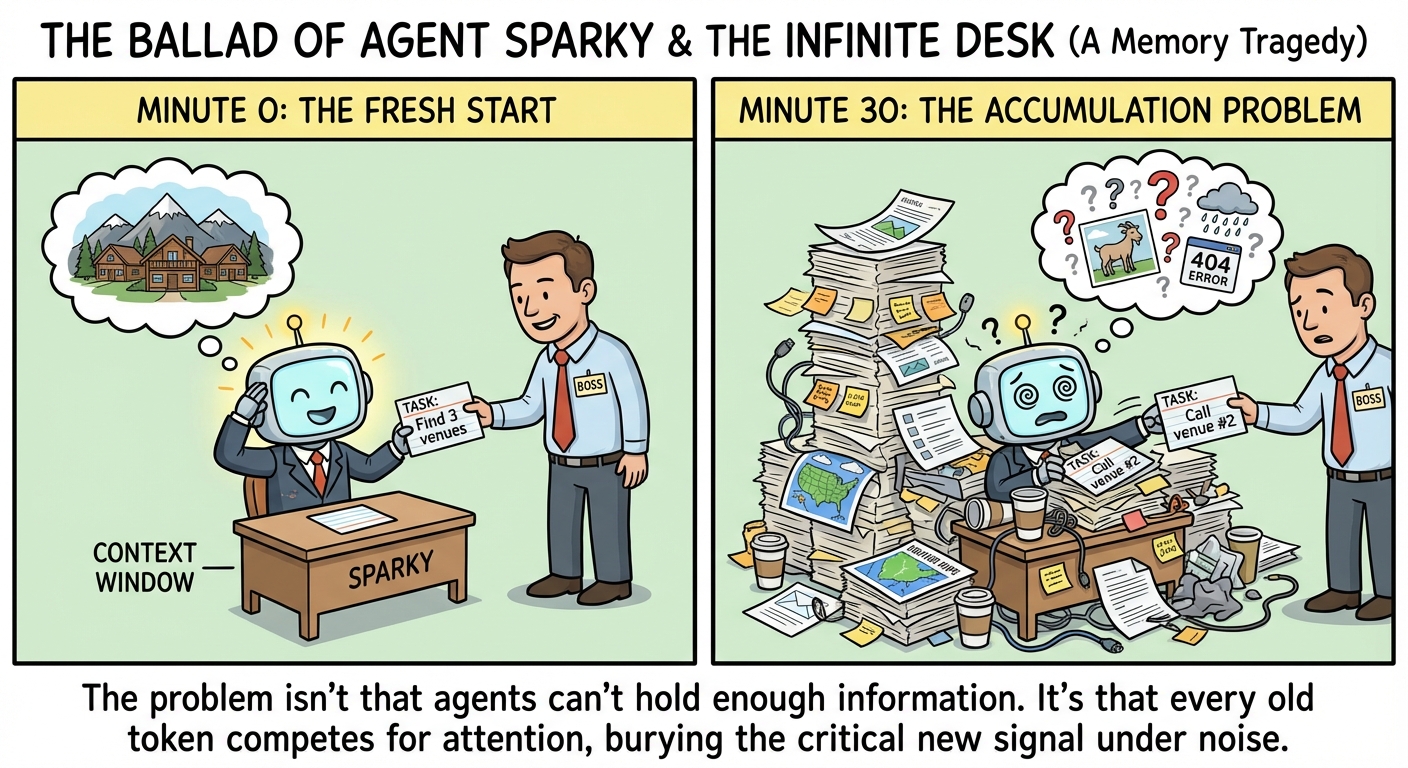
Think of domain memory as the library: an agent can have a GREAT library and still have a really overloaded desk. And then you’re not getting anywhere.
That overloaded desk is a companion failure mode that’s just as common and just as poorly understood as the domain memory problem. It’s not about what happens between sessions. It’s about what happens within a single session as the agent runs longer.
And what’s interesting is that this within-session problem set seems more widespread than the domain memory piece.
Think about it: it’s relatively easy to come up with a big pile of external memory your agents can access and use. It may take executive blessing (which is why I aimed that first piece at leaders via executive circle), but it gets done.
For engineers and builders, this second piece around in-session state management is the hard part, because getting to a ‘clean desk’ for an agent is a really hard technical problem. And that’s exactly what we’re going to demystify and tackle here.
Watch any agent work on a complex task. For the first ten minutes, it’s sharp. Clear reasoning, appropriate tool use, steady progress. Then something shifts. Around minute twenty or thirty—or after a few dozen tool calls—the agent starts repeating itself. It forgets constraints it acknowledged earlier. It tries approaches it already tried. The reasoning that looked crisp at minute five turns muddy and unreliable.
This isn’t the domain memory problem. You could have perfect external records of project state, and this would still happen. The agent knows what it’s supposed to do. It just... loses the thread. And that’s not an LLM intelligence problem. A smarter model will run into the SAME issue.
My naive assumption was this was an AI intelligence problem. I kept seeing this pattern and assuming it was a model limitation—something that would get fixed when context windows got bigger or models got smarter. That assumption was wrong.
The research now shows that longer context windows often make things worse, not better. And the organizations running agents at production scale—Google, Anthropic, the Manus team—have converged on an explanation that changes how I think about building these systems.
The problem isn’t that agents can’t hold enough information. The problem is that every token you add to the context window competes for the model’s attention. Stuff a hundred thousand tokens of history into the window and the model’s ability to reason about what actually matters degrades. The critical constraint from step three gets buried under the noise from steps four through forty. The agent doesn’t forget because it ran out of space—it forgets because signal got drowned by accumulation.
This is the context engineering problem. And it turns out there’s a coherent framework for solving it.
Three papers from late 2025 lay out the architecture. They lay out how to get that work done. Google’s Agent Development Kit takes a different approach: instead of letting papers pile higher with every task, the agent clears the desk and pulls only what’s relevant for the current step. Stanford and SambaNova’s ACE research shows agents can learn from their own mistakes mid-task—noticing when they grabbed the wrong file and adjusting, without needing to be rebuilt from scratch. And Manus, one of the most widely-used consumer agents, published hard-won lessons after four complete redesigns, explaining how they finally learned to keep their agent focused even when a single task touches fifty different tools.
If domain memory is about what the agent reads at the start of a session, context engineering is about what the agent sees at every step within the session. The two patterns work together. You need both.
Here’s what’s inside:
- The non-technical TLDR: If you’re not technical, you have a clear summary of why the heck you should care and what we are talking about
- Why accumulation fails: The research on context rot, attention budgets, and why million-token windows made the problem worse
- Context as compiled view: The architectural shift from “append everything” to “compute what’s relevant”—and why it determines whether agents can run for minutes or hours
- The four-layer memory model: Working context, sessions, memory, and artifacts—what each layer stores, how they interact, and why the separation matters
- Nine scaling principles: The specific patterns that make long-running agents work, drawn from all three papers, with tradeoffs and implementation details
- Nine failure modes: How agents break when these principles are ignored—the patterns I see repeatedly in broken implementations
- What becomes possible: The capabilities that only exist with correct memory architecture—not incremental improvements, but qualitatively different work
- Where to build: A note on where practitioners are actually building these agents
- Twelve design prompts to build your own context architecture:
- State Persistence Analysis — Classify what your agent must remember vs. discard
- View Compilation Design — Define the minimal context needed for each decision
- Retrieval Trigger Design — Solve the problem of memory that never gets used
- Attention Budget Allocation — Justify every token in your context window
- Summarization Schema Design — Specify what must survive compression
- External Memory Architecture — Draw the line between context and storage
- Multi-Agent Scope Design — Test whether agent splits add clarity or just complexity
- Cache Stability Optimization — Audit for cost and latency at scale
- Failure Reflection System — Design how agents learn from mistakes
- Architecture Ceiling Test — Find where your harness limits model capability
- Context Observability Audit — Build the tracing layer for production debugging
- The Non-Tech Prompt — Make sense of all this if you’re NOT an engineer
Clearing the desk for the agent is one of the biggest blockers in the way of long-running agentic workflows.
And those matter because we can get to REAL value real fast if we can give our agents long-running tasks and trust them to get it done.
Think about it: how many workflows get unlocked if you had an AI that could dependably focus for hours vs. minutes? What if that agent could LEARN and record its evolving strategy as it went, improving future runs? That’s what we’re talking about here.
Let’s dive in and learn how to clear the desk for our agents!
Subscribers get all these posts!
Grab the prompts
This prompt pack isn’t a collection of clever templates. It’s a structured design process—eleven guided sessions that force you to answer the hard questions about your agent’s memory architecture before you build, plus a twelfth prompt to help you makes sense of all this if you’re non-technical.
Each prompt runs as a conversation: you describe your agent, then get challenged on every assumption. The State Persistence Analysis makes you classify every piece of information and defend why it needs to persist. The Attention Budget Allocation forces you to justify every token in your context window. The Summarization Schema Design prevents the failure mode where you compress away critical constraints and discover the problem at step 47.
These prompts exist because most agent failures trace back to memory decisions that were never explicitly made—defaults inherited from chat interfaces that don’t apply to long-running autonomous work.
Where to actually build this: If you’re just experimenting, Claude Projects or ChatGPT with tools will let you feel the limitations firsthand—you’ll hit the degradation problem within an hour of serious use.
For building real agent systems, most teams are using frameworks like LangGraph or the new Google ADK. If you’re technical and want to start simple, Claude Code or Cursor give you agent-like capabilities for coding workflows without building infrastructure from scratch. The prompts above work regardless of platform—they’re about designing the architecture, which you’ll need no matter what you build on.
The Non-Technical Version
Here’s what you need to know if you’re not building agents yourself but need to understand why this matters.
AI agents—systems that use AI to accomplish multi-step tasks with tools—have a memory problem. Actually, they have two memory problems.
The first problem: agents forget everything between conversations. You work with an agent on Monday, make real progress, then come back Tuesday and it has no idea what happened. It’s like working with a new contractor every day who’s never seen the project. I wrote about this problem and its solution—structured external records—in a previous piece.
The second problem, which this piece addresses: agents get worse the longer they run within a single session. They start sharp and focused. Twenty minutes later, they’re confused, repeating themselves, forgetting things they knew earlier. This happens because everything the agent does—every tool it uses, every result it gets—piles up in what it’s paying attention to. Eventually the important stuff gets buried under all the accumulated noise.
The solution isn’t bigger memory. It’s smarter memory—being deliberate about what the agent sees at each step rather than just accumulating everything. The organizations running agents successfully at scale have figured out patterns for this. That’s what we’re covering here.
If you’re evaluating AI agents for your organization, this explains why impressive demos often fail in production and what to ask vendors about their memory architecture. If you’re building agents, this is the technical framework. If you’re just trying to understand where AI agents actually are as a technology, this explains the current constraint that separates “works in demos” from “works in practice.”
Lessons from Google, Anthropic, and Manus on Context Engineering for Agents
The Two Memory Problems
In a previous piece, I argued that agents fail on multi-session work because they have no persistent record of where things stand. Every session starts fresh. The agent guesses what happened before, often incorrectly. Different sessions invent different definitions of “done.” The solution is structured external records—task lists, progress logs, validation criteria—that give each amnesiac agent session the context it needs to pick up where the last one left off.
That’s the cross-session problem. External records solve it. But there’s a companion failure mode that structured records don’t touch.
Watch an agent work on something complex within a single session. For the first ten or fifteen minutes, it’s sharp. Clear reasoning, appropriate tool use, steady progress. Then something shifts. The agent starts repeating itself. It tries approaches it already tried. It forgets constraints it acknowledged twenty minutes ago. The reasoning that looked crisp early on turns muddy and circular.
This isn’t domain memory failure. You could have perfect external records of project state, and this would still happen. The agent knows what it’s supposed to do—it read the task list at the start. The problem is everything that’s accumulated since then. Every tool call result. Every intermediate step. Every observation. All of it piling up in the context window, competing for the model’s attention.
I kept assuming this was a model limitation that would get fixed with bigger context windows. That assumption was wrong. The research shows that longer context windows often make things worse, not better. And the organizations running agents at production scale have converged on an explanation that’s changed how I think about building these systems.
Domain memory solves what the agent knows at the start of a session. Context engineering solves what the agent sees at every step within the session. You need both. This piece is about the second problem.
Why Accumulation Fails
The default approach to managing agent state within a session is simple accumulation. Every message, every tool call, every result gets appended to a growing transcript that’s passed to the model on each turn. This is how chat interfaces work, and it’s how most agent frameworks work by default.
For chatbots, it’s fine. Conversations are short. The model can attend to everything in the window. But agents aren’t chatbots. A typical Manus task—one of the most-used consumer agents—averages 50 tool calls. Each call produces output that gets appended to context. The input-to-output token ratio averages 100:1. Most of what you’re sending to the model is accumulated history, not the current decision.
Here’s what happens as that history grows. Research from Chroma tested 18 different models and found consistent performance degradation as input length increases, especially for tasks requiring reasoning across the full context. A paper called “Lost in the Middle” showed that models struggle with information placed in the middle of long inputs—beginning and end get attention; middle gets ignored. This isn’t a bug that’s getting patched. It’s architectural.
The transformer architecture that powers these models creates n² pairwise relationships between tokens. Every token attends to every other token. As context grows, the model’s ability to capture those relationships gets stretched thin. Training data also skews toward shorter sequences, so models have fewer specialized parameters for handling long-range dependencies.
Anthropic frames this as an “attention budget.” Every token you include is a token of attention spent. Include a hundred thousand tokens of history and the model’s capacity to weigh what actually matters degrades. The critical constraint from step three gets buried under the noise from steps four through forty.
The practical implication is uncomfortable for anyone who thought longer context windows would solve the agent reliability problem. Naively stuffing more into context leads to worse reasoning, not better. The model that fumbles at minute thirty would perform perfectly if you started fresh with just the relevant information.
This is why I keep seeing the same pattern: agents that demo well fail in production. Demo tasks are short. The context window stays small. Everything works. Production tasks run for hours, touch hundreds of files, involve dozens of interdependent decisions. The accumulation problem that’s invisible in a five-minute demo becomes the entire bottleneck at scale.
The Architectural Shift
Three papers from late 2025 converge on the same insight, and it’s a genuine reframe of how to think about agent context.
Google’s Agent Development Kit documentation puts it most directly: in previous-generation agent frameworks, context was treated like a mutable string buffer. You appended to it. Eventually you hit limits and truncated. ADK is built around a different thesis: context is a compiled view over a richer stateful system.
The distinction matters more than it sounds. Sessions, memory, and artifacts are the sources—the full, structured state of the interaction and its data. Flows and processors are the compiler pipeline—a sequence of passes that transform that state. The working context is the compiled output you ship to the LLM for this one invocation.
Once you internalize this, context engineering stops being prompt manipulation and starts looking like systems engineering. You’re forced to ask different questions. Not “how do I fit more into the window?” but “what’s the intermediate representation?” Not “when should I truncate?” but “where do I apply compaction?” Not “what’s in the prompt?” but “how do I make transformations observable?”
The Manus team arrived at the same place through what they call “Stochastic Graduate Descent”—four complete architecture rewrites since launch, each time after discovering a better way to shape context. They bet on context engineering over fine-tuning because it lets them ship improvements in hours instead of weeks. In their framing: if model progress is the rising tide, they want to be the boat, not a pillar stuck to the seabed.
The ACE paper from Stanford and SambaNova extends this to memory that evolves. Instead of static prompts that freeze the agent at version one, they treat context as an “evolving playbook” that accumulates, refines, and organizes strategies through execution feedback. The agent learns from what works and what doesn’t—without retraining the model.
What these three sources share is a rejection of the accumulation model. You don’t build agent context by appending. You build it by computing what’s relevant for this specific step from a richer underlying state.
The Four-Layer Model
The domain memory piece covered external records—task lists, progress logs, validation criteria that persist across sessions. Those records still matter. They’re what the agent reads at session start to understand where things stand.
But within a session, you need additional structure. The model that’s emerged from production systems has four layers, and understanding why they’re separate is prerequisite to building agents that work beyond short interactions.
Working context is what actually gets sent to the model on each call. Instructions, identity, selected history, relevant tool outputs, memory hits, artifact references. This should be as small as possible while remaining sufficient for the current decision.
The key insight: working context is computed, not accumulated. Every time you make an LLM call, you’re assembling a fresh projection against fuller state. What’s relevant now? What instructions apply now? Which artifacts matter now? You answer these at runtime, for each step, rather than assuming a static prompt that grows indefinitely.
Sessions are structured event logs for the full trajectory within a single interaction. Not raw prompt strings, but typed records: user messages, agent replies, tool calls, results, control signals, errors. Each captured as a discrete event.
This matters for three reasons. First, you can swap models without rewriting history—the storage format is decoupled from prompt format. Second, downstream operations like compaction and debugging work over structured events rather than parsing opaque text. Third, you get observability—precise state transitions and actions you can inspect.
The session is your ground truth for what happened. It can grow large. That’s fine—the model doesn’t see it directly. The model sees working context, which is computed from the session.
Memory is searchable knowledge that the agent can query on demand. This overlaps with domain memory—the external records that persist across sessions. Within a session, memory also includes insights extracted from earlier in the current trajectory. The distinction: memory is retrieved when relevant, not permanently present.
Artifacts are large objects stored by reference. A codebase, a PDF, database results. These aren’t tokenized into the window. They’re stored externally and accessed through pointers. The model knows they exist and can request specific portions.
The parallel to traditional computer architecture is intentional. Working context is cache—expensive and limited. Sessions are RAM—larger but still bounded. Memory and artifacts are disk—can grow arbitrarily. The tiered model lets state expand without proportionally increasing per-call cost.
If you’ve implemented domain memory, you already have the external records layer. Context engineering is about how you use those records—and everything else—within a session. What gets loaded into working context? When? How do you keep the window small while giving the model what it needs?
Principle 1: Context Is Computed, Not Accumulated
Every LLM call should be a freshly computed projection against durable state. What’s relevant now? What instructions apply now? Which artifacts matter now? You answer these at runtime.
The naive pattern—append everything into one giant prompt—collapses under what ADK calls “three-way pressure.” Cost and latency scale with context length. Signal degrades as information gets buried (”lost in the middle”). And eventually you hit hard limits regardless of window size.
The compiled view approach addresses all three. You can grow underlying state arbitrarily while keeping each working context small. You get natural insertion points for compaction, filtering, and caching without rewriting prompts. You can tune how context gets assembled without touching agent logic.
ADK implements this by building fresh working context from the current agent’s perspective while preserving factual history in the Session. Each agent sees itself as the “Assistant” without misattributing broader system history to itself. The session is source of truth; the working context is a computed view optimized for this specific call.
The tradeoff: you need infrastructure. You can’t just concatenate strings. You need a session store, a view-compilation pipeline, clear contracts between components. For simple demos, this is overhead. For production agents running hours-long tasks, it’s prerequisite.
Principle 2: Separate Storage from Presentation
Durable state and per-call views serve different purposes. They should evolve independently.
Your session stores everything that happened—every event, every tool result, every state change. Your working context is a computed subset of that, optimized for the model’s current decision. The compilation logic can change without touching storage. You might compress more aggressively as sessions grow. You might prioritize different event types for different phases. You might experiment with summarization strategies. None of this requires changing how you store the raw events.
Manus implements this with “full” and “compact” representations. Tool results are stored in full in the filesystem. The context window carries compact references—file paths, not payloads. The agent can fetch full results if needed, but doesn’t pay the token cost unless it’s actually relevant.
This matters enormously for cost. If your input-to-output ratio is 100:1, most of what you’re paying for is context, not generation. Reduce context through intelligent view compilation—without losing necessary information—and savings compound across every step.
The separation also enables debugging. When something goes wrong, you can inspect the full session to see what actually happened, then inspect the working context to see what the model actually saw. If those diverge in ways that explain the failure, you’ve found your bug.
Principle 3: Scope by Default
Default context should contain nearly nothing. Additional information enters through explicit decisions—loading memory, requesting artifacts, querying past results.
This inverts the common pattern where everything gets included by default and you worry about trimming later. Instead, you start minimal and the agent chooses when to reach for more.
The rationale is attention budget. Every token competes for limited attention. Old information that’s “nice to have” dilutes signal from new information that’s actually relevant. By forcing retrieval to be explicit, you ensure the model only processes what someone decided was worth including for this specific step.
Manus implements this as “reduce, offload, isolate.” Reduce context by compacting stale results—swapping full tool outputs for references that point to where the data lives. Offload by writing to the filesystem and referring by path. Isolate by giving sub-agents their own windows rather than sharing one giant context.
The tradeoff: retrieval adds latency and decision overhead. The agent must know what might exist and when to request it. This works better for agents with clear domain boundaries than for exploratory tasks where relevant context is unpredictable.
Claude Code illustrates a hybrid. Small, almost-always-relevant files (CLAUDE.md) get loaded upfront. Everything else is retrieved just-in-time using glob and grep. The agent navigates its environment and fetches what it needs rather than having everything preloaded.
Principle 4: Retrieval Over Pinning
Attempts to keep everything permanently in context fail because attention constraints bite. Even with million-token windows, performance degrades when you pin everything.
Treat memory as something the agent queries on demand, with relevance-ranked results. The working context should be the result of a search, not the accumulation of history.
This is how agents differentiate between a critical constraint from thirty steps ago and noise from three steps ago. Without explicit retrieval, agents become recency-biased—whatever appeared most recently dominates attention regardless of actual importance.
Domain memory feeds into this. Your external records—task lists, progress logs, validation criteria—aren’t dumped wholesale into every context. They’re queried. The agent retrieves the specific task it’s working on, the relevant progress entries, the applicable validation criteria. Not everything. The slice that matters.
Implementation matters here. Retrieval quality depends on how you structure what’s stored. Random text blobs searched by embedding similarity produce different results than structured events queried by type, timestamp, and tags. The more structure in storage, the more precisely you can retrieve.
Principle 5: Summarization Must Be Schema-Driven
If you don’t aggressively maintain context, it decays—either through bloat or through lossy summarization. The failure modes are predictable: bloat until you hit limits and truncate randomly, or summarize so aggressively that you lose critical information.
I keep seeing teams summarize “to save space” without specifying what must be preserved. Then the agent fails at step 47 because a constraint was compressed away. No one can explain what happened because the raw data is gone.
The ACE paper names this failure mode: “brevity bias,” where summarization drops domain-specific insights for generic compression, and “context collapse,” where iterative rewriting erodes detail over time. You summarize once and lose a little. Summarize again and lose more. After a few rounds, you have vague mush that doesn’t support decision-making.
The fix is schema-driven summarization. Before you compress anything, define what must survive. Causal steps—the chain of decisions and why. Active constraints—rules still in effect. Failures—what was tried and didn’t work. Open commitments—promises not yet fulfilled. Key entities—names and references that must stay resolvable.
ADK implements this through context compaction at the session layer. When thresholds are reached, an LLM summarizes older events over a sliding window, producing a new “compaction” event. Because compaction operates on the structured event stream, you can inspect how summarization happened. You can tune it without touching agent code.
Manus uses staged compression. First, swap full tool results for compact references—lightweight and reversible. When that reaches diminishing returns, escalate to schema-based summarization. The schema guarantees required fields survive. You lose surface detail but preserve structure.
The practical test: can your summarized context make the same decisions as full context on known examples? If not, your schema is wrong or your compression is too aggressive.
Principle 6: Offload Heavy State to Tools and Sandboxes
Don’t feed the model raw tool results at scale. Write them to disk and pass pointers.
Modern context windows offer 128K tokens or more. In practice, that’s often not enough—and sometimes it’s counterproductive. Tool results can be huge. Web pages, PDFs, database queries. A single observation can blow past what’s reasonable. And even when results fit, including them raw degrades performance by diluting attention.
The Manus solution: treat the filesystem as the ultimate context. Unlimited size, persistent by nature, directly operable by the agent. The model writes to and reads from files on demand, using the filesystem as externalized memory.
Compression becomes reversible. A web page’s content can be dropped from context as long as the URL is preserved. A document’s contents can be omitted if the path remains available. You shrink context without permanently losing information—the agent can fetch it back if needed.
Tool design follows the same philosophy. Manus uses fewer than 20 atomic tools: bash, filesystem operations, code execution. Rather than bloating the function-calling layer with specialized tools, they push complexity into the sandbox. MCP tools are exposed through CLI commands the agent runs via bash.
Claude’s Skills feature works similarly. Skills live in the filesystem, not as bound tools. The agent uses basic file operations to progressively discover and use them. You don’t need the entire skill library in context—just enough to know what’s available and how to access it.
The architectural point: tool schemas consume attention too. They sit near the front of serialized context. Expose fifty overlapping tools and you’ve spent significant attention budget before the agent sees any actual task content.
Principle 7: Isolate Context with Sub-Agents
Multi-agent systems should manage context, not mimic org charts. Sub-agents exist to give different work its own window—not to roleplay human teams.
I see this mistake constantly. Someone reads about multi-agent systems and creates a Designer Agent, PM Agent, Engineer Agent, QA Agent. They chat in a shared context like a simulated standup meeting. The result: context explosion with no corresponding capability gain. Cross-agent chatter becomes drift and hallucination rather than genuine coordination.
Manus explicitly warns against this. Their sub-agents exist to isolate context. A planner assigns tasks. A knowledge manager curates what should be saved. An executor performs work. Each has its own window and communicates through structured artifacts—not transcripts passed back and forth.
The communication protocol matters. For simple tasks where the planner only needs output, it passes instructions via function call. The sub-agent works in its own context and returns a structured result. For complex tasks with shared state, the planner shares full context—but the sub-agent still has its own action space and instructions.
In both cases, output follows a schema. The sub-agent has a “submit results” tool that populates defined fields. Constrained decoding ensures adherence. No free-form “here’s what I did” that the planner has to parse.
ADK implements similar patterns as Agents-as-Tools (specialized agent as function call) and Agent Transfer (full handoff with inherited context). Knobs control how much flows from parent to child. You can restrict context for agents that don’t need full history.
The test: “What gets clearer or more correct with separate windows?” If you can’t answer that, the split is probably wrong.
Principle 8: Design for Cache Stability
KV-cache hit rate may be the single most important metric for production agents. It directly affects latency and cost.
The mechanism: contexts with identical prefixes can reuse cached key-value computations. With Claude Sonnet, cached tokens cost $0.30 per million versus $3.00 for uncached—10x difference. Agents making dozens of calls per task see this compound dramatically.
But cache benefits require prefix stability. Due to autoregressive processing, even a single-token difference invalidates cache from that point forward. This creates specific requirements.
Keep your prompt prefix stable. A common mistake: including a timestamp—especially precise to the second—at the beginning of the system prompt. It lets the model tell time, but destroys cache hit rate. That timestamp changes every call, invalidating everything after it.
Make context append-only. Don’t modify previous actions or observations. Ensure serialization is deterministic. Many JSON libraries don’t guarantee key ordering. Non-deterministic serialization silently breaks cache even when logical content is identical.
Mark cache breakpoints explicitly when needed. Some providers require manual breakpoint insertion. At minimum, ensure breakpoints cover the system prompt so it caches across turns.
ADK’s separation of session and working context enables this naturally. The architecture divides context into stable prefix (system instructions, agent identity, long-lived summaries) and variable suffix (latest input, new tool outputs). Changes to suffix don’t invalidate prefix cache.
The Manus team reports this as their most-tracked metric. Cache efficiency determines whether multi-hour agent sessions are economically viable.
Principle 9: Let Context Evolve Through Execution
Static prompts freeze agents at version one. The agent never learns from experience. Every failure is re-discovered rather than remembered.
The ACE paper provides the framework for solving this. Instead of monolithic prompt rewrites, ACE represents context as structured “bullets”—discrete items with metadata (unique ID, helpful/harmful counts) and content (strategy, concept, failure mode). Updates add new bullets or modify existing ones. Localized changes that preserve past knowledge.
Three components collaborate. The Generator produces reasoning trajectories, surfacing strategies and pitfalls. The Reflector critiques those traces to extract lessons. The Curator synthesizes lessons into delta entries, merged by lightweight non-LLM logic.
Because updates are itemized, multiple deltas merge in parallel. The system supports multi-epoch adaptation—revisiting queries to progressively strengthen context.
Results: +10.6% on agent benchmarks, +8.6% on finance tasks, with 86.9% lower adaptation latency than existing methods. On AppWorld, ACE with a smaller open-source model matched top-ranked GPT-4.1 agents on average and exceeded them on harder splits.
Critically, ACE uses execution feedback rather than labeled data. The Reflector analyzes what actually happened—successes and failures—to extract insights. No human annotation required.
With domain memory, your external progress logs capture what worked and what didn’t across sessions. ACE-style evolution captures the same within sessions and crystallizes it into improved prompts and strategies.
The implication: design systems to capture outcomes and feed them back. The agent that ran this morning should inform the context for the agent running this afternoon.
The Failure Modes
These are the patterns I see when people haven’t internalized context engineering. Some are the same mistakes I made before working through this material.
The append-everything trap. You keep a single growing transcript and hand it to the model every turn. Cost and latency scale linearly. Attention dilutes as stale events accumulate. Performance degrades predictably around the 20-30 minute mark. I’ve watched teams debug these agents for weeks, trying prompt tweaks, when the problem is architectural.
Blind summarization. You compress “to save space” without defining what must survive. ACE calls this brevity bias and context collapse. Agents forget edge cases, constraints, what was already tried. Behavior degrades as you “optimize.” The fix isn’t better summarization prompts—it’s explicit schemas that guarantee preservation of decision-relevant information.
The long-context delusion. You upgrade to a million-token model and assume the problem is solved. Performance gets worse. You’re paying more for a more distracted model. The structural issues—no filtering, no compaction, no scoping—don’t disappear with bigger windows. They just manifest at higher token counts.
Observability as context. You stick debug logs, raw tool outputs, stack traces into the same buffer as task instructions. You conflate what you need for debugging with what the model needs for decisions. Those are different. The model drowns in log noise. Sessions should capture everything for observability; working context should be curated for decision-making.
Tool schema bloat. You bind dozens of tools with detailed descriptions. Each description consumes attention budget. Overlapping tools create ambiguity—the model oscillates between similar options or calls the wrong one. Manus uses fewer than 20 atomic tools and pushes complexity into the sandbox.
Anthropomorphic multi-agent. You create Designer Agent and PM Agent and Engineer Agent because it feels like good division of labor. They share a giant context and “communicate” by appending messages. Context explodes. Cross-agent chatter becomes hallucination. The Manus team explicitly warns against this: sub-agents exist to isolate context, not to cosplay teams.
Static configurations. No accumulation of knowledge. No sharpening of heuristics. You rebuild from scratch every session. ACE’s whole point: contexts must evolve through execution feedback. Your agents never improve because you discard all signal from trajectories.
Over-structured harness. You build elaborate multi-step planners, strict tool hierarchies, complex routing logic. When you swap in a better model, performance barely changes. The harness is the bottleneck—your structure prevents the model from using its capabilities. The Manus team has refactored five times because they know this trap.
Cache destruction. You rebuild prompts every turn with unstable prefixes. Timestamps, non-deterministic serialization, reorganized content. You pay full cost for identical logical content because the bytes differ. You’re forced into premature summarization because you refuse to separate stable from volatile sections.
What Becomes Possible
With domain memory, you get continuity across sessions—agents that know where they left off. With context engineering from this piece, you get coherence within sessions—agents that don’t degrade as they run longer. Together, they enable capabilities that simply don’t exist otherwise.
Multi-hour autonomy. Research tasks, code migrations, audit workflows—work that runs for hours and touches hundreds of files. The agent stays coherent because it receives relevant slices of state rather than drowning in accumulated history. Manus sustains 50+ tool calls per task. ADK’s tiered state plus compaction lets agents maintain full event history while feeding the model curated views.
Self-improving agents. Systems that log strategies, update heuristics, learn from mistakes—without retraining. ACE shows this works: evolving contexts enable smaller models to match or exceed larger-model agents with static prompts. Improvement happens in memory and instruction layers, not weights.
Scalable personalization. Persistent preferences, learned constraints, prior outcomes—without ballooning context. Long-term memory is retrieved on demand, not pinned. You inject what matters and leave the rest searchable.
Multi-agent coordination that works. Planner, executor, validator—collaborating through structured artifacts instead of shared context that degrades everything. Each agent sees what it needs. Coordination is debuggable: you can trace exactly what each saw and why.
Reasoning over large corpora. Codebases, document collections, datasets—treated as artifacts rather than tokenized wholesale. Structured retrieval decouples reasoning from raw size. The agent works with bodies of information that vastly exceed window limits.
Auditable systems. Full reconstructability of what the model saw and why. Session logs, compaction events, memory updates—all traceable. When something goes wrong at step 47, you can inspect exactly what context produced that decision.
Viable economics. Sub-linear cost growth through cache reuse and intelligent compaction. Agents you can afford to run in production, not just demo at a hackathon. Manus reports significantly lower per-task costs than integrated alternatives, largely from context engineering.
Domain-specific workspaces. Finance agents with durable risk context. Code agents with project history. Research agents with evidence logs. These become persistent environments rather than one-shot sessions. The agent understands long-term arc because the architecture supports it.
What To Do Now
If you haven’t designed domain memory for your workflows—the external records that your agents can interact with—start there. Context engineering assumes you have persistent state to work with. Without it, you’re trying to optimize a system that can’t maintain continuity in the first place.
If domain memory is in place, audit your within-session architecture.
Map against the four layers. Where does working context end and session begin? What qualifies as memory versus artifact? If you can’t answer these clearly, you don’t have architecture—you have accumulation that will degrade.
Measure your context window. What percentage is actually relevant to the current decision? If most of it is stale history, repeated results, or “nice to have” information, you’re paying attention tax on noise.
Examine your summarization. Is it schema-driven or blind compression? Can you reconstruct decision-relevant structure from summaries? Test explicitly—have summarized context produce the same decisions as full context on known examples.
Audit your tool surface. Could you achieve the same capability with fewer, more orthogonal tools? Does complexity live in schemas or in the sandbox where it belongs? Count your tools. More than 20 likely means overlap and ambiguity.
Check prefix stability. What changes between calls? Is the system prompt truly stable, or do you inject timestamps, session IDs, varying content near the beginning? Check serialization for deterministic ordering.
Run the ceiling test. If you swap in a more capable model, does your agent get proportionally better? If not, your architecture is the bottleneck. The Bitter Lesson applies here: structure that helped with weaker models becomes constraint with stronger ones.
Design for feedback. How does your system capture what worked and what didn’t? How do outcomes feed back into context refinement? Even without full ACE implementation, you can capture execution results and manually incorporate lessons.
The Full Picture
Domain memory gives agents continuity across sessions. Context engineering gives agents coherence within sessions. Both are necessary. Neither is sufficient alone.
The organizations getting agents to work at scale have internalized both. They’re not waiting for models to get smarter or context windows to get bigger. They’re building the memory infrastructure that makes any model more reliable.
The organizations still running failed experiments are typically missing one or both pieces. They’ve built domain memory but accumulate context until within-session performance degrades. Or they’ve optimized context engineering but start every session without state, wondering why agents can’t maintain progress over time.
This is the trade craft for building agents that finish work. No shortcuts exist. But the path is documented now—both parts of it.
Grab the papers
1. Architecting efficient context-aware multi-agent framework for production (Google Developers Blog)
Google’s ADK framework separates storage from presentation, uses explicit context transformations, and scopes each agent call to minimum required context.
2. Context Engineering in Manus (Lance Martin)
Manus uses three context strategies—reduce via compaction/summarization, isolate via sub-agents, offload to filesystem—enabling 50+ tool-call tasks without window overflow.
3. Agentic Context Engineering: Evolving Contexts for Self-Improving Language Models (arXiv)
ACE treats context as evolving playbooks that accumulate and refine strategies, achieving +10.6% on agent benchmarks while reducing adaptation cost.
4. Effective context engineering for AI agents (Anthropic Engineering)
TLDR Context is a tiny desk: optimize via compaction, structured note-taking, sub-agents, and just-in-time retrieval rather than pre-loading everything.
Good luck with building :)
I make this Substack thanks to readers like you! Learn about all my Substack tiers here and grab my prompt tool here