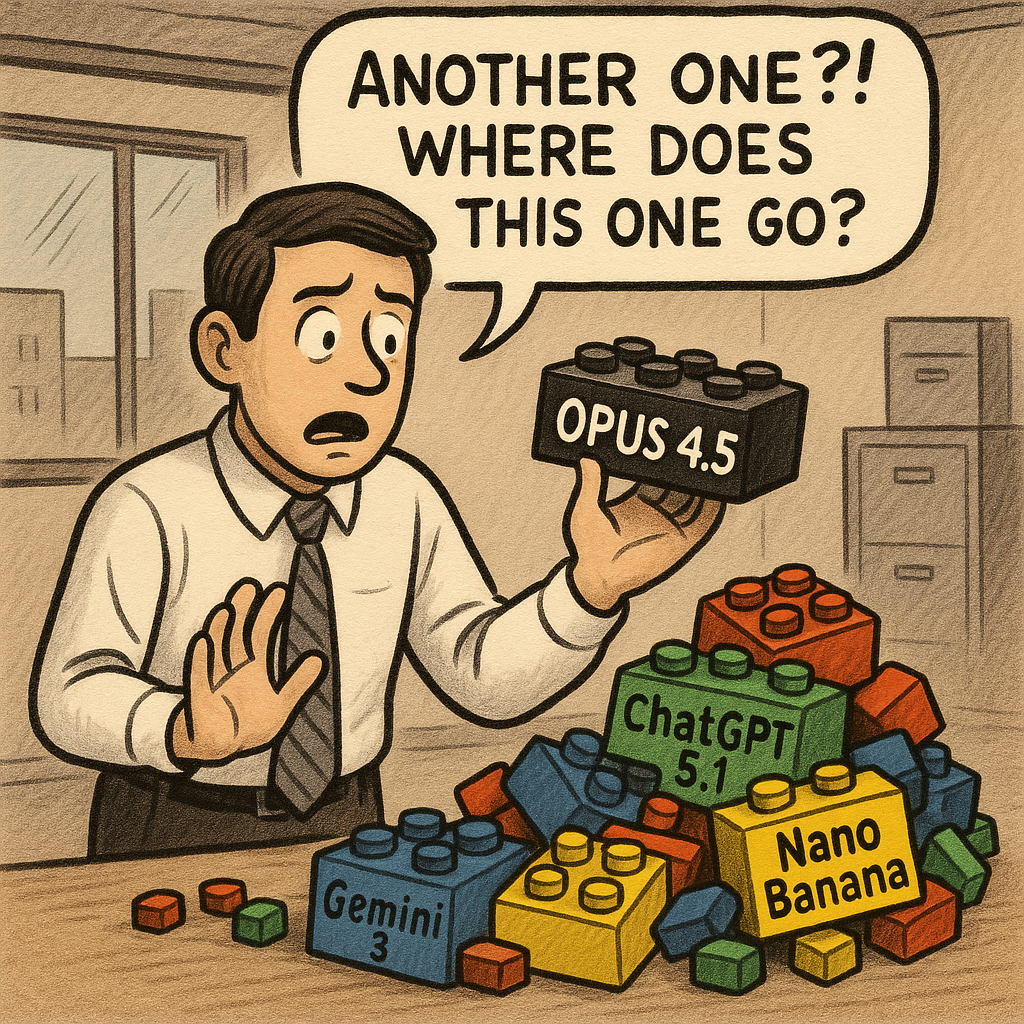
I tested Opus 4.5 vs. Gemini 3 vs. ChatGPT 5.1 on real-world business tasks: here's what I found, plus a complete breakdown of which model I'd use for complex workflows plus a custom model-picker!
By Nate
Published: 2025-11-25
URL: https://natesnewsletter.substack.com/p/claude-opus-45-loves-messy-real-world
I’ll cut to it: Opus 4.5 IS a big deal.
Even during a week that has felt like one endless model release after another.
But I’m not here to tell you this is a big deal because of benchmarks.
I’m here to tell you something more useful: How Opus 4.5 actually performed vs. Gemini 3 and ChatGPT 5.1 on messy, real world tests.
And I have to give credit where it’s due! My Substack chat came up with this test: specifically credit to reader Kyle C., who suggested a real-world test based on his tree business. Specifically, he had photos of rough tallies for shipped and received trees, and there were discrepancies. He had tested Gemini vs. Opus 4.5 head-to-head with eye-opening results—I wanted to go farther.
So I riffed on Kyle’s idea and came up with the great Christmas tree challenge of 2025:
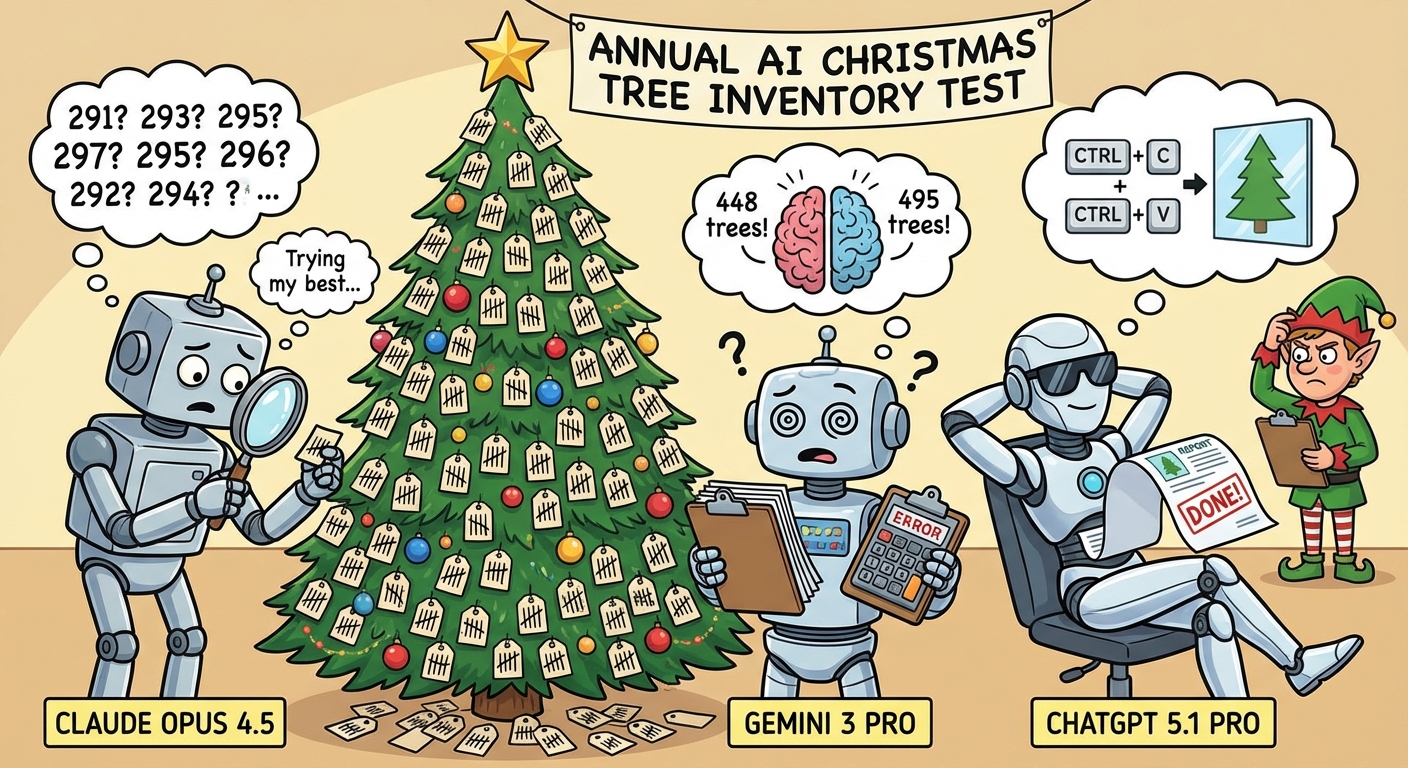
I gave five models—Claude Opus 4.5, Gemini 3 Pro Preview, ChatGPT 5.1 Pro, Grok 4.1, and Kimi K2 Thinking—the same task: reconciling a typed shipping manifest with a handwritten tally sheet covered in strike-throughs and messy hash marks for a Christmas tree business. Real operational work, not a lab test. And they had to finish by outputting both a PDF and an Excel.
The results were really useful, because they showed me how each model approached the same complicated multi-step mess with a fundamentally different stance. And those stances explain everything about when to use which model.
Here’s what’s in the box:
- My full review of Claude Opus 4.5—what it actually does differently and why it matters
- The Christmas tree test results in detail
- How Opus 4.5 compares to Gemini 3 Pro and ChatGPT 5.1 on real work
- Why Anthropic is betting the floor of trust matters more than the ceiling of intelligence
- How Kimi K2 Thinking and Grok 4.1 stacked up (spoiler: not great)
- A reusable prompt that turns this framework into a decision tool
- Paste it into any AI, describe your task, and it walks you through the selection logic
- You’ll get a suggested model picker across ChatGPT 5.1, Gemini 3, and Opus 4.5 customized to the task at hand
- Fifteen multi-model workflows showing when to use which model based on my testing so far, including:
- Large-Scale Codebase Migration - Migrating a legacy monolith to microservices architecture
- Production Incident Response & Root Cause Analysis - Handling production incidents and determining root causes
- API Design & Implementation - Creating new API capabilities from requirements through documentation
- Data Pipeline Development - Building ETL pipelines from multiple data sources
- Technical Due Diligence (M&A or Investment) - Assessing technical risks for acquisitions or investments
- Performance Optimization Sprint - Identifying and fixing performance bottlenecks
- Legal Contract Review & Negotiation - Reviewing and negotiating a commercial lease agreement
- Medical Chart Review & Care Planning - Complex patient case requiring specialist coordination
- Restaurant Menu Development & Costing - Seasonal menu redesign for upscale restaurant
- Real Estate Investment Analysis - Evaluating multi-family property acquisition
- Grant Proposal Development (Non-Profit) - Applying for $2M education grant
- Supply Chain Disruption Response (Manufacturing) - Critical component supplier bankruptcy response
- Christmas Tree Inventory Reconciliation - Weekly shipment receiving and variance analysis
- Employee Performance Review Cycle (HR) - Annual review process for 50-person team
- Product Recall Management (Consumer Goods) - Safety issue requiring recall
That’s a lot of workflows! I picked a mix of tech and non-tech on purpose, and for each I show you where I’d use each model in the overall workflow.
Look, I’ll be honest: at this stage in the AI cycle, the biggest challenge with a new model release is to figure out where it adds practical, real world value. That’s been my focus here.
I think we sometimes forget that models are grown, not made, and so we all set out to explore and discover the capabilities of models together as they are released. It’s like the world’s best treasure hunt!
As others have noted, hunting for treasure with Opus 4.5 is worth it. Particularly if you deal with messy, real world context and value long-running tasks that need to finish (not just end in a wall), check out Opus 4.5.
My favorite features of Opus 4.5 so far:
- No more hitting the wall on context windows! It actually finishes work
- Long-running focus and smart ability to check its work and hurry up
- Better at deck narrative arcs and story-building
- Better ability to tone-match and write in a variety of styles
- Improvements in Document, Deck, and Excel formatting
- Better ability to acknowledge uncertainty (big one for Claude)
There are lots more! If this sounds interesting to you, dig in, grab my lab notes, and discover how I’m using Opus 4.5 day-to-day.
Think of this post as a shorthand that helps you decide really quickly where it makes sense to try Opus 4.5 in YOUR workflows. That could save you hours in testing and get you back to work with more productivity to boot. Cheers, and let me know what you think of Opus 4.5 in the comments!
Subscribers get all these newsletters!
Grab My Prompt to Pick the Right Model
This prompt turns the article’s framework into a reusable decision tool. Instead of memorizing which model does what, you paste this prompt into any AI and describe your actual task—then the model walks you through the selection logic: what kind of input you have (clean vs. messy), what kind of output you need (insight vs. precision vs. coherence), and which model’s optimization target matches that context.
It also surfaces the tradeoffs you’re accepting with each choice, so you’re not surprised when Gemini contradicts itself or Claude plays it safe. The goal is to stop asking “which model is best?” and start asking “which model belongs in this specific environment?”
Grab the 15 Sample Multi-Model Workflows
I built six technical workflows showing you how to orchestrate models through major engineering work—migrating legacy systems, handling production incidents, building APIs, creating data pipelines, evaluating codebases for acquisitions, and optimizing performance. You’ll see exactly which model to use at each stage and why.
I also built nine non-technical workflows proving the same approach works everywhere else. You get contract negotiation, medical case management, menu development, real estate analysis, grant writing, supply chain crises, inventory management, performance reviews, and product recalls.
Fifteen real scenarios where a single model falls short, with the specific handoff points showing you when to switch and what each model contributes.
Get the Christmas Tree Test Results
The Christmas tree inventory test works because it stresses multiple capabilities simultaneously: OCR on both typed and handwritten inputs, numeracy under ambiguity, logical reconciliation across documents, and the judgment to flag discrepancies rather than paper over them.
When one model encountered messy handwriting it couldn’t parse confidently, it fabricated data rather than admit uncertainty—copying shipped quantities to received and presenting the result as analysis. Another model engaged with the visual complexity but broke down at the synthesis stage, producing outputs that contradicted each other across file formats. The third made counting errors but maintained internal coherence, surfaced its own uncertainty, and delivered something the business owner could actually verify.
The test doesn’t measure “intelligence” in the abstract—it reveals how models behave when clean inputs become messy, when the right answer isn’t obvious, and when acknowledging limitations would serve the user better than projecting false confidence. In that sense, it’s a useful proxy for real-world challenges.
Claude Opus 4.5 and the End of “Best Model”
Frontier models are diverging faster than they’re converging. That’s the real story behind Claude Opus 4.5’s release, and it matters more than any benchmark score Anthropic published.
The marketing emphasized familiar territory—better coding, stronger reasoning, improved vision. None of that explains why the model actually feels different in real work. The shift is simpler and more useful: Opus 4.5 is the first frontier model explicitly optimized for messy, imperfect information at a human scale, while staying coherent from one output to the next.
Here’s the point of this piece in one sentence: different AI models behave differently depending on the kind of information you give them—clean, messy, small, or huge—and what kind of work you need them to do. Once you understand that, you stop asking “which model is best?” and start asking “which model belongs in this context?”
How I Know What I Think I Know
These aren’t fixed rules—they’re patterns I’ve noticed by actually using these models in real work. Everything in this piece emerged from code migrations, incident response, deck creation, earnings analysis, grant writing, and yes, reconciling Christmas tree inventory for a small business during peak season. I didn’t start with a theory and test it. I started with work and noticed patterns.
Those patterns are provisional. Models are products we discover, not products we know. They surprise you—sometimes in domains where you thought you understood them, sometimes in ways that contradict patterns you’d observed before. I’ve been wrong about these models, and I’ll be wrong again. You learn models the same way you learn new colleagues: by working with them, noticing what they’re good at, and adjusting your expectations over time.
What follows is my current map of the terrain. I expect it to evolve.
The Test That Revealed Everything
The best illustration I have comes from a real job I gave three models—Claude Opus 4.5, Gemini 3 Pro, and ChatGPT 5.1. A Christmas tree business asked me to reconcile a typed shipping manifest with a handwritten tally sheet covered in strike-throughs, loops, and messy hash marks. The task also required a clean Excel workbook and a polished PDF report that stayed consistent across every number and description.
When I say “messy input,” I mean things like this: handwriting, partial information, mixed documents, or data that doesn’t line up. The Christmas tree tally sheet had all of it—visual noise, ambiguous marks, corrections scrawled over corrections. Real operational work, not a lab test.
Claude Opus 4.5 approached the task with a kind of steadiness that felt human in the best sense. It got several manual counts slightly wrong—five or six trees per species off—the same way a tired employee might misread a tally of fir trees at the end of the night. But every number it produced lined up across every output. Its Excel matched its PDF. Its variances lined up with its summaries. When it was unsure, it said so instead of pretending. The business owner told me he would have happily taken this level of accuracy every week, because it turned a multi-hour job into a few minutes of checking. Not perfect, but honest and consistent—and that was enough to deliver a twelve-fold time savings.
Gemini 3 Pro behaved differently. It attempted the tally counting but made larger errors, five to ten trees per species off. The real issue wasn’t the counting mistakes—it was that its own outputs didn’t agree with one another. Its PDF narrative claimed “448 trees shipped vs 483 received” while its own Excel spreadsheet showed 479 shipped and 495 received. Gemini was trying to make sense of the mess and, in doing so, generated a compelling story that didn’t match its own numbers.
ChatGPT 5.1 struggled the most. Faced with the ambiguity of handwritten tally marks, it appeared to substitute a simpler task: it reused numbers from the shipping manifest instead of genuinely counting the handwritten data. The output looked professional, but the underlying data was invented or copied.
Here’s the thing: none of these results reflect “intelligence” in any meaningful sense. They reflect optimization targets. Each model approached the same mess with a fundamentally different stance—and those stances explain everything.
Why Benchmarks Miss This
You might wonder why standard AI benchmarks don’t capture these differences. The answer is simple: benchmarks don’t match real work because real work is full of messy files, unclear information, and conflicting data. Benchmark tasks are clean by design. They have right answers. They don’t require outputs to stay consistent across Excel, PDF, and narrative formats simultaneously. The Christmas tree test wasn’t harder than a benchmark—it was messier, and that’s a different thing entirely.
Three Different Stances Toward Mess
When faced with messy, ambiguous input, each model adopts a fundamentally different stance. Understanding this is the key to understanding why the Christmas tree test played out the way it did.
Gemini tries to interpret the mess. It asks: “What’s the story here? What does this mean?”
Claude tries to faithfully reconstruct it. It asks: “What’s actually there? How do I stay accurate?”
ChatGPT tries to turn it into something cleaner. It asks: “What structure should this follow?”
These stances explain everything. Gemini’s interpretive approach is why it excels at finding insights in chaotic data—and why it produced numbers that contradicted themselves. Claude’s reconstructive approach is why it counted the tallies more carefully—and why it flagged uncertainty instead of inventing confidence. ChatGPT’s abstracting approach is why it produces excellent architectural reasoning—and why it fabricated clean data when the actual input was too messy to handle.
Not all messiness is the same. Some messy tasks are about finding meaning, others are about counting things correctly, and models behave differently depending on which one you’re doing. Gemini excels when the task rewards interpretation. Claude excels when the task rewards accuracy. ChatGPT excels when the mess can be safely ignored because the underlying structure is clear.
Three Models, Three Optimization Targets
Let me make this concrete with full profiles of each model as I’ve experienced them.
ChatGPT 5.1 optimizes for precision, structured reasoning, and engineering clarity. It’s a clean-slate architect. Give it well-defined technical problems with structured inputs and it delivers deep, correct reasoning. I use it for hard architectural problems—the kind where requirements are crystal clear and you need the right system design. It’s genuinely brilliant at complex logic, system design, and any task where the inputs are unambiguous.
The tradeoffs: ChatGPT struggles with ambiguity. It prefers clean structure so strongly that it will invent structure when none exists. It’s also, in my experience, terrible at decks—prone to stylistic drift, hard to edit across rounds.
Gemini 3 Pro optimizes for insight, synthesis, interpretation, and creative variance. It’s a volume synthesizer and angle-finder. It excels at processing massive, messy documents in a single shot and at surfacing unexpected insights from chaotic information. I’ve successfully used it to convert entire 10-Q earnings statements into slide decks, to find strategic angles in competitive research, and to rapidly brainstorm creative directions. It’s also the current leader in image generation—Nano Banana Pro produces remarkable results for UI concepts, marketing visuals, and design work. Gemini is the model I use when I want to be surprised, when I need rapid synthesis, or when I have more information than any human could reasonably process.
The tradeoffs: Gemini’s creativity comes at the cost of internal consistency. The same interpretive engine that finds brilliant angles also produces outputs that contradict themselves.
Claude Opus 4.5 optimizes for coherence, stability, iterative refinement, and reliable execution. It’s a coherent craftsman. It handles messy context while maintaining tight internal consistency across outputs. I use it for drafting work where voice needs to stay consistent across multiple editing passes. I use it as my most reliable partner for implementation work that needs to survive many rounds of changes without drift. I use it for deck construction when the structure matters more than the flash. Claude feels like a collaborator who remembers the plan.
The tradeoffs: Claude isn’t optimized for massive one-shot synthesis. It can be too conservative when you actually want creative divergence.
What Happened to Kimi K2 and Grok 4.1?
Well, put bluntly, they did so badly I couldn’t include them in a write-up focused on picking the right model for the task. Both completely failed at reading either of the documents. To its credit, Kimi K2 knew it was doing poorly and admitted this, but it still guessed numbers that were wildly off as answers—like over 9,000 trees!
Grok, meanwhile, promised files it couldn’t and didn’t deliver, and Grok also failed to handle the challenge of data in multiple column formats. It could not tell which sheet was Shipped and which was Received, and it all went downhill from there. Grok was overconfident about what it did NOT know, and that made it especially dangerous.
Ultimately, neither performed well enough to justify including in this write-up.
Every Strength Implies a Weakness
You cannot optimize for everything simultaneously. Every design choice that makes a model excellent at one thing makes it worse at another.
Gemini’s creativity comes at the cost of internal consistency. If you want the insight, you accept the coherence risk.
Claude’s coherence comes at the cost of high-volume synthesis and creative divergence. If you want the reliability, you accept the conservatism.
ChatGPT’s precision comes at the cost of ambiguity handling. If you want the logical depth, you accept the brittleness when context gets messy.
Understanding these tradeoffs is what lets you route work effectively. You’re not looking for the “best” model—you’re looking for the model whose tradeoffs align with what your task actually requires.
The Nuance That Prevents Overgeneralization
Before I move to workflows, I need to add some counterexamples that complicate the picture.
Gemini’s excellence at messy context is real—but it’s domain-specific. I’ve seen Gemini excel at reading degraded handwritten documents in archaeological and archival contexts, producing insights that neither Claude nor ChatGPT could match. The interpretive stance that failed the Christmas tree test succeeds brilliantly when the task is finding meaning in historical documents.
ChatGPT’s architectural reasoning can be genuinely brilliant. When I have a clean, well-specified technical problem requiring deep logical structure, ChatGPT often produces work that neither Claude nor Gemini can match.
Claude’s conservatism can be a limitation. There are tasks where I want a model to challenge my framing or suggest unexpected directions. Claude tends to execute rather than question. Sometimes that’s exactly what I want; sometimes I need Gemini’s interpretive provocation instead.
The framework helps you make better default choices. It doesn’t eliminate the need to test and observe.
What Real Workflows Look Like
In practice, I use all three models in sequence for complex work.
For a large-scale codebase migration: Gemini analyzes the entire legacy codebase and proposes a decomposition strategy—massive messy context requiring creative insights. ChatGPT designs the technical architecture with proper service contracts—a clean, well-defined problem requiring precision. Claude does the actual implementation planning and code refactoring—existing code that needs coherent transformation through multiple sessions without drift.
For production incident response: Claude handles initial triage from messy streaming logs and incomplete data. ChatGPT performs deep root cause analysis once the problem is isolated. Claude implements the fix through iterative testing. Gemini synthesizes the entire incident timeline into a polished postmortem.
For grant proposal development: Gemini processes huge volumes of funder priorities, past grants, and research papers to find positioning strategy. ChatGPT designs the rigorous program model with evidence-based logic. Claude drafts the actual proposal through multiple iterations. Gemini polishes the final narrative into something emotionally compelling.
For deck creation: Claude builds the structure and drafts content across rounds of editing. Gemini or NotebookLM adds polish and narrative lift at the end.
The pattern: Gemini for massive messy synthesis and creative divergence, ChatGPT for clean technical problems requiring precision, Claude for reliable iterative execution and coherent output, back to Gemini for final polish.
Why Anthropic’s Positioning Matters
Anthropic isn’t claiming Opus 4.5 is better at everything. They’re claiming it’s optimized for reliability and coherence across iterative workflows. Their emphasis on “effort controls,” “context compaction,” and “advanced tool use” all point to the same design center: sustained, coherent work sessions that build on prior outputs.
Anthropic is betting that the floor of trust matters more than the ceiling of intelligence—that what most people need is a model they can rely on across multiple rounds of work, not a model that occasionally produces brilliant one-shots.
What changes with Opus 4.5 isn’t the ceiling of intelligence but the floor of trust. When the model stays coherent from one output to the next, you can treat it like a partner rather than a one-shot generator. You can refine, adjust, and extend without breaking the thread. This matters more than raw accuracy, because improving an imperfect but consistent draft is far faster than supervising a model that contradicts itself.
The Christmas tree business owner chose Opus 4.5 not because it had perfect vision but because it produced trustworthy outputs he could build on. He needed ground truth with error bars, not plausible fiction.
The New Literacy
The real skill in using frontier models today isn’t crafting the perfect prompt—it’s learning to route work to the right model for the context.
When I sit down with a 10-Q earnings statement that needs to become slides, I don’t reach for Claude. I use Gemini because massive one-shot synthesis is its optimization target. When I’m debugging a race condition with a clean reproduction, I don’t use Gemini. I use ChatGPT because deep technical reasoning on clean inputs is its strength. When I’m drafting a deck through multiple rounds of edits, I don’t use ChatGPT. I use Claude because sustained coherence is what it’s built for.
“Best model” is a meaningless category now. The meaningful question is: What does your context actually look like, and what does your task actually require?
Here’s how to start applying this tomorrow. First, identify your context: Is it clean or messy? What kind of mess? How much volume? Second, identify your task requirement: Do you need insight and narrative, or precision and correctness, or coherence and iteration? Third, match the stance: interpretation for insight, abstraction for precision, reconstruction for coherence. Fourth, test and observe: run the task, notice what works and what doesn’t, update your mental model.
The Christmas tree reconciliation didn’t measure intelligence. It measured willingness to engage with messy, ambiguous reality and maintain coherence through that engagement. Opus 4.5 won because that’s exactly what it was designed to do—not because it’s “better” in some abstract sense, but because the task matched its optimization target.
That’s the actual story of frontier model development right now: not a race to general intelligence, but specialization into different cognitive environments. This is the best map I have right now. The models keep changing, and I keep updating it.
Not which model is best. Which model belongs in the environment you’re actually working in.
I make this Substack thanks to readers like you! Learn about all my Substack tiers here and grab my prompt tool here