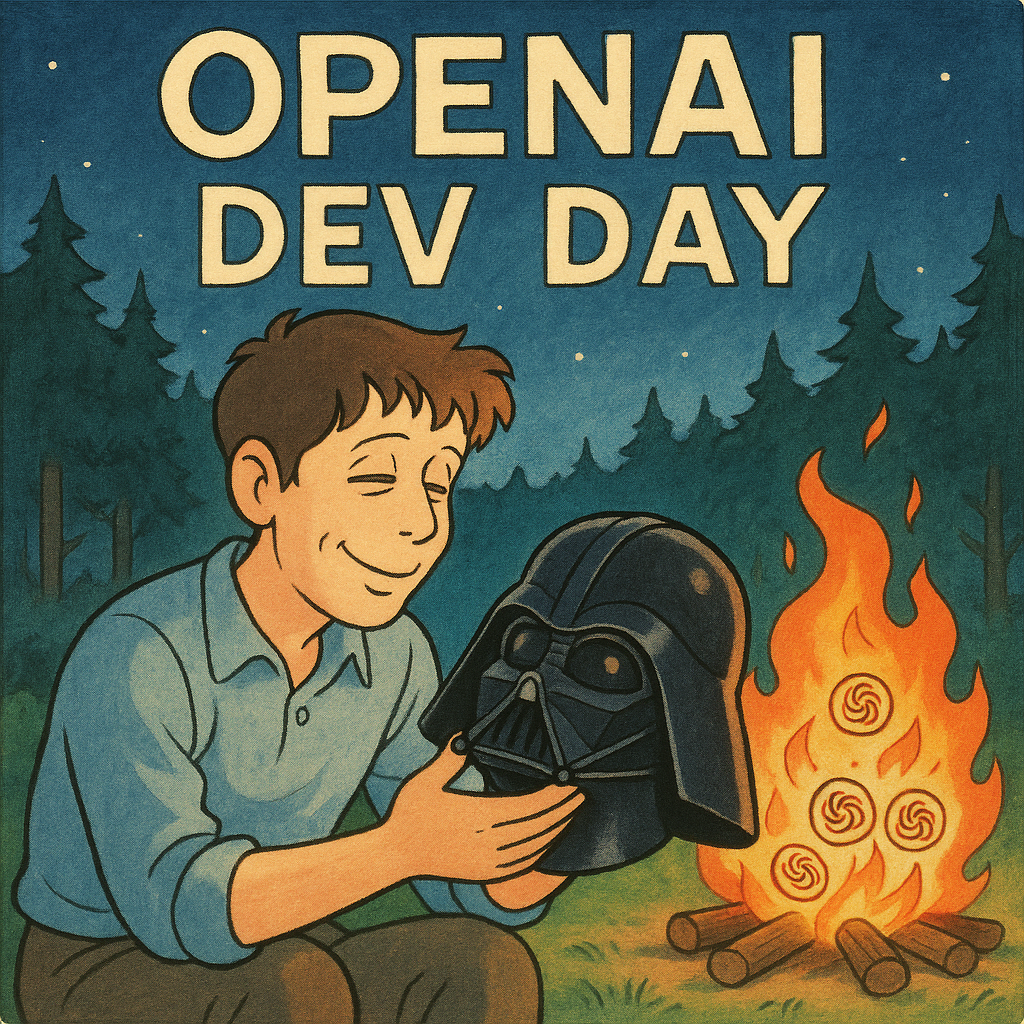
OpenAI is trying to expand to be the platform of the future for, well, everything. I spent hours digging into their strategy, and no one is talking about the real implications of Dev Day for all of us
By Nate
Published: 2025-10-08
URL: https://natesnewsletter.substack.com/p/openai-dev-day-three-scenarios-for
OpenAI just had one of their biggest days of the year, but it was all dressed in developer speak.
I spent hours digging in this week, and I’m realizing that we aren’t really hearing the real story anywhere.
The common story is that OpenAI is going for world domination, they are launching startup killer apps left-and-right, and they have basically won the AI game.
I don’t think the story is that simple as I talk to developers and leaders who are actually affected by all this. I dug into it with the video, talking about the story that’s behind the scenes.
I also collected some of the early reactions I’m hearing from builders and leaders around the industry. Spoiler alert: they’re not all as happy with OpenAI as the newspaper stories might suggest.
Finally (as always) I want to bring it home for you, so I started to pull out implications of Dev Day for builders, for leaders, and for AI enthusiasts.
I know it’s weird to say that Dev Day matters for everyone, but when you’re a company that has 10% of the planet for customers, and when this is THE biggest build even of the year, it matters.
So dig in, get the full details, and grab the custom prompt that will help you figure out how to apply all of this to YOUR situation.
OpenAI played the first move, but it’s up to the rest of us to write the rest of the story. Let’s make it a good one.
Subscribers get all these newsletters!
The Real Story Behind OpenAI’s Dev Day 2025: The Infrastructure Play Nobody’s Talking About
The Surface Narrative vs. The Actual Strategy
OpenAI’s Dev Day 2025 is being covered as a product launch. New APIs, agent builders, structured outputs, competitive pricing. The tech press is focused on features. The market is watching revenue growth—$28 million in 2022 to approximately $4.6 billion in 2025, a 164x expansion in three years.
But that’s not the story.
The actual story is a sophisticated infrastructure play disguised as product innovation. While everyone debates which model is better—GPT-4o versus Claude versus Gemini—OpenAI is executing a different strategy entirely: using their 800 million weekly active users as leverage to own the intelligence compute layer across the entire AI stack.
This isn’t defensive positioning to protect market share. This is an offensive play to become the AWS of artificial intelligence—the infrastructure layer that every AI application depends on, regardless of which model it uses.
Whether this strategy succeeds is genuinely uncertain. But understanding what OpenAI is attempting matters more than debating benchmark scores.
The Distribution Advantage That Changes Everything
Start with the numbers that matter. OpenAI has 800 million weekly active users as of October 2025. Not monthly. Weekly. They’ve achieved 92% Fortune 500 penetration. They have 4 million developers building on their platform, processing billions of tokens daily.
These aren’t just impressive metrics. They represent a structural advantage that competitors cannot replicate through better models alone.
Compare this to Anthropic (Claude), which has superior reasoning capabilities for many use cases but operates at a fraction of OpenAI’s scale. Or Google, which has comparable infrastructure through GCP but is still playing catch-up on consumer mindshare. “ChatGPT” has become synonymous with AI in the same way “Google” became synonymous with search. That linguistic capture represents billions in implicit marketing value.
But here’s what makes this interesting: OpenAI isn’t trying to protect this advantage through model superiority. They’re trying to leverage it into something potentially more durable—infrastructure control.
The question is whether they can execute this transformation before the market commoditizes or competitors neutralize their advantages.
Why This Is NOT the iPhone Moment
The surface comparison is tempting. OpenAI launches an Apps SDK—effectively an app store inside ChatGPT where third-party developers can integrate Spotify, Calendly, QuickBooks, Zoom directly into the platform. It looks like Apple’s 2007 playbook: dominant hardware becomes a platform, then the App Store becomes the monetization engine.
But this comparison breaks down under examination, and the reasons why reveal the actual competitive dynamics at play.
In 2007, the iPhone was the first truly interactive multimedia phone with product market fit. Yes, there were phones with screens. Yes, there were some phones with apps. Yes, there was BlackBerry. But none had an intuitive, clean platform anyone could plug into and just build. The iPhone was the only game in town.
Today’s AI landscape has no such monopoly. Claude has the MCP server ecosystem and has open-sourced it—Google is using it, OpenAI is using it. Anthropic excels at work primitives like Excel and PowerPoint generation. They have Claude Code for developers. Google competes aggressively on per-token pricing with massive hardware advantages through custom TPUs. Meta distributes Llama openly to prevent platform lock-in.
This is not a world with one iPhone. This is a world with five different iPhones, each with distinct advantages, and that fundamentally changes the platform economics OpenAI is pursuing.
Part of what made the App Store successful was exclusivity. That’s not true for OpenAI. It is not the only game in town, and developers know it.
The Microsoft Partnership: More Than Capital
The conventional narrative treats Microsoft’s investment in OpenAI as a funding relationship. That misses the strategic substance.
What OpenAI actually gained through the Microsoft partnership is preferential access to Azure’s compute infrastructure. While Anthropic and other competitors rent capacity from AWS or GCP and face more conservative rate limits, OpenAI has favorable allocation to H100 and H200 GPU clusters. This translates into something developers care deeply about: token liquidity.
Token liquidity isn’t marketing jargon. It’s the ability to process large volumes of tokens without rate limiting, to scale from zero to production load rapidly, to support both token-intensive agentic architectures and token-efficient structured flows without constraint. When OpenAI hands out plaques commemorating billion and trillion token milestones, they’re demonstrating infrastructural capacity.
This manifests in ways that matter for production systems:
- When a developer’s application goes viral and needs to scale significantly in hours, OpenAI can often deliver
- When an agentic system explores multiple tool-calling paths and burns tokens unpredictably, OpenAI has more headroom
- When an enterprise needs to process tens of millions of tokens for analysis, OpenAI’s infrastructure can handle it
But this advantage isn’t exclusive or permanent. Google has comparable infrastructure through GCP. As cloud providers continue expanding AI capacity, this advantage may diminish. The question is whether OpenAI can convert temporary infrastructure advantages into permanent platform effects before that happens.
The Offensive Strategy: Own the Orchestration Layer
Here’s where Dev Day 2025 reveals its actual strategic intent.
The new products aren’t primarily about making GPT-4 better. They’re about positioning OpenAI as the orchestration platform for any AI workload:
The Apps SDK isn’t just a feature marketplace—it’s OpenAI’s bid to host the application layer while developers provide logic.
Agent Builder isn’t just tooling for their models—it’s infrastructure for orchestrating agentic workflows that could, in theory, work across models.
Real-time API isn’t just about latency optimization—it’s about becoming the reliability and streaming layer.
Structured outputs aren’t purely a model capability—they’re a production infrastructure primitive that makes deterministic systems more viable.
The pattern suggests a strategy: OpenAI is building the middleware layer between developers and models. Their apparent bet is that developers want multi-model architectures, and OpenAI will provide the infrastructure that makes multi-model practical—while capturing margin on orchestration, not just inference.
This resembles the AWS playbook: Provide the compute layer many need, support diverse workloads, capture margin on infrastructure rather than applications, become embedded enough that leaving requires rearchitecture.
But here’s the challenge: This only works if developers accept the convenience of managed infrastructure over the control of direct model access. And there are strong reasons to believe many won’t.
The Developer Tension: Choice vs. Control
This is where the strategy faces its most significant resistance.
In conversations with developers building production AI systems, a consistent pattern emerges. They want multi-model architectures. They’re deliberately avoiding vendor lock-in. They’re building abstractions specifically to make model switching trivial. And they’re skeptical of platform intermediation.
Consider the competitive response from existing orchestration tools. N8n, one of the agent builders most directly affected by OpenAI’s Agent Builder launch, can argue a crucial differentiator: it offers pre-built connectors with a wide range of apps and it’s model agnostic. You can bring in Claude, you can bring in OpenAI, they don’t care.
OpenAI isn’t model agnostic. You’re bringing in OpenAI’s models. That’s what they want. That’s why they built it.
The architectural debate breaks along interesting lines:
Agentic architectures (autonomous AI that decides which tools to call and when) tend to favor Claude for its superior reasoning and tool use. These systems burn tokens unpredictably as the AI explores solution paths. They require generous rate limits and infrastructure tolerance for exploration.
Structured flows (deterministic systems where AI executes developer-defined workflows) tend to favor OpenAI for reliability and structured output guarantees. These systems are token-efficient by design, with predictable load patterns.
But here’s a critical insight: OpenAI’s infrastructure can support both architectural approaches at scale. Claude might be better at agentic reasoning, but OpenAI can deploy agentic architectures in production because they have the token liquidity and processing capacity to handle unpredictable token consumption.
This creates a complex dynamic. Developers might prefer Claude for certain reasoning tasks. They might use local models for cost optimization. They might test Gemini for multimodal capabilities. But when it comes to production deployment at scale, OpenAI’s infrastructure often becomes the practical choice—not because their model is best, but because their infrastructure offers certain reliability advantages.
Yet developers actively resist platform intermediation. They want direct API access to each model. They want to own their orchestration logic through tools like LangChain, LlamaIndex, or N8n. They don’t want another abstraction layer capturing value between their applications and the models.
This tension—OpenAI’s push for platform control versus developers’ desire for infrastructure independence—is the central question that determines whether this strategy succeeds.
The Token Efficiency Paradox
This brings us to one of the most revealing tensions in OpenAI’s strategy: the misalignment between celebrating token consumption and developers wanting token efficiency.
At Dev Day 2025, OpenAI literally gave out highly visible awards—physical plaques—to developers who spent the most tokens with them. Ten billion tokens. A trillion tokens. They put the names up on stage with Sam Altman. The message was clear: OpenAI has the infrastructure capacity to handle massive token burn, and they want to celebrate those who use it.
But here’s the uncomfortable reality: some of the developers whose names appeared on that billboard publicly stated afterward that they didn’t want to be there. Their actual goal is to spend fewer tokens, not more. Their job is to compute less, to be more efficient, to drive better margins for their businesses.
This is the fundamental tension of being a model maker in a metered market. You’re offering intelligence, but people know it’s metered by the token. They’re charged by the token. They don’t want to pay more than they have to. Every CTO wants to reduce their token spend the same way they want to reduce their cloud bill.
OpenAI wants you to burn more tokens. You want to burn fewer. That’s not a partnership—that’s an adversarial optimization problem.
This is where Google’s infrastructure advantages become strategically important. Google has custom TPUs in their stack, which helps them compete aggressively on price. When they can compete aggressively on price, they establish a price floor that OpenAI must respect. OpenAI cannot charge a premium for their models beyond a certain point because developers will just switch to Gemini.
The pattern is clear: any given individual in the AI ecosystem wants to spend fewer tokens. Model makers want to celebrate token consumption. This misalignment creates natural resistance to platform lock-in that celebrates volume over efficiency.
Why OpenAI Is Competing on Price
This tension helps explain one of the most telling strategic signals: OpenAI is competing aggressively on price, especially against Google Gemini.
If OpenAI had a defensible infrastructure moat, conventional logic suggests they should charge premium prices and extract platform rents. AWS doesn’t primarily compete on price—they compete on features and ecosystem lock-in. Microsoft doesn’t discount Office—they bundle and integrate.
But OpenAI keeps dropping prices:
- GPT-4o cheaper than GPT-4 Turbo
- GPT-4o mini at ultra-competitive rates
- Actively matching or undercutting Gemini on comparable tiers
This reveals something important: the infrastructure advantage provides cost advantage, not pricing power. OpenAI can compete on price because of their scale and compute access. But they must compete on price because Google has comparable infrastructure and can match or undercut them.
The price competition serves the larger strategic goal: use scale economics to commoditize model inference while building the platform layer that captures higher-margin orchestration and tooling revenue.
This is classic platform strategy. Make the commodity layer cheap or free (inference) to drive adoption of the higher-value layer (orchestration, tooling, ecosystem). It’s why AWS made compute increasingly affordable while extracting margin from managed services. It’s why Google made search free while monetizing ads.
OpenAI is attempting the same play: commoditize model access, own the infrastructure layer.
The risk: If the infrastructure layer doesn’t deliver sufficient additional value, you’ve just commoditized your own product without building a defensible platform business.
The Competitive Landscape Reframed
Understanding OpenAI’s infrastructure strategy reframes the entire competitive landscape.
Anthropic/Claude represents the “best-of-breed” alternative. Better reasoning for specific use cases, developer preference for code and agentic workflows, premium positioning. But they’re more capacity-constrained by renting compute from AWS. They can’t match OpenAI on token liquidity or price at current scale. Their position is similar to Slack’s against Microsoft Teams—better product, but fighting uphill against distribution and integration advantages.
Google/Gemini is the only competitor with comparable infrastructure. GCP plus custom TPUs gives them cost parity with OpenAI’s Azure access. They have enterprise distribution through Workspace. But they’re still playing catch-up on consumer mindshare, and “Gemini” hasn’t achieved the brand dominance that “ChatGPT” has. Their path forward requires either out-innovating OpenAI on models (possible but difficult) or leveraging Workspace integration better than they historically have (which would be significant).
Microsoft/Azure represents a complicated strategic relationship. Microsoft has invested heavily in OpenAI and provides the infrastructure that enables their token liquidity advantages. But Azure is pursuing a deliberately multi-model strategy under Satya Nadella’s platform leadership. Azure lets you access Grok, Claude, Gemini—whatever model you want. As long as you’re running on Azure Cloud, Microsoft doesn’t care which model you choose.
This is Satya’s platform play: remain agnostic about model selection, capture the cloud infrastructure margin regardless. It’s a hedge against any single model provider dominating, and it positions Azure as the enterprise infrastructure layer even as the model landscape fragments.
This creates an interesting dynamic: OpenAI needs Microsoft’s infrastructure; Microsoft benefits from OpenAI’s models but isn’t exclusively dependent on them. How that balance shifts as Microsoft integrates AI more deeply into their stack determines much about future market structure.
Meta/Llama is pursuing commodity distribution through open source. They can’t monetize directly but can prevent any single player from controlling the model layer. This keeps the market contested and prevents OpenAI from extracting monopoly rents, which serves Meta’s strategic goal—they don’t need to win AI, they just need to prevent anyone else from dominating it enough to threaten their core business.
The Lock-In Reality: Segmented and Weaker Than It Appears
The lock-in analysis requires segmentation because different user groups experience vastly different switching costs:
For consumers: High lock-in through habit formation. “ChatGPT” is a verb. Custom instructions, conversation history, and saved GPTs represent personal infrastructure that’s annoying to migrate. The free tier is good enough for most use cases, so there’s limited incentive to explore alternatives unless something significantly better emerges.
For enterprises: Medium lock-in, but not for technical reasons. The switching costs are procurement friction (new vendor review takes 6-9 months), training expenses (retraining thousands of employees isn’t trivial), and risk aversion (”nobody got fired for standardizing on OpenAI”). But these aren’t insurmountable, especially when Google offers comparable capabilities at competitive prices through tooling enterprises already use (Workspace). The technical migration is straightforward; the organizational change management is hard.
For developers: Low-to-medium lock-in. Technical switching is trivial—changing from gpt-4 to claude-3-opus is tens of lines of code for most applications. Many sophisticated developers already maintain multi-model architectures. The “lock-in” is token liquidity and infrastructure reliability, which is real but pragmatic rather than structural. If Anthropic achieves comparable scale, or if developers are willing to manage orchestration complexity themselves, switching becomes very low friction.
This segmentation matters because OpenAI’s platform play depends on converting low developer lock-in into higher lock-in through orchestration infrastructure. If developers resist that platform layer and insist on direct model access, OpenAI becomes “just another model provider” in a commoditizing market.
This is the central vulnerability in the strategy.
Three Scenarios for How This Resolves
Scenario 1: OpenAI Achieves Infrastructure Platform Status (30% probability)
OpenAI successfully establishes themselves as the orchestration infrastructure layer that many AI applications depend on. Enough developers accept the convenience of managed infrastructure over the control of direct model access. The Apps SDK, Agent Builder, and orchestration tools gain significant adoption, similar to how AWS services became standard despite vendor lock-in concerns.
In this scenario, models continue to commoditize, but OpenAI captures meaningful margin on infrastructure. Anthropic and others become model providers, potentially even running on OpenAI’s platform for certain use cases. Google competes at the infrastructure layer but the market splits. Microsoft integrates Copilot deeply while using OpenAI infrastructure underneath.
OpenAI’s revenue shifts from inference-heavy to infrastructure-heavy, with higher margins on orchestration services. They succeed at a similar transition to what AWS made from “cheap compute” to “comprehensive cloud platform.”
Critical dependencies: Developer adoption of orchestration layer, maintaining infrastructure advantages, successful ecosystem development.
Scenario 2: Fragmentation and Direct Model Access Remains Standard (45% probability)
Developers resist platform intermediation and insist on direct model APIs. Multi-model architectures stay DIY, with developers using open-source orchestration frameworks (LangChain, LlamaIndex, N8n) or building custom solutions. No infrastructure layer consolidates across the industry.
In this scenario, OpenAI remains the largest standalone model provider by user volume, but doesn’t achieve platform economics. They’re forced to compete primarily on inference pricing, which commoditizes. Margins compress. The market fragments across multiple model providers, with developers mixing and matching based on specific use cases.
This resembles the database market—many viable options, ecosystem tooling that abstracts away differences, no dominant platform capturing disproportionate value. OpenAI remains successful but doesn’t achieve the infrastructure platform transformation.
Critical dependencies: Developer preference for control, open-source orchestration tools maturing, competing infrastructure providers emerging.
Scenario 3: Enterprise Integration Plays Reshape the Market (20% probability)
The enterprise and developer markets consolidate around integration platforms that leave OpenAI with consumer dominance but lock them out of the more lucrative enterprise and developer segments.
This could manifest in several ways:
Azure’s multi-model integration becomes the de facto enterprise standard. Microsoft leverages their existing enterprise relationships and Azure infrastructure to offer model-agnostic AI infrastructure. Enterprises get to choose best-of-breed models (Claude for reasoning, Gemini for multimodal, OpenAI for specific use cases) while Microsoft captures the platform margin through Azure. Satya Nadella’s deliberate multi-model strategy wins because it gives enterprises flexibility while maintaining cloud lock-in.
Google leverages Workspace integration to make Gemini the default AI for hundreds of millions of enterprise users. The infrastructure advantages prove comparable to OpenAI’s, but the distribution advantages of being embedded in Gmail, Docs, Sheets, and Meet prove decisive. OpenAI retains consumer mindshare but enterprise spending shifts toward Google because of integration convenience and bundling.
Amazon and Anthropic formalize deeper partnership, with Anthropic becoming the preferred “premium reasoning” layer on AWS infrastructure, competing directly with OpenAI for enterprise developer mindshare while offering comparable infrastructure through AWS’s scale.
Apple integrates Anthropic more deeply into its ecosystem, creating an alternative consumer + developer pathway that leverages Apple’s platform advantages for the hundreds of millions in their ecosystem.
In any of these variations, the pattern is the same: cloud providers or platform companies with existing enterprise relationships and infrastructure capture the platform economics, while OpenAI’s consumer dominance doesn’t translate into enterprise or developer platform control.
Critical dependencies: Successful execution of complex partnerships, enterprises prioritizing integration over standalone features, cloud providers maintaining neutrality while competing with OpenAI.
The Counterarguments That Matter
Any honest analysis must address serious challenges to the infrastructure platform thesis:
Developer Resistance is Rational: Developers have been burned by platform plays before. The lock-in concerns aren’t paranoia—they’re pattern recognition. OpenAI asking developers to route through their orchestration layer instead of accessing models directly is asking them to accept dependency that may constrain future flexibility.
The Orchestration Layer Value May Be Insufficient: The value AWS provides through managed services (databases, queues, networking, security) significantly exceeds running your own data centers. It’s unclear whether OpenAI’s orchestration layer provides comparable value over directly calling model APIs. If the value delta is small, developers won’t accept the platform taxation.
Google’s Infrastructure Parity: Google has equivalent compute capacity through GCP and custom TPU infrastructure. If the main advantage is infrastructure, and Google has comparable infrastructure, then OpenAI’s moat is narrower than the analysis suggests. Google also has superior integration points through Workspace.
Regulatory Scrutiny Incoming: As OpenAI’s market position strengthens, antitrust attention becomes inevitable. Platform dominance in infrastructure layers attracts regulatory scrutiny, particularly when it creates dependencies for competitors. This could constrain growth strategies or force structural changes.
Historical Pattern of Commodity Infrastructure: Every infrastructure layer eventually commoditizes. Cloud compute did. Databases did. CDNs did. The only question is timeline. If AI infrastructure commoditizes faster than OpenAI can build defensible platform effects, the strategy fails.
What This Means for Different Stakeholders
For Developers:
The architectural decisions you make now determine your flexibility later. Multi-model abstractions aren’t paranoia—they’re engineering hygiene in a market where the infrastructure layer is contested.
Build with portability in mind, but recognize that OpenAI’s token liquidity and infrastructure reliability offer genuine pragmatic advantages, not just marketing. Agentic architectures benefit from generous rate limits; structured flows benefit from reliable production infrastructure. Choose the right tool for each use case, but don’t assume the current market structure is permanent.
The debate between agentic and structured architectures likely matters more than model selection. That architectural choice determines what kind of developer you need to be in 2027—orchestrator of AI autonomy versus builder of deterministic systems with AI components.
Most importantly: Your resistance to platform intermediation isn’t just personal preference—it’s shaping the market structure. If enough developers insist on direct model access over managed orchestration, that collective preference prevents platform consolidation regardless of OpenAI’s strategy.
For C-Suite:
The “standardize on OpenAI” decision is defensible today, but the technical lock-in is weaker than the procurement friction suggests. Your actual switching costs are organizational, not technical—training, process changes, vendor reviews.
Multi-model strategy with abstraction layers is the prudent approach. Don’t bet the company on infrastructure that’s being aggressively commoditized. Budget for experimentation with alternative models, because the market structure in 2027 may look very different from today.
Watch the price competition between OpenAI and Google closely. If Google leverages Workspace integration effectively, your “ChatGPT or Copilot” decision might evolve into “Gemini in Workspace or pay extra for standalone.” Procurement conversations change rapidly when one option is bundled with tools you already pay for.
The regulatory environment also matters. Platform dominance attracts scrutiny. Don’t build dependencies on platforms that might face structural changes due to regulatory intervention.
For AI Enthusiasts and Learners:
Stop optimizing for “the best model.” That changes every few months and misses the more important question: what kind of AI infrastructure are we building?
The skills that matter are platform literacy (understanding why infrastructure advantages persist even when models commoditize), architectural thinking (agentic versus structured systems), and orchestration capability (using multiple models for different tasks).
Your valuable knowledge isn’t which model scores highest on benchmarks. It’s understanding the economics of token liquidity, the trade-offs between model autonomy and system determinism, and how infrastructure shapes what’s possible regardless of which model is “smartest.”
This is a builder’s paradise. If you can build with OpenAI’s new app store and it takes off, you’re positioned to do well. If you can build with agents, you’re positioned to do well. If you can build with Claude Code because it’s more effective for your use case, you’re positioned to do well.
Your competition isn’t hotshot developers in Palo Alto. Your competition is non-technical folks. Your ability to persist through and build functional AI systems—whether with OpenAI’s Agent Builder, N8n, or any other tool—already puts you worlds ahead of most people dealing with AI right now.
The Bottom Line
Dev Day 2025 is OpenAI’s most aggressive move yet—but not in the direction most coverage suggests.
This isn’t about defending model superiority against Claude or Gemini. It’s about using 800 million users as leverage to own the infrastructure layer that makes multi-model AI practical.
OpenAI is betting that developers want choice, and they’ll provide it—but through their orchestration platform. They’re betting that token liquidity and infrastructure reliability matter more than model preference. They’re betting that convenience beats control, the same way managed services eventually beat DIY infrastructure for many workloads.
Whether this works is genuinely uncertain.
Developer resistance to platform intermediation is real and rational. Google has comparable infrastructure and enterprise distribution. The market is commoditizing faster than lock-in can form. Azure is actively pursuing a multi-model strategy that competes with OpenAI’s platform ambitions. Price competition prevents extracting platform rents before platform economics are established. The value proposition of the orchestration layer remains unproven.
But if OpenAI succeeds, they become something much more durable than “the company with the best model.” They become the infrastructure layer that many AI applications depend on—the AWS of artificial intelligence.
And if they fail, they remain a very successful model provider in a fragmenting market where distribution advantages gradually erode and margins compress. Still valuable, still influential, but not the transformative platform play they’re attempting.
The next 18-24 months determine which future we get. Dev Day 2025 is OpenAI declaring their strategy. The market’s response—particularly from developers who understand the platform play being executed—determines whether that strategy succeeds.
The real story isn’t about what OpenAI shipped. It’s about what they’re trying to become: not necessarily the best AI, but potentially the unavoidable infrastructure for much AI development.
That’s the platform play worth understanding. Everything else is just features.
Whether it works depends less on OpenAI’s execution and more on whether the market—particularly the developer community—accepts the premise that managed AI orchestration delivers sufficient value to justify platform intermediation.
That’s the billion-dollar question Dev Day 2025 is betting on.
Strategic Analysis Prompt: Interpreting OpenAI’s Dev Day 2025 for Your Context
Use this prompt with Claude, ChatGPT, or any AI assistant to interpret the OpenAI Dev Day analysis specifically for your situation.
THE PROMPT
I’ve just read an analysis of OpenAI’s Dev Day 2025 that argues OpenAI is making an infrastructure play to become the “AWS of AI” rather than just competing on model quality. The analysis identifies three possible scenarios:
Scenario 1 (30% probability): OpenAI succeeds in becoming the orchestration platform layer that most AI applications depend on, capturing platform margins like AWS does.
Scenario 2 (45% probability): The market fragments, developers resist platform intermediation and insist on direct model access, and no single infrastructure layer dominates.
Scenario 3 (20% probability): Enterprise integration plays (Azure multi-model, Google Workspace, Amazon-Anthropic partnerships) reshape the market, leaving OpenAI with consumer dominance but locked out of enterprise platform economics.
The key tensions identified are:
Developers want multi-model flexibility vs. OpenAI wants platform lock-in
Developers want to minimize token spend vs. OpenAI wants to maximize token consumption
Token liquidity and infrastructure reliability vs. model quality and reasoning capability
Convenience of managed orchestration vs. control of direct API access
Now help me think through what this means specifically for my situation.
My role/context: [FILL IN: e.g., “I’m a CTO at a mid-sized B2B SaaS company evaluating AI strategy” OR “I’m a solo developer building AI-powered tools” OR “I’m a product manager trying to understand where to invest” OR “I’m learning AI to advance my career in marketing”]
What I’m trying to decide or understand: [FILL IN: e.g., “Should we standardize on OpenAI or build multi-model architecture?” OR “Which AI tools should I learn to build with?” OR “How should I position my product given these platform dynamics?”]
My current situation: [FILL IN: Relevant details about your current AI usage, investments, skills, constraints, or opportunities]
My constraints: [FILL IN: e.g., budget limitations, technical capabilities, time horizon, risk tolerance, existing vendor relationships]
Based on this analysis and my specific situation, please help me think through:
Which scenario matters most to my situation and why?
Which of the three scenarios would most significantly impact what I’m trying to achieve?
What are the early warning signs I should watch for to know which scenario is unfolding?
What are my strategic options given each scenario?
For each scenario, what would be the optimal strategy for someone in my position?
What would I need to do differently if Scenario 1 unfolds vs Scenario 2 vs Scenario 3?
What decisions should I make now vs defer?
Given the uncertainty, which decisions do I need to make immediately?
Which decisions should I explicitly defer until the market dynamics become clearer?
What are the reversible decisions vs irreversible commitments I’m facing?
What does this mean for my specific technology choices?
Should I be building with OpenAI’s new tools (Apps SDK, Agent Builder)?
Should I be using model-agnostic orchestration tools like N8n, LangChain, or LlamaIndex?
Should I be maintaining abstraction layers to enable multi-model architectures?
How should I think about agentic vs structured flow architectures for my use case?
What capabilities should I be building or acquiring?
What skills or knowledge do I personally need to develop?
What organizational capabilities does my team/company need?
What partnerships or vendor relationships should I be cultivating?
What are my realistic switching costs?
If I commit to OpenAI’s platform now, how hard would it actually be to switch later?
What’s the difference between my technical switching costs vs organizational switching costs?
How should I structure my implementations to maintain optionality?
What’s my 18-month action plan?
Given that the next 18-24 months will determine which scenario unfolds, what should I be doing quarterly?
What experiments should I be running to learn which approach works best for my context?
What metrics should I track to evaluate whether my strategy is working?
What am I potentially missing or misunderstanding?
Based on my situation, what aspects of this analysis are most relevant that I might be overlooking?
What assumptions am I making that I should challenge?
What questions should I be asking that I’m not asking?
Please be specific to my context rather than generic. Use concrete examples relevant to my situation. Challenge my assumptions where appropriate. Help me think clearly about uncertainty rather than pretending the future is knowable.
HOW TO USE THIS PROMPT
- Fill in the bracketed sections with your specific details
- Copy the entire filled-in prompt to your AI assistant
- Have a conversation - the initial response will likely trigger follow-up questions
- Iterate on the strategic options - ask “what if” questions about different scenarios
- Document your decisions - keep track of what you decide and why
- Revisit quarterly - market dynamics are changing rapidly; update your thinking every 3 months
EXAMPLE FILLED-IN CONTEXTS
For a Builder/Developer:
- My role: Solo developer building AI productivity tools for freelancers
- Trying to decide: Which platform to build on and whether to use low-code tools or custom APIs
- Current situation: Currently using ChatGPT API for simple workflows, considering expanding to agents
- Constraints: Limited budget ($500/month), need to ship fast, not deeply technical but can code
For C-Suite:
- My role: CTO at 500-person enterprise software company
- Trying to decide: Whether to standardize on OpenAI for our AI initiatives or maintain multi-vendor strategy
- Current situation: Pilot projects using mix of OpenAI, Anthropic, some teams want to use Gemini
- Constraints: Need enterprise support, compliance requirements, 18-month planning cycles
For Career Development:
- My role: Marketing manager wanting to become “the AI person” at my company
- Trying to decide: What AI skills to learn and how to demonstrate value to leadership
- Current situation: Using ChatGPT for content, interested in building custom tools for my team
- Constraints: No coding background, learning in evenings/weekends, need to show ROI within 6 months
For Product Strategy:
- My role: Product lead at early-stage startup building AI-powered analytics
- Trying to decide: How to position our product given platform consolidation risks
- Current situation: Built on OpenAI APIs, considering whether we’re at risk if OpenAI builds competing features
- Constraints: Limited runway, need to differentiate, founder thinks we should “go all in” on OpenAI
ADVANCED: MULTI-PERSPECTIVE ANALYSIS
If you want even deeper analysis, run this prompt multiple times with different role perspectives:
- Run it as yourself (your actual role)
- Run it as your customer/user (what would they care about?)
- Run it as your competition (what would they do?)
- Run it as a skeptic (what could go wrong?)
Compare the outputs to find strategic insights you might miss from a single perspective.
FOLLOW-UP PROMPTS FOR DEEPER DIVES
After getting your initial analysis, use these follow-ups:
“What are the specific early warning signs I should monitor to know which scenario is unfolding? Give me a dashboard of leading indicators.”
“Help me design experiments to test my assumptions. What could I try in the next 30 days that would give me real data about which strategy works for my situation?”
“Play devil’s advocate: assume my current approach is wrong. What would the contrarian position be and why might it be right?”
“I have to brief my [leadership/team/investors] on this. Help me create a 5-minute explanation of what this means for us and what we should do about it.”
“What would [specific person you admire]’s approach be to this situation? How would they think about these tradeoffs?”
Remember: The goal isn’t to predict the future perfectly. It’s to think clearly about uncertainty, maintain strategic optionality, and make decisions that are robust across multiple possible futures.
I make this Substack thanks to readers like you! Learn about all my Substack tiers here