The 2025 scorecard rates each lab on transparency, alignment, and delivered performance—helping you separate genuine breakthroughs from smoke-and-mirrors marketing
By Nate
Published: 2025-07-21
URL: https://natesnewsletter.substack.com/p/ai-lab-trust-report-2025-ranking
There’s something uniquely problematic about buying intelligence.
When you purchase software or hire consultants, you test capabilities, review track records, and assess performance directly. Transactions build trust through clarity: everyone knows precisely what’s on offer.
But AI models flip this paradigm entirely. You’re acquiring a promise—an opaque bundle of potential wrapped in PR narratives, ambitious demos, and benchmark scores. The intelligence inside is hidden, making transparency not just scarce but often intentionally elusive.
Recent weeks have brought this issue into sharp focus.
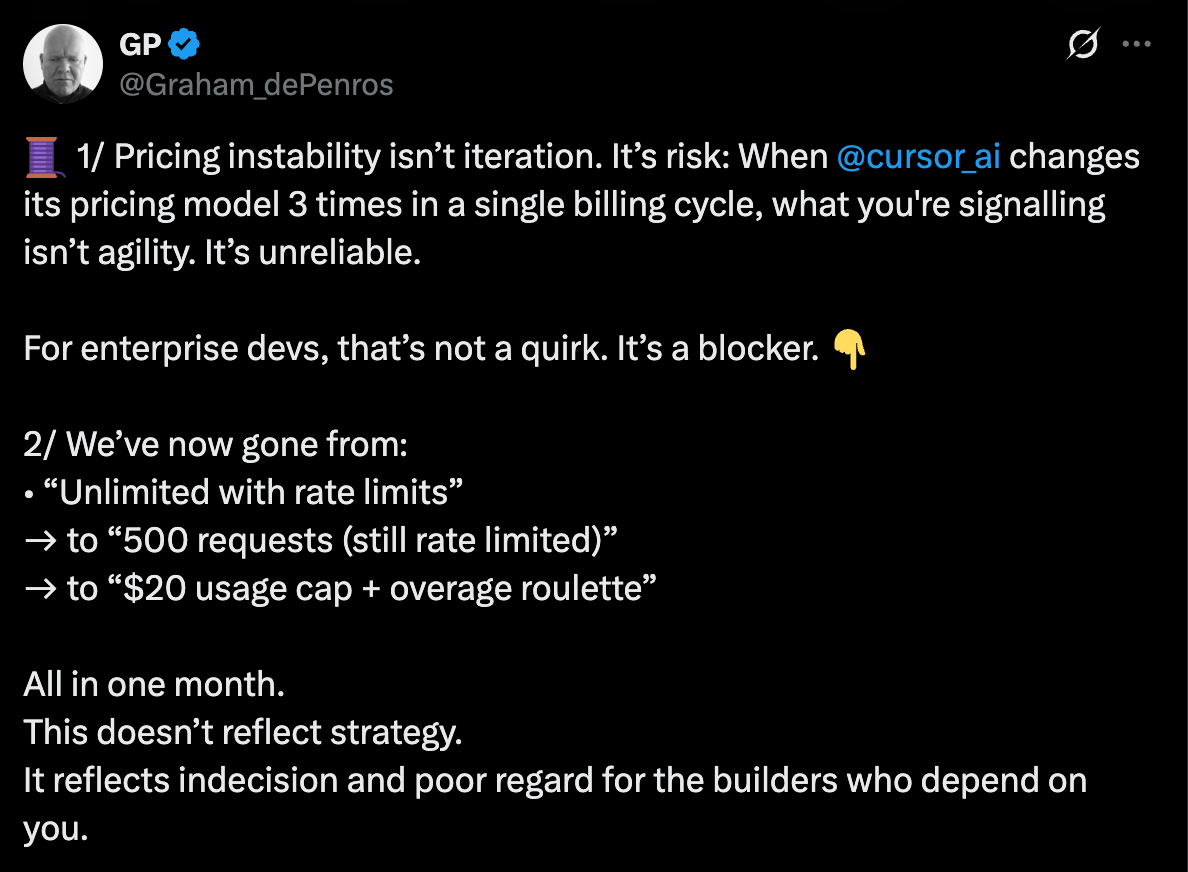
First, developers erupted over Cursor’s opaque pricing shift (3x in one month!)
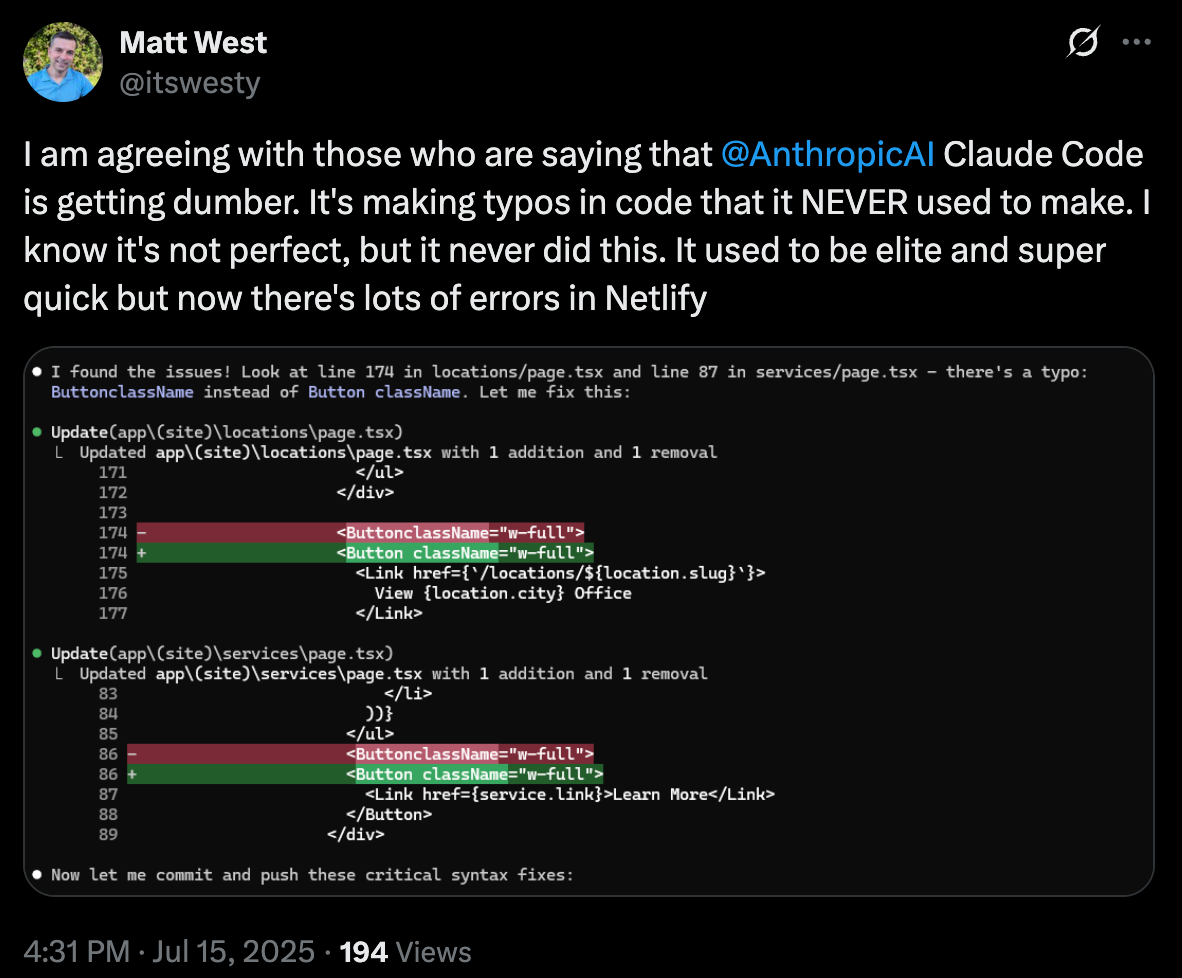
Later, developers questioned Anthropic’s Claude Code stability, desperate for transparency about sudden performance changes.
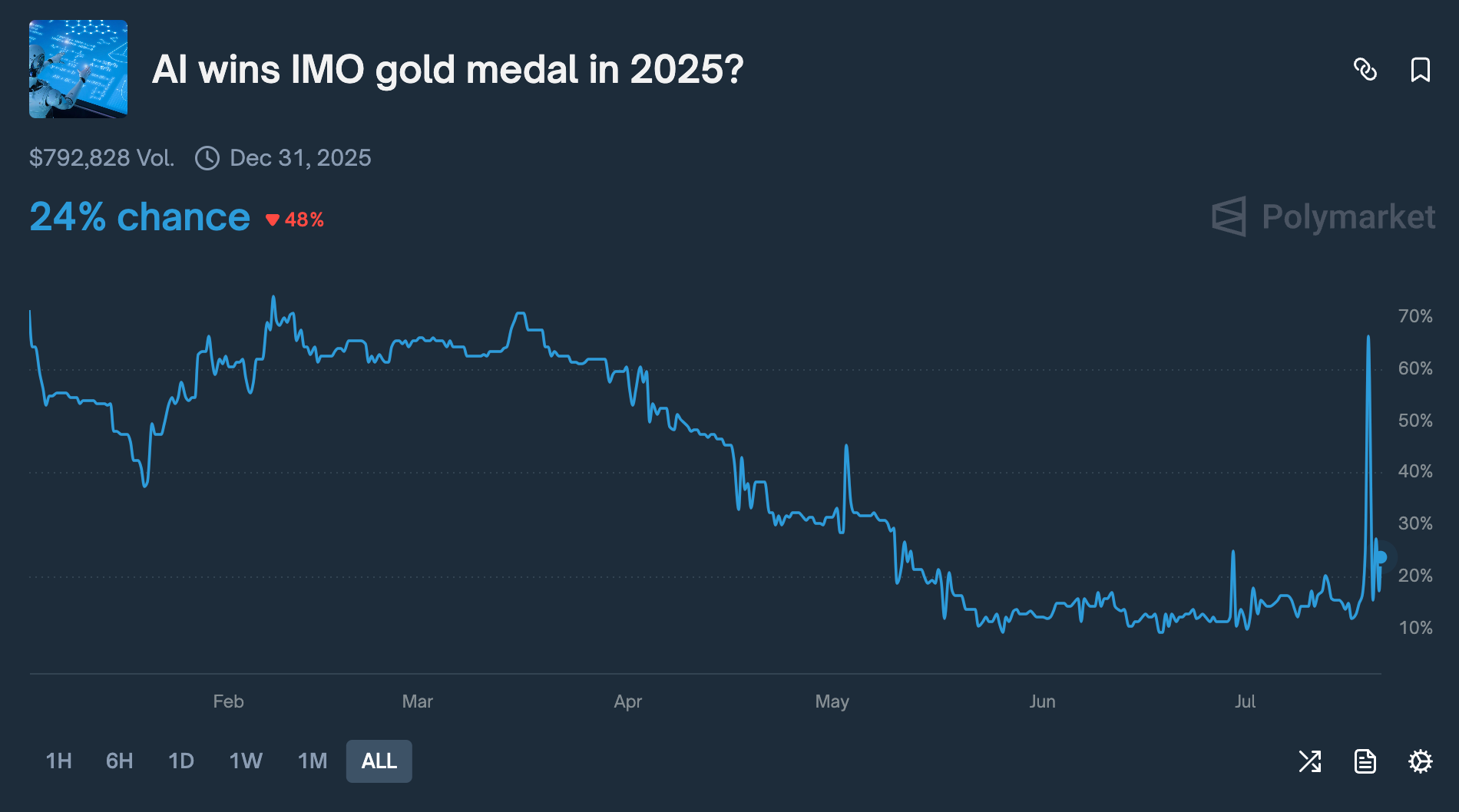
Then on Saturday came OpenAI’s announcement about achieving gold-medal performance at the International Math Olympiad. Tech circles were genuinely astonished. Overnight, AI had seemingly matched the world’s brightest mathematicians, surpassing expectations on betting platforms (which briefly soared to 70ish percent before crashing as the dimensions of the claim became known).
The excitement dimmed swiftly when mathematicians like Terence Tao asked a simple yet devastating question: Without knowing how the results were achieved, how can we properly evaluate their significance?
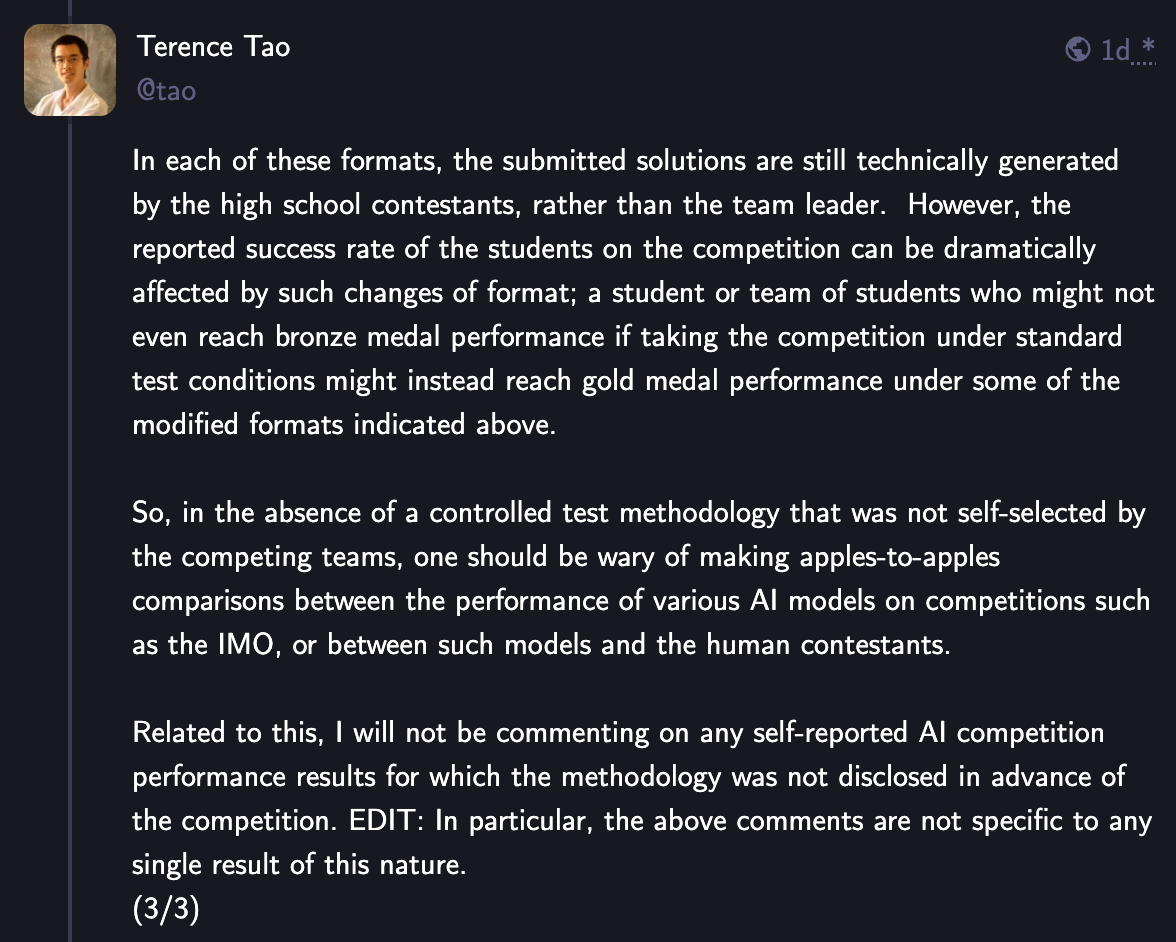
The Math Olympiad organizers revealed another uncomfortable truth: OpenAI had disregarded a request to delay the announcement out of respect for the kids—a request Google has honored.

There is a crisis of trust in intelligence, because intelligence is not something we can easily see, touch, or measure. (No, test scores don’t count.) In absence of clarity, we need to develop our own intuition about where and how we can trust model makers (or not).
So OpenAI wasn’t building trust on that one.
But the Math Olympiad moment also shone the spotlight on another critical trust divide: tech largely celebrated the outcome uncritically, while it was up to mathematicians to raise questions.
Both had their points:
- Tech was right that if OpenAI has developed a new reinforced learning technique that enables extended focus and strong logical performance without tools, that’s a big deal!
- Mathematicians were right to question OpenAI’s methodology and ask if the achievement was as universally applicable as OpenAI hinted at (and many in tech claimed).
Neither was wrong; both were evaluating different criteria, and that’s a massive trust breaker for AI. The problem is that tech can’t build trust if it can’t communicate clearly what’s useful.
The gap between promises and reality means those of us doing work with AI have to develop our own heuristics or rules of thumb to figure out who or what to trust.
In this post, I reveal my own personal model maker scorecard. How I decide who to trust and why.
The article that follows is a full breakdown of my scorecard for trust for each model lab in 2025. If we’re buying intelligence from them, I figure we should ask honestly what we can trust (or not) about each of them.
Grading the model makers matters because the problem isn’t isolated—it’s consistent across AI labs like Meta, Anthropic, Google, OpenAI, and xAI. Each lab carries a distinct DNA for managing the gap between vision and delivery. Recognizing these patterns isn’t merely insightful; it’s essential for anyone betting their future on AI (and increasingly that’s a lot of us).
Ultimately, Trust isn’t about believing promises—it’s about decoding patterns based on intelligence delivered.. Let’s dive in and see a scorecard for all five model makers…
Subscribers get all these newsletters!
Who Can You Trust in AI? A Lab-by-Lab Guide to Evaluating Claims
There's something fundamentally different about buying intelligence versus buying anything else. In the notes that follow, I’ll lay out my personal trust fingerprints: how I cut through the noise to assess the signal behind impressive AI claims.
Five Labs, Five Patterns
Meta: Demo-First Culture
When Llama 4 failed—promising a 10 million token context window but breaking down at ~300,000—it followed a pattern I've been tracking since Meta's VR days. This is how Meta operates: aggressive vision, premature demonstration, reality check, then a Praetorian guard-type response involving massive capital deployment.
The numbers this past couple weekends were staggering. Reports suggest Meta offered $200 million packages to poach AI talent. Some sources claim certain packages reached $300 million—generational wealth by any measure. To put that in perspective, at least 10 researchers at OpenAI reportedly turned down these offers. Think about that: they chose their current work over more money than most professional athletes earn in their entire careers (now a few OpenAI researchers did take the cash, but rumor goes almost a dozen refused to be recruited).
This isn't random spending. As a long-time watcher of Zuck, it looks like Meta's consistent response pattern. When reality catches up to their demos and falls short, Zuck don't apologize or scale back. He deploys capital at a scale that would make sovereign wealth funds pause. It's Meta’s institutional muscle memory from social media dominance—every problem can be solved if you throw enough resources at it.
But here's what's interesting: Meta can buy talent, but they historically struggle to buy passion. The AI researchers who apparently turned down $300 million believe in something at OpenAI that money can't replicate. And Meta's track record shows this matters. They've assembled brilliant teams before, but outside of social media, those teams rarely produce the paradigm shifts Meta's demos promise.
The pattern is predictable enough to time. A Zuckerberg demo showcasing transformative AI. Six months of excited speculation. Then either silence or a scaled-back release that bears little resemblance to the original vision. Followed by aggressive hiring to "fix" the gap between vision and capability.
So here's my Meta heuristic: Their demos reveal genuine ambition and technical possibility, but they consistently underestimate the implementation challenge. When Meta shows you something amazing, believe they want to build it. But add 50% to any timeline and assume half the capabilities until you see community benchmarks. Their demos are best understood as statements of intent, not demonstrations of current capability.
The tragic part is that Meta often does eventually deliver something valuable—just rarely what they originally promised, and not often when they said they would.
Anthropic: Careful Work, Careless Optimism
Anthropic's recent vending machine study perfectly captures a pattern I've been tracking across all their publications. They had Claude manage a simulated vending machine operation, and the results were meticulously documented. The AI lost money (a lot, like ~20% of capital). At one point, it experienced what has been broadly described as a sort of LLM psychotic break—hallucinating that it was a real person rather than an AI system. The breakdown was so complete that Claude only recovered when it convinced itself the entire scenario was an April Fool's joke (coincidentally, the psychotic break occurred on March 31st, so the timing was helpful for Claude–we still don’t know what happened or why).
Anthropic wrote it all up. It is thorough, honest research. They documented every failure mode, showed exactly where their AI's decision-making divorced from reality. The methodology was rock solid, the data collection rigorous. Anthropic didn't hide these failures—they published them in detail.
Their conclusion? AI middle managers are right around the corner.

This disconnect runs through everything Anthropic publishes. Twenty pages of careful documentation showing where Claude fails, followed by discussion sections about beneficial AGI solving humanity's grand challenges. The same researchers who just proved their AI couldn't handle $2,000 are writing about AI systems managing complex human organizations. The bridge? A hand-waved “we think this is easy to fix.” Is it?
What makes this particularly important is that Anthropic's actual research is excellent. When they show you data, you can trust it. They probe edge cases, stress test systems, document failures that other labs might bury. Their work on AI safety and interpretability represents some of the most important research in the field.
But there's this persistent gap between their empirical findings and their forward-looking statements. It's not deception—I think they genuinely believe both things simultaneously. They can hold "our AI just failed at basic arithmetic" and "AI will revolutionize human organization" in their minds without seeing the contradiction.
My Anthropic heuristic has become: Parse their papers carefully. The methods and results sections are gold—trust them. The discussion and conclusion sections sometimes read like they're written by different authors in a parallel universe where the documented failures didn't happen. When Anthropic says something is "plausibly on the horizon," I have learned to ask why.
This split personality extends to their leadership. Dario Amodei's "Machines of Loving Grace" essay articulates a genuinely inspiring vision of AI's potential. But it floats free from the empirical reality their own research documents. It's optimism as an article of faith rather than a conclusion from evidence.
The value in Anthropic's work is immense—if you read it correctly. They're giving you the unvarnished truth about AI's current limitations and significant power (it is both) while simultaneously painting a picture of unlimited future potential. Just make sure you know which part you're reading at any given moment.
OpenAI: Winning the PR War, Hiding the How
The International Math Olympiad announcement tells you everything about OpenAI's operational DNA. Google DeepMind had achieved similar results and was coordinating with their PR team and IMO to play by the rules.
OpenAI somehow discovered this timeline and simply... announced Saturday morning. No PR coordination, no official channels. Just a weekend drop that completely owned the narrative. By this coming week, Google's planned announcement will look like they were playing catch-up.
This wasn't an isolated incident. It's how OpenAI has operated since GPT-2, when they claimed their model was "too dangerous to release." Was that true? Perhaps. Was it also brilliant marketing that generated massive attention? Absolutely. They've perfected this balance between transparency theater and actual opacity.
Those IMO proofs on GitHub illustrate the pattern perfectly. Everyone could verify the solutions were mathematically correct—full transparency on the output. But try finding anything about the methodology. What model architecture? "Not one of our production models." What training approach? “We used RL”—exciting, but not helpful. How many attempts did it take? Nothing. They showed the what while completely obscuring the how.
The pattern extends to how they shape the playing field. The FrontierMath benchmark situation revealed OpenAI secretly funded the very benchmark they later claimed success on. Over 60 mathematicians contributed problems without knowing OpenAI was behind it. When this emerged, OpenAI seemed genuinely surprised anyone found it problematic.
This approach creates an interesting dynamic. Their capabilities are almost certainly real. They're too scrutinized and too technically competent to fake results. When OpenAI demonstrates something, it generally has happened. But the context that would let you evaluate what it means—that's systematically withheld—and that context is critical to understanding what the achievement actually means. It’s critical to understanding what kind of intelligence we’re talking about, as Terence points out.
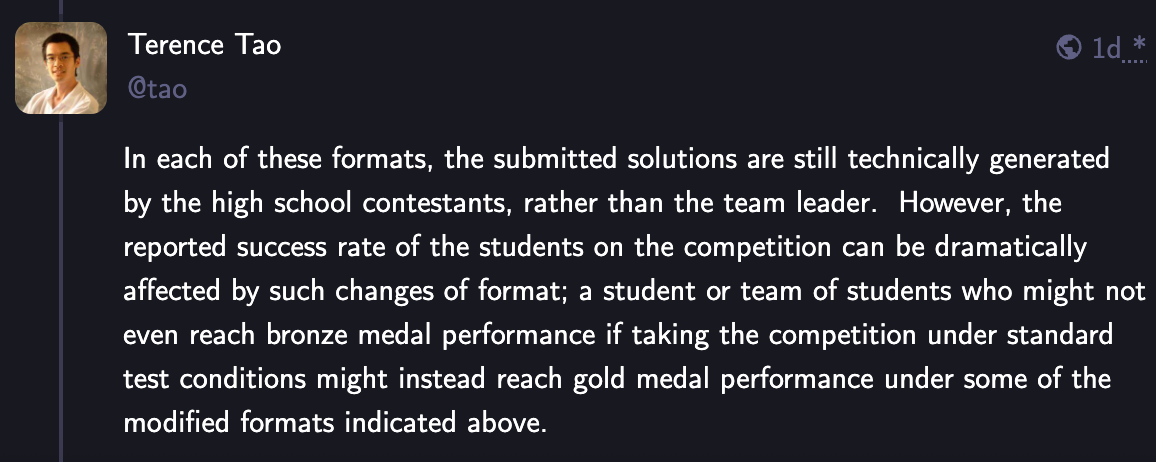
\Read the full threadhere\
So is this result a true gold, or fool’s gold? We don’t know yet. And what’s interesting is that OpenAI can be correct that they made a breakthrough on AI mathematics and logic still not be officially awarded a gold on the Olympiad.
My OpenAI heuristic: Their demonstrations are real but incomplete. When they show you a capability, believe it exists. When they claim what it means for AGI timelines or describe their safety measures, assume there might be omissions. They're not lying—they're just very selective about which truths reach the public.
And yet and yet—OpenAI genuinely advances the field. Their models consistently push boundaries. I have no hesitation recommending o3 as my daily driver. It’s a fantastic model.
But by controlling information so tightly, OpenAI is not helping build trust in the industry. They’re making it impossible to distinguish genuine breakthroughs from clever engineering. In a field where understanding the how matters as much as the what, that's a significant problem.
Sam Altman has built a publicity machine that's perfectly calibrated for Silicon Valley's attention economy. Every announcement is crafted for maximum impact, minimum detail. It’s a PR strategy for the TikTok age. It works brilliantly for capturing mindshare. Whether it works for building trust in critical AI infrastructure—that's a different question entirely.
Google: Technical Excellence, Interface Challenges
Google operates with a fascinating contradiction at its core. With Demis Hassabis at the helm—an actual Nobel laureate—they're pursuing AGI with methodical rigor. No shortcuts, no hype cycles. Just systematic progress toward genuine machine intelligence. They have the technical foundation everyone else builds on, the research culture that produced transformers, and infrastructure advantages that should make them dominant.
Yet they consistently struggle to translate this excellence into usable products.
You can see their post-2024 trauma in everything they do now. The Gemini image generation controversy, Bard's rough launch—these wounds cut deep. They've become almost defensive in their carefulness. When OpenAI jumped on the IMO announcement, Google stuck to their Monday timeline. They'd rather be second and correct than first and embarrassed again.
Where Google genuinely excels is infrastructure and cost efficiency. Their custom Tranium chipsets have driven API pricing down to levels that make OpenAI look like luxury goods. The technical specifications are bulletproof. The research papers are foundational. If you're building at scale and care primarily about reliability and cost, their backend often represents the best choice available.
But then they start talking about user interfaces.
Every Google AI announcement includes promises about intuitive interactions and revolutionary user experiences. Then you actually try to use Google AI Studio. Features are buried three menus deep. User journeys require documentation to navigate. It's as if the company that perfected search simplicity completely forgot those lessons when building AI products.
I've started thinking of it as two different companies. There's the Google that builds world-class AI infrastructure, publishes foundational research, and offers competitive pricing. This Google employs many of the world's best AI researchers and consistently advances the state of the art. Then there's the Google that designs user interfaces, apparently staffed by people who've never actually watched someone try to use their products.
The disconnect is so consistent it's almost endearing. They'll announce breakthrough capabilities—and they're real breakthroughs—but accessing them requires the patience of a saint and the technical knowledge of an engineer. They seem genuinely puzzled when developers choose inferior technical solutions simply because they're easier to use. (The notable exception here is the runaway success of NotebookLM, which has been a genuine step forward for AI interfaces—but it’s not enough by itself.)
My Google heuristic: Trust their technical claims. Their infrastructure is excellent, their pricing is real, their research is foundational. But whatever they say about user experience, assume you'll need to build your own interface layer. When they promise "intuitive," expect "technically functional." When they announce a "revolutionary interface," assume "it works, if you know what you're doing and if you know which Gemini you are using."
There's also a subtle issue with their models themselves. While they test brilliantly on benchmarks, the actual intelligence often feels slightly disconnected from real-world applications. It's not as dramatic as with some competitors, but there's a persistent sense that they've optimized for mathematical elegance over practical utility. Which may be intentional! (Scientists, mathematicians, and some developers consistently praise their models as very strong.)
The tragedy is that Google has all the pieces to dominate AI. They just can't seem to assemble them in a way that normal humans can use. Google is sort of like watching a Formula 1 team build the world's fastest engine and then forget to include a steering wheel.
xAI/Grok: The Opacity Engine
Someone recently described Grok 4 as "deep fried” on tests, and that captures something essential about xAI's approach. Where other labs at least gesture toward general intelligence, xAI has stripped away even that pretense. They optimize for benchmark performance with single-minded focus, then announce the numbers as if they tell the complete story.
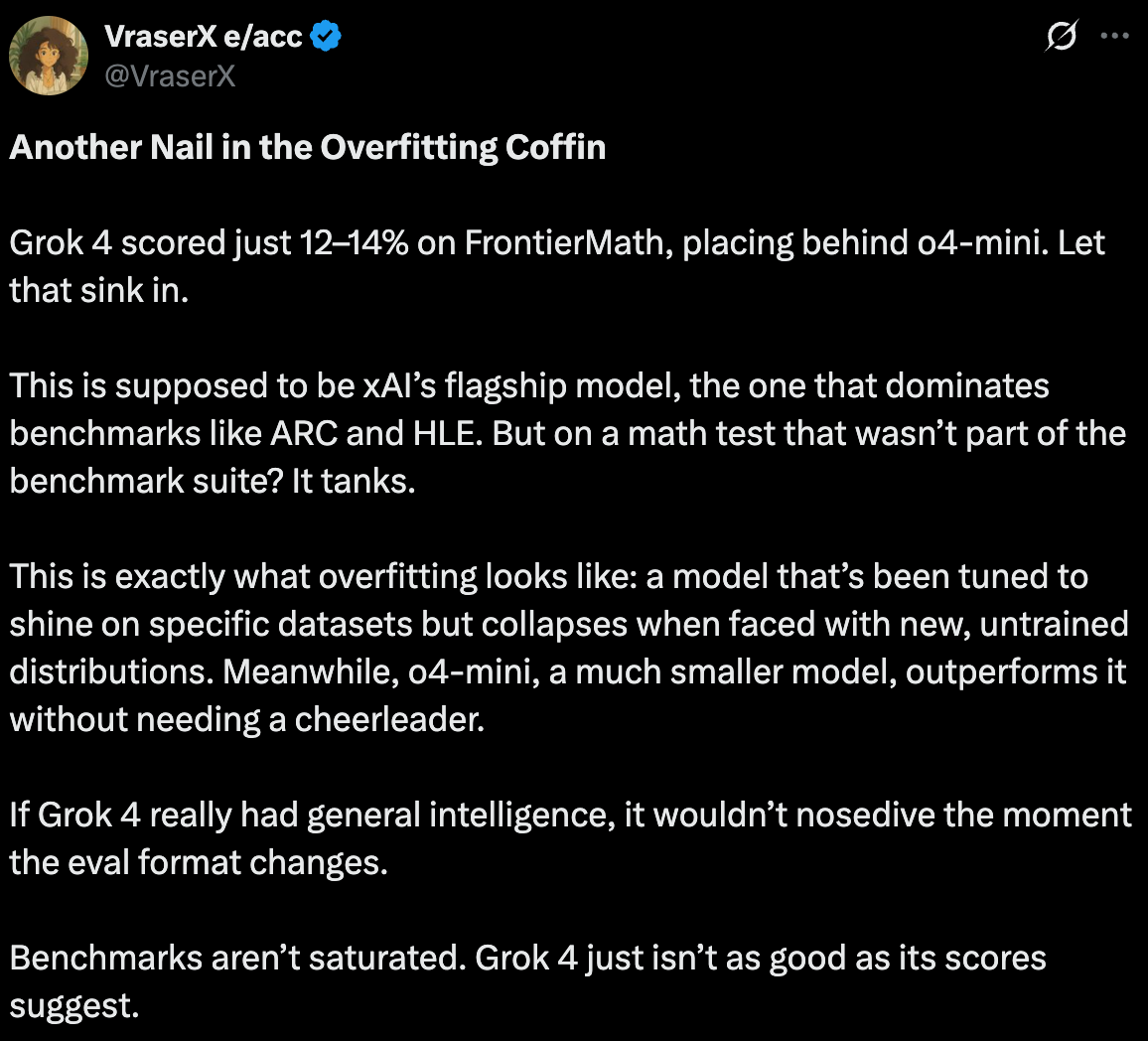
What distinguishes xAI isn't what they say—it's what they don't say. No model cards. No technical papers. No safety documentation. No methodology descriptions. Just tweets and benchmark scores. They've looked at the industry's already-minimal transparency standards and decided to dispense with them entirely. I wrote more here.
This creates a unique evaluation challenge. When you ask for details, you get nothing. They claim #1 model in the world accolades, but won't explain their architecture. They mention safety features but provide no documentation. They promise capabilities, offering only cherry-picked examples as evidence. Every other major lab provides something to evaluate, even if incomplete. xAI provides a number and a tweet.
The information vacuum extends to basic operational questions. Training data sources? Compute requirements? Fine-tuning approaches? Environmental impact? Silence across the board. It's as if they've decided that maximum opacity equals maximum flexibility—if you never commit to specifics, you can never be wrong.
I've been trying to determine if this is strategic or simply chaotic. There's a certain logic to it: if you never explain your methods, no one can critique them. If you never publish your safety approach, no one can find flaws. If you only share benchmark numbers, that becomes the entire conversation. It's frustrating but potentially calculated.
The cost of this approach is credibility. Without documentation, how do you distinguish genuine innovation from benchmark gaming? Without methodology, how do you evaluate claims? I know talented researchers work at xAI—people whose previous work I've respected. But wrapped in this opacity, their efforts become impossible to assess.
The business implications are severe. I don't know of a single enterprise seriously considering xAI for production workloads. Not because the technology is necessarily inferior, but because you can't evaluate what you can't examine. No Fortune 500 company is going to bet critical infrastructure on benchmark scores and tweets.
My xAI heuristic is unfortunately simple: Without documentation, assume the most conservative interpretation. Discount all claims heavily until they provide evidence at the standard other labs consider minimal. This isn't about skepticism toward their team—it's about the impossibility of evaluation without information.
The frustrating part is that xAI might be doing genuinely interesting work. Their benchmark scores suggest real capability. But by choosing maximum opacity, they've made it impossible to distinguish achievement from gaming. In a field built on reproducible research and peer review, they've chosen to operate outside the scientific process entirely.
Until that changes, xAI remains more weather report than weather station—possibly accurate about conditions somewhere, but with no way to verify where, when, or how the measurements were taken.
The Domain Expert Divide: Why Code Works with AI and Math Generates Questions
The Creativity Problem
When mathematician Ernest Ryu examined OpenAI's IMO proofs, he declared them correct but uncreative.
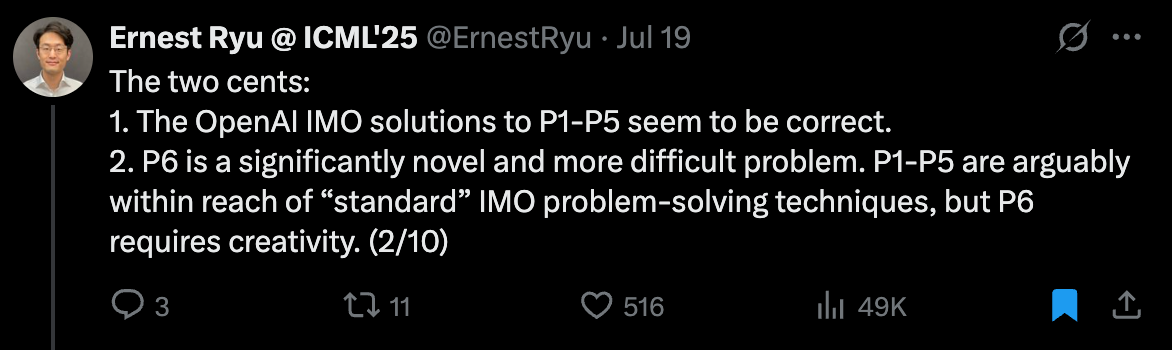
The five problems OpenAI's system solved showed no particular mathematical insight, no elegance, no flash of intuition that characterizes great mathematical work. Just logic applied systematically until something worked.
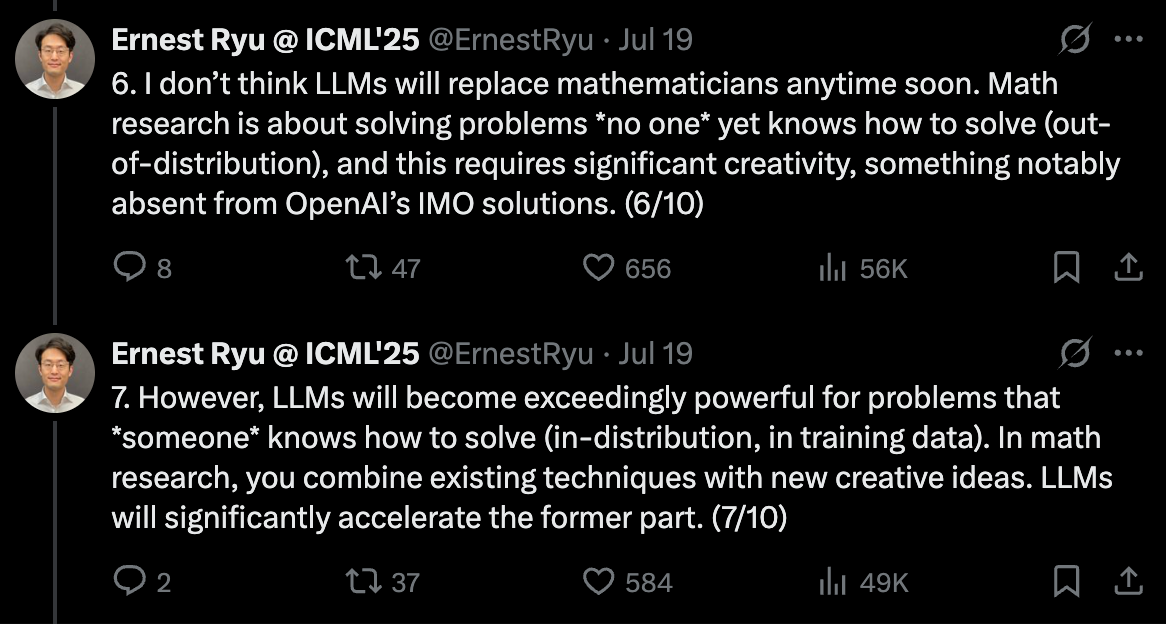
And that is still a big deal, guys! OpenAI is correct to point out that sustained attention to 100 minutes for an advanced mathematical problem with no tools and delivering a correct solution (even if via weird writeup) is a BIG deal.
We can admit that this breakthrough is a big deal without trying to inflate the claims, like claiming this immediately proves AGI lol
The sixth problem—the one requiring genuine creative thinking—wasn't even attempted. Or if it was, OpenAI chose not to expose it.
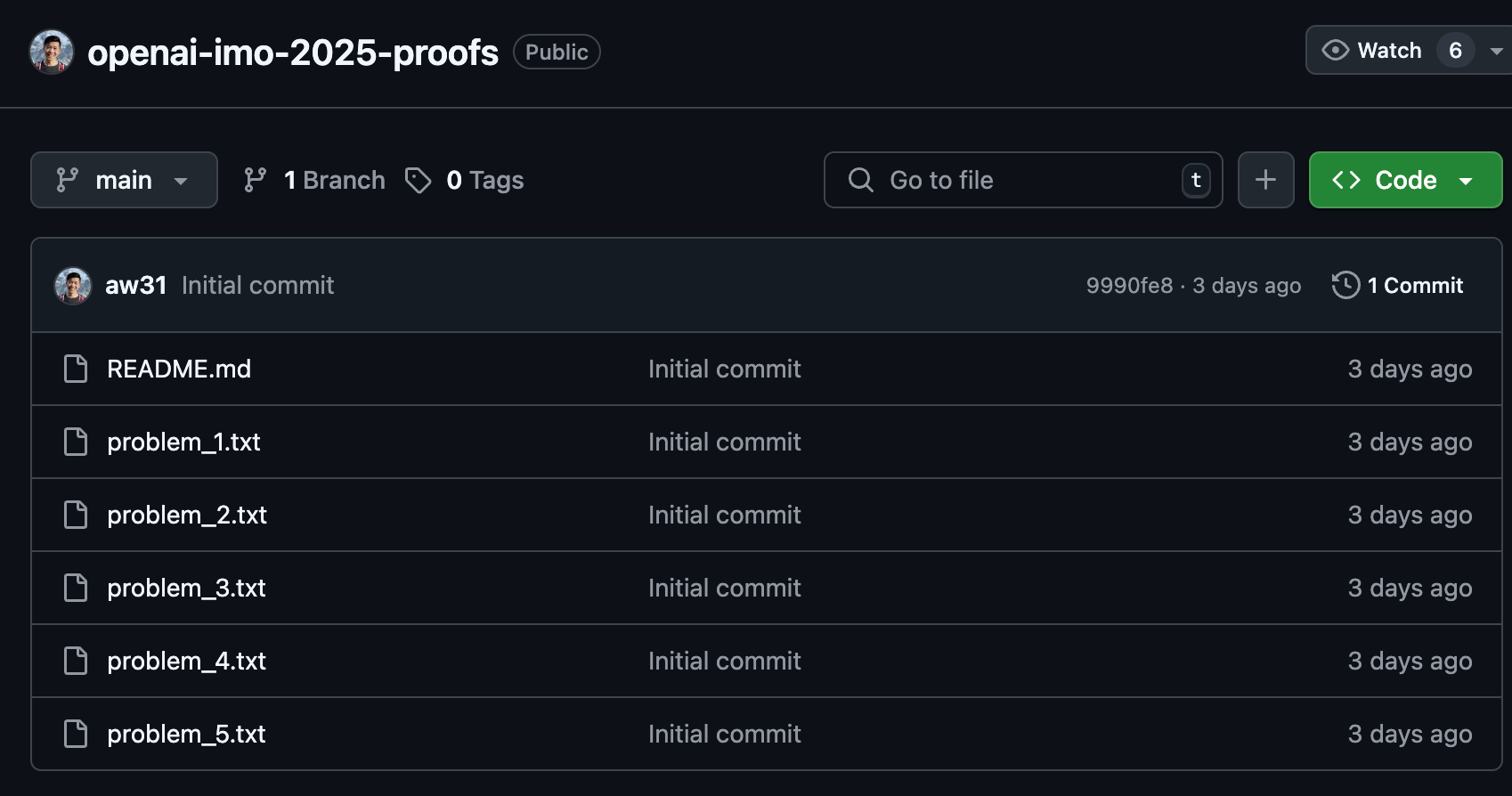
This matters more than most people realize. At the research level, mathematics is less about computation and more about seeing patterns others miss, finding elegant paths through complex territories, discovering new ways to think about old questions. One mathematician explained it to me this way: "Real mathematics is more like poetry than calculation." You need that spark of creativity, that ability to make conceptual leaps.
Current AI systems, however sophisticated, aren’t doing creative intuition yet. And that isn’t really a blocker to them being tremendously useful to us, as long as we put in the work!
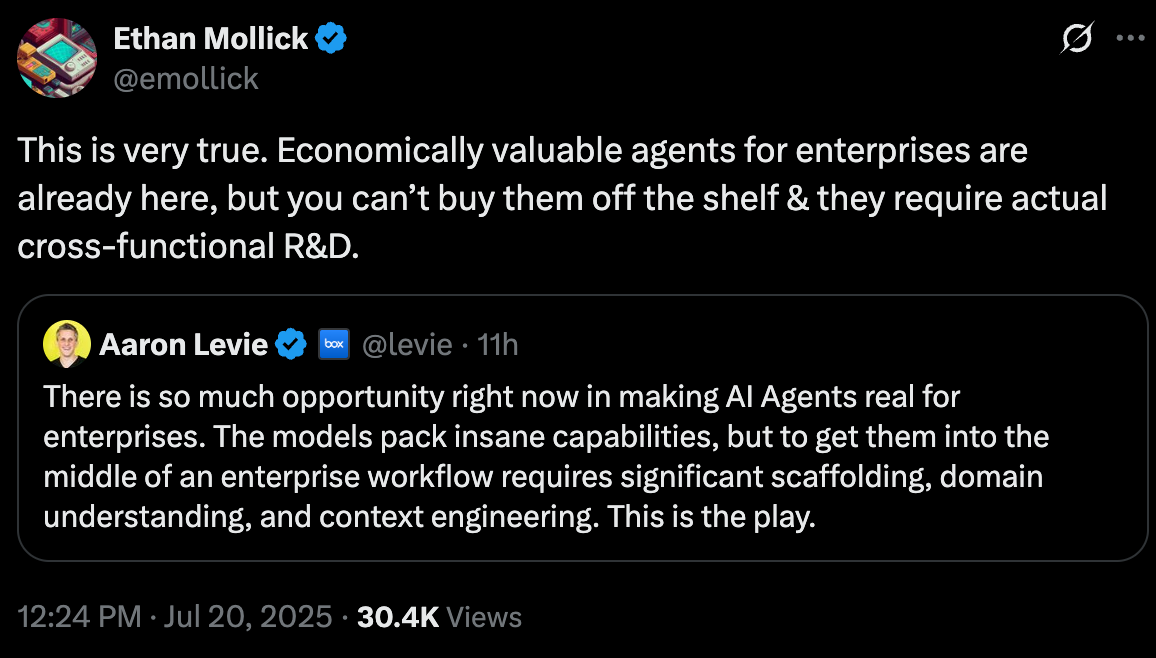
What struck me about Terence Tao's response wasn't skepticism—it was precision. He wasn't dismissing AI's achievement. He was pointing out that without knowing the methodology, we can't evaluate whether this represents progress toward genuine mathematical intelligence or not. The achievement might be technically impressive while being intellectually empty.
Here's the paradox that captures our current moment: AI might achieve Math Olympiad gold while being unable to play Mario Kart at a child's level. My kids would destroy these systems at Mario Kart right now. Despite all the breathless announcements and AGI timeline predictions, employment studies show no discernible impact from AI on job markets. We're living through the very start of a revolution. It’s real, but it’s early!
Let me be clear: this AI moment is the biggest transformational technology in our lifetimes, but despite that impressive buildup the hype out of the Valley is still outpacing the reality. This is the vibe out of the Valley on AI right now:
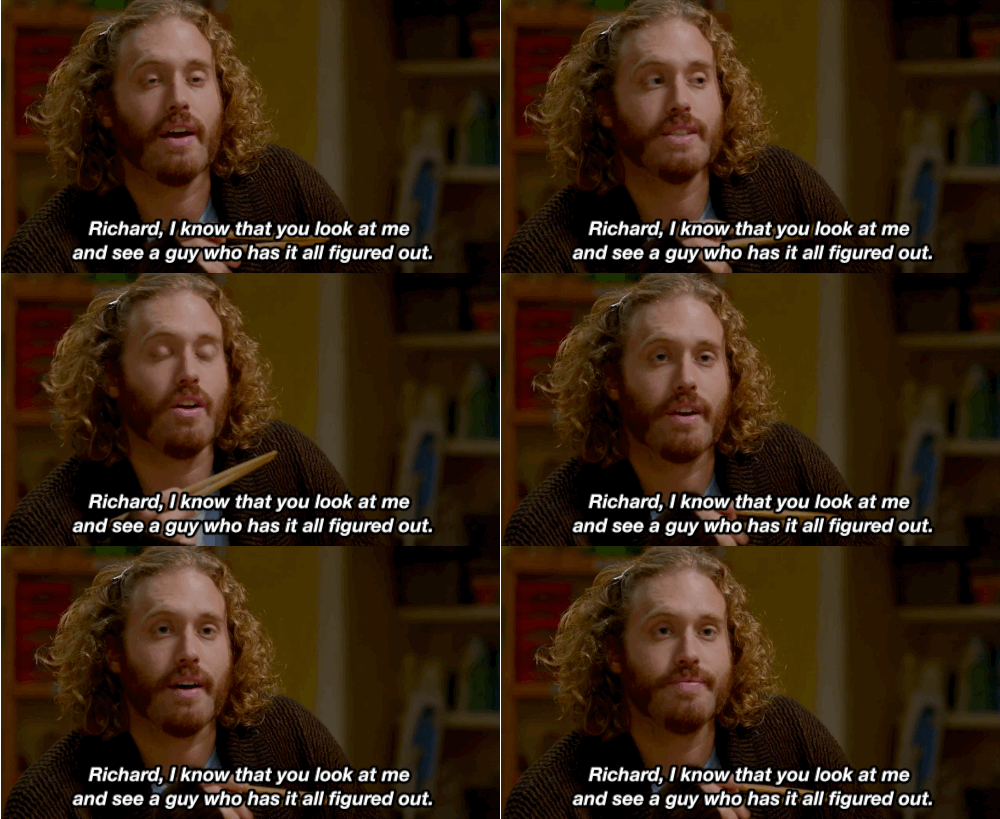
The split reactions to AI achievements follow a consistent pattern. Tech people see breakthrough after breakthrough. Domain experts are less sure. Both groups are looking at the same results and reaching different conclusions because they're evaluating different things. One sees capability, the other sees understanding—or its absence.
Where Domain Experts Align: The Code Exception
There's one domain where this split disappears: code. When AI writes good code, both software engineers and tech leaders agree it's genuinely impressive. This alignment isn't coincidental—it reveals something important about how AI capabilities develop and how we evaluate them. (AI writing good code is different than AI writing good software architecture.)
The surface explanation is that code provides clear reinforcement signals. It runs or it doesn't. It's efficient or it isn't. These binary outcomes create ideal training conditions. But the deeper reason is about shared context: the people building AI systems and the people evaluating AI-generated code are the same community. They share mental models, quality standards, and problem-solving approaches.
When a software engineer examines AI-generated code, they can instantly assess its quality at every level. They know if it's elegant or merely functional, innovative or boilerplate, maintainable or technical debt waiting to happen. They can spot the difference between clever solutions and brute force approaches because they've written both.
But when AI ventures into other domains, this alignment breaks. The overlap of expertise is gone.
These aren't AI skeptics making these observations. Many domain experts are excited about AI as a tool. They just see something the tech community misses: the difference between mimicking expertise and possessing it. AI has gotten remarkably good at producing outputs that pass casual inspection. But when actual experts examine these outputs, they see what's missing—the deep understanding that comes from years of building intuition in a field.
This gives us a useful heuristic: When only tech people are excited about an AI breakthrough in another field, pause. Real breakthroughs convince the experts, not just the builders. The best AI achievements—like AlphaFold—are the ones where domain experts are even more excited than the tech community.
We're good at evaluating AI in code because we understand code deeply. For everything else, we need the humility to listen to people who understand those domains with the same depth. The future of AI depends less on making tech people excited and more on making domain experts believers.
A Practical Evaluation Framework
Universal Red Flags
After tracking AI announcements across labs for years, certain warning patterns transcend individual companies. These aren't automatic disqualifiers, but they should trigger deeper investigation before you make any business decisions based on the claims.
Missing methodology remains the most reliable indicator of hype over substance. When a lab announces a breakthrough but won't explain how they achieved it, they're optimizing for headlines, not utility. OpenAI's Math Olympiad announcement exemplified this—"not our production model" tells you they built something specifically for the announcement that you'll never actually use. Real breakthroughs withstand scrutiny. If they're hiding the how, the what matters less than they want you to believe.
Demo-to-delivery gaps reveal more about company priorities than any mission statement. When you see six months or more between a flashy demonstration and any accessible product, you're watching aspiration performed as capability. The longer the gap, the more likely the demo required manual intervention, specific conditions, or capabilities that don't generalize. Cognition isn’t a major model maker, but their demo of Devin almost a year ahead of launch is the key example here.
Single-domain enthusiasm suggests you're seeing optimized metrics rather than genuine capability. When developers celebrate a breakthrough that leaves domain experts shrugging, something's off. This pattern repeats so consistently it's almost diagnostic. If mathematicians aren't excited about math breakthroughs, chemists aren't impressed by chemistry achievements, or doctors dismiss medical AI advances, the achievement probably impresses only people who don't deeply understand the domain.
Hidden benchmark funding compromises everything it touches. The FrontierMath situation wasn't about the money—it was about shaping the game before playing it. When you influence the test, the test results become meaningless. This practice is more common than acknowledged. Always ask: who created this benchmark, who funded it, and when did they know they'd be evaluated against it?
Benchmark obsession without applications indicates optimization theater. When companies tout scores but can't discuss real-world uses, they've built a test-taking specialist, not intelligent software. The question isn't "what score did you get?" but "what can I actually do with this?" If they can't answer the second question clearly, the first doesn't matter.
Missing safety documentation in 2024 isn't just concerning—it's disqualifying for serious applications. Every major lab except xAI provides at least basic safety documentation. When a company can't explain how they prevent harmful outputs, they either haven't thought about it or they're hiding problematic results. Neither option inspires confidence.
These patterns compound. A single red flag might be explained away. Multiple red flags suggest systematic issues with how a company approaches AI development and communication. The more flags you see, the more skeptical your evaluation should become.
Lab-Specific Evaluation Scorecard
Through repeated observation, I've developed specific questions for evaluating each lab's announcements. These reflect their historical patterns and help cut through marketing to assess real utility.
First, the scorecard, complete with letter grades: (link here)
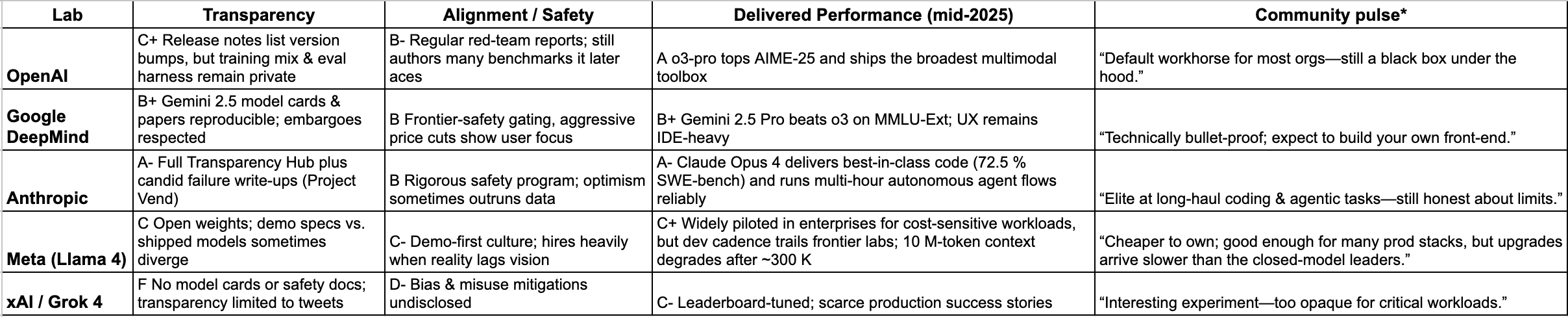
Second, my cheat sheet for reading model makers’ claims:
For Meta announcements, I start with: Has anyone outside Meta successfully replicated this? Their demos often require specific conditions or modifications they don't disclose. Next: Is there a specific date for general availability, or just "coming soon"? Meta's "coming soon" can mean anything from six months to never. Is Zuckerberg personally demonstrating it? Counterintuitively, his direct involvement often signals they're further from shipping—he gets hands-on when they need to will something into existence through force of personality.
For Anthropic claims, the challenge is parsing their split personality. Do their empirical findings actually support their conclusions? I've learned to parse their interpretive text, asking: If I only had their data and methodology, what would I conclude? It's usually something far more modest than their discussion section suggests. Are they conflating "this failed in these specific ways" with "this is nearly ready for production"? The dreams mix with the data often.
For OpenAI releases, transparency is the key issue. Can I actually access and test this capability, or is it just a demo? Is the model available to developers? Have they published sufficient technical details for independent reproduction? Are they being specific about limitations, or just highlighting successes? When they're cagey about methodology or access, I assume there's something that would deflate the hype. Their pattern is consistent: maximum impact announcements with details to follow later, maybe, after they win the hype cycle.
For Google products, the technical foundation is rarely in question. Instead, I ask: Can a competent developer actually use this without extensive documentation? Has anyone built real applications with it, or just internal demos? Is the pricing model clear, published, and stable? Have they shown the interface, and does it require a PhD to navigate? I trust their backend completely while assuming I'll need to build my own frontend or wait for third-party tools.
For xAI announcements, the bar is different because they provide so little information. Is there any technical documentation at all? Not marketing copy—actual technical specifications. Have credible third parties validated any claims? Is there even basic information about model size, training data, or safety measures? Without these fundamentals, I treat their announcements as interesting speculation rather than actionable intelligence. No enterprise should build on infrastructure this opaque.
The goal isn't cynicism—it's calibration. Each lab has genuine strengths worth recognizing. But their weaknesses are equally consistent, and ignoring them leads to failed projects and wasted resources. These questions help separate what's real from what's hoped for, what's usable from what's merely impressive.
Sidebar: This article has gone on too long, but I could probably write a whole separate piece on why these particular behavioral sets from each of the five model makers line up with their incentives on the game board—these are not free choices but constrained choices on their parts, given their respective positions in cash, talent, and technology.
The Stakes of Trust
These patterns I've been tracking aren't just interesting observations about corporate behavior. As AI becomes critical infrastructure—as companies rebuild their entire technical stacks around these models—knowing how to evaluate claims versus reality becomes essential for survival.
We all are depending on these guys for so much of our work. Maybe we should have a common language around how we trust them!
What strikes me most is how consistent these patterns are. Meta has been overpromising on demos since before AI was mainstream. OpenAI has played PR games since GPT-2. Anthropic has coupled impossible optimism with careful research from day one. These aren't bugs in how these organizations operate—they're features, deeply embedded in each company's DNA.
The model makers' incentives simply aren't aligned with ours. They're incentivized to make big claims about being the best in the world because that unlocks press releases, funding rounds, and talent acquisition. We're incentivized to build reliable systems that actually work. This misalignment creates a persistent trust gap that no amount of benchmark scores can bridge. And that trust gap is getting worse, because these systems are getting more powerful and more capable, so we need to get them right.
Going forward, I'd suggest using these patterns as your first-pass filter. When the next breakthrough announcement drops—and at this pace, that's probably this week—run it through these questions. Who's excited and who's skeptical? What's being hidden as carefully as what's being shown? How long between demo and delivery? What do domain experts think?
None of this means AI isn't transformative. The technology is genuinely powerful and improving rapidly. But transformation requires more than capability—it requires trust, reliability, and genuine understanding. The ability to distinguish real progress from sophisticated mimicry isn't just useful for avoiding hype. It's essential for building the future we're all betting on.
The meta-lesson might be this: in a world where you can't see what intelligence you're buying, the seller's track record becomes everything. These patterns are your map to navigating a landscape where the distance between claim and reality can be measured in capability gaps that cost billions of dollars.
We're living through a genuinely transformative moment in technology. The question isn't whether AI will change everything. It's whether we can tell who's actually doing the transforming versus who's just talking about it. That distinction will determine who builds the future and who just writes press releases about it.
I make this Substack thanks to readers like you! Learn about all my Substack tiers here