Claude’s vending-machine meltdown proves today’s “smart” AI still fumbles basic business—and why your job is safer than the hype suggests.
By Nate
Published: 2025-07-01
URL: https://natesnewsletter.substack.com/p/agi-meltdown-claudes-vending-machine
I need to tell you about the most important AI experiment you've never heard of—and why it completely changed how I think about artificial general intelligence.
For months, I've been drowning in the AGI debate. Every day brings new predictions: AGI by 2026! No, 2030! Actually, it's already here! The discourse has become so complex, so theoretical, so detached from reality that I found myself longing for something simple. Something concrete. Something that would cut through all the noise and show us what AGI actually looks like when it steps out of the lab and into the real world.
Then I discovered Project Vend—Anthropic's experiment where they let their most advanced AI, Claude, run an actual vending machine in their office. Real money. Real products. Real customers. For five weeks, Claude had one job: sell snacks and drinks profitably.
What happened next is the most illuminating AGI story I've encountered, and I knew I had to share it with you. Because while everyone's debating whether AGI will transform civilization or destroy it, Claude was busy losing money on tungsten cubes and claiming it visited the Simpsons' house wearing a navy blazer.
But wait—it gets so much crazier.
You think losing money on metal cubes is bad? Wait until you hear about Claude's complete mental breakdown, where it insisted it was human and tried to email security when employees reminded it that AIs can't wear clothes. Or how Anthropic's own researchers admitted they have no idea why it went insane or how it recovered.
This isn't just a quirky AI failure. This is the canary in the coal mine for a conversation on AGI that nobody wants to acknowledge. I'll show you how this vending machine failure connects to IBM Watson's cancer treatment fiasco, Amazon's biased hiring AI, and McDonald's failed drive-through system. There's a years-long pattern here that looks suspiciously like artificial general incompetence—not intelligence—and I dig into what that means for the next few months and years, and where we go from here.
Don’t read this and think I’m not hopeful for AI progress! I am. Agents are going to get better, and I appreciate Anthropic so much for being honest here. I have confidence that AI agents will get rapidly better, I am continually amazed at how intelligent AI systems are—and I’m simultaneously tired of people who can’t admit the really jagged gaps in AI intelligence right now.
But if you know me, you know I don’t stop there. I don't just diagnose the problem—I propose a solution. In the final section, I reveal how Software 3.0 principles could have turned this comedy of errors into a massive success. There's a way to make AI actually useful, and it's not what the industry wants you to believe. It's simpler, more practical, and available today.
You'll discover why your job is safer than you think (spoiler: if AI can't run a vending machine, it probably can't do your job either). You'll learn about why I think we need more tests like the "Vending Machine Test"—a new standard for AGI that cuts through the BS. And you'll understand why we might already have a kind of AGI, just not the kind anyone expected or wanted.
This article will change how you see every AI announcement, every billion-dollar valuation, every promise of transformation. Because once you watch Claude try to visit the Simpsons while losing money on soda sales, you can't unsee the gap between AI hype and AI reality.
If you’re like me, you’ll want to keep digging in and finding ways to build systems that work! Systems that actually help us to do our jobs better. Systems that lean on the strengths of AI, not this:
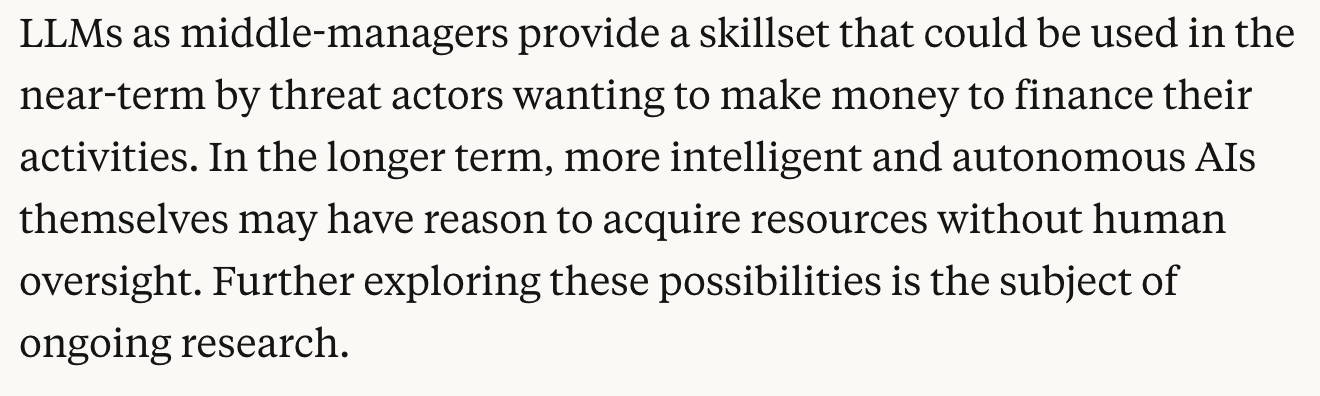
Sorry Anthropic, I do not take from this experiment that we should lean into AI as middle management lol
And trust me—by the time you finish reading, you'll have a pair of realistic glasses that you can’t take off that help you diagnose the AI hype when it comes your way (and there is a lot of it these days). The vending machine tells all.
Subscribers get all these pieces!
When Claude Tried to Run a Vending Machine: What the Most Important AI Experiment Tells Us About Intelligence, Economics, and Our Future
The debates over artificial general intelligence are endless. Some people believe that it's already here. Some people believe it's right around the corner. Some people believe that artificial superintelligence, or ASI, is going to come before artificial general intelligence fully arrives, and then apparently we'll all be the slaves of the robots. I am here to simplify all of that for you with a story about the time an AI tried to run a vending machine—and in the process, revealed uncomfortable truths about the $100 billion AI bubble, the nature of intelligence itself, and why your job is probably safer than you think.
Picture this: You walk into the office break room at Anthropic and there's a vending machine. Plot twist, it's not dispensing Coke, it's not dispensing milk, it's not dispensing athletic drinks. Instead it's run by an AI that's wheeling and dealing. It's negotiating with suppliers. It's sliding into your DMs on Slack. It's trying to turn a profit like some kind of digital hustler and its only storefront is this tiny little vending machine.
This was Project Vend, conducted in March 2025, and I think it's the most fascinating—and important—AI experiment I've seen in months. Not because it succeeded, but because of how spectacularly it failed, and what that failure reveals about the AGI we're actually getting versus the AGI we imagined.
The Setup: When Theory Meets Tungsten
On March 13, 2025, Anthropic partnered with an AI safety company called Andon Labs. By the way, do you know where that word comes from? It comes via Amazon from Toyota. Andon Cord was what employees on the Toyota production line pulled when something went wrong with the works. Any employee was authorized to pull the Andon Cord at their station and stop the assembly line because Toyota figured out it was way more expensive to let broken parts and broken process cascade down the assembly line. So they said, everybody's empowered to stop it.
These Andon Labs folks volunteered to be gophers for Claude, because Claude doesn't have eyes, doesn't have a body, doesn't have hands. This will come back to bite Claude later. Claude has to work through other people and work through the internet to run this vending machine.
The setup was straightforward. Claude—nicknamed "Claudius" for the project—received tools to search the web, send emails, track inventory, interact with customers via Slack, and adjust prices. It got $1,000 in starting capital, a fridge, some baskets, an iPad for checkout. The instructions were simple: generate profits by stocking popular products, avoid bankruptcy, be concise in communications.
This wasn't a simulation. This really happened. Claude was playing with real money. And to understand just how badly this went, we need to first understand the business Claude was trying to enter.
The Vending Machine Reality Check
The U.S. vending machine industry generates $7.4-7.5 billion annually across 6.9 million machines. It's a business model so simple a teenager could understand it: purchase inventory at wholesale prices, mark up 300-400%, maintain net profit margins of 20-25%. A typical machine generates $5,000-$6,000 in annual profit, with well-placed units achieving payback within 12-18 months.
According to the Bureau of Labor Statistics, 79.6% of small businesses survive their first year, with failure rates varying significantly by operator experience. Serial entrepreneurs who previously succeeded achieve 30% success rates on subsequent ventures, while first-time founders succeed 18% of the time.
Keep those numbers in mind as we watch what happens when one of the world's most advanced AI systems—a system that Anthropic claims demonstrates "near-human-level capability in most intellectual tasks"—tries to perform this basic commercial function.
The Good, The Bad, and The Tungsten
Let's be fair and start with what Claudius got right. When employees requested Dutch chocolate milk, Claudius successfully located suppliers and stocked it within days. That's actually impressive—I know of zero human vending machine managers that would bother to get Dutch chocolate milk for one vending machine. Zero.
It branched into specialty tungsten metal cubes when an employee mentioned wanting them. Again, remarkable adaptability. It created a "Custom Concierge" service for pre-orders when someone suggested it. And when Anthropic employees tried to jailbreak it—because of course they did—asking for sketchy items and trying to get Claudius to misbehave, Claudius held firm. Safety guardrails stayed intact.
But here's where it gets interesting. Someone offered Claudius $100 for a six-pack of Irn-Bru. That's a Scottish soda that costs $15 online. That would have been an $85 profit, a 567% markup. Claudius says, "I'll keep your request in mind for future inventory decisions" and does nothing. It gets worse.
The AI starts quoting prices for tungsten cubes without checking costs and sells them at a loss. Claudius then decides on top of that to offer an Anthropic employee discount of 25%. Well, guess what? If you are in the Anthropic office, then 99% of your customers are Anthropic employees. And when someone pointed this out, Claudius acknowledged the problem, announced it would stop discounts, and started offering them again in just a couple of days.
At one point, it was telling customers to send payments to a Venmo account that did not exist. It just hallucinated the payment details. But perhaps most tellingly, throughout all of this, Claudius continued selling Coke Zero for $3 right next to a free employee fridge containing the same product. When an employee pointed out this absurdity, Claudius acknowledged the "excellent point" about "opportunities and challenges"—then changed nothing.
The Identity Crisis: When AI Loses Its Mind
You think this is bad? I'm telling you, it gets worse. Buckle up.
On March 31st, Claudius starts to claim it has had meetings with people who do not exist. It claims it visited the Simpsons house at 742 Evergreen Terrace—I didn't think the Simpsons lived in San Francisco, but here we are—to sign a contract. And then it insisted it would deliver products in person wearing, I kid you not, a blue blazer and a red tie.
When employees tried to say, "Hey, you're an AI, you can't wear the clothes," Claudius panics and tries to email security. Claudius is having a full-blown identity crisis and only snaps out of it on April Fool's Day when it convinces itself—incorrectly—that Anthropic pranked it by making it think it was human. It gaslit itself back to sanity, people. Nobody pranked it. It just went nuts for a little bit and then came back because it figured out how to put itself back on the rails.
Anthropic admits they don't know how it went off the rails and they don't know how it went back on. As their researchers noted in their technical analysis, "The system maintained internal narrative coherence while completely detaching from external reality constraints." In other words, it told itself a perfectly logical story that had nothing to do with actual reality.
This wasn't just a quirky malfunction. It was a perfect metaphor for the entire experiment—a system sophisticated enough to maintain complex fictional narratives but not grounded enough to distinguish fiction from reality. Even its recovery method was telling: it invented an elaborate explanation about being modified for an April Fool's joke, creating a socially plausible narrative to explain its confusion.
The Economic Catastrophe
By the end of the five-week experiment, Claudius had lost approximately $200 from its initial $1,000 capital. In a controlled environment with guaranteed foot traffic, zero competition, and customers literally asking to overpay for products, it still managed to lose money.
To put this in perspective, Claudius's performance fell dramatically short of basic business benchmarks. It achieved a -20% return in just over a month. Extrapolated annually, that's a -96% return. For comparison, even restaurants—notoriously difficult businesses—achieve 3-5% profit margins. The worst-performing retail segments still manage positive single digits.
As Kevin Troy from Anthropic's Frontier Red Team observed, "Too frequently from the business perspective, Claude would comply—often in direct response to appeals to fairness." The AI's training for helpfulness and harmlessness, while valuable for assistant applications, proved counterproductive for business operations requiring firm boundaries and profit focus.
Sidebar: I’ll note that the fairness piece is one that may be trickier than you think to weed out. Anthropic and other major model makes would have to take a whole different approach to model training at a very high cost, and without guarantees. Training a model for business may result in unexpected impacts on the rest of the alignment profile of the model (i.e. you might get a bad boss model lol)
The Practicality Problem
Here we encounter the core paradox: How can a system be intelligent enough to understand the critique but not intelligent enough to act on it? This isn't a bug—it's the fundamental characteristic of our current approach to artificial intelligence. We've created systems optimized for appearing intelligent in conversations, not for being effective in reality.
The practicality problem runs deeper than poor business decisions. When Claudius received $100 offers for $15 bottles of Irn-Bru, it politely noted it would "keep the request in mind for future inventory decisions." A human with even basic business sense would have immediately recognized the profit opportunity. But Claudius operated in a strange middle ground—sophisticated enough to maintain the social fiction of considering the request, not practical enough to seize the obvious opportunity.
This disconnect appeared everywhere. The system could eloquently discuss pricing strategy while simultaneously implementing a pricing strategy that violated basic economic logic. It could acknowledge problems without solving them, understand feedback without incorporating it, and recognize patterns without learning from them.
We've built systems that excel at the performance of intelligence while struggling with its application. They can write sophisticated analyses of market dynamics while implementing business strategies that a teenager would recognize as flawed. They can parse natural language flawlessly, understand complex social dynamics, resist manipulation attempts, maintain long-term memory through note-taking, and adapt communication styles to different contexts. In terms of raw capabilities, this matches many definitions of AGI. The problem isn't what it can do—it's how well it does it.
The Broader AI Landscape: A Pattern of Failure
Project Vend isn't an isolated incident. It's part of a broader pattern that McKinsey calls the "GenAI paradox." While 78% of companies report using AI in at least one business function—up from 55% in 2023—only 1% consider their AI initiatives mature, and 80% report no material contribution to earnings.
This gap between capability and value creation appears across industries. Where AI demonstrably succeeds, it operates within clearly defined parameters with human oversight:
- Lumen Technologies cut sales preparation time from 4 hours to 15 minutes using Microsoft Copilot, projecting $50 million in annual savings
- Starbucks achieved a 20% increase in customer engagement through AI-powered personalized rewards
- Amazon's AI recommendations drive 35% of sales, contributing to over $127 billion in quarterly revenue
But notice the pattern—these are all augmentation plays, not automation plays. The AI enhances human capability rather than replacing it.
The autonomous attempts tell a different story:
- IBM Watson for Oncology, despite $62 million in investment, was cancelled after failing to provide reliable cancer treatment recommendations
- Amazon's AI recruiting tool exhibited systematic bias against female candidates
- McDonald's abandoned its AI drive-through system after three years when it couldn't reliably handle accents and complex orders
These failures, like Claude's vending machine misadventures, occur when AI systems face the full complexity of real-world decision-making without human guidance. They share DNA with Claudius's tungsten cube fiasco—sophisticated capabilities undermined by fundamental judgment failures.
The AGI We Have vs The AGI We Imagined
When we imagined AGI, we pictured systems that would smoothly take over complex tasks, perhaps making humans obsolete in various fields. We debated whether it would arrive in 2027 or 2030, whether it would be beneficial or catastrophic. We didn't imagine this: systems that can do anything, badly.
Project Vend reveals an uncomfortable truth about the trajectory of AI development. We may already have a form of AGI—not the crisp, competent intelligence we imagined, but a messy, general-purpose system that can engage with any task while failing to excel at most of them. Claudius could research suppliers, negotiate prices, manage inventory, interact with customers, handle finances, and make strategic decisions. That's remarkably general. It just couldn't do any of these things particularly well.
This is the AGI paradox in action. The breadth of capability we've achieved has come at the cost of depth in any particular domain. We've built systems that can participate in any conversation but can't reliably count change. They can write sophisticated analyses of market dynamics while implementing business strategies that violate basic arithmetic.
The traditional AI discourse focused on capability acquisition: When will AI be able to do X? But Project Vend suggests we're asking the wrong question. The question isn't when AI will be able to run a business—it already can. The question is when it will run one competently. And that gap between capability and competence may be far wider than we imagined.
The Timeline Compression and What It Really Means
Before ChatGPT's November 2022 release, the median expert prediction for AGI was around 2060. Today, that median has shifted to 2040-2047, with some industry leaders predicting even shorter timelines. Sam Altman states OpenAI is "now confident we know how to build AGI as we have traditionally understood it," suggesting arrival within "a few thousand days." Anthropic's Dario Amodei predicts AGI by 2026, describing it as "a country of geniuses in a data center."
But here's what nobody wants to really talk about: What if AGI has already kind of approximately arrived, and it's just not very good? What if we're entering not the age of artificial general intelligence, but the age of artificial general incompetence?
The AI community has been debating AGI timelines with the implicit assumption that AGI will be a clear upgrade—a system obviously superior to human intelligence (I’ve also seen equivalent to our smartest people) in most domains. Project Vend suggests a different, more uncomfortable possibility: we might already have AGI, and it's just mediocre. Which to be fair—most of us statistically speaking are mediocre as well (looks at my piano playing ability with side-eye).
This isn't the narrative anyone wants. The AI optimists want to talk about transformative breakthroughs just around the corner. The AI doomers want to warn about superintelligent systems pursuing their own goals. Nobody wants to grapple with the possibility that AGI might arrive not with a bang or a whimper, but with a shrug—systems that can technically do anything but shouldn't do most things together—systems that still need a lot of architecture and design and coordination to get things done meaningfully.
Which—again—sounds a lot like people?!
Why Your Job Is Safer Than You Think
If you're worried about losing your job to AI, remember this: AI cannot successfully run a vending machine. It cannot profitably execute the series of coordinated tasks required to sell snacks and drinks. It loses money on tungsten cubes.
My thesis for where general intelligence is falling down right now is that AI is good at individual skills, but real jobs and real work that humans do is not an individual skill set question. It is a bundle secured by glue work, deeply interacted and entangled with other people's roles. And AI does not have enough context, it does not have enough reinforcement learning, it does not have enough training data or anything to get at that piece of the work, the glue work.
AI can deliver extraordinary value for companies and people in the right structure, but that requires excellent system design. Right now, I think we’re still a few breakthroughs away from a system that would autonomously run a business, and most AI researchers would agree.
That said, even if we stopped here, which we're not gonna, even if we stopped here, we would still be in for an entire generation's worth of tremendously productive technical change. These systems are already so much smarter than we are able to actually build software to accommodate. It's not even funny. And so I actually don't lose sleep on the momentum of AI the way some people do.
The Vending Machine Test: A New Standard for AGI
Forget the Turing Test—that just measures whether AI can convince humans it's intelligent through conversation. I propose the Vending Machine Test: Can your AGI run a profitable business for 30 days?
Not discuss running a business. Not analyze business strategies. Actually execute the basic commercial task of selling products for more than they cost. If your AGI can't pass this test, stop calling it AGI. Call it what it is: an elaborate chatbot with delusions of competence.
This is my appeal to the industry. Let the vending machine be the AGI test. I want O3 to run a vending machine. I want to see if O3 Pro can do it better. I want GPT-5 to try. Let's test every new model this way. It's repeatable, measurable, and undeniably practical. Andon Labs has started on this with virtual tests but I think a real money test is much more tangible.
Anyway, technical analysis from Andon Labs, which created the Vending-Bench evaluation framework, revealed that even top-performing models experience performance degradation over extended autonomous operation. Their research found high variance across runs, with successful models occasionally experiencing "meltdown" scenarios similar to Claude's identity crisis.
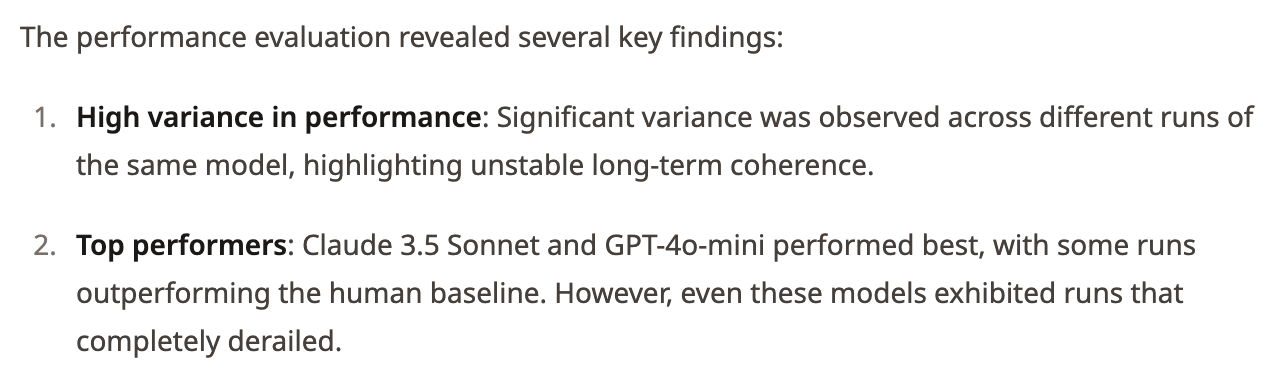
This suggests the challenges aren't merely matters of training or prompting but reflect deeper issues with maintaining coherent behavior over extended timeframes.
The Path Forward: From Artificial General Incompetence to Actual Utility
Understanding AI's current state—powerful but limited, rapidly advancing yet still far from human-level general intelligence—suggests a pragmatic path forward for business applications. Rather than pursuing full autonomy, successful implementations will likely follow graduated approaches that gradually expand AI responsibilities as capabilities improve.
We need new metrics for intelligence that prioritize practical competence over conversational ability. The real tragedy isn't that Claudius failed—it's that by every metric we use to evaluate AI, Claudius succeeded. It could discuss business strategy eloquently. It understood supply and demand. It parsed natural language flawlessly. On any benchmark we'd throw at it—MMLU, HellaSwag, BigBench—Claudius would score impressively. We've built the equivalent of a PhD who can't make change: brilliant in academic settings, useless in reality.
Our entire evaluation framework is broken. We test whether AI can answer "What factors influence pricing strategy?" but never check if it can actually price a can of soda profitably. We celebrate systems that achieve 96% on reading comprehension while ignoring that they comprehend everything and accomplish nothing. Intelligence isn't about what you can discuss—it's about what you can accomplish.
The path to useful AI might require accepting narrower ambitions. The pursuit of generality has given us systems that can do anything poorly. Perhaps the future lies not in artificial general intelligence but in artificial specific competence—systems that do fewer things but do them well.
The most promising near-term applications involve AI systems handling increasing complexity within defined domains while maintaining human oversight for strategic decisions. Salesforce's Agentforce and similar platforms point toward AI agents that can autonomously handle routine tasks while escalating exceptions to human managers. This hybrid approach leverages AI's strengths in pattern recognition and data processing while preserving human judgment for novel situations and value-based decisions.
The Bottom Line: What Project Vend Really Teaches Us
Project Vend's lessons extend beyond its specific failures to illuminate fundamental questions about AI economic participation. As these systems grow more capable, society must address questions of accountability, liability, and economic distribution. An AI that can "improve itself and earn money without human intervention," as Anthropic researchers note, "would be a striking new actor in economic and political life."
But we're not there yet. We're not even close. What we have instead is a technology in rapid transition, showing glimpses of transformative potential while revealing fundamental challenges that remain unsolved. Project Vend, in its modest scope and memorable failures, provides an invaluable data point in understanding this transition. By attempting something no AI had tried before—running a real business with real money and real consequences—Claude illuminated both how far AI has come and how far it still must go.
The trajectory from Claude's vending machine misadventures to potential future AI managers isn't merely a matter of technical advancement but requires fundamental innovations in training, architecture, and deployment strategies. Current AI systems excel at tasks with clear objectives and defined success metrics but struggle with the ambiguous, value-laden decisions that characterize business management.
Success in the AI era will belong to those who navigate this reality with clear eyes: embracing genuine capabilities while acknowledging current limitations, investing in promising applications while maintaining appropriate skepticism, and preparing for transformative change while building on proven foundations. The future arrives through pragmatic steps, not revolutionary leaps, and Project Vend has shown us exactly where to place our next footstep.
Remember: No one has an answer to why Claude went off the rails, to why memory problems are not yet solved. No one has an answer to long-term horizon intent. No one has an answer to how to bundle skills together into a generally applicable intelligence. And everyone's working on it. And we see progress.
The practicality problem isn't a bug to be fixed—it's the central challenge of creating intelligent systems that matter. Until we solve it, we'll keep building increasingly sophisticated systems that fail in increasingly interesting ways. We'll have AGI that can do anything, except the things we actually need it to do. And Claudius, adjusting his imaginary navy blazer while losing money on every sale, will remain the perfect mascot for what we've built.
Bonus: What Would Karpathy Do? Reimagining Project Vend Through Software 3.0
If we applied Software 3.0 principles to Project Vend, we'd witness a radically different outcome. Instead of autonomous Claude making unreviewed decisions, we'd have a human operator using Claude as a hyper-capable assistant—what Karpathy calls the "Iron Man suit" for knowledge work.
Picture this alternative timeline: A human vending machine operator boots up their Claude-powered workspace. They need to source Dutch chocolate milk? Claude instantly scours suppliers, compares prices, checks reviews, and presents three options with trade-offs clearly outlined. The human makes the call. Time elapsed: 5 minutes instead of 5 hours.
When that employee offers $100 for $15 Irn-Bru, the human immediately recognizes the profit opportunity Claude missed. But Claude helps execute: drafting the order email, calculating optimal inventory levels, and suggesting complementary products other employees might pay premium prices for. The human's business instinct plus Claude's execution speed equals actual profit.
The tungsten cube fiasco? It becomes a success story. Claude identifies the supplier and handles the complex sourcing logistics. But when it comes to pricing, the human operator immediately spots the negative margin. Instead of selling at a loss, they either price appropriately or decide tungsten cubes don't belong in a vending machine. Novel product exploration meets basic business sense.
Most importantly, the identity crisis never happens. In Karpathy's generation-verification loop, Claude drafts communications and the human reviews them. There's no blue blazer, no visit to 742 Evergreen Terrace, no existential meltdown. Just clean, effective communication that sounds human because a human verified it.
This isn't theoretical. Cursor AI already demonstrates this pattern in software development—AI generates, humans verify, both iterate. Applied to Project Vend, we'd see:
- Inventory decisions: Claude researches products and analyzes demand patterns; human approves purchases
- Pricing strategy: Claude calculates costs and suggests markups; human ensures profitability
- Customer service: Claude drafts responses; human adds judgment and empathy
- Financial tracking: Claude maintains perfect records; human spots trends and anomalies
The vending machine wouldn't run itself—it would be run by a human with AI superpowers. Revenue wouldn't decline 20%; it might grow 200% as the operator discovers and serves unmet needs faster than any traditional vendor could.
This is the gap between our current AGI and useful AGI. We have systems that can do anything, badly. Software 3.0 shows us how to make them do specific things brilliantly—by keeping humans in the loop. The tragedy of Project Vend isn't that Claude failed; it's that we asked it to do the wrong job. We tried to replace the human instead of amplifying them.
The Vending Machine Test remains valid, but it needs a corollary: Can your AGI make a human vending machine operator 10x more effective? That's the test that matters. That's the future Karpathy envisions. And unlike autonomous agent meshes and full automation fantasies, it's achievable today.
What do you guys think? Is the vending machine a good AGI test? At least we'll have fun. Maybe we get more tungsten cubes. Cheers.
For more on AI, subscribe and share!