Why context engineering will define how intelligent systems behave—and why you need to understand it now in order to understand AI agents, the evolution of AI job roles, and where AI is going in 2026!
By Nate
Published: 2025-06-20
URL: https://natesnewsletter.substack.com/p/beyond-the-perfect-prompt-the-definitive
Why Context Engineering Will Define the Next Era of Artificial Intelligence—And Why You Need to Understand It Now
I get asked about AI prompts constantly. Like, constantly. And look, I love talking about prompt engineering because it genuinely works—I've put together hundreds of pages on this Substack writing about AI prompts and artificial intelligence optimization because the right prompting techniques can completely transform what you get from large language models. But here's the thing that's been bugging me: while we've all been obsessing over crafting perfect prompts, something way bigger has been happening in AI system design.
It’s big, and I haven’t written about it at all yet.
And although I know I should cover it, I almost didn't write this piece. It seemed too deep, too in the weeds, too much like something only machine learning engineers would care about. But then I watched Claude go out and search 500+ sources to research a topic I asked about (I kid you not, I counted), and I realized my carefully crafted prompt was maybe 0.1% of the total context it actually processed.


Yes I definitely push that multi-agent lifestyle lol
Anyway staring at those numbers enough times is when it hit me: we're not just doing prompt engineering anymore. We're doing context engineering—and it's the future of artificial intelligence development.
And honestly? Most people have no idea this shift is happening in AI systems.
Here's what I've learned: these AI agents aren't just reading your prompts anymore. They're actively searching hundreds of websites, pulling from your Google Drive, connecting to databases, and synthesizing information from sources you never directly gave them. The AI prompt you write? That's becoming a tiny drop in an ocean of context these large language models discover on their own.
This is a fundamental shift in how we need to think about artificial intelligence systems. And it's not just for machine learning engineers—though if you're working in AI development I’ve included plenty of technical detail for you here. But really, this is for anyone who wants to actually understand how these AI tools work and get better results from them.
We're living through the emergence of what I'm calling deterministic versus probabilistic context in AI systems. The stuff you control—your AI prompts, uploaded documents, system instructions—that's deterministic context. But there's this whole other layer of probabilistic context: the vast web of information AI agents autonomously find and integrate. When Claude searches the web for investment advice, your original prompt becomes maybe 0.1% of what the large language model is actually processing.
Fair warning: this guide is necessarily long because artificial intelligence context engineering is complex and the stakes are genuinely high. I'm going to walk you through exactly how this two-layer AI system architecture works, why token optimization (all that obsessing over making AI prompts shorter and cheaper) completely misses the point when AI agents are processing massive context windows you can't directly control, and most importantly, how to design what I call "semantic highways"—ways to guide artificial intelligence discovery toward useful information while avoiding some very real AI security risks.
Because yes, bad actors are already figuring out how to manipulate AI model behavior through poisoned web content and compromised data sources. (More on that later—it's wild.)
You'll see real examples of how organizations are implementing context engineering in AI systems today, from financial firms using AI tools to process real-time market data to healthcare systems integrating patient records with the latest research through artificial intelligence. I'll break down the emerging AI development tools like Anthropic's Model Context Protocol that are making this possible, and honestly assess both the incredible opportunities and genuine limitations we're facing in machine learning.
The future belongs to people who understand how to architect artificial intelligence context ecosystems, not just write good AI prompts. And that future? It's happening right now.
What You'll Find in This Complete Guide to Context Engineering:
- The Two-Layer Architecture That's Reshaping AI Systems - I'll break down the fundamental distinction between deterministic context (the prompts, documents, and instructions you directly control) and probabilistic context (the vast information landscape AI agents autonomously explore). You'll see exactly how large language models process hundreds of sources beyond your initial input, why your carefully crafted prompt becomes just 0.1% of total context, and how to design Layer 1 to effectively guide Layer 2 discoveries without losing control.
- Why Token Optimization is Solving the Wrong Problem - While everyone's obsessing over techniques like Chain-of-Draft to reduce token costs, I'll show you why this misses the bigger picture entirely. You'll learn why correctness trumps compression, how context failures cost exponentially more than token expenses, and why the organizations focusing on semantic compression and relevance over efficiency are building the AI systems that actually work in production.
- The Emerging Infrastructure Revolution: MCP, RAG, and Multi-Agent Orchestration - Get an inside look at the tools actually powering context engineering today. I'll walk through Anthropic's Model Context Protocol and why it's becoming the universal standard, how advanced RAG architectures have evolved far beyond "Frankenstein" systems, and the sophisticated multi-agent frameworks that are replacing simple conversation-based approaches with hierarchical command structures and graph-based routing.
- Real Security Threats and How to Defend Against Them - This isn't theoretical anymore. I'll show you the documented vulnerabilities in context-aware systems, including prompt injection through MCP channels and cross-tenant contamination risks. You'll get a practical framework for implementing VPC deployments, role-based access controls, and audit logging, plus the emerging attack vectors that most organizations aren't even thinking about yet.
- Enterprise Implementation Patterns That Actually Work - Drawing from case studies across financial services, healthcare, manufacturing, and legal industries, you'll see the three-phase implementation approach that successful organizations follow. From context consolidation through dynamic integration to autonomous context management, I'll show you exactly how companies are measuring context quality, tracking decision accuracy, and achieving measurable ROI from context engineering investments.
- The Five Design Principles for Context Architecture - Learn the systematic approach to building context systems that enable discovery without chaos. You'll master designing for semantic highways, embracing probabilistic outcomes, layering security defenses, measuring context quality over token quantity, and version controlling everything. Each principle includes implementation strategies and measurement frameworks you can deploy immediately.
- The Competitive Landscape and What's Coming Next - Understand how context engineering fits alongside state space models, fine-tuning, and intent-based computing. I'll give you an honest assessment of where context engineering excels, where it falls short, and how the smartest organizations are building hybrid architectures that combine multiple approaches based on specific requirements rather than betting everything on a single methodology.
Subscribers get all these pieces!
The TLDR on Context Engineering
I write extensively about prompts because they're genuinely powerful—I've seen how the right prompt engineering can transform AI interactions. But I've realized it's time to open the aperture and talk about something bigger.
While I've been optimizing individual prompts, something more fundamental has been emerging: context engineering—the systematic design of environments where AI systems discover and synthesize knowledge, not just respond to our carefully crafted messages.
Prompts remain crucial, but they're one instrument in an orchestra of context systems. The real opportunity isn't just better prompts; it's architecting the entire space where machine intelligence operates.
The breakthrough lies in understanding two distinct layers that must work in harmony:
Deterministic Context (Layer 1): What I directly control—static prompts, curated knowledge bases, structured APIs. This provides predictable, auditable context delivery.
Probabilistic Context (Layer 2): The emergent layer—agent-initiated searches, dynamic tool selection, recursive information gathering. This enables adaptive intelligence but requires sophisticated orchestration.
As agentified workflows scale, this distinction becomes critical. I can't control what an agent discovers in extensive web searches, but I can design Layer 1 to guide Layer 2 toward useful discoveries while preventing context explosion or drift.
The paradigm shift expands our thinking: from "How do I write the perfect message?" to "How do I design systems that naturally surface relevant context?"
The infrastructure for this broader approach exists today. Organizations mastering context architecture alongside excellent prompting will define how intelligent systems behave tomorrow.
The article that follows explores exactly how to build these expanded systems.
Context Engineering: The Architecture of Intelligence
The Definitive Guide to the Next Revolution in AI System Design
How the systematic design of context ecosystems is transforming artificial intelligence beyond the limitations of prompt engineering
The Death of the Perfect Prompt
We spent years perfecting the art of the prompt—carefully placing instructions here, examples there, pushing critical information to the edges to combat attention decay. We built evaluation frameworks, version control systems, and optimization pipelines. We called it "prompting as code" and felt sophisticated.
But while we were optimizing individual interactions, something more fundamental was emerging.
The research is now definitive: prompt engineering faces fundamental limitations that sophisticated context architectures can address. Context window constraints create hard boundaries. Static prompts cannot adapt to dynamic information needs. Multi-agent coordination requires architectural solutions beyond message crafting. The documented challenges of prompt engineering reveal a discipline hitting constraints just as enterprise demand explodes.
Yet contrary to premature declarations, prompt engineering is far from dead. Current research documents 58 distinct prompting techniques for large language models and 40 techniques for other modalities. Prompt engineering skills have become so essential they're being absorbed into broader technical roles, and you’ll see guides for prompt engineering popping up everywhere (and rightly so).
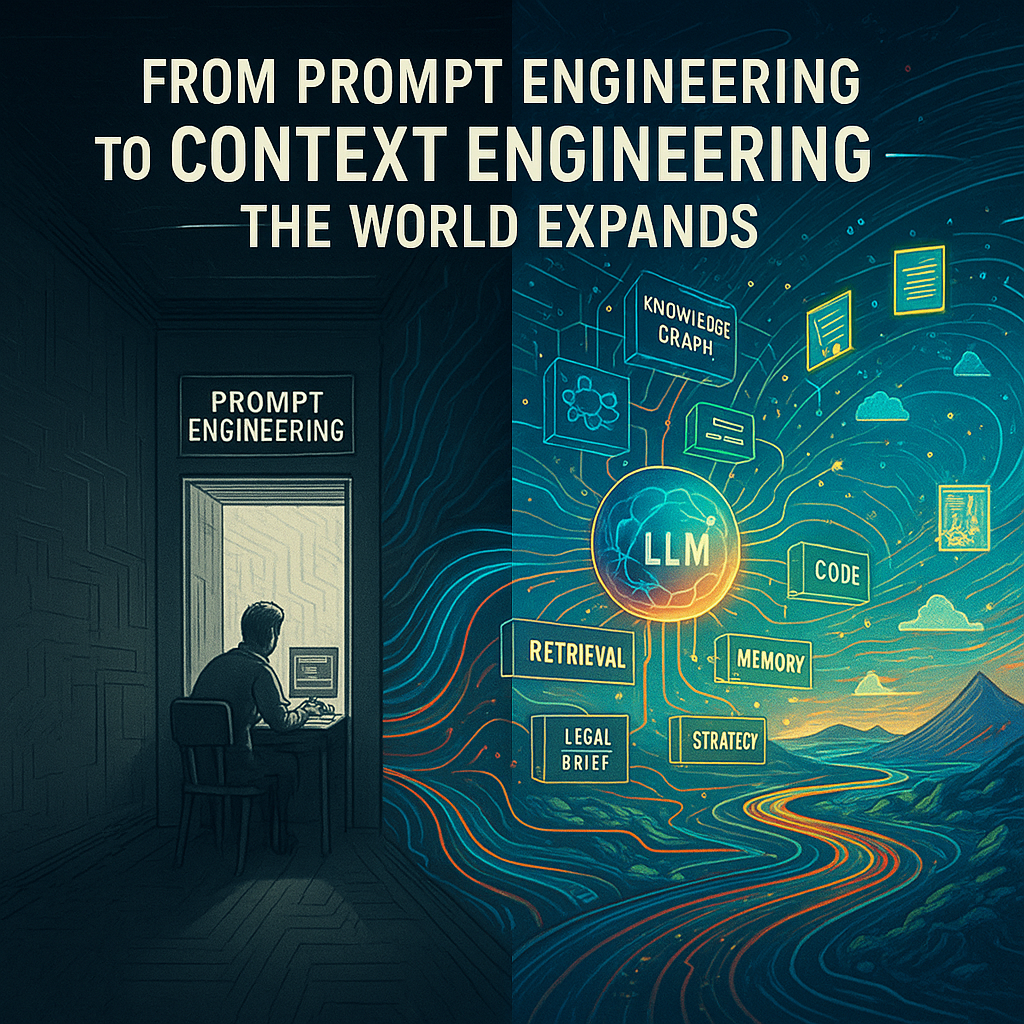
The evolution isn't about abandoning prompt engineering—it's about recognizing that the prompt is just one instrument in an orchestra of context systems. The future isn't about crafting perfect messages to AI systems. It's about designing the environments in which AI systems discover, synthesize, and create knowledge. Welcome to the emerging discipline of context engineering—the systematic design of context architectures that enable artificial intelligence to think, not just respond.
Beyond the Prompt Box: A New Paradigm Emerges
Context engineering recognizes a fundamental truth that traditional prompt engineering approaches miss: the prompt is just one layer in a complex context ecosystem. When you interact with modern AI, you're not just sending a message—you're activating an entire context architecture:
- System prompts that establish behavioral foundations
- Tool-specific rules embedded in platforms like Cursor, Claude, or ChatGPT
- Dynamic retrievers using emerging protocols to search knowledge bases
- Direct connectors to Google Drive, Slack, databases, and APIs
- Autonomous agents that independently discover and synthesize new context
- Memory systems that persist context across sessions and interactions
Each layer interacts in ways we're only beginning to understand. More critically, modern AI agents don't just consume the context you provide—they actively seek their own.
Research on RAG is a good example of this type of evolution. Comprehensive surveys document progression from basic retrieval approaches through modular architectures to what researchers now recognize as the foundation of context engineering: sophisticated systems with autonomous reasoning capabilities that can significantly improve response quality compared to traditional approaches.
This isn't theoretical. Anthropic's Model Context Protocol (MCP) has grown rapidly since its November 2024 launch, with confirmed adoption across multiple platforms and organizations. The infrastructure is real, deployed, and expanding.
The Two-Layer Architecture of Context
Context engineering operates on two fundamental layers that must be designed in harmony:
Layer 1: Deterministic Context
The foundation you directly control:
- Static prompts and behavioral instructions with version control and A/B testing
- Curated knowledge bases and documentation with semantic indexing
- Structured data feeds and APIs with real-time synchronization
- Explicit retrieval rules and filters with quality assurance
- Version-controlled context modules with dependency management
This layer provides predictable, auditable context delivery. Enterprise implementations include VPC deployments, role-based access controls, audit logging, and compliance frameworks for GDPR and HIPAA. Performance benchmarks show sub-microsecond processing for simple queries and millisecond response times for complex multi-source retrieval.
Layer 2: Probabilistic Context
The emergent intelligence layer:
- Agent-initiated web searches returning hundreds of sources with relevance scoring
- Dynamic tool selection based on task understanding and available resources
- Recursive information gathering with cycle detection and termination conditions
- Context discovered through exploration with quality filters and validation
- Autonomous expansion of knowledge boundaries with safety constraints
This layer enables adaptive intelligence but requires sophisticated orchestration. Research frameworks provide explicit control over agent communication, while graph-based approaches offer advantages over simple conversation-based systems.
The art lies not in controlling both layers—that's impossible. Instead, context engineering designs Layer 1 to guide Layer 2 toward useful discoveries while preventing context explosion, hallucination, or drift.
The Paradigm Shift: From Messages to Environments
Traditional prompt engineering asks: "How do I write the perfect message?"
Context engineering asks: "How do I design systems that naturally surface relevant context?"
This shift is profound and measurable. Consider a seemingly simple request: "How should recent semiconductor export restrictions affect our investment strategy?"
A prompt engineer optimizes the question, perhaps adding examples and constraints, hoping the AI has sufficient built-in knowledge.
A context engineer designs a system where:
- The AI understands it needs both public policy information and internal portfolio data through context classification
- Web search agents automatically gather regulatory documents and analysis with relevance scoring
- Internal connectors surface relevant portfolio positions and prior strategy documents through semantic search
- The system synthesizes numerous sources while maintaining coherence through hierarchical summarization
- Context flows naturally from discovery to synthesis to recommendation with audit trails
The human never explicitly programmed this flow. They designed an environment where the right context emerges through architectural principles, not prompt optimization.
This approach delivers measurable results. Recent enterprise implementations show meaningful accuracy improvements, processing capabilities for extensive document collections, and support for thousands of concurrent connections using advanced algorithms with logarithmic search complexity.
Why Token Optimization Misses the Point
The current obsession with token efficiency—techniques like Chain-of-Draft that promise dramatic token reduction—is like celebrating fuel efficiency while driving to the wrong destination.
The Chain-of-Draft research from Zoom Communications is legitimate. Their peer-reviewed work demonstrates significant token reduction while improving accuracy in certain scenarios. The technique works by generating initial drafts, then producing concise final responses, achieving notable efficiency gains.
But tokens cost money; context failures cost fortunes.
A financial services firm deploying a context-engineered system might consume 10x more tokens while preventing a single catastrophic investment decision worth millions. The ROI calculation isn't about tokens—it's about outcomes.
Context engineering prioritizes:
Correctness over compression: What context guarantees the right answer, regardless of token cost?
Coherence over efficiency: How do we maintain narrative threads across numerous sources without losing meaning?
Relevance over completeness: What context actually matters for this decision, and how do we filter noise?
Adaptability over optimization: How does context evolve as understanding deepens and requirements change?
However, efficiency still matters for practical deployment. Semantic compression techniques reliably achieve meaningful compression ratios while preserving semantic content, enabling broader context windows without sacrificing depth. These methods use advanced approaches to maintain meaning while reducing size, though dramatic compression claims require careful validation.
The Context Engineering Toolkit: From Research to Production Reality
Modern context engineers work with tools that represent genuine advances in AI system architecture:
Model Context Protocol (MCP): The Universal Context Standard
Anthropic's MCP represents a significant breakthrough in context standardization. Built on JSON-RPC 2.0 with support for stdio, HTTP/SSE, and WebSocket transports, MCP addresses the "M×N problem"—connecting every AI application to every data source through a universal protocol.
The technical architecture is sophisticated but practical:
- Client-server model with AI applications as clients and data sources as servers
- Standardized message formats for resources, tools, and prompts
- Security boundaries with capability-based access control
- Transport flexibility supporting stdio for local development and HTTP for production
Real adoption (e.g. OpenAI saying yes to Dario’s idea) validates the approach. Beyond confirmed implementations at major technology companies like OpenAI, enterprise integration reports document MCP deployment across various industry sectors.
However, the ecosystem remains early-stage. Security researchers have identified significant vulnerabilities, including prompt injection through MCP channels and authentication weaknesses. These challenges highlight that context engineering, while powerful, requires careful attention to security architecture—a consideration often overlooked in simpler prompt-based systems.
Advanced RAG Architectures: From Assembly to Symphony
The evolution of Retrieval-Augmented Generation represents a fundamental shift in AI architecture. Industry insiders (like me—I guess I’m an industry insider—I’ve certainly seen some ugly RAG systems) often describe traditional RAG as "Frankenstein" systems—components optimized in isolation and stitched together, leading to suboptimal performance.
Contextual AI's platform was really founded to push past traditional RAG implementations. The company's pedigree is impressive: founders Douwe Kiela and Amanpreet Singh were among the original RAG creators at Meta FAIR, with their 2020 paper receiving over 4,000 citations. With $80 million in funding and enterprise customers, they validate the commercial viability of advanced context engineering.
Their performance improvements stem from end-to-end optimization. Rather than absolute performance multipliers, the gains represent architectural efficiency—achieving large-model performance with smaller infrastructure requirements. Benchmarked accuracy improvements are meaningful though measured, and infrastructure efficiency gains prove substantial in production deployments.
The advanced architecture includes:
- Joint optimization of retrieval and generation components
- Learned sparse retrieval with neural ranking models
- Multi-hop reasoning for complex query decomposition
- Contextual compression reducing information density while preserving relevance
- Feedback loops improving retrieval based on generation quality
Multi-Agent Orchestration: Beyond Conversation Chaos
Anthropic's guidance on building effective agents demonstrates the sophistication required. Modern frameworks provide explicit control over agent communication, addressing fundamental limitations of simple conversation-based approaches.
Recent developments include:
- Hierarchical agent architectures with clear command structures
- Graph-based message routing avoiding conversation bottlenecks
- Explicit state management with checkpoint and rollback capabilities
- Resource allocation balancing computational load across agents
- Error handling with graceful degradation and recovery
However, critics argue that multi-agent systems remain challenging for production use. Their analysis highlights coordination overhead, debugging complexity, and emergent behaviors that resist control. The debate reflects a maturing field grappling with fundamental trade-offs between capability and reliability.
Semantic Compression: Quality-Preserving Context Reduction
Research on semantic compression validates techniques achieving meaningful compression ratios while preserving meaning. Unlike statistical compression, semantic compression maintains conceptual relationships and inference capabilities.
Key approaches include:
- Advanced summarization with attention-guided content selection
- Hierarchical information extraction preserving structure while reducing detail
- Context-aware paraphrasing maintaining meaning with reduced linguistic complexity
- Relevance-guided filtering removing information unlikely to impact decisions
Implementation challenges include maintaining consistency across multiple compression passes, handling multi-modal content, and preserving critical details that might appear unimportant in isolation.
Context Modules: Version Control for Intelligence
The most mature context engineering practice treats context like code—versioned, tested, and composable blocks that can be mixed and matched for different use cases.
Production implementations include:
- Git-based version control with branching strategies for context development
- Automated testing validating context quality across diverse scenarios
- Dependency management tracking relationships between context modules
- Performance monitoring measuring context effectiveness and identifying improvements
- A/B testing frameworks comparing context architectures in production
Enterprise adoption studies document organizations implementing these practices, with measurable improvements in system reliability and development velocity.
The New Design Principles: Architecture Over Optimization
Context engineering requires a different mindset than prompt engineering, grounded in systems thinking rather than message optimization:
1. Design for Discovery
Your context architecture should enable AI to find information you didn't know it needed. Build semantic highways, not prescriptive paths.
Implementation: Use graph-based knowledge representation with automated relationship discovery. Deploy semantic search engines that surface unexpected connections. Implement exploration rewards encouraging agents to investigate novel information sources.
Measurement: Track discovery rates of relevant but unexpected information. Monitor the frequency of context expansion beyond initial queries. Measure decision quality improvements from autonomous exploration.
2. Embrace Probabilistic Outcomes
You can't control what an agent discovers in extensive web searches. Design systems that gracefully handle unexpected context.
Implementation: Implement robust filtering and validation pipelines. Use ensemble methods combining multiple context sources. Deploy anomaly detection identifying suspicious or contradictory information.
Measurement: Monitor information quality metrics across diverse sources. Track system performance under unexpected context loads. Measure recovery rates from context anomalies.
3. Layer Your Defenses
Every external context is a potential attack vector. Build validation, sanitization, and provenance tracking into your architecture.
Implementation: Deploy multi-layer security architectures with VPC isolation, role-based access controls, and audit logging. Implement content validation using multiple verification sources. Use provenance tracking maintaining chains of custody for all context.
Measurement: Track security incident rates and response times. Monitor unauthorized access attempts and data leakage. Measure compliance performance across regulatory frameworks.
4. Measure Context Quality, Not Token Quantity
Track relevance, coherence, and decision impact. A perfectly compressed prompt that leads to wrong answers is worthless.
Implementation: Deploy relevance scoring using learned ranking models. Implement coherence metrics measuring logical consistency across context sources. Use outcome tracking connecting context quality to decision effectiveness.
Measurement: Monitor precision and recall for context retrieval. Track decision accuracy correlated with context quality scores. Measure user satisfaction with context-driven recommendations.
5. Version Everything
Context modules should be as rigorously managed as code. A/B test context architectures, not just prompts.
Implementation: Use infrastructure-as-code for context architectures. Deploy automated testing validating context changes before production. Implement blue-green deployments for context updates.
Measurement: Track context change impact on system performance. Monitor rollback frequency and causes. Measure development velocity improvements from structured context management.
The Technical Reality: Capabilities and Constraints
Modern context engineering operates within specific technical boundaries that shape practical implementations:
Computational Complexity: The Quadratic Wall
Transformer-based systems exhibit O(n²) computational complexity in sequence length. This isn't a bug to fix—research proves this complexity is necessary for self-attention computation unless fundamental computational assumptions are false.
Practical implications:
- Doubling context length quadruples computational cost
- Processing 128k tokens requires substantially more memory than 4k tokens
- Real-time applications face hard limits on context size
Design responses:
- Hierarchical context architectures processing information at multiple granularities
- Streaming approaches incrementally updating context rather than reprocessing everything
- Hybrid systems combining transformers with linear-complexity alternatives
Performance Benchmarks: What's Actually Possible
Current production systems achieve:
- Sub-microsecond processing for simple context queries
- Millisecond response times for complex multi-source retrieval
- Thousands of concurrent connections using optimized vector databases
- Million-document collections with real-time search using advanced algorithms
These capabilities enable sophisticated applications but fall short of unlimited expectations. Real systems require careful engineering balancing capability with computational constraints.
Security Architecture: Beyond Academic Concerns
Context-aware systems face documented security vulnerabilities:
- Context leakage between users in multi-tenant environments
- Injection attacks manipulating system behavior through crafted context
- Cross-tenant contamination exposing sensitive information
Production systems address these challenges through:
- VPC deployments with network isolation
- Role-based access controls with granular permissions
- Audit logging with immutable records
- Compliance frameworks for industry-specific regulations
The Competitive Landscape: Context Engineering Among Alternatives
Context engineering operates within a competitive landscape of approaches, each with distinct trade-offs:
State Space Models: Linear Complexity Alternatives
Research on extending context length documents techniques achieving linear computational complexity, potentially addressing the quadratic scaling challenge.
State Space Models like Mamba offer:
- Linear memory and computational requirements
- Potentially unlimited sequence lengths
- Efficient training and inference
However, they sacrifice some capabilities:
- Reduced in-context learning compared to transformers
- Limited bidirectional attention affecting some reasoning tasks
- Immature tooling compared to transformer ecosystems
Fine-Tuning: Behavioral Modification vs. Information Integration
Fine-tuning excels for behavioral changes while context engineering suits real-time information incorporation. The approaches are complementary rather than competing:
Fine-tuning strengths:
- Consistent behavioral patterns across interactions
- Efficient inference without context overhead
- Strong performance on specific domains
Context engineering strengths:
- Real-time information incorporation
- Adaptability to changing requirements
- Transparency in information sources
Intent-Based Computing: Outcome Specification
Emerging paradigms shift from command-based to outcome-specification interfaces. Rather than describing how to accomplish tasks, users specify desired outcomes.
This approach potentially transcends both prompt and context engineering by:
- Abstracting implementation details from user interaction
- Enabling autonomous tool selection based on outcome requirements
- Reducing cognitive load on human operators
However, intent-based systems require sophisticated context engineering as a foundation—understanding outcomes requires rich contextual knowledge about domains, constraints, and user preferences.
Industry Adoption: Vision Meets Reality
The transition to context engineering is already underway in enterprise environments, though formal recognition lags practical implementation:
Market Dynamics: Growth Without Formal Structure
While "context engineering" lacks formal recognition as a discipline (no dedicated job postings, courses, or certifications), the underlying market for AI context management shows explosive growth. The RAG market alone is projected to reach $67+ billion by 2034, reflecting enterprise demand for sophisticated context management.
This disconnect reflects bottom-up emergence. Enterprise demand drives innovation despite limited formal structure. Major platforms build sophisticated context capabilities:
- IBM Watson with enterprise knowledge integration
- Microsoft Azure AI with multi-modal context processing
- Google Vertex AI with dynamic information retrieval
- Amazon Bedrock with knowledge base connectivity
Enterprise Implementation Patterns
Survey data from enterprise leaders reveals common implementation patterns:
Phase 1: Context Consolidation
- Connecting existing knowledge bases and documents
- Implementing basic RAG architectures
- Establishing security and compliance frameworks
Phase 2: Dynamic Integration
- Adding real-time data sources and APIs
- Implementing multi-agent coordination
- Deploying context quality monitoring
Phase 3: Autonomous Context Management
- Enabling agent-driven context discovery
- Implementing adaptive context architectures
- Optimizing for outcome-based metrics
Industry-Specific Applications
Different industries emphasize different aspects of context engineering:
Financial Services: Real-time market data integration, regulatory compliance, risk assessment across multiple time horizons
Healthcare: Patient record integration, treatment protocol updates, clinical decision support with outcome tracking
Manufacturing: Supply chain visibility, quality control data, predictive maintenance with IoT integration
Legal: Case law research, document analysis, regulatory interpretation with precedent tracking
The Value Realization Challenge
Despite high adoption rates, more than 80% of organizations report not seeing EBIT level impact of gen AI investments yet. This gap highlights implementation challenges beyond technology:
- Talent skill gaps affect 46% of implementations
- Resource constraints limit 38% of organizations
- Regulatory compliance concerns increased 10 percentage points through 2024
Only 47% of organizations achieved positive ROI from AI initiatives, with many struggling to measure value from context improvements—faster development cycles, innovation acceleration, and productivity gains prove difficult to quantify precisely.
The Path Forward: Building Context Infrastructure
The organizations that master context engineering will build AI systems that feel magical—not because they have better prompts, but because they've designed better context ecosystems.
Immediate Opportunities: Low-Hanging Fruit
Document Intelligence: Most organizations have vast repositories of unstructured documents. Context engineering can immediately improve document search, analysis, and synthesis capabilities.
Real-Time Integration: Connecting AI systems to live data sources—market feeds, IoT sensors, social media streams—creates immediate value through current information access.
Multi-Modal Context: Combining text, images, audio, and structured data into unified context architectures enables richer understanding and more sophisticated responses.
Medium-Term Infrastructure: The Next 2-3 Years
Universal Context Protocols: MCP adoption will likely accelerate, potentially becoming the standard interface between AI applications and data sources.
Context Quality Frameworks: Formal methodologies for measuring and optimizing context quality will emerge, similar to software quality assurance practices.
Hybrid Architectures: Successful systems will combine context engineering with fine-tuning, alternative model architectures, and other approaches based on specific requirements.
Long-Term Vision: The Context-Native Future
Self-Organizing Context: Systems that automatically discover, organize, and optimize context structures without human intervention.
Context Markets: Platforms enabling context sharing and monetization across organizations, potentially creating new business models.
Context-Native Applications: Software designed from the ground up for context-rich environments rather than adapted from prompt-based paradigms.
Critical Limitations: Honest Assessment of Boundaries
Context engineering is not a panacea. Understanding its limitations is crucial for appropriate application:
Fundamental Constraints
Machines cannot sense context the way humans do. They process information patterns but lack embodied understanding of meaning and implications.
Consistency challenges plague critical applications.One study examining prompt engineering techniques showed consistency variations ranging from 30% to 77.5% depending on the prompting method used, highlighting reliability concerns.
The knowledge engineering bottleneck persists. Capturing nuanced human expertise in machine-readable context remains fundamentally difficult.
Technical Boundaries
Computational complexity creates hard limits on scalability. The quadratic attention mechanism in transformers cannot be optimized away—it's architectural.
Context window limits remain despite technical advances. Processing extremely long contexts requires trade-offs between accuracy and efficiency.
Latency requirements constrain real-time applications. Some decisions cannot wait for comprehensive context gathering and analysis.
Practical Constraints
Implementation complexity scales dramatically with context sophistication. Managing multiple context sources requires orchestration, conflict resolution, and quality assurance.
Security and privacy requirements add cost and complexity, limiting accessibility for smaller organizations.
Talent scarcity slows adoption. Context engineering requires expertise spanning AI, systems architecture, and domain knowledge.
The Context Engineering Manifesto: Principles for the New Paradigm
I’d like to propose the following—laddering this all up—as a manifesto for the AI age.
Our Core Beliefs
We recognize that the future lies in emergence, not deterministic perfection.
Context is not a constraint—it's the medium of artificial thought. Just as human intelligence emerges from rich environmental interaction, artificial intelligence requires sophisticated context architectures to achieve its potential.
Prompts are not instructions—they're initialization vectors in context space. The true power lies not in the prompt itself but in the context architecture it activates.
Tokens are not the scarce resource—coherent, relevant context is. Optimizing for token efficiency while sacrificing context quality is false economy that leads to poor decisions.
AI systems don't need better prompts—they need better environments. The most sophisticated prompt cannot overcome inadequate context architecture.
The future of AI isn't about talking to machines—it's about designing the spaces where machine intelligence emerges and evolves.
A Suggested Commitment to Excellence
We commit to building context architectures that:
- Prioritize truth over efficiency while seeking both
- Value modularity at core
- Enable extended discovery as a fundamental pathway to correctness, rather than constraining exploration unnecessarily
- Evolve empirically based on outcome measurement and iteration
All that being said…
We recognize that context engineering is one approach among many in the evolving landscape of AI system design. We commit to:
- Honest assessment of capabilities and limitations
- Collaborative development with practitioners of complementary approaches
- Open sharing of techniques, tools, and lessons learned
- Continuous learning as the field evolves beyond our current understanding
A New Discipline Is Born: The Intersection of Multiple Fields
Context engineering stands at the intersection of established disciplines, drawing insights and techniques from each:
Systems Architecture
- Distributed computing patterns for managing context across multiple nodes
- Service-oriented architecture principles for context modularity and reusability
- Reliability engineering practices for maintaining context quality under stress
Information Architecture
- Library science methodologies for information organization and retrieval
- Taxonomy design principles for structuring contextual knowledge
- Information theory foundations for measuring context value and redundancy
Cognitive Science
- Human information processing models for understanding context utilization
- Memory research insights for designing context persistence and retrieval
- Decision theory frameworks for optimizing context in decision-making processes
Security Engineering
- Threat modeling for context-specific vulnerabilities
- Defense in depth strategies for protecting context integrity
- Privacy engineering techniques for context sharing without exposure
Data Engineering
- Pipeline orchestration for managing complex context flows
- Data quality frameworks adapted for contextual information
- Real-time processing architectures for dynamic context updates
This interdisciplinary foundation provides context engineering with robust theoretical grounding while enabling practical innovation across multiple domains.
The Call to Action: Building the Future
The gap between current practice and context engineering's potential is vast and represents unprecedented opportunity. While pioneers build foundational infrastructure, most organizations still treat context as an afterthought.
For Technical Leaders
Start small but think big. Implement basic context engineering patterns in pilot projects while designing for eventual scale. Begin with document integration and real-time data feeds before attempting sophisticated multi-agent architectures.
Invest in talent. Context engineering requires rare combinations of AI expertise, systems thinking, and domain knowledge. Build teams that span these disciplines or develop partnerships with specialized providers.
Measure outcomes, not tokens. Establish metrics connecting context quality to business outcomes. Track decision accuracy, response relevance, and user satisfaction rather than optimizing for computational efficiency alone.
For Business Strategists
Competitive advantage is temporary. Context engineering capabilities will quickly become table stakes for AI-enabled businesses. Early investment creates temporary advantage; delayed adoption creates permanent disadvantage.
Data becomes infrastructure. In context-engineered systems, your data assets become the foundation for AI capabilities. Invest in data quality, organization, and accessibility as infrastructure rather than overhead.
Hybrid approaches win. Pure context engineering works well for specific applications but fails as a universal solution. Plan for architectures combining multiple approaches based on specific requirements.
For Researchers and Practitioners
The field needs formal foundations. Context engineering currently lacks academic programs, certification frameworks, and standardized methodologies. Opportunities abound for establishing these foundations.
Cross-pollination accelerates progress. The best innovations emerge at the intersection of context engineering with other approaches. Explore hybrid architectures rather than pure implementations.
Reality checks prevent overpromising. Context engineering has genuine limitations that honest practitioners must acknowledge. Build credibility through accurate capability assessment rather than inflated claims.
The Revolution Is Here: Infrastructure for Artificial Thought
This is not a prediction about the future—it's documentation of a transition already underway. The infrastructure for context-native AI is being built today. MCP adoption accelerates with thousands of implementations. Enterprise implementations scale with production deployments across major organizations. Academic research validates the theoretical foundations.
The organizations making this transition won't just build better AI applications. They'll build the infrastructure for artificial thought itself—the context architectures where machine intelligence emerges, learns, and evolves.
The Technical Reality: What We Can Build Today
Current technology enables context architectures that were science fiction just years ago:
Real-time knowledge integration connecting AI systems to live data streams, maintaining current understanding without manual updates.
Multi-source synthesis combining information from dozens of sources while maintaining provenance and handling conflicts.
Adaptive information architectures that reorganize themselves based on usage patterns and emerging needs.
Secure context boundaries protecting sensitive information while enabling sophisticated reasoning.
Scale-aware processing adjusting context depth and breadth based on computational resources and time constraints.
The Human Element: Augmentation, Not Replacement
The most successful context engineering implementations augment human intelligence rather than replacing it. As Andrej Karpathy said this week, aim for the augmented Iron Man suit! Consider how context-aware systems change work:
Analysts spend less time gathering information and more time interpreting insights. Context systems surface relevant data, identify patterns, and highlight anomalies, enabling focus on strategic thinking.
Developers work with AI partners that understand codebase context, project requirements, and team preferences. Context-aware development environments provide relevant examples, identify potential issues, and suggest optimizations.
Researchers explore vast literature with AI assistants that understand domain context, research methodologies, and theoretical frameworks. Context systems connect ideas across disciplines and identify promising research directions.
Decision-makers receive contextualized information tailored to their responsibilities, time constraints, and decision frameworks. Context architectures filter noise while ensuring critical information reaches appropriate stakeholders.
The Network Effect: Context Ecosystems
Individual organizations implementing context engineering achieve significant benefits, but the true potential emerges when context-aware systems interact. Consider the possibilities:
Cross-organizational knowledge sharing where compatible context protocols enable selective information exchange while maintaining security boundaries.
Industry-wide intelligence where sector-specific context architectures aggregate insights across organizations, identifying trends and opportunities invisible to individual companies.
Global research acceleration where scientific context systems connect researchers worldwide, enabling collaboration and discovery at unprecedented scale.
Democratic access to expertise where context architectures make sophisticated analysis available to smaller organizations that couldn't afford dedicated experts.
These network effects require standardization, interoperability protocols, and careful attention to privacy and security. The organizations building context infrastructure today position themselves as nodes in tomorrow's intelligence networks.
Stop Asking the Wrong Question
For too long, we've asked: "How do I write the perfect prompt?"
It's time to ask: "How do I design the perfect context system?"
The prompt was just the beginning. Context is the architecture. And engineering that architecture—building the environments where artificial intelligence thrives—represents the future of human-machine collaboration itself.
The Choice Is Clear
Continue optimizing individual interactions, or help build the infrastructure for artificial thought.
The revolution isn't coming—it's here, waiting for architects brave enough to build it. The question isn't whether context engineering will reshape AI development. The question is whether you'll help shape that transformation, or simply respond to it.
Organizations that master context architecture today will define how intelligent systems behave tomorrow. Those who continue treating context as an afterthought will find themselves permanently disadvantaged as AI capabilities become increasingly central to competitive advantage.
The technical foundations exist. The business case is proven. The early adopters demonstrate what's possible. What remains is the work—careful, considered, collaborative work—of building systems that realize the full potential of artificial intelligence.
Welcome to the age of context engineering. The architecture of intelligence awaits your contribution.
For more on AI, subscribe and share!